2.2 Groups
A group is a concept that combines a set with a particular operation. This set can be anything - numbers, functions, molecules, etc. The operation, which is a kind of rule, takes two elements from the set and combines them to form another element within the set.
What's interesting is that the set can be very diverse. The operation, though, has to follow some specific properties to make the set work as a group. This means we can have different groups using the same set, just by changing the operation.
Let's look at a more formal definition to get a clearer picture:
def: Group
∢ G ∈ S ⋅ : G × G → G Associativity: ∀ x , y , z ∈ G : ( x ⋅ y ) ⋅ z = x ⋅ ( y ⋅ z ) Identity: ∃ e ∈ G : ∀ x ∈ G : e ⋅ x = x ⋅ e = x Inverse: ∀ x ∈ G : ∃ x − 1 ∈ G : x ⋅ x − 1 = x − 1 ⋅ x = e ( G , ⋅ ) − group \begin{align*}
&\sphericalangle \\
&G \in \mathcal S \\
&\cdot: G \times G \to G \\
\text{Associativity:} \,\, &\forall x, y, z \in G: (x \cdot y) \cdot z = x \cdot (y \cdot z) \\
\text{Identity:} \,\,&\exists e \in G: \forall x \in G: e \cdot x = x \cdot e = x \\
\text{Inverse:} \,\, &\forall x \in G: \exists x^{-1}\in G: x\cdot x^{-1} = x^{-1} \cdot x = e &
\\
\hline
\\
&(G, \cdot) - \text{group} \\
\end{align*} Associativity: Identity: Inverse: ∢ G ∈ S ⋅ : G × G → G ∀ x , y , z ∈ G : ( x ⋅ y ) ⋅ z = x ⋅ ( y ⋅ z ) ∃ e ∈ G : ∀ x ∈ G : e ⋅ x = x ⋅ e = x ∀ x ∈ G : ∃ x − 1 ∈ G : x ⋅ x − 1 = x − 1 ⋅ x = e ( G , ⋅ ) − group In this definition, we used the notation ⋅ \cdot ⋅ 1 1 1 e e e
Alternatively, we could use the symbol + + + e e e 0 0 0 a − 1 a^{-1} a − 1 − a -a − a
It's important to note that these are just conventions. In theory, any symbol could serve the purpose – be it ∘ \circ ∘ ⊙ \odot ⊙ ⊡ \boxdot ⊡
To denote that G G G ⋅ \cdot ⋅ G ∈ G ( ⋅ ) G \in \mathcal{G}_{(\cdot)} G ∈ G ( ⋅ ) ( G , ⋅ ) ∈ G ( ⋅ ) (G, \cdot) \in \mathcal{G}_{(\cdot)} ( G , ⋅ ) ∈ G ( ⋅ ) G ( ⋅ ) \mathcal{G}_{(\cdot)} G ( ⋅ ) ⋅ \cdot ⋅
Sometimes we'll omit the operation symbol when it's clear from the context what the operation is. For example, instead of writing a ⋅ b a\cdot b a ⋅ b a b ab ab
Group Examples
Example: Additive group of integers
In the group ( Z , + ) (\mathbb{Z}, +) ( Z , + ) e : = 0 e := 0 e := 0 x x x − x -x − x
Example: Multiplicative group of real numbers
The set ( R ∖ { 0 } , ⋅ ) (\mathbb{R} \setminus \{0\}, \cdot) ( R ∖ { 0 } , ⋅ ) e : = 1 e := 1 e := 1 x x x x − 1 = 1 / x x^{-1} = 1/x x − 1 = 1/ x
Example: Multiplicative group of complex numbers
G : = ( C , ⋅ ) e : = 1 x = r e i ϕ ⟹ x − 1 = 1 / r ⋅ e − i ϕ \begin{align*}
&G:=(\mathbb{C}, \cdot) \\
&e:=1 \\
&x = re^{i\phi} \implies x^{-1} = 1/r\cdot e^{-i\phi} \\
\end{align*} G := ( C , ⋅ ) e := 1 x = r e i ϕ ⟹ x − 1 = 1/ r ⋅ e − i ϕ Example: A group of integers modulo n
The group Z n \Z_n Z n 0 0 0 n − 1 n-1 n − 1 n n n + + + ⋅ \cdot ⋅ n n n 0 ≤ r ≤ n − 1 0 \le r \le n-1 0 ≤ r ≤ n − 1
These operations are commonly denoted as being performed modulo n n n
For instance, in the group Z 5 \Z_5 Z 5 0 , 1 , 2 , 3 , 4 {0, 1, 2, 3, 4} 0 , 1 , 2 , 3 , 4 2 + 4 ≡ 1 ( m o d n ) 2 + 4 \equiv 1 \pmod n 2 + 4 ≡ 1 ( mod n ) 3 ⋅ 4 ≡ 2 ( m o d n ) 3 \cdot 4 \equiv 2 \pmod n 3 ⋅ 4 ≡ 2 ( mod n )
Example: A group of permutations of a finite set
Consider the set X n : = 1 , … , n X_n := {1, \ldots, n} X n := 1 , … , n σ : X n → X n \sigma: X_n \to X_n σ : X n → X n X n X_n X n σ \sigma σ S n S_n S n
Now, when we combine S n S_n S n ∘ \circ ∘ ( S n , ∘ ) (S_n, \circ) ( S n , ∘ ) ∘ \circ ∘ ( S n , ∘ ) (S_n, \circ) ( S n , ∘ )
Proposition 2.2.1: Group Properties
∢ ( G , ⋅ ) ∈ G Unique identity: ∃ ! e Unique inverse: ∀ x ∈ G : ∃ ! x − 1 ∀ x ∈ G : ( x − 1 ) − 1 = x ∀ x , y ∈ G : ( x ⋅ y ) − 1 = y − 1 ⋅ x − 1 ∀ x , y ∈ G : ∃ ! z ∈ G : x ⋅ z = y ∀ x , y ∈ G : ∃ ! z ∈ G : z ⋅ x = y Cancellation: x ⋅ a = x ⋅ b ⟹ a = b Cancellation: a ⋅ x = b ⋅ x ⟹ a = b \begin{align*}
&\sphericalangle \\
&(G, \cdot) \in \mathcal{G}
\\
\hline
\\
\text{Unique identity: }& \exists ! e \tag{a} \\
\text{Unique inverse: }&\forall x \in G: \exists ! x^{-1} \tag{b} \\
&\forall x \in G: (x^{-1})^{-1} = x \tag{c} \\
&\forall x,y \in G: (x\cdot y)^{-1} = y^{-1}\cdot x^{-1} \tag{d} \\
&\forall x, y\in G: \exists!z \in G: x \cdot z=y \tag{e} \\
&\forall x, y\in G: \exists!z \in G: z \cdot x=y \tag{f} \\
\text{Cancellation: }&x\cdot a=x\cdot b \implies a=b \tag{g} \\
\text{Cancellation: }&a\cdot x=b\cdot x \implies a=b \tag{h} \\
\end{align*} Unique identity: Unique inverse: Cancellation: Cancellation: ∢ ( G , ⋅ ) ∈ G ∃ ! e ∀ x ∈ G : ∃ ! x − 1 ∀ x ∈ G : ( x − 1 ) − 1 = x ∀ x , y ∈ G : ( x ⋅ y ) − 1 = y − 1 ⋅ x − 1 ∀ x , y ∈ G : ∃ ! z ∈ G : x ⋅ z = y ∀ x , y ∈ G : ∃ ! z ∈ G : z ⋅ x = y x ⋅ a = x ⋅ b ⟹ a = b a ⋅ x = b ⋅ x ⟹ a = b ( a ) ( b ) ( c ) ( d ) ( e ) ( f ) ( g ) ( h ) Proof
a. Assume ∃ e 1 , e 2 ∈ G ⟹ e 1 = e 1 ⋅ e 2 = e 2 \exists e_1, e_2 \in G \implies e_1=e_1\cdot e_2 = e_2 ∃ e 1 , e 2 ∈ G ⟹ e 1 = e 1 ⋅ e 2 = e 2
b. Assume x ∈ G , ∃ y 1 , y 2 : x ⋅ y 1 = y 1 ⋅ x = e , x ⋅ y 2 = y 2 ⋅ x = e x \in G, \exists y_1, y_2: x \cdot y_1= y_1\cdot x =e, x \cdot y_2= y_2\cdot x =e x ∈ G , ∃ y 1 , y 2 : x ⋅ y 1 = y 1 ⋅ x = e , x ⋅ y 2 = y 2 ⋅ x = e
y 1 = y 1 ⋅ e 1 = y 1 ⋅ ( x ⋅ y 2 ) = ( y 1 ⋅ x ) ⋅ y 2 = e ⋅ y 2 = y 2 y_1 = y_1 \cdot e_1=y_1 \cdot (x \cdot y_2) = (y_1 \cdot x) \cdot y_2 = e \cdot y_2 = y_2 y 1 = y 1 ⋅ e 1 = y 1 ⋅ ( x ⋅ y 2 ) = ( y 1 ⋅ x ) ⋅ y 2 = e ⋅ y 2 = y 2 c. This means that the inverse of x − 1 x^{-1} x − 1 x x x x ⋅ x − 1 = x ⋅ x − 1 = e x\cdot x^{-1}=x \cdot x^{-1} = e x ⋅ x − 1 = x ⋅ x − 1 = e
d. ( x ⋅ y ) − 1 = ( x ⋅ y ) − 1 e = ( x ⋅ y ) − 1 ( x ⋅ y ⋅ y − 1 ⋅ x − 1 ) = y − 1 ⋅ x − 1 (x\cdot y)^{-1}=(x\cdot y)^{-1}e=(x\cdot y)^{-1}(x\cdot y \cdot y^{-1}\cdot x^{-1})=y^{-1}\cdot x^{-1} ( x ⋅ y ) − 1 = ( x ⋅ y ) − 1 e = ( x ⋅ y ) − 1 ( x ⋅ y ⋅ y − 1 ⋅ x − 1 ) = y − 1 ⋅ x − 1
e. x ⋅ z = y ⟹ x − 1 ⋅ x ⋅ z = x − 1 ⋅ y ⟹ z = x − 1 ⋅ y x \cdot z = y \implies x^{-1} \cdot x \cdot z = x^{-1} \cdot y \implies z = x^{-1} \cdot y x ⋅ z = y ⟹ x − 1 ⋅ x ⋅ z = x − 1 ⋅ y ⟹ z = x − 1 ⋅ y
Assume ∃ z 1 , z 2 ∈ G : x ⋅ z 1 = y , x ⋅ z 2 = y ⟹ x ⋅ z 1 = x ⋅ z 2 ⟹ x − 1 ⋅ x ⋅ z 1 = x − 1 ⋅ x ⋅ z 2 ⟹ z 1 = z 2 \exists z_1, z_2 \in G: x \cdot z_1 =y, x \cdot z_2 =y \implies \\ x\cdot z_1 = x \cdot z_2 \implies
x^{-1}\cdot x \cdot z_1 = x^{-1}\cdot x \cdot z_2 \implies z_1 = z_2 ∃ z 1 , z 2 ∈ G : x ⋅ z 1 = y , x ⋅ z 2 = y ⟹ x ⋅ z 1 = x ⋅ z 2 ⟹ x − 1 ⋅ x ⋅ z 1 = x − 1 ⋅ x ⋅ z 2 ⟹ z 1 = z 2
f. Similar to e.
g. Follows from e., assuming y = x ⋅ a = x ⋅ b y=x\cdot a = x\cdot b y = x ⋅ a = x ⋅ b
h. Follows from f., assuming y = a ⋅ x = b ⋅ x y=a\cdot x = b\cdot x y = a ⋅ x = b ⋅ x
Cayley tables
Cayley tables are like a special kind of multiplication or addition table used in group theory. These tables are a simple way to show how elements in a small group combine with each other under a specific group operation, like addition or multiplication.
For example:
( Z 8 ∗ , ⋅ ) : = ( { 1 , 3 , 5 , 7 } , ⋅ ) ⊆ ( Z 8 , ⋅ ) 1 3 5 7 1 1 3 5 7 3 3 1 7 5 5 5 7 1 3 7 7 5 3 1 (\Z_8^*, \cdot):=(\{1, 3, 5, 7\}, \cdot) \subseteq (\Z_8, \cdot) \\
\\
\,
\\
\,
\begin{array}{c|cccc}
& 1 & 3 & 5 & 7 \\ \hline
1 & 1 & 3 & 5 & 7 \\
3 & 3 & 1 & 7 & 5 \\
5 & 5 & 7 & 1 & 3 \\
7 & 7 & 5 & 3 & 1 \\
\end{array} ( Z 8 ∗ , ⋅ ) := ({ 1 , 3 , 5 , 7 } , ⋅ ) ⊆ ( Z 8 , ⋅ ) 1 3 5 7 1 1 3 5 7 3 3 1 7 5 5 5 7 1 3 7 7 5 3 1 ( Z 4 , + ) 0 1 2 3 0 0 1 2 3 1 1 2 3 0 2 2 3 0 1 3 3 0 1 2 (\Z_4, +) \\
\\
\,
\\
\,
\begin{array}{c|cccc}
& 0 & 1 & 2 & 3 \\ \hline
0 & 0 & 1 & 2 & 3 \\
1 & 1 & 2 & 3 & 0 \\
2 & 2 & 3 & 0 & 1 \\
3 & 3 & 0 & 1 & 2 \\
\end{array} ( Z 4 , + ) 0 1 2 3 0 0 1 2 3 1 1 2 3 0 2 2 3 0 1 3 3 0 1 2 def: Group order
∢ G ∈ G ∣ G ∣ − group order \begin{align*}
&\sphericalangle \\
&G \in \mathcal{G}
\\
\hline
\\
&|G| - \text{group order}
\end{align*} ∢ G ∈ G ∣ G ∣ − group order In other words group order is the number of elements in the group.
The concept of "order," as number of elements, is used exclusively in group theory, primarily for historical reasons. In contrast, when referring to other mathematical structures such as sets, rings, and fields, the term "cardinality" is used to denote the count of elements within the set.
def: Abelian group
When a group has the additional property of commutativity in its operation, it is called an Abelian group. This is defined as follows:
∢ G ∈ G ( ⋅ ) Commutativity: ∀ x , y : x ⋅ y = y ⋅ x G − abelian G ∈ G ( ⋅ ) A \begin{align*}
&\sphericalangle \\
&G\in \mathcal G_{(\cdot)} \\
\text{Commutativity:} \,\, &\forall x, y: x \cdot y = y \cdot x\\
\hline
\\
&G-\text{abelian} \\
&G \in \mathcal{G}^{\mathcal A}_{(\cdot)}
\end{align*} Commutativity: ∢ G ∈ G ( ⋅ ) ∀ x , y : x ⋅ y = y ⋅ x G − abelian G ∈ G ( ⋅ ) A Our study will primarily focus on Abelian groups. As shown in many examples , the groups of numbers are abelian. However, this is not always the case, as demonstrated by the group of permutations .
Subgroups
def: Subgroup
∢ M ∈ G ( ⋅ ) H ⊆ M , H ∈ G ( ⋅ ) H ⊆ G M ( H is a subgroup of M ) \begin{align*}
&\sphericalangle \\
&M \in \mathcal{G}_{(\cdot)} \\
&H \subseteq M, H \in \mathcal{G}_{(\cdot)}
\\
\hline
\\
&H \subseteq_G M \,\,\, (H \text{ is a subgroup of } M)
\end{align*} ∢ M ∈ G ( ⋅ ) H ⊆ M , H ∈ G ( ⋅ ) H ⊆ G M ( H is a subgroup of M ) The notation ⊆ G \subseteq_G ⊆ G H H H M M M H H H
Alternatively, we will use the notation ⊆ ( G , + ) \subseteq_{(G, +)} ⊆ ( G , + )
Consider a subset H H H M M M M M M H H H ⋅ : H × H → H \cdot: H \times H \to H ⋅ : H × H → H H H H M M M restriction.
However, certain conditions must be met for this restriction to be valid. If any of the following scenarios occur, the subset H H H
An element of H × H H \times H H × H M ∖ H M \setminus H M ∖ H
The identity element e e e M M M H H H
The inverse of an element x ∈ H x \in H x ∈ H M ∖ H M \setminus H M ∖ H
If any of these conditions are violated, H H H M M M H H H
Proposition 2.2.2: Subgroup criterion 1
H ⊆ G G ⟺ { e ∈ H ( a ) ∀ h 1 , h 2 ∈ H : h 1 ⋅ h 2 ∈ H ( b ) ∀ h ∈ H : h − 1 ∈ H ( c ) H \subseteq_G G\iff
\begin{cases}
e \in H & (a)\\
\forall h_1, h_2 \in H: h_1 \cdot h_2 \in H & (b) \\
\forall h \in H: h^{-1} \in H & (c)
\end{cases} H ⊆ G G ⟺ ⎩ ⎨ ⎧ e ∈ H ∀ h 1 , h 2 ∈ H : h 1 ⋅ h 2 ∈ H ∀ h ∈ H : h − 1 ∈ H ( a ) ( b ) ( c ) Proof
⟹ \implies ⟹
Obvious
⟸ \impliedby ⟸
(b) implies that operation ⋅ \cdot ⋅ H H H ⋅ \cdot ⋅ H H H □ \square □
Proposition 2.2.3: Subgroup criterion 2
H ⊆ G G ⟺ { H ≠ ∅ ∀ h , g ∈ H : g ⋅ h − 1 ∈ H H\subseteq_G G\iff
\begin{cases}
H \neq \empty \\ \forall h, g \in H: g \cdot h^{-1} \in H
\end{cases} H ⊆ G G ⟺ { H = ∅ ∀ h , g ∈ H : g ⋅ h − 1 ∈ H Proof
⟹ \implies ⟹
Obvious
⟸ \impliedby ⟸
H ≠ ∅ ⟹ ∃ g ∈ H ⟹ g ⋅ g − 1 = e ∈ H ∀ h ∈ H : e ⋅ h − 1 = h − 1 ∈ H ∀ h 1 , h 2 ∈ H : h 1 ⋅ ( h 2 − 1 ) − 1 = h 1 ⋅ h 2 ∈ H H \ne \empty \implies \exists g \in H \implies g \cdot g^{-1} =e \in H \\
\forall h \in H: e\cdot h^{-1} = h^{-1} \in H \\
\forall h_1, h_2 \in H: h_1 \cdot (h_2^{-1})^{-1}=h_1 \cdot h_2 \in H \\ H = ∅ ⟹ ∃ g ∈ H ⟹ g ⋅ g − 1 = e ∈ H ∀ h ∈ H : e ⋅ h − 1 = h − 1 ∈ H ∀ h 1 , h 2 ∈ H : h 1 ⋅ ( h 2 − 1 ) − 1 = h 1 ⋅ h 2 ∈ H □ \square □
Subgroup examples
Example 1
Consider a set n Z : = { n ⋅ k , k ∈ Z } n\Z := \{n\cdot k, k \in \Z \} n Z := { n ⋅ k , k ∈ Z } n Z ⊆ ( G , + ) Z n\Z \subseteq_{(G, +)}\Z n Z ⊆ ( G , + ) Z
Example 2
H : = { 1 , i , − 1 , − i } , H ⊆ ( G , ⋅ ) C H:=\{1, i, -1, -i\}, H \subseteq_{(G, \cdot)} \mathbb{C} H := { 1 , i , − 1 , − i } , H ⊆ ( G , ⋅ ) C
Example 3
Q ⊆ ( G , + ) R ⊆ ( G , + ) C \mathbb{Q} \subseteq_{(G, +)} \R \subseteq_{(G, +)} \mathbb{C} Q ⊆ ( G , + ) R ⊆ ( G , + ) C
Example 4
Q ∖ { 0 } ⊆ ( G , ⋅ ) R ∖ { 0 } ⊆ ( G , ⋅ ) C ∖ { 0 } \mathbb{Q} \setminus \{0\} \subseteq_{(G, \cdot)} \mathbb{R} \setminus \{0\} \subseteq_{(G, \cdot)} \mathbb{C} \setminus \{0\} Q ∖ { 0 } ⊆ ( G , ⋅ ) R ∖ { 0 } ⊆ ( G , ⋅ ) C ∖ { 0 }
Finitely generated groups
Finitely generated groups serve as the fundamental building blocks in group theory. They allow construction and understanding groups by generating them from a finite set of elements and the operations applied to these elements. This approach simplifies the study of potentially complex groups by reducing them to their basic generating elements and operations.
def: Finitely generated subgroup
∢ L ∈ G S ⊆ L , ∣ S ∣ < ∞ ⟨ S ⟩ G : S ⊆ ⟨ S ⟩ G ⊆ G L ∀ M : S ⊆ M ⊆ G L ⟹ ⟨ S ⟩ G ⊆ M ⟨ S ⟩ G is a finitely generated subgroup by S \begin{align*}
&\sphericalangle \\
&L \in \mathcal{G} \\
&S \subseteq L, |S| \lt \infty \\
&\lang S \rang_G: S \subseteq \lang S \rang_G \subseteq_G L \\
&\forall M: S \subseteq M \subseteq_G L \implies \lang S \rang_G \subseteq M \\
\hline
\\
&\lang S \rang_G \,\,\,\text{is a finitely generated subgroup by } S
\end{align*} ∢ L ∈ G S ⊆ L , ∣ S ∣ < ∞ ⟨ S ⟩ G : S ⊆ ⟨ S ⟩ G ⊆ G L ∀ M : S ⊆ M ⊆ G L ⟹ ⟨ S ⟩ G ⊆ M ⟨ S ⟩ G is a finitely generated subgroup by S In other words, H = ⟨ S ⟩ G H = \lang S \rang_G H = ⟨ S ⟩ G H H H S S S C : = { X : S ⊆ X ⊆ G L } C:=\{X: S \subseteq X \subseteq_G L\} C := { X : S ⊆ X ⊆ G L } X ≤ P Y : = X ⊆ G Y X \leq_P Y:=X \subseteq_G Y X ≤ P Y := X ⊆ G Y
⟨ S ⟩ G \lang S \rang_G ⟨ S ⟩ G S S S
For example, an expresion over H = { 1 , i , − 1 , − i } H=\{1, i, -1, -i\} H = { 1 , i , − 1 , − i } ( i ⋅ 1 ⋅ ( − i ) ) − 1 ⋅ ( − 1 ) (i \cdot 1 \cdot (-i))^{-1} \cdot(-1) ( i ⋅ 1 ⋅ ( − i ) ) − 1 ⋅ ( − 1 )
We will also use a shorthand notation ⟨ s 1 , . . . , s n ⟩ G : = ⟨ { s 1 , . . . , s n } ⟩ G \lang s_1, ..., s_n\rang_G := \lang \{s_1, ..., s_n\} \rang_G ⟨ s 1 , ... , s n ⟩ G := ⟨{ s 1 , ... , s n } ⟩ G
∢ G ∈ G g 1 , … , g n ∈ G ⟨ g 1 , … , g n ⟩ G = { g 1 α 1 g 2 α 2 … g k α k , α i ∈ Z } \begin{align*}
&\sphericalangle \\
&G \in \mathcal G \\
&g_1, \ldots, g_n \in G
\\
\hline
\\
&\lang g_1, \ldots, g_n \rang_G=\{g_1^{\alpha_1}g_2^{\alpha_2}\ldots g_k^{\alpha_k}, \alpha_i \in \Z\}
\end{align*} ∢ G ∈ G g 1 , … , g n ∈ G ⟨ g 1 , … , g n ⟩ G = { g 1 α 1 g 2 α 2 … g k α k , α i ∈ Z } g i g_i g i
Proof
H 1 : = ⟨ g 1 , … , g n ⟩ G , H 2 : = { g 1 α 1 g 2 α 2 … g k α k , α i ∈ Z } H_1: = \lang g_1, \ldots, g_n \rang_G, H_2:=\{g_1^{\alpha_1}g_2^{\alpha_2}\ldots g_k^{\alpha_k}, \alpha_i \in \Z\} H 1 := ⟨ g 1 , … , g n ⟩ G , H 2 := { g 1 α 1 g 2 α 2 … g k α k , α i ∈ Z } { g 1 , … , g n } ⊆ H 2 \{g_1, \ldots, g_n\} \subseteq H_2 { g 1 , … , g n } ⊆ H 2 H 2 ⊆ G H 1 H_2 \subseteq_G H_1 H 2 ⊆ G H 1 H 1 = H 2 H_1 = H_2 H 1 = H 2 H 1 H_1 H 1
Obviously H 2 ⊆ H 1 H_2 \subseteq H_1 H 2 ⊆ H 1 g 1 0 = e ∈ H 2 g_1^0 = e \in H_2 g 1 0 = e ∈ H 2 ( g 1 α 1 g 2 α 2 … g k α k ) − 1 = g k − α k … g 2 − α 2 g 1 − α 1 (g_1^{\alpha_1}g_2^{\alpha_2}\ldots g_k^{\alpha_k})^{-1}=g_k^{-\alpha_k}\ldots g_2^{-\alpha_2}g_1^{-\alpha_1} ( g 1 α 1 g 2 α 2 … g k α k ) − 1 = g k − α k … g 2 − α 2 g 1 − α 1
□ \square □
Example: Finitely generated subgroup
⟨ i ⟩ G = { 1 , i , − 1 , − i } ⊆ G C ∖ { 0 } \lang i \rang_G=\{1, i, -1, -i\} \subseteq_G \mathbb C \setminus \{0\} ⟨ i ⟩ G = { 1 , i , − 1 , − i } ⊆ G C ∖ { 0 }
Cyclic Groups
The complex mathematical characteristics of cyclic groups, especially their connection to difficult problems like the discrete logarithm problem, are crucial for many cryptographic algorithms. Thus, exploring these groups is a natural next step in our study.
Before we proceed, let's first establish some useful notation for exponentiation, which will help our further discussions.
def: Exponentiation
∢ n ∈ N x n : = x ⋅ x ⋅ . . . ⋅ x ⏞ n times x − n : = x − 1 ⋅ x − 1 ⋅ . . . ⋅ x − 1 ⏞ n times x 0 : = 1 \begin{align*}
&\sphericalangle \\
&n \in \mathbb{N}
\\
\hline
\\
&x^n := \overbrace{x \cdot x \cdot ... \cdot x}^{n \text{ times}} \\
&x^{-n} := \overbrace{x^{-1} \cdot x^{-1} \cdot ... \cdot x^{-1}}^{n \text{ times}} \\
&x^0 := 1
\end{align*}
∢ n ∈ N x n := x ⋅ x ⋅ ... ⋅ x n times x − n := x − 1 ⋅ x − 1 ⋅ ... ⋅ x − 1 n times x 0 := 1 This notation works for multiplicative groups. For additive groups, will use the notation n x = x + x + . . . + x ⏞ n times nx=\overbrace{x + x + ... + x}^{n \text{ times}} n x = x + x + ... + x n times
Proposition 2.2.5: Exponentiation properties
x m x n = x m + n ( x m ) n = x m n ( g h ) n = ( h − 1 g − 1 ) − n \begin{align}
&x^mx^n=x^{m+n} \tag{a} \\
&(x^m)^n=x^{mn} \tag{b} \\
&(gh)^n = (h^{-1}g^{-1})^{-n} \tag{c}
\end{align}
x m x n = x m + n ( x m ) n = x mn ( g h ) n = ( h − 1 g − 1 ) − n ( a ) ( b ) ( c ) Proof
Verified directly
Proposition 2.2.6: Generated group representation
∢ G ∈ G ( ⋅ ) ⟨ a ⟩ G = { a n , n ∈ Z } \begin{align*}
&\sphericalangle \\
&G \in \mathcal{G}_{(\cdot)} \\
\hline
\\
&\lang a \rang_G=\{a^n, n \in \Z\}
\end{align*} ∢ G ∈ G ( ⋅ ) ⟨ a ⟩ G = { a n , n ∈ Z } Proof
Obviously { a n , n ∈ Z } ⊆ ⟨ a ⟩ G \{a^n, n \in \Z\} \subseteq \lang a \rang_G { a n , n ∈ Z } ⊆ ⟨ a ⟩ G ⟨ a ⟩ G \lang a \rang_G ⟨ a ⟩ G { a n , n ∈ Z } \{a^n, n \in \Z\} { a n , n ∈ Z }
a 0 ∈ ⟨ a ⟩ G ⟹ ⟨ a ⟩ G ≠ ∅ ∀ g = a m , h = a k ∈ ⟨ a ⟩ G : a m ( a k ) − 1 = ( 2.2.5. b ) a m a − k = ( 2.2.5. a ) a m − k ∈ { a n , n ∈ Z } a^0 \in \lang a \rang_G \implies \lang a \rang_G \ne \empty \\
\forall g = a^m, h = a^k \in \lang a \rang_G: a^m(a^{k})^{-1}\overset{(2.2.5.b)}=a^ma^{-k}\overset{(2.2.5.a)}= \\
a^{m-k} \in \{a^n, n \in \Z\} a 0 ∈ ⟨ a ⟩ G ⟹ ⟨ a ⟩ G = ∅ ∀ g = a m , h = a k ∈ ⟨ a ⟩ G : a m ( a k ) − 1 = ( 2.2.5. b ) a m a − k = ( 2.2.5. a ) a m − k ∈ { a n , n ∈ Z } □ \square □
def: Cyclic group
∢ G ∈ G ∃ a ∈ G : ⟨ a ⟩ G = G G ∈ G ↺ ( G is a cyclic group ) a − group generator \begin{align*}
&\sphericalangle \\
&G \in \mathcal{G} \\
&\exists a \in G: \lang a \rang_G=G
\\
\hline
\\
&G \in \mathcal{G}^{\circlearrowleft} \,\,\,(G \text{ is a cyclic group})
& \\
&a - \text{group generator}
\end{align*} ∢ G ∈ G ∃ a ∈ G : ⟨ a ⟩ G = G G ∈ G ↺ ( G is a cyclic group ) a − group generator def: Element order
∢ G ∈ G a ∈ G A : = { n ∈ N : a n = e } ord a : = { min A if A ≠ ∅ ∞ otherwise \begin{align*}
&\sphericalangle \\
&G \in \mathcal{G} \\
&a \in G \\
&A := \{n \in \N: a^{n}=e\}
\\
\hline
\\
&\text{ord }a:=\begin{cases}
\min A &\text{if } A \ne \empty\\
\infty &\text{otherwise}
\end{cases}
\end{align*} ∢ G ∈ G a ∈ G A := { n ∈ N : a n = e } ord a := { min A ∞ if A = ∅ otherwise Proposition 2.2.7: Cyclic groups properties
G ↺ ⊆ G A H ⊆ G G , G ∈ G ↺ ⟹ H ∈ G ↺ ord ( a ) = ∣ ⟨ a ⟩ G ∣ G = ⟨ a ⟩ G , a k = e ⟺ ord ( a ) ∣ k G = ⟨ a ⟩ , ord ( a ) < ∞ ⟹ ord ( a k ) = ord a gcd ( ord ( a ) , k ) \begin{align}
&\mathcal{G}^{\circlearrowleft} \subseteq \mathcal{G}^{\mathcal A} \tag{a}\\
&H \subseteq_G G, G \in \mathcal{G}^{\circlearrowleft} \implies H \in \mathcal{G}^{\circlearrowleft} \tag{b}\\
& \text{ord}(a) = |\lang a \rang_G| \tag{c}\\
&G = \lang a \rang_G ,a^k = e \iff \text{ord}(a) \mid k \tag{d}\\
&G=\lang a \rang, \text{ord}(a) \lt \infty \implies \text{ord}(a^k)= \frac{\text{ord }a}{\text{gcd}(\text{ord}(a), k)} \hspace{0.5cm} \tag{e}
\end{align} G ↺ ⊆ G A H ⊆ G G , G ∈ G ↺ ⟹ H ∈ G ↺ ord ( a ) = ∣ ⟨ a ⟩ G ∣ G = ⟨ a ⟩ G , a k = e ⟺ ord ( a ) ∣ k G = ⟨ a ⟩ , ord ( a ) < ∞ ⟹ ord ( a k ) = gcd ( ord ( a ) , k ) ord a ( a ) ( b ) ( c ) ( d ) ( e ) Proof
a. ∀ G ∈ G ↺ , ∀ g , h ∈ G : g h = a m a n = ( 2.2.5. a ) a n a m = h g \forall G \in \mathcal{G}^{\circlearrowleft}, \forall g,h\in G: gh=a^ma^n\overset{(2.2.5.a)}{=}a^na^m=hg ∀ G ∈ G ↺ , ∀ g , h ∈ G : g h = a m a n = ( 2.2.5. a ) a n a m = h g
b.
H = { e } ⟹ H ∈ G ↺ H = \{e\} \implies H \in \mathcal{G}^{\circlearrowleft} H = { e } ⟹ H ∈ G ↺
Assume H ≠ { e } H \ne \{e\} H = { e } ∃ b ∈ H , b = a x , x ≠ 0 ⟹ a − x ∈ H \exists b \in H, b = a^x, x \ne 0 \implies a^{-x} \in H ∃ b ∈ H , b = a x , x = 0 ⟹ a − x ∈ H X : = { z : z > 0 , a z ∈ H } X:=\{z:z > 0, a^z\in H\} X := { z : z > 0 , a z ∈ H }
Define m : = min X , h : = a m m:=\min X, h:= a^{m} m := min X , h := a m
∀ g ∈ H : g = a y = a m q + r = h q a r , 0 ≤ r < m a r = g ( h q ) − 1 ⟹ a r ∈ H a r ∈ H , m = min X ⟹ ( r ≥ m ) ∨ ( r = 0 ) 0 ≤ r < m ⟹ r = 0 ⟹ ∀ g ∈ H : g = h q ⟹ H = ⟨ h ⟩ G \forall g \in H: g=a^y=a^{mq+r}=h^qa^r, 0 \le r \lt m \\
a^r = g(h^q)^{-1} \implies a^r \in H \\
a^r \in H, m = \min X \implies (r \ge m)\vee(r=0) \\
0 \le r \lt m \implies r = 0 \implies \forall g \in H: g = h^q \implies H=\lang h \rang_G \\ ∀ g ∈ H : g = a y = a m q + r = h q a r , 0 ≤ r < m a r = g ( h q ) − 1 ⟹ a r ∈ H a r ∈ H , m = min X ⟹ ( r ≥ m ) ∨ ( r = 0 ) 0 ≤ r < m ⟹ r = 0 ⟹ ∀ g ∈ H : g = h q ⟹ H = ⟨ h ⟩ G c.
We'll leave the case of ord a = ∞ \text{ord }a=\infty ord a = ∞ ord a < ∞ \text{ord }a \lt \infty ord a < ∞
⟨ a ⟩ G = ( 2.2.6 ) { a n , n ∈ Z } = { a ord a ⋅ k + r , k ∈ Z , 0 ≤ r < ord a } = = { a r , 0 ≤ r < ord a } \lang a \rang_G \overset{(2.2.6)}{=}\{a^n, n \in \Z\} = \{a^{\text{ord }a \cdot k + r}, k \in \Z, 0 \le r < \text{ord }a \} = \\ = \{a^{r}, 0 \le r < \text{ord }a \} ⟨ a ⟩ G = ( 2.2.6 ) { a n , n ∈ Z } = { a ord a ⋅ k + r , k ∈ Z , 0 ≤ r < ord a } = = { a r , 0 ≤ r < ord a } Assume ∃ k , n ∈ N : k < n ≤ ord a , a k = a n \exists k, n \in \N: k < n \le \text{ord }a, a^k=a^n ∃ k , n ∈ N : k < n ≤ ord a , a k = a n a n − k = e , 1 ≤ k − n < ord a a^{n-k}=e, 1\le k-n < \text{ord }a a n − k = e , 1 ≤ k − n < ord a { a r , 0 < r ≤ ord a } \{a^{r}, 0 < r \leq \text{ord }a \} { a r , 0 < r ≤ ord a }
d.
⟹ \implies ⟹
n : = ord a ⟹ { a n = e ∀ r : 0 < r < n : a r ≠ e n := \text{ord } a \implies
\begin{cases}
a^n = e \\
\forall r: 0 < r < n: a^r \ne e
\end{cases}
n := ord a ⟹ { a n = e ∀ r : 0 < r < n : a r = e a k = e ⟹ a n q + r = e , 0 ≤ r < n ⟹ a r = e ⟹ r = 0 ⟹ n ∣ k a^k = e \implies a^{nq+r}=e, 0\le r < n \implies a^r=e \implies\\ r=0 \implies n \mid k \\ a k = e ⟹ a n q + r = e , 0 ≤ r < n ⟹ a r = e ⟹ r = 0 ⟹ n ∣ k ⟸ \impliedby ⟸
e.
m : = ord ( a k ) , n : = ord ( a ) , g : = gcd ( n , k ) m:=\text{ord}(a^k), n:= \text{ord}(a), g:=\text{gcd}(n, k) m := ord ( a k ) , n := ord ( a ) , g := gcd ( n , k ) m = n / g m = n/g m = n / g
a k m = e ⟹ ( c ) n ∣ k m ⟹ n / g ∣ m k / g ⟹ gcd ( n / g , k / g ) = 1 n / g ∣ m ⟹ m ≥ n / g ( a k ) n / g = ( a n ) k / g = e ⟹ ord a k = m ≤ n / g a^{km}=e \overset{(c)}{\implies} n \mid km \implies n/g \mid mk/g \overset{\gcd(n/g, k/g)=1}{\implies}\\ n/g \mid m \implies m\ge n/g \\
(a^{k})^{n/g}=(a^{n})^{k/g}=e \implies \text{ord }a^k= m \leq n/g a km = e ⟹ ( c ) n ∣ km ⟹ n / g ∣ mk / g ⟹ g c d ( n / g , k / g ) = 1 n / g ∣ m ⟹ m ≥ n / g ( a k ) n / g = ( a n ) k / g = e ⟹ ord a k = m ≤ n / g □ \square □
Cyclic groups of integers
Recall that Z n = 0 , . . . , n − 1 \Z_n = {0, ..., n-1} Z n = 0 , ... , n − 1 n n n example above.
def: Group of units
Z n ∗ : = { x ∈ Z n : ∃ b ∈ Z n : x ⋅ b ≡ 1 ( m o d n ) } \Z^*_n:=\{x \in \mathbb{Z}_n:\exists b \in \mathbb{Z}_n: x\cdot b\equiv 1 \pmod n\} Z n ∗ := { x ∈ Z n : ∃ b ∈ Z n : x ⋅ b ≡ 1 ( mod n )} Example
Consider Z 5 \Z_5 Z 5
1 ⋅ 1 ≡ 1 ( m o d 5 ) 2 ⋅ 3 ≡ 1 ( m o d 5 ) 3 ⋅ 2 ≡ 1 ( m o d 5 ) 4 ⋅ 4 ≡ 1 ( m o d 5 ) 1 \cdot 1\equiv 1 \pmod 5 \\
2 \cdot 3\equiv 1 \pmod 5 \\
3 \cdot 2\equiv 1 \pmod 5 \\
4 \cdot 4\equiv 1 \pmod 5 \\ 1 ⋅ 1 ≡ 1 ( mod 5 ) 2 ⋅ 3 ≡ 1 ( mod 5 ) 3 ⋅ 2 ≡ 1 ( mod 5 ) 4 ⋅ 4 ≡ 1 ( mod 5 ) Thus we have ∣ Z 5 ∗ ∣ = 4 |\Z^*_5|=4 ∣ Z 5 ∗ ∣ = 4
def: Euler function
ϕ ( n ) : = ∣ { k ∈ N : k < n , gcd ( k , n ) = 1 } ∣ \phi(n):=|\{k \in \N: k<n, \text{gcd}(k,n)=1\}| ϕ ( n ) := ∣ { k ∈ N : k < n , gcd ( k , n ) = 1 } ∣ Note that ϕ ( 5 ) = 4 = ∣ Z 5 ∗ ∣ \phi(5) = 4 = |\Z^*_5| ϕ ( 5 ) = 4 = ∣ Z 5 ∗ ∣
Proposition 2.2.8: Group of units order
∣ Z n ∗ ∣ = ϕ ( n ) |\Z^*_n|=\phi(n) ∣ Z n ∗ ∣ = ϕ ( n ) Proof
gcd ( k , n ) = 1 ⟺ ( 2.1.6 ) ∃ x , y ∈ Z : k ⋅ x + n ⋅ y = 1 ⟺ ∃ x ∈ Z n : k x ≡ 1 ( m o d n ) ⟺ k ∈ Z n ∗ \gcd(k, n) = 1 \overset{(2.1.6)}{\iff} \exists x, y \in \Z: k\cdot x+n\cdot y=1 \iff \\ \exists x \in \Z_n: kx \equiv 1 \pmod n \iff k \in \Z^*_n g cd( k , n ) = 1 ⟺ ( 2.1.6 ) ∃ x , y ∈ Z : k ⋅ x + n ⋅ y = 1 ⟺ ∃ x ∈ Z n : k x ≡ 1 ( mod n ) ⟺ k ∈ Z n ∗ □ \square □
Theorem 2.2.9: Euler theorem
∢ a , n ∈ N gcd ( a , n ) = 1 a ϕ ( n ) ≡ 1 ( m o d n ) \begin{align*}
&\sphericalangle \\
&a, n \in \N \\
&\gcd(a, n)=1
\\
\hline
\\
&a^{\phi(n)} \equiv 1 \pmod n
\end{align*} ∢ a , n ∈ N g cd( a , n ) = 1 a ϕ ( n ) ≡ 1 ( mod n ) Proof
a , n ∈ N , gcd ( a , n ) = 1 ⟹ a ∈ Z n ∗ a, n\in \mathbb{N}, \text{gcd}(a,n)=1 \implies a\in \Z^*_n a , n ∈ N , gcd ( a , n ) = 1 ⟹ a ∈ Z n ∗ It's obvious that ⟨ a ⟩ G ⊆ G Z n ∗ \lang a \rang_G \subseteq_G \Z^*_n ⟨ a ⟩ G ⊆ G Z n ∗ ∣ ⟨ a ⟩ G ∣ ∣ ∣ Z n ∗ ∣ |\lang a \rang_G| \mid |\Z^*_n| ∣ ⟨ a ⟩ G ∣ ∣ ∣ Z n ∗ ∣
∣ ⟨ a ⟩ G ∣ ∣ ∣ Z n ∗ ∣ ⟹ ( 2.2.7. c ) ord a ∣ ∣ Z n ∗ ∣ ⟹ ( 2.2.8 ) ord a ∣ ϕ ( n ) ⟹ ( 2.2.7. d ) ⟹ a ϕ ( n ) = e (in Z n ) ⟹ a ϕ ( n ) ≡ 1 ( m o d n ) |\lang a \rang_G| \,|\, |\Z^*_n| \overset{(2.2.7.c)}{\implies} \text{ord a } |\, |\Z^*_n|
\overset{(2.2.8)}\implies \text{ord a } |\, \phi(n) \overset{(2.2.7.d)}{\implies} \\
\implies a^{\phi(n)} = e \text{ (in } \Z_n \text{)} \implies a^{\phi(n)}\equiv1 \pmod n ∣ ⟨ a ⟩ G ∣ ∣ ∣ Z n ∗ ∣ ⟹ ( 2.2.7. c ) ord a ∣ ∣ Z n ∗ ∣ ⟹ ( 2.2.8 ) ord a ∣ ϕ ( n ) ⟹ ( 2.2.7. d ) ⟹ a ϕ ( n ) = e (in Z n ) ⟹ a ϕ ( n ) ≡ 1 ( mod n ) □ \square □
Corrolary 2.2.10: Fermat's little theorem
p ∈ P ⟹ a p − 1 ≡ 1 ( m o d p ) p \in \mathfrak{P} \implies a^{p-1}\equiv 1\pmod p p ∈ P ⟹ a p − 1 ≡ 1 ( mod p ) Proof
∀ p ∈ P : ϕ ( p ) = p − 1 \forall p \in \mathfrak{P}: \phi(p)=p-1 ∀ p ∈ P : ϕ ( p ) = p − 1
□ \square □
Fermat's Little Theorem frequently finds application in finite multiplicative groups of prime order for determining the inverse element, as it states that a p − 2 = a − 1 ( m o d p ) a^{p-2} = a^{-1} \pmod p a p − 2 = a − 1 ( mod p )
Permutations
def: Permutation
∢ σ n : { 1 , . . . , n } ↔ { 1 , . . . , n } σ n ∈ S n ( σ is a permutation ) \begin{align*}
&\sphericalangle \\
&\sigma_n:\{1,...,n\} \leftrightarrow \{1,...,n\}
\\
\hline
\\
&\sigma_n \in S_n \,\,\, (\sigma \text{ is a permutation})
\end{align*} ∢ σ n : { 1 , ... , n } ↔ { 1 , ... , n } σ n ∈ S n ( σ is a permutation ) In other words, permutation is a bijective mapping between two finite equal sets of integers.
We will represent the set of all permutations of the set { 1 , . . . , n } \{1, ..., n\} { 1 , ... , n } S n S_n S n S n S_n S n symmetric group) under the operation of function composition. However, this particular aspect of S n S_n S n
def: Cycle
∢ σ ∈ S n ∃ A ⊆ { 1 , . . . , n } , A = { a 1 , . . . , a k } σ ( a 1 ) = a 2 , σ ( a 2 ) = a 3 , . . . , σ ( a k ) = a 1 ∀ x ∈ { 1 , . . . , n } ∖ A : σ ( x ) = x σ n ∈ S n ↺ ( σ is a cycle ) σ n = ( a 1 a 2 … a k ) \begin{align*}
&\sphericalangle \\
&\sigma \in S_n \\
&\exists A \subseteq \{1, ..., n\}, A = \{a_1, ..., a_k\} \\
&\sigma(a_1) = a_2, \sigma(a_2) = a_3, ..., \sigma(a_k) = a_1\\
&\forall x\in \{1, ..., n\} \setminus {A}: \sigma(x) = x \\
\hline
\\
&\sigma_n \in S_n^{\circlearrowleft} \,\,\,(\sigma \text{ is a cycle}) \\
&\sigma_n = (a_1\, a_2\, \ldots\, a_k)
\end{align*} ∢ σ ∈ S n ∃ A ⊆ { 1 , ... , n } , A = { a 1 , ... , a k } σ ( a 1 ) = a 2 , σ ( a 2 ) = a 3 , ... , σ ( a k ) = a 1 ∀ x ∈ { 1 , ... , n } ∖ A : σ ( x ) = x σ n ∈ S n ↺ ( σ is a cycle ) σ n = ( a 1 a 2 … a k ) def: Disjoint cycles
∢ σ = ( a 1 , . . . , a k ) τ = ( b 1 , . . . , b l ) { a 1 , . . . , a k } ∩ { b 1 , . . . , b l } = ∅ σ ∩ τ = ∅ ( σ , τ are disjoint cycles ) \begin{align*}
&\sphericalangle \\
&\sigma = (a_1, ..., a_k) \\
&\tau = (b_1, ..., b_l) \\
&\{a_1, ..., a_k\} \cap \{b_1, ..., b_l\} = \empty
\\
\hline
\\
& \sigma \cap \tau = \empty \,\,\,(\sigma, \tau \text{ are disjoint cycles})
\end{align*} ∢ σ = ( a 1 , ... , a k ) τ = ( b 1 , ... , b l ) { a 1 , ... , a k } ∩ { b 1 , ... , b l } = ∅ σ ∩ τ = ∅ ( σ , τ are disjoint cycles ) Proposition 2.2.11: Disjoint cycles commutativity
σ ∩ τ = ∅ ⟹ σ ∘ τ = τ ∘ σ \sigma \cap \tau = \empty \implies \sigma \circ \tau = \tau \circ \sigma σ ∩ τ = ∅ ⟹ σ ∘ τ = τ ∘ σ Proof
Clearly, given that cycles are disjoint, each element in the permutations σ ∘ τ \sigma \circ \tau σ ∘ τ τ ∘ σ \tau \circ \sigma τ ∘ σ
□ \square □
Proposition 2.2.12: Cyclic representation
∀ σ ∈ S n : ∃ { σ 1 , . . . , σ k } : σ = σ 1 ∘ . . . ∘ σ k , σ i ∈ S n ↺ , i ≠ j ⟹ σ i ∩ σ j = ∅ \forall \sigma\in S_n: \exists \{\sigma_1, ..., \sigma_k\}: \sigma=\sigma_1\circ...\circ\sigma_k, \sigma_i \in S_n^{\circlearrowleft} , \\
i\ne j \implies \sigma_i \cap \sigma_j = \empty ∀ σ ∈ S n : ∃ { σ 1 , ... , σ k } : σ = σ 1 ∘ ... ∘ σ k , σ i ∈ S n ↺ , i = j ⟹ σ i ∩ σ j = ∅ Proof
Let's make a proof by construction. Here's the algorithm for finding all σ i \sigma_i σ i
i : = 1 , X : = { 1 , . . . , n } i := 1, X:=\{1, ..., n\} i := 1 , X := { 1 , ... , n } a 1 : = min X a_1 := \min X a 1 := min X a 2 : = σ ( a 1 ) a_2 := \sigma(a_1) a 2 := σ ( a 1 ) … until
a 1 = σ ( a m ) a_1 = \sigma(a_m) a 1 = σ ( a m ) σ i : = ( a 1 , . . . , a m ) \sigma_i:=(a_1,...,a_m) σ i := ( a 1 , ... , a m ) X : = X ∖ { a 1 , . . . , a m } X:=X \setminus \{a_1, ...,a_m\} X := X ∖ { a 1 , ... , a m } i : = i + 1 i:=i+1 i := i + 1 If X ≠ ∅ , X \ne \empty, X = ∅ ,
σ : = σ 1 ⋅ . . . ⋅ σ i − 1 \sigma:=\sigma_1\cdot...\cdot\sigma_{i-1} σ := σ 1 ⋅ ... ⋅ σ i − 1
Note that we'll eventually reach step 5 because the set X X X σ ( a k ) = a j , j < k \sigma(a_k) = a_j, j<k σ ( a k ) = a j , j < k j = 1 j=1 j = 1 σ ( a j − 1 ) = σ ( a k ) , j − 1 ≠ k \sigma(a_{j-1})=\sigma(a_{k}), j-1 \ne k σ ( a j − 1 ) = σ ( a k ) , j − 1 = k σ \sigma σ
□ \square □
We typically omit such singleton cycles, focusing only on cycles that contain more than one element. For example, instead of writing σ = ( 1 4 ) ∘ ( 2 ) ∘ ( 3 5 ) \sigma = (1\, 4) \circ (2) \circ (3\, 5) σ = ( 1 4 ) ∘ ( 2 ) ∘ ( 3 5 ) ( 2 ) (2) ( 2 ) σ = ( 1 4 ) ∘ ( 3 5 ) \sigma = (1\, 4) \circ (3\, 5) σ = ( 1 4 ) ∘ ( 3 5 )
Example: Cycle
Assume σ = ( 1 3 6 ) \sigma=(1\, 3\, 6) σ = ( 1 3 6 ) X : = { 1 , . . . , 7 } X:=\{1, ..., 7\} X := { 1 , ... , 7 }
σ ( 1 ) = 3 σ ( 2 ) = 2 σ ( 3 ) = 6 σ ( 4 ) = 4 σ ( 5 ) = 5 σ ( 6 ) = 1 σ ( 7 ) = 7 \sigma(1)=3 \\
\sigma(2)=2 \\
\sigma(3)=6 \\
\sigma(4)=4 \\
\sigma(5)=5 \\
\sigma(6)=1 \\
\sigma(7)=7 \\ σ ( 1 ) = 3 σ ( 2 ) = 2 σ ( 3 ) = 6 σ ( 4 ) = 4 σ ( 5 ) = 5 σ ( 6 ) = 1 σ ( 7 ) = 7 Example: Decomposition into disjoint cycles
Consider the permutation σ = ( 1 3 6 ) ∘ ( 3 6 7 ) \sigma = (1\, 3\, 6) \circ (3\,6\, 7) σ = ( 1 3 6 ) ∘ ( 3 6 7 ) X : = { 1 , . . . , 7 } X:=\{1, ..., 7\} X := { 1 , ... , 7 }
To begin with, let's examine how we compute the values for this permutation. Each element is initially permuted using the cycle on the right, and then the outcome of this first permutation is further permuted by the cycle on the left. For instance:
Here, we use square brackets to indicate the application of the function, distinguishing it from the parentheses used in cycle notation.
So we have:
σ ( 1 ) = ( 1 3 6 ) [ ( 3 6 7 ) [ 1 ] ] = ( 1 3 6 ) [ 1 ] = 3 σ ( 3 ) = ( 1 3 6 ) [ ( 3 6 7 ) [ 3 ] ] = ( 1 3 6 ) [ 6 ] = 1 \sigma(1) = (1\, 3\, 6)[(3\, 6\, 7)[1]] = (1\, 3\, 6)[1] = 3 \\
\sigma(3) = (1\, 3\, 6)[(3\, 6\, 7)[3]] = (1\, 3\, 6)[6] = 1 σ ( 1 ) = ( 1 3 6 ) [( 3 6 7 ) [ 1 ]] = ( 1 3 6 ) [ 1 ] = 3 σ ( 3 ) = ( 1 3 6 ) [( 3 6 7 ) [ 3 ]] = ( 1 3 6 ) [ 6 ] = 1 So we get σ 1 = ( 1 3 ) \sigma_1=(1 \, 3) σ 1 = ( 1 3 )
X : = { 2 , 4 , 5 , 6 , 7 } σ ( 2 ) = ( 1 3 6 ) [ ( 3 6 7 ) [ 2 ] ] = ( 1 3 6 ) [ 2 ] = 2 σ 2 = ( 2 ) X:= \{2, 4, 5, 6, 7\} \\
\sigma(2) = (1\, 3\, 6)[(3\, 6\, 7)[2]] = (1\, 3\, 6)[2] = 2 \\
\sigma_2 = (2) \\
\\ X := { 2 , 4 , 5 , 6 , 7 } σ ( 2 ) = ( 1 3 6 ) [( 3 6 7 ) [ 2 ]] = ( 1 3 6 ) [ 2 ] = 2 σ 2 = ( 2 ) X : = { 4 , 5 , 6 , 7 } σ ( 4 ) = ( 1 3 6 ) [ ( 3 6 7 ) [ 4 ] ] = ( 1 3 6 ) [ 4 ] = 4 σ 3 = ( 4 ) X:= \{4, 5, 6, 7\} \\
\sigma(4) = (1\, 3\, 6)[(3\, 6\, 7)[4]] = (1\, 3\, 6)[4] = 4 \\
\sigma_3 = (4) \\ X := { 4 , 5 , 6 , 7 } σ ( 4 ) = ( 1 3 6 ) [( 3 6 7 ) [ 4 ]] = ( 1 3 6 ) [ 4 ] = 4 σ 3 = ( 4 ) X : = { 5 , 6 , 7 } σ ( 5 ) = ( 1 3 6 ) [ ( 3 6 7 ) [ 5 ] ] = ( 1 3 6 ) [ 5 ] = 5 σ 4 = ( 5 ) X:= \{5, 6, 7\} \\
\sigma(5) = (1\, 3\, 6)[(3\, 6\, 7)[5]] = (1\, 3\, 6)[5] = 5 \\
\sigma_4 = (5) \\ X := { 5 , 6 , 7 } σ ( 5 ) = ( 1 3 6 ) [( 3 6 7 ) [ 5 ]] = ( 1 3 6 ) [ 5 ] = 5 σ 4 = ( 5 ) X : = { 6 , 7 } σ ( 6 ) = ( 1 3 6 ) [ ( 3 6 7 ) [ 6 ] ] = ( 1 3 6 ) [ 7 ] = 7 σ ( 7 ) = ( 1 3 6 ) [ ( 3 6 7 ) [ 7 ] ] = ( 1 3 6 ) [ 3 ] = 6 σ 5 = ( 6 7 ) X:= \{6, 7\} \\
\sigma(6) = (1\, 3\, 6)[(3\, 6\, 7)[6]] = (1\, 3\, 6)[7] = 7 \\
\sigma(7) = (1\, 3\, 6)[(3\, 6\, 7)[7]] = (1\, 3\, 6)[3] = 6 \\
\sigma_5 = (6\, 7) \\ X := { 6 , 7 } σ ( 6 ) = ( 1 3 6 ) [( 3 6 7 ) [ 6 ]] = ( 1 3 6 ) [ 7 ] = 7 σ ( 7 ) = ( 1 3 6 ) [( 3 6 7 ) [ 7 ]] = ( 1 3 6 ) [ 3 ] = 6 σ 5 = ( 6 7 ) Finally, by excluding 1-cycles from our consideration, we arrive at the simplified representation
σ = ( 1 3 ) ∘ ( 6 7 ) \sigma = (1\, 3) \circ (6\, 7) σ = ( 1 3 ) ∘ ( 6 7 )
This form is more advantageous than the original expression, because:
Cycles here are commutative
Only one cycle is necessary to determine the value of a single argument (either left or right)
Cosets
Cosets are very useful in understanding how groups can be broken down into simpler pieces. When we explore factor groups (discussed below), which are like simpler versions of a bigger group, cosets help us see how the original group is organized. This is really important when we're trying to find out if two groups are essentially the same in structure.
def: Coset
∢ H ⊆ G G g ∈ G Left coset g H : = { g h , h ∈ H } Right coset H g : = { h g , h ∈ H } \begin{align*}
&\sphericalangle \\
&H \subseteq_G G \\
&g \in G \\
\hline
\\
\text{Left coset } &gH := \{gh, h \in H\} \\
\text{Right coset } &Hg := \{hg, h \in H\}
\end{align*} Left coset Right coset ∢ H ⊆ G G g ∈ G g H := { g h , h ∈ H } H g := { h g , h ∈ H } In the case of an Abelian group, where the operation is commutative, the left coset and right coset are identical. Consequently, in such contexts, we simply refer to them as a coset.
We have used a shorthand notation for group operations, which will be frequently utilized hereafter. In this notation, rather than expressing the operation as h ⋅ g h \cdot g h ⋅ g h g hg h g
However, when the operation in the group is explicitly stated, such as in the case of an additive group, the coset notation is adapted accordingly. For example, in the context of an additive group, the coset would be denoted as g + H g+H g + H
Example: n Z n\Z n Z
Consider H : = n Z , G : = Z , g : = 1 H:=n\Z, G:=\Z, g:=1 H := n Z , G := Z , g := 1 g + H = { 1 + n k , k ∈ Z } g+H=\{1+nk, k \in \Z\} g + H = { 1 + nk , k ∈ Z }
Example: Z 6 \Z_6 Z 6
If H : = { 0 , 3 } , G : = Z 6 H:=\{0, 3\}, G:=\Z_6 H := { 0 , 3 } , G := Z 6 0 + H = { 0 , 3 } , 1 + H = { 1 , 4 } , 2 + H = { 2 , 5 } 0+H = \{0,3\}, 1+H = \{1, 4\}, 2+H=\{2, 5\} 0 + H = { 0 , 3 } , 1 + H = { 1 , 4 } , 2 + H = { 2 , 5 }
Example: C \mathbb{C} C
H : = { 1 , i , − 1 , − i } , G : = C , H ⊆ ( G , ⋅ ) G H:=\{1, i, -1, -i\}, G:=\mathbb{C}, H\subseteq_{(G, \cdot)} G H := { 1 , i , − 1 , − i } , G := C , H ⊆ ( G , ⋅ ) G 2 H = { 2 , 2 i , − 2 , − 2 i } , i H = H , − 1 H = H 2H = \{2, 2i, -2, -2i\}, iH = H, -1H=H 2 H = { 2 , 2 i , − 2 , − 2 i } , i H = H , − 1 H = H
It is obvious that, in many instances, distinct elements of a group often result in identical cosets. Below, we present a criterion that establishes the conditions for coset equality:
Proposition 2.2.13: Coset equality criteria
∢ H ⊆ G G g 1 , g 2 ∈ G The following are equivalent: g 1 H = g 2 H H g 1 − 1 = H g 2 − 1 g 2 ∈ g 1 H g 1 − 1 g 2 ∈ H g 1 H ⊆ g 2 H \begin{align*}
&\sphericalangle \\
&H \subseteq_G G \\
&g_1, g_2 \in G
&
\\
\hline
\\
&\text{The following are equivalent:} \\
&g_1H = g_2H \tag{a}\\
&Hg_1^{-1} = Hg_2^{-1} \tag{b}\\
&g_2 \in g_1H \tag{c}\\
&g_1^{-1}g_2 \in H \tag{d} \\
&g_1H \subseteq g_2H \tag{e}\\
\end{align*} ∢ H ⊆ G G g 1 , g 2 ∈ G The following are equivalent: g 1 H = g 2 H H g 1 − 1 = H g 2 − 1 g 2 ∈ g 1 H g 1 − 1 g 2 ∈ H g 1 H ⊆ g 2 H ( a ) ( b ) ( c ) ( d ) ( e ) Proof
(a) ⟹ \implies ⟹
g 1 h 1 = g 2 h 2 ⟺ ( g 1 h 1 ) − 1 = ( g 2 h 2 ) − 1 ⟺ h 1 − 1 g 1 − 1 = h 2 − 1 g 2 − 1 ⟺ h 3 g 1 − 1 = h 4 g 2 − 1
g_1h_1=g_2h_2 \iff (g_1h_1)^{-1}=(g_2h_2)^{-1} \iff \\
h_1^{-1}g_1^{-1}=h_2^{-1}g_2^{-1} \iff h_3g_1^{-1}=h_4g_2^{-1}
g 1 h 1 = g 2 h 2 ⟺ ( g 1 h 1 ) − 1 = ( g 2 h 2 ) − 1 ⟺ h 1 − 1 g 1 − 1 = h 2 − 1 g 2 − 1 ⟺ h 3 g 1 − 1 = h 4 g 2 − 1 (b) ⟹ \implies ⟹
h 1 g 1 − 1 = h 2 g 2 − 1 ⟹ g 1 h 1 − 1 = g 2 h 2 − 1 ⟹ g 2 = g 1 h 1 − 1 h 2 h_1g_1^{-1}=h_2g_2^{-1} \implies g_1h_1^{-1}=g_2h_2^{-1} \implies g_2=g_1h_1^{-1}h_2 h 1 g 1 − 1 = h 2 g 2 − 1 ⟹ g 1 h 1 − 1 = g 2 h 2 − 1 ⟹ g 2 = g 1 h 1 − 1 h 2 (c) ⟹ \implies ⟹
g 2 = g 1 h 1 ⟹ g 1 − 1 g 2 = h 1 g_2 = g_1h_1 \implies g_1^{-1}g_2=h_1 g 2 = g 1 h 1 ⟹ g 1 − 1 g 2 = h 1 (d) ⟹ \implies ⟹
g 1 − 1 g 2 = h 1 ⟹ g 1 = g 2 h 1 − 1 ⟹ ∀ h 2 ∈ H : ∃ h 3 ∈ H : g 1 h 2 = g 2 h 1 − 1 h 2 = g 2 h 3 g_1^{-1}g_2=h_1 \implies g_1=g_2h_1^{-1} \implies \\\forall h_2 \in H: \exists h_3 \in H: g_1h_2=g_2h_1^{-1}h_2=g_2h_3 g 1 − 1 g 2 = h 1 ⟹ g 1 = g 2 h 1 − 1 ⟹ ∀ h 2 ∈ H : ∃ h 3 ∈ H : g 1 h 2 = g 2 h 1 − 1 h 2 = g 2 h 3 (e) ⟹ \implies ⟹
g 1 ∈ g 1 H , g 1 H ⊆ g 2 H ⟹ g 1 ∈ g 2 H ⟹ g 1 = g 2 h ⟹ g 2 = g 1 h − 1 ⟹ g 2 h 1 = g 1 h − 1 h 1 ⟹ g 2 H ⊆ g 1 H g_1 \in g_1H, g_1H \subseteq g_2H \implies g_1 \in g_2H \implies g_1 = g_2h \implies \\
g_2 = g_1h^{-1} \implies g_2h_1=g_1h^{-1}h_1 \implies g_2H \subseteq g_1H g 1 ∈ g 1 H , g 1 H ⊆ g 2 H ⟹ g 1 ∈ g 2 H ⟹ g 1 = g 2 h ⟹ g 2 = g 1 h − 1 ⟹ g 2 h 1 = g 1 h − 1 h 1 ⟹ g 2 H ⊆ g 1 H
□ \square □
Proposition 2.2.14: Cosets partition
∢ H ⊆ G G ∀ g 1 , g 2 ∈ G : ( g 1 H = g 2 H ) ∨ ( g 1 H ∩ g 2 H = ∅ ) ⋃ g ∈ G g H = G \begin{align*}
&\sphericalangle \\
&H \subseteq_G G
\\
\hline
\\
&\forall g_1, g_2 \in G: (g_1H=g_2H) \vee (g_1H\cap g_2H =\empty) \tag{a}\\
&\bigcup_{g \in G}gH = G \tag{b}
\end{align*} ∢ H ⊆ G G ∀ g 1 , g 2 ∈ G : ( g 1 H = g 2 H ) ∨ ( g 1 H ∩ g 2 H = ∅ ) g ∈ G ⋃ g H = G ( a ) ( b ) Proof
a.
g 1 H ∩ g 2 H ≠ ∅ ⟹ ∃ a : a = g 1 h 1 = g 2 h 2 ⟹ g 2 = g 1 h 1 h 2 − 1 ∈ g 1 H ⟹ ( 2.2.13. c ) g 1 H = g 2 H g_1H\cap g_2H \neq\empty \implies \exists a: a=g_1h_1=g_2h_2 \implies \\ g_2 = g_1h_1h_2^{-1} \in g_1H
\overset{(2.2.13.c)}\implies g_1H=g_2H g 1 H ∩ g 2 H = ∅ ⟹ ∃ a : a = g 1 h 1 = g 2 h 2 ⟹ g 2 = g 1 h 1 h 2 − 1 ∈ g 1 H ⟹ ( 2.2.13. c ) g 1 H = g 2 H b. Obvious (assume h = e h=e h = e
Proposition 2.2.15: Number of left and right cosets
∢ H ⊆ G G C l : = { g H , g ∈ G } C r : = { H g , g ∈ G } : ∣ C l ∣ = ∣ C r ∣ \begin{align*}
&\sphericalangle \\
&H \subseteq_G G \\
&C_l:=\{gH, g\in G\} \\
&C_r:=\{Hg, g\in G\}:
\\
\hline
\\
&|C_l| = |C_r|
\end{align*} ∢ H ⊆ G G C l := { g H , g ∈ G } C r := { H g , g ∈ G } : ∣ C l ∣ = ∣ C r ∣ Proof
Consider a mapping ϕ : C l → C r \phi: C_l \to C_r ϕ : C l → C r g H ↦ H g − 1 gH \mapsto Hg^{-1} g H ↦ H g − 1
H g 1 − 1 = H g 2 − 1 ⟺ ( 2.2.13 ) g 1 H = g 2 H Hg_1^{-1}=Hg_2^{-1} \overset{(2.2.13)}\iff g_1H=g_2H H g 1 − 1 = H g 2 − 1 ⟺ ( 2.2.13 ) g 1 H = g 2 H Thus ϕ \phi ϕ
Lastly, it is surjective since for every element H g Hg H g C r C_r C r ϕ \phi ϕ ϕ − 1 ( H g ) = g − 1 H \phi^{-1}(Hg) = g^{-1}H ϕ − 1 ( H g ) = g − 1 H
□ \square □
Given that the number of left and right cosets of a group are equal, we can introduce the following definition:
def: Subgroup index
∢ H ⊆ G G [ G : H ] : = ∣ { g H , g ∈ G } ∣ = ∣ { H g , g ∈ G } ∣ \begin{align*}
&\sphericalangle \\
&H \subseteq_G G
\\
\hline
\\
&[G:H] := |\{gH, g \in G\}|=|\{Hg, g \in G\}| \,\,\,
\end{align*} ∢ H ⊆ G G [ G : H ] := ∣ { g H , g ∈ G } ∣ = ∣ { H g , g ∈ G } ∣ In other words, Subgroup index of H H H H H H
Example: Subgroup index in Z 6 \Z_6 Z 6
Consider H = { 0 , 3 } , H ⊆ G Z 6 H = \{0, 3\}, H \subseteq_G \Z_6 H = { 0 , 3 } , H ⊆ G Z 6 [ Z 6 : H ] = 3 [\Z_6:H] = 3 [ Z 6 : H ] = 3 Z 6 : H , 1 + H , 2 + H \Z_6: H, 1+H, 2+H Z 6 : H , 1 + H , 2 + H
Example: Subgroup index in C \mathbb C C
H = { 1 , i , − 1 , − i } , H ⊆ G C ∖ { 0 } ⟹ ∣ C : H ∣ = ∞ H = \{1, i, -1, -i\}, H \subseteq_G \mathbb{C} \setminus \{0\} \implies |\mathbb{C}:H| = \infty H = { 1 , i , − 1 , − i } , H ⊆ G C ∖ { 0 } ⟹ ∣ C : H ∣ = ∞
Lemma 2.2.16: Coset size
∢ H ⊆ G G ϕ g : H → g H , h ↦ g h ϕ g : H ↔ g H ∣ g H ∣ = ∣ H ∣ ∀ g 1 , g 2 ∈ G : ∣ g 1 H ∣ = ∣ g 2 H ∣ \begin{align*}
&\sphericalangle \\
&H \subseteq_G G \\
&\phi_g: H \to gH, h \mapsto gh
\\
\hline
\\
&\phi_g: H \leftrightarrow gH \tag{a} \\
&|gH| = |H| \tag{b} \\
&\forall g_1, g_2 \in G: |g_1H| = |g_2H| \tag{c} \\
\end{align*} ∢ H ⊆ G G ϕ g : H → g H , h ↦ g h ϕ g : H ↔ g H ∣ g H ∣ = ∣ H ∣ ∀ g 1 , g 2 ∈ G : ∣ g 1 H ∣ = ∣ g 2 H ∣ ( a ) ( b ) ( c ) Proof
a.
ϕ g ( h 1 ) = ϕ g ( h 2 ) ⟹ g h 1 = g h 2 ⟹ ( 2.2.1. g ) h 1 = h 2 ⟹ ϕ g : H → 1 − 1 g H \phi_g(h_1)=\phi_g(h_2) \implies gh_1 = gh_2 \overset{(2.2.1.g)}{\implies} h_1 = h_2 \implies \phi_g: H \overset{1-1}{\to} gH ϕ g ( h 1 ) = ϕ g ( h 2 ) ⟹ g h 1 = g h 2 ⟹ ( 2.2.1. g ) h 1 = h 2 ⟹ ϕ g : H → 1 − 1 g H ∀ a ∈ g H : a = g h , ϕ g − 1 ( a ) = h ∈ H ⟹ ϕ g ( H ) = g H \forall a \in gH:a =gh, \phi_g^{-1}(a)=h \in H \implies \phi_g(H)=gH ∀ a ∈ g H : a = g h , ϕ g − 1 ( a ) = h ∈ H ⟹ ϕ g ( H ) = g H b., c.
Follows immediately from a.
Theorem 2.2.17: Lagrange
∢ H ⊆ G G ∣ G ∣ < ∞ [ G : H ] = ∣ G ∣ / ∣ H ∣ \begin{align*}
&\sphericalangle \\
&H \subseteq_G G \\
&|G| \lt \infty
\\
\hline
\\
&[G:H]=|G|/|H|
\end{align*} ∢ H ⊆ G G ∣ G ∣ < ∞ [ G : H ] = ∣ G ∣/∣ H ∣ Proof
From (2.2.15), (2.2.16) we know that G G G [ G : H ] [G:H] [ G : H ] ∣ H ∣ |H| ∣ H ∣ ∣ G ∣ = [ G : H ] ⋅ ∣ H ∣ |G| = [G:H]\cdot |H| ∣ G ∣ = [ G : H ] ⋅ ∣ H ∣
□ \square □
Corrolary 2.2.18: Subgroup order
∢ H ⊆ G G ∣ G ∣ < ∞ ∣ H ∣ ∣ ∣ G ∣ (order of H divides order of G ) \begin{align*}
&\sphericalangle \\
&H \subseteq_G G \\
&|G| \lt \infty
\\
\hline
\\
&|H| \mid |G| \text{ (order of } H \text{ divides order of } G \text{)}
\end{align*} ∢ H ⊆ G G ∣ G ∣ < ∞ ∣ H ∣ ∣ ∣ G ∣ (order of H divides order of G ) Proof
Follows from (2.2.17)
Corrolary 2.2.19: Group of prime order is cyclic
∢ G ∈ G ∣ G ∣ ∈ P G ∈ G ↺ ∀ g ∈ G , g ≠ e : G = ⟨ g ⟩ G \begin{align*}
&\sphericalangle \\
&G \in \mathcal{G} \\
&|G| \in \mathfrak{P}
\\
\hline
\\
&G \in \mathcal{G}^{\circlearrowleft} \\
&\forall g \in G, g \ne e: G = \lang g \rang_G
\end{align*} ∢ G ∈ G ∣ G ∣ ∈ P G ∈ G ↺ ∀ g ∈ G , g = e : G = ⟨ g ⟩ G Proof
g ∈ G , g ≠ e ⟹ ( 2.2.18 ) ∣ ⟨ g ⟩ G ∣ ∣ ∣ G ∣ ⟹ ∣ G ∣ ∈ P ∣ ⟨ g ⟩ G ∣ = ∣ G ∣ ⟹ ⟨ g ⟩ G = G g \in G, g \ne e \overset{(2.2.18)}{\implies} |\lang g \rang_G|\, | \,|G| \overset{|G| \in \mathfrak{P}}{\implies} |\lang g \rang_G|\, = \,|G| \implies \lang g \rang_G = G g ∈ G , g = e ⟹ ( 2.2.18 ) ∣ ⟨ g ⟩ G ∣ ∣ ∣ G ∣ ⟹ ∣ G ∣ ∈ P ∣ ⟨ g ⟩ G ∣ = ∣ G ∣ ⟹ ⟨ g ⟩ G = G □ \square □
Factor groups and Normal subgroups
Factor groups and normal subgroups are important in the study of abstract algebra, particularly in the context of isomorphisms and extensions within groups, rings, and fields. These concepts will be heavily utilized in the upcoming sections of our discussion, so it's essential to having a firm understanding of these concepts.
def: Normal subgroup
∢ H ⊆ G M ∀ g ∈ M : g H = H g H ⊲ G M ( H is a normal subgroup of M ) \begin{align*}
&\sphericalangle \\
&H \subseteq_G M \\
&\forall g \in M: gH = Hg
\\
\hline
\\
&H \lhd_G M \,\,\, (H \text{ is a normal subgroup of } M)
\end{align*} ∢ H ⊆ G M ∀ g ∈ M : g H = H g H ⊲ G M ( H is a normal subgroup of M ) Example: Normal subgroup in R 2 \R^2 R 2
Consider a group ( R 2 , + ) (\R^2, +) ( R 2 , + ) H : = { ( x , 0 ) , x ∈ R } H:=\{(x, 0), x \in \R \} H := {( x , 0 ) , x ∈ R } ∀ g ∈ G : g + H = H + g \forall g \in G: g + H = H + g ∀ g ∈ G : g + H = H + g
Example: Not normal subgroup in S 3 S_3 S 3
Consider S 3 S_3 S 3 { 1 , 2 , 3 } \{1, 2, 3\} { 1 , 2 , 3 }
First let H : = { e , ( 1 2 ) } , H ⊆ G G H:=\{e, (1\, 2)\}, H \subseteq_G G H := { e , ( 1 2 )} , H ⊆ G G
( 1 2 3 ) H = { ( 1 2 3 ) , ( 1 3 ) } ≠ { ( 1 2 3 ) , ( 2 3 ) } = H ( 1 2 3 ) (1\, 2\, 3)H = \{(1\, 2\, 3), (1\, 3)\} \ne \{(1\, 2\, 3), (2\, 3)\}=H(1\, 2\, 3) ( 1 2 3 ) H = {( 1 2 3 ) , ( 1 3 )} = {( 1 2 3 ) , ( 2 3 )} = H ( 1 2 3 ) Thus, H H H not a normal subgroup of G.
Now consider N : = { e , ( 1 2 3 ) , ( 1 3 2 ) } , N ⊆ G G N:=\{e, (1\, 2\, 3), (1\, 3\, 2)\}, N \subseteq_G G N := { e , ( 1 2 3 ) , ( 1 3 2 )} , N ⊆ G G
( 1 2 ) N = N ( 1 2 ) = { ( 1 2 ) , ( 1 3 ) , ( 2 3 ) } ( 1 3 ) N = N ( 1 3 ) = { ( 1 2 ) , ( 1 3 ) , ( 2 3 ) } ( 2 3 ) N = N ( 2 3 ) = { ( 1 2 ) , ( 1 3 ) , ( 2 3 ) } ( 1 2 3 ) N = N ( 1 2 3 ) = N ( 1 3 2 ) N = N ( 1 3 2 ) = N e N = N e = N (1\, 2)N = N(1 \, 2) = \{(1 \, 2), (1 \, 3), (2 \, 3)\} \\
(1\, 3)N = N(1 \, 3) = \{(1 \, 2), (1 \, 3), (2 \, 3)\} \\
(2\, 3)N = N(2 \, 3) = \{(1 \, 2), (1 \, 3), (2 \, 3)\} \\
(1\, 2\, 3)N = N(1\, 2 \, 3) = N \\
(1\, 3\, 2)N = N(1\, 3 \, 2) = N \\
eN = Ne = N \\ ( 1 2 ) N = N ( 1 2 ) = {( 1 2 ) , ( 1 3 ) , ( 2 3 )} ( 1 3 ) N = N ( 1 3 ) = {( 1 2 ) , ( 1 3 ) , ( 2 3 )} ( 2 3 ) N = N ( 2 3 ) = {( 1 2 ) , ( 1 3 ) , ( 2 3 )} ( 1 2 3 ) N = N ( 1 2 3 ) = N ( 1 3 2 ) N = N ( 1 3 2 ) = N e N = N e = N So N ⊲ G G N \lhd_GG N ⊲ G G
Proposition 2.2.20: Abelian group has only normal subgroups
∢ G ∈ G A H ⊆ G G H ⊲ G G \begin{align*}
&\sphericalangle \\
&G \in \mathcal{G}^{\mathcal A} \\
&H \subseteq_G G
\\
\hline
\\
&H \lhd_G G
\end{align*} ∢ G ∈ G A H ⊆ G G H ⊲ G G Proof
Obvious
Proposition 2.2.21: Normal group criteria
∢ G ∈ G N ⊆ G G The following are equivalent : N ⊲ G G ∀ g ∈ G : g N g − 1 ⊆ N ∀ g ∈ G : g N g − 1 = N \begin{align*}
&\sphericalangle \\
&G \in \mathcal{G} \\
&N \subseteq_G G
\\
\hline
\\
&\text{The following are equivalent}: \\
&\begin{align}
&N \lhd_G G \tag{a} \\
&\forall g \in G: gNg^{-1} \subseteq N \hspace{1cm} \tag{b} \\
&\forall g \in G: gNg^{-1} = N \tag{c} \\
\end{align}
\end{align*} ∢ G ∈ G N ⊆ G G The following are equivalent : N ⊲ G G ∀ g ∈ G : g N g − 1 ⊆ N ∀ g ∈ G : g N g − 1 = N ( a ) ( b ) ( c ) Proof
( a ) ⟹ ( b ) (a) \implies (b) ( a ) ⟹ ( b )
∀ g ∈ G : g N = N g ⟹ ∀ n 1 ∈ N : ∃ n 2 ∈ N : g n 1 = n 2 g ⟹ g n 1 g − 1 = n 2 ⟹ g N g − 1 ⊆ N \forall g \in G: gN = Ng \implies \forall n_1 \in N: \exists n_2 \in N: gn_1 = n_2g \implies \\ gn_1g^{-1}=n_2 \implies gNg^{-1} \subseteq N ∀ g ∈ G : g N = N g ⟹ ∀ n 1 ∈ N : ∃ n 2 ∈ N : g n 1 = n 2 g ⟹ g n 1 g − 1 = n 2 ⟹ g N g − 1 ⊆ N ( b ) ⟹ ( c ) (b) \implies (c) ( b ) ⟹ ( c )
Fix some g ∈ G g \in G g ∈ G
∀ n ∈ N : ∃ n 2 ∈ N : g − 1 n g = g − 1 n ( g − 1 ) − 1 = g − 1 N ( g − 1 ) − 1 ⊆ N n 2 ∈ N ⟹ n = g n 2 g − 1 ⟹ N ⊇ g N g − 1 \forall n \in N: \exists n_2 \in N:g^{-1}ng = g^{-1}n(g^{-1})^{-1} \overset{g^{-1}N(g^{-1})^{-1} \subseteq N}{=} \\
n_2 \in N \implies n = gn_2g^{-1} \implies N \supseteq gNg^{-1} ∀ n ∈ N : ∃ n 2 ∈ N : g − 1 n g = g − 1 n ( g − 1 ) − 1 = g − 1 N ( g − 1 ) − 1 ⊆ N n 2 ∈ N ⟹ n = g n 2 g − 1 ⟹ N ⊇ g N g − 1 ( c ) ⟹ ( a ) (c) \implies (a) ( c ) ⟹ ( a )
Fix some g ∈ G g \in G g ∈ G
∀ n ∈ N : ∃ n 2 ∈ N : g n g − 1 = n 2 ⟹ g n = n 2 g ⟹ g N ⊆ N g ∀ n 2 ∈ N : ∃ n ∈ N : g n g − 1 = n 2 ⟹ g n = n 2 g ⟹ g N ⊇ N g \forall n \in N: \exists n_2 \in N: gng^{-1}=n_2 \implies
gn=n_2g \implies gN \subseteq Ng \\
\forall n_2 \in N: \exists n \in N: gng^{-1}=n_2 \implies
gn=n_2g \implies gN \supseteq Ng ∀ n ∈ N : ∃ n 2 ∈ N : g n g − 1 = n 2 ⟹ g n = n 2 g ⟹ g N ⊆ N g ∀ n 2 ∈ N : ∃ n ∈ N : g n g − 1 = n 2 ⟹ g n = n 2 g ⟹ g N ⊇ N g □ \square □
def: Factor group
∢ K ∈ G N ⊲ G K K / N : = ( { g N , g ∈ K } , ⋅ : g 1 N ⋅ g 2 N ↦ g 1 g 2 N ) K / N − factor group \begin{align*}
&\sphericalangle \\
&K \in \mathcal{G} \\
&N \lhd_G K \\
&K/N:=(\{gN, g \in K\}, \cdot:g_1N \cdot g_2N \mapsto g_1g_2N)
\\
\hline
\\
&K/N - \text{factor group}
\\
\end{align*} ∢ K ∈ G N ⊲ G K K / N := ({ g N , g ∈ K } , ⋅ : g 1 N ⋅ g 2 N ↦ g 1 g 2 N ) K / N − factor group Proposition 2.2.22: Factor group is a group
∢ G ∈ G N ⊲ G G G / N ∈ G ∣ G / N ∣ = [ G : N ] \begin{align*}
&\sphericalangle \\
&G \in \mathcal{G} \\
&N \lhd_G G \\
\hline
\\
&\begin{align*}
&G/N \in \mathcal G \tag{a} \\
&|G/N| = [G:N] \hspace{1cm} \tag{b}
\end{align*}
\end{align*} ∢ G ∈ G N ⊲ G G G / N ∈ G ∣ G / N ∣ = [ G : N ] ( a ) ( b ) Proof
a.
First, we need to establish that the group operation ⋅ \cdot ⋅ G / N G/N G / N ∀ a , b , c , d ∈ G : a N = b N , c N = d N \forall a, b, c, d \in G: aN=bN, cN=dN ∀ a , b , c , d ∈ G : a N = b N , c N = d N a N ⋅ c N = b N ⋅ d N aN\cdot cN = bN\cdot dN a N ⋅ c N = b N ⋅ d N
a N = b N , c N = d N ⟹ ∃ n 1 , n 2 ∈ N : a = b n 1 , c = d n 2 ⟹ a N ⋅ c N = a c N = b n 1 d n 2 N = b n 1 d N = N ⊲ G G b n 1 N d = b N d = b d N = = b N ⋅ d N aN=bN, cN=dN \implies \exists n_1, n_2 \in N: a=bn_1, c=dn_2 \implies \\
aN\cdot cN =acN = bn_1dn_2N = bn_1dN\overset{N \lhd_G G }{=}bn_1Nd=bNd=bdN= \\
= bN \cdot dN a N = b N , c N = d N ⟹ ∃ n 1 , n 2 ∈ N : a = b n 1 , c = d n 2 ⟹ a N ⋅ c N = a c N = b n 1 d n 2 N = b n 1 d N = N ⊲ G G b n 1 N d = b N d = b d N = = b N ⋅ d N Associativity is obvious, identity is N N N ( g N ) − 1 : = g − 1 N (gN)^{-1} := g^{-1}N ( g N ) − 1 := g − 1 N
b.
Obvious by definition of [ G : N ] [G:N] [ G : N ]
□ \square □
It's important to note that a subgroup must be normal for the concept of a factor group to be meaningful. The significance of normal subgroups will be further developed in the section discussing isomorphisms.
Example: Z / n Z \Z/n\Z Z / n Z
A factor group Z / n Z = { n Z , 1 + n Z , . . . , n − 1 + n Z } \Z/n\Z = \{n\Z, 1+n\Z, ..., n-1+n\Z\} Z / n Z = { n Z , 1 + n Z , ... , n − 1 + n Z } ( Z n , + ) (\Z_n, +) ( Z n , + )
Example: R 2 / ( y = 0 ) \R^2/(y=0) R 2 / ( y = 0 )
Consider a group ( R 2 , + ) (\R^2, +) ( R 2 , + ) H : = { ( x , 0 ) , x ∈ R } H:=\{(x, 0), x \in \R \} H := {( x , 0 ) , x ∈ R } R 2 / H = { a + H , a ∈ R } \R^2/H = \{a+H, a \in \R\} R 2 / H = { a + H , a ∈ R } R 2 / H R^2/H R 2 / H R \R R
Homomorphisms
Homomorphisms offer insights into the nature and relationships of groups. Homomorphisms are particularly useful in identifying and exploring underlying similarities between different groups.
def: Group homomorphism
∢ G 1 ∈ G ( ⋅ ) G 2 ∈ G ( ∘ ) ϕ : G 1 → G 2 ∀ g , h ∈ G 1 : ϕ ( g ⋅ h ) = ϕ ( g ) ∘ ϕ ( h ) ϕ : G 1 ⇝ G G 2 or G 1 ⇝ ϕ G G 2 ( ϕ is a homomorphism from G 1 to G 2 ) \begin{align*}
&\sphericalangle \\
&G_1 \in \mathcal G_{(\cdot)} \\
&G_2 \in \mathcal G_{(\circ)} \\
&\phi: G_1 \to G_2 \\
&\forall g, h \in G_1: \phi(g \cdot h) = \phi(g)\circ \phi(h)
\\
\hline
\\
&\phi: G_1 \rightsquigarrow_G G_2 \text{ or } G_1 \overset{\phi}{\rightsquigarrow}_G G_2\,\,\,\\
&(\phi \text{ is a homomorphism from } G_1 \text{ to } G_2)
\end{align*} ∢ G 1 ∈ G ( ⋅ ) G 2 ∈ G ( ∘ ) ϕ : G 1 → G 2 ∀ g , h ∈ G 1 : ϕ ( g ⋅ h ) = ϕ ( g ) ∘ ϕ ( h ) ϕ : G 1 ⇝ G G 2 or G 1 ⇝ ϕ G G 2 ( ϕ is a homomorphism from G 1 to G 2 ) Example: Homomorphism from integers to any group
ϕ : ( Z , + ) → G , n ↦ g n \phi: (\Z, +) \to G, n \mapsto g^{n} ϕ : ( Z , + ) → G , n ↦ g n ϕ ( n 1 + n 2 ) = g n 1 + n 2 = g n 1 ⋅ g n 2 = ϕ ( n 1 ) ⋅ ϕ ( n 2 ) \phi(n_1 + n_2) = g^{n_1 + n_2} = g^{n_1} \cdot g^{n_2} = \phi(n_1) \cdot \phi(n_2) ϕ ( n 1 + n 2 ) = g n 1 + n 2 = g n 1 ⋅ g n 2 = ϕ ( n 1 ) ⋅ ϕ ( n 2 ) ( Z , + ) ⇝ ϕ G G (\Z, +) \overset{\phi}{\rightsquigarrow}_G G ( Z , + ) ⇝ ϕ G G
Example: Homomorphism of real and complex numbers
ϕ : ( R , + ) → ( C , ⋅ ) , x ↦ e i x \phi: (\R, +) \to (\mathbb{C}, \cdot), x \mapsto e^{ix} ϕ : ( R , + ) → ( C , ⋅ ) , x ↦ e i x ( R , + ) ⇝ ϕ G ( C , ⋅ ) (\mathbb{R}, +) \overset{\phi}{\rightsquigarrow}_G (\mathbb{C}, \cdot) ( R , + ) ⇝ ϕ G ( C , ⋅ )
Proposition 2.2.23: Homomorphisms properties
∢ G 1 , G 2 ∈ G G 1 ⇝ ϕ G G 2 ϕ ( e 1 ) = e 2 ∀ g ∈ G 1 : ϕ ( g − 1 ) = ϕ ( g ) − 1 H 1 ⊆ G G 1 ⟹ ϕ ( H 1 ) ⊆ G G 2 H 2 ⊆ G G 2 ⟹ ϕ − 1 ( H 2 ) ⊆ G G 1 H 2 ⊲ G G 2 ⟹ ϕ − 1 ( H 2 ) ⊲ G G 1 \begin{align*}
&\sphericalangle \\
&G_1, G_2 \in \mathcal G \\
&G_1 \overset{\phi}{\rightsquigarrow}_G G_2
\\
\hline
\\
&\begin{align*}
& \phi(e_1)=e_2 \tag{a}\\
& \forall g \in G_1: \phi(g^{-1})=\phi(g)^{-1} \tag{b}\\
& H_1 \subseteq_G G_1 \implies \phi(H_1) \subseteq_G G_2 \tag{c}\\
& H_2 \subseteq_G G_2 \implies \phi^{-1}(H_2) \subseteq_G G_1 \tag{d}\\
& H_2 \lhd_G G_2 \implies \phi^{-1}(H_2) \lhd_G G_1 \tag{e}\\
\end{align*}
\end{align*} ∢ G 1 , G 2 ∈ G G 1 ⇝ ϕ G G 2 ϕ ( e 1 ) = e 2 ∀ g ∈ G 1 : ϕ ( g − 1 ) = ϕ ( g ) − 1 H 1 ⊆ G G 1 ⟹ ϕ ( H 1 ) ⊆ G G 2 H 2 ⊆ G G 2 ⟹ ϕ − 1 ( H 2 ) ⊆ G G 1 H 2 ⊲ G G 2 ⟹ ϕ − 1 ( H 2 ) ⊲ G G 1 ( a ) ( b ) ( c ) ( d ) ( e ) Proof
a.
e 2 ϕ ( e 1 ) = ϕ ( e 1 ) = ϕ ( e 1 e 1 ) = ϕ ( e 1 ) ϕ ( e 1 ) ⟹ e 2 = ϕ ( e 1 ) e_2\phi(e_1)=\phi(e_1)=\phi(e_1e_1)=\phi(e_1)\phi(e_1) \implies e_2=\phi(e_1) e 2 ϕ ( e 1 ) = ϕ ( e 1 ) = ϕ ( e 1 e 1 ) = ϕ ( e 1 ) ϕ ( e 1 ) ⟹ e 2 = ϕ ( e 1 ) b.
ϕ ( g − 1 ) ϕ ( g ) = ϕ ( g − 1 g ) = ϕ ( e 1 ) = e 2 ⟹ ϕ ( g − 1 ) = ϕ ( g ) − 1 \phi(g^{-1})\phi(g)=\phi(g^{-1}g)=\phi(e_1)=e_2 \implies \phi(g^{-1})=\phi(g)^{-1}
ϕ ( g − 1 ) ϕ ( g ) = ϕ ( g − 1 g ) = ϕ ( e 1 ) = e 2 ⟹ ϕ ( g − 1 ) = ϕ ( g ) − 1 c.
( a ) ⟹ ϕ ( H 1 ) ≠ ∅ ∀ x , y ∈ ϕ ( H 1 ) : ∃ a , b ∈ H 1 : ϕ ( a ) = x , ϕ ( b ) = y x y − 1 = ϕ ( a ) ϕ ( b ) − 1 = ϕ ( a b − 1 ) ∈ ϕ ( H 1 ) ⟹ ( 2.2.3 ) □ (a) \implies \phi(H_1) \ne \empty \\
\forall x, y \in \phi(H_1):\exists a, b\in H_1:\phi(a)=x, \phi(b)=y \\
xy^{-1}=\phi(a)\phi(b)^{-1} = \phi(ab^{-1}) \in \phi(H_1)\overset{(2.2.3)}{\implies} \square ( a ) ⟹ ϕ ( H 1 ) = ∅ ∀ x , y ∈ ϕ ( H 1 ) : ∃ a , b ∈ H 1 : ϕ ( a ) = x , ϕ ( b ) = y x y − 1 = ϕ ( a ) ϕ ( b ) − 1 = ϕ ( a b − 1 ) ∈ ϕ ( H 1 ) ⟹ ( 2.2.3 ) □ d.
H 1 : = ϕ − 1 ( H 2 ) ( a ) ⟹ e 1 ∈ H 1 a , b ∈ H 1 ⟹ ϕ ( a b − 1 ) = ϕ ( a ) ϕ ( b ) − 1 ∈ H 2 ⟹ a b − 1 ∈ H 1 ⟹ 2.2.3 □ H_1:=\phi^{-1}(H_2) \\
(a) \implies e_1 \in H_1 \\
a, b \in H_1 \implies \phi(ab^{-1})=\phi(a)\phi(b)^{-1}\in H_2 \implies ab^{-1} \in H_1 \overset{2.2.3}{\implies} \square H 1 := ϕ − 1 ( H 2 ) ( a ) ⟹ e 1 ∈ H 1 a , b ∈ H 1 ⟹ ϕ ( a b − 1 ) = ϕ ( a ) ϕ ( b ) − 1 ∈ H 2 ⟹ a b − 1 ∈ H 1 ⟹ 2.2.3 □ e.
H 2 ⊲ G G 2 H 1 : = ϕ − 1 ( H 2 ) g , h ∈ H 1 : ϕ ( g − 1 h g ) = ϕ ( g ) − 1 ϕ ( h ) ϕ ( g ) ∈ H 2 ⟹ g − 1 h g ∈ H 1 ⟹ □ H_2 \lhd_G G_2 \\
H_1:=\phi^{-1}(H_2) \\
g, h \in H_1: \phi(g^{-1}hg)=\phi(g)^{-1}\phi(h)\phi(g) \in H_2 \implies g^{-1}hg \in H_1 \implies \square H 2 ⊲ G G 2 H 1 := ϕ − 1 ( H 2 ) g , h ∈ H 1 : ϕ ( g − 1 h g ) = ϕ ( g ) − 1 ϕ ( h ) ϕ ( g ) ∈ H 2 ⟹ g − 1 h g ∈ H 1 ⟹ □ □ \square □
def: Homomorphism kernel
∢ G 1 , G 2 ∈ G G 1 ⇝ ϕ G G 2 ker ϕ : = ϕ − 1 ( e 2 ) \begin{align*}
&\sphericalangle \\
&G_1, G_2 \in \mathcal G \\
&G_1 \overset{\phi}{\rightsquigarrow}_G G_2
\\
\hline
\\
&\ker \phi:= \phi^{-1}(e_2)
\end{align*} ∢ G 1 , G 2 ∈ G G 1 ⇝ ϕ G G 2 ker ϕ := ϕ − 1 ( e 2 ) Example: Kernel of R ⇝ C \R \rightsquigarrow \mathbb C R ⇝ C
ϕ : ( R , + ) → ( C , ⋅ ) , x ↦ e i x \phi: (\R, +) \to (\mathbb{C}, \cdot), x \mapsto e^{ix} ϕ : ( R , + ) → ( C , ⋅ ) , x ↦ e i x ker ϕ = { 2 π n , n ∈ Z } \ker \phi=\{2\pi n, n \in \Z\} ker ϕ = { 2 πn , n ∈ Z }
Proposition 2.2.24: Homomorphism kernel is a normal subgroup
∢ G 1 , G 2 ∈ G G 1 ⇝ ϕ G G 2 ker ϕ ⊲ G G 1 \begin{align*}
&\sphericalangle \\
&G_1, G_2 \in \mathcal G \\
&G_1 \overset{\phi}{\rightsquigarrow}_G G_2
\\
\hline
\\
&\ker \phi \lhd_G G_1
\end{align*} ∢ G 1 , G 2 ∈ G G 1 ⇝ ϕ G G 2 ker ϕ ⊲ G G 1 Proof
Follows trivially from (2.2.23.e)
□ \square □
Proposition 2.2.25: Injective homomorphism
∢ G 1 , G 2 ∈ G G 1 ⇝ ϕ G G 2 ker ϕ = { e } ϕ : G 1 → 1 − 1 G 2 ϕ : G 1 ↔ ϕ ( G 1 ) \begin{align*}
&\sphericalangle \\
&G_1, G_2 \in \mathcal G \\
&G_1 \overset{\phi}{\rightsquigarrow}_G G_2 \\
&\ker \phi = \{e\}
\\
\hline
\\
&\begin{align*}
&\phi: G_1 \overset{1-1}{\to}G_2 \tag{a}\\
&\phi: G_1 \leftrightarrow \phi(G_1) \hspace{1cm} \tag{b}\\
\end{align*}
\end{align*} ∢ G 1 , G 2 ∈ G G 1 ⇝ ϕ G G 2 ker ϕ = { e } ϕ : G 1 → 1 − 1 G 2 ϕ : G 1 ↔ ϕ ( G 1 ) ( a ) ( b ) Proof
a.
ϕ ( a ) = ϕ ( b ) ⟹ ϕ ( a ) ϕ ( b ) − 1 = e ⟹ ϕ ( a b − 1 ) = e ⟹ a b − 1 = e ⟹ a = b \phi(a) =\phi(b) \implies \phi(a)\phi(b)^{-1} = e \implies \\ \phi(ab^{-1})=e \implies ab^{-1}=e \implies a = b ϕ ( a ) = ϕ ( b ) ⟹ ϕ ( a ) ϕ ( b ) − 1 = e ⟹ ϕ ( a b − 1 ) = e ⟹ a b − 1 = e ⟹ a = b b.
Obvoius from (a)
□ \square □
Ocasionally, we will use the notation ker ϕ = { e } \ker \phi = \{e\} ker ϕ = { e }
Example: Homomorphisms from Z 5 \Z_5 Z 5 Z 9 \Z_9 Z 9
Let's determine what homomorpisms we can build from Z 5 \Z_5 Z 5 Z 9 \Z_9 Z 9 ker ϕ \ker \phi ker ϕ Z 5 \Z_5 Z 5 Z 5 \Z_5 Z 5 { 0 } \{0\} { 0 } Z 5 \Z_5 Z 5 ( 2.2.18 ) (2.2.18) ( 2.2.18 ) ker ϕ = 0 \ker \phi = 0 ker ϕ = 0 ( 2.2.25 ) (2.2.25) ( 2.2.25 ) ϕ \phi ϕ ∣ ϕ ( Z 5 ) ∣ = ∣ Z 5 ∣ = 5 |\phi(\Z_5)|=|\Z_5|=5 ∣ ϕ ( Z 5 ) ∣ = ∣ Z 5 ∣ = 5 ( 2.2.23. c ) (2.2.23.c) ( 2.2.23. c ) ϕ ( Z 5 ) ⊆ G Z 9 \phi(\Z_5) \subseteq_G \Z_9 ϕ ( Z 5 ) ⊆ G Z 9 ( 2.2.18 ) (2.2.18) ( 2.2.18 )
Than means that Z 5 ⇝ ϕ G Z 9 ⟹ ϕ : x ↦ 0 \Z_5 \overset{\phi}{\rightsquigarrow}_G \Z_{9} \implies \phi: x \mapsto 0 Z 5 ⇝ ϕ G Z 9 ⟹ ϕ : x ↦ 0
def: Natural homomorphism
∢ G ∈ G H ⊲ G G ϕ : G → G / H , g ↦ g H ϕ − natural homomorphism \begin{align*}
&\sphericalangle \\
&G \in \mathcal G \\
&H \lhd_G G \\
&\phi: G \to G/H, g \mapsto gH
\\
\hline
\\
&\phi - \text{natural homomorphism}
\end{align*} ∢ G ∈ G H ⊲ G G ϕ : G → G / H , g ↦ g H ϕ − natural homomorphism It's easy to see that ϕ \phi ϕ
ϕ ( g 1 g 2 ) = g 1 g 2 H = g 1 H g 2 H = ϕ ( g 1 ) ϕ ( g 2 ) \phi(g_1g_2)=g_1g_2H=g_1Hg_2H=\phi(g_1)\phi(g_2) ϕ ( g 1 g 2 ) = g 1 g 2 H = g 1 H g 2 H = ϕ ( g 1 ) ϕ ( g 2 ) Isomorphisms
Isomorphisms take homomorphisms a step further showing two groups are fundamentally the same in structure, despite possible differences in their presentation or elements.
def: Group isomorphism
∢ G 1 , G 2 ∈ G G 1 ⇝ ϕ G G 2 G 1 ↔ ϕ G 2 ϕ : G 1 ≅ G G 2 or G 1 ≅ ϕ G G 2 ϕ − isomorphism between G 1 and G 2 (or G 1 is isomorphic to G 2 ) \begin{align*}
&\sphericalangle \\
&G_1, G_2 \in \mathcal G \\
&G_1 \overset{\phi}{\rightsquigarrow}_G G_2 \\
&G_1 \overset{\phi}{\leftrightarrow} G_2
\\
\hline
\\
&\phi: G_1 {\cong}_G G_2 \text{ or } G_1 \overset{\phi}{\cong}_G G_2 \\
&\phi - \text{isomorphism between } G_1 \text{ and } G_2 \\
&\text{(or } G_1 \text{ is isomorphic to } G_2 \text{)}
\end{align*} ∢ G 1 , G 2 ∈ G G 1 ⇝ ϕ G G 2 G 1 ↔ ϕ G 2 ϕ : G 1 ≅ G G 2 or G 1 ≅ ϕ G G 2 ϕ − isomorphism between G 1 and G 2 (or G 1 is isomorphic to G 2 ) Two isomorphic groups can be seen as the same group, but just in different forms or with different elements. This is because everything important about how the groups work — the rules and relationships between elements — is exactly the same in both. This concept is very useful because it allows us to study one group and apply what we learn to its isomorphic counterpart, saving time and effort in understanding different groups with similar structures.
Example: Integers and complex numbers
Z 4 ≅ ϕ G ⟨ i ⟩ G , ϕ : n ↦ i n \Z_4 \overset{\phi}{\cong}_G \lang i \rang_G, \phi: n \mapsto i^n Z 4 ≅ ϕ G ⟨ i ⟩ G , ϕ : n ↦ i n Z 4 ↔ ϕ ⟨ i ⟩ G \Z_4 \overset{\phi}{\leftrightarrow} \lang i \rang_G Z 4 ↔ ϕ ⟨ i ⟩ G ϕ ( m + n ) = i m + n = i m i n = ϕ ( m ) ϕ ( n ) \phi(m+n)=i^{m+n}=i^{m}i^{n}=\phi(m)\phi(n) ϕ ( m + n ) = i m + n = i m i n = ϕ ( m ) ϕ ( n )
Example: Integers and cartesian product of integers
Z 8 ∗ = { 1 , 3 , 5 , 7 } ≅ ϕ G ( Z 2 , + ) × ( Z 2 , + ) \Z_8^*=\{1, 3, 5, 7\} \overset{\phi}{\cong}_G (\Z_2, +) \times (\Z_2, +) Z 8 ∗ = { 1 , 3 , 5 , 7 } ≅ ϕ G ( Z 2 , + ) × ( Z 2 , + )
ϕ ( 1 ) = ( 0 , 0 ) ϕ ( 3 ) = ( 0 , 1 ) ϕ ( 5 ) = ( 1 , 0 ) ϕ ( 7 ) = ( 1 , 1 ) \phi(1) = (0, 0) \\
\phi(3) = (0, 1) \\
\phi(5) = (1, 0) \\
\phi(7) = (1, 1) ϕ ( 1 ) = ( 0 , 0 ) ϕ ( 3 ) = ( 0 , 1 ) ϕ ( 5 ) = ( 1 , 0 ) ϕ ( 7 ) = ( 1 , 1 ) It can be clearly seen from the Cayley tables that these two groups are actually the same.
Z 8 ∗ : 1 3 5 7 1 1 3 5 7 3 3 1 7 5 5 5 7 1 3 7 7 5 3 1 ( Z 2 , + ) × ( Z 2 , + ) : ( 0 , 0 ) ( 0 , 1 ) ( 1 , 0 ) ( 1 , 1 ) ( 0 , 0 ) ( 0 , 0 ) ( 0 , 1 ) ( 1 , 0 ) ( 1 , 1 ) ( 0 , 1 ) ( 0 , 1 ) ( 0 , 0 ) ( 1 , 1 ) ( 1 , 0 ) ( 1 , 0 ) ( 1 , 0 ) ( 1 , 1 ) ( 0 , 0 ) ( 0 , 1 ) ( 1 , 1 ) ( 1 , 1 ) ( 1 , 0 ) ( 0 , 1 ) ( 0 , 0 ) \Z_8^*:
\begin{array}{c|cccc}
& 1 & 3 & 5 & 7 \\ \hline
1 & 1 & 3 & 5 & 7 \\
3 & 3 & 1 & 7 & 5 \\
5 & 5 & 7 & 1 & 3 \\
7 & 7 & 5 & 3 & 1 \\
\end{array}
\\
\,
\\
\\
(\Z_2, +) \times (\Z_2, +):
\begin{array}{c|cccc}
& (0,0) & (0,1) & (1,0) & (1,1) \\ \hline
(0,0) & (0,0) & (0,1) & (1,0) & (1,1) \\
(0,1) & (0,1) & (0,0) & (1,1) & (1,0) \\
(1,0) & (1,0) & (1,1) & (0,0) & (0,1) \\
(1,1) & (1,1) & (1,0) & (0,1) & (0,0) \\
\end{array} Z 8 ∗ : 1 3 5 7 1 1 3 5 7 3 3 1 7 5 5 5 7 1 3 7 7 5 3 1 ( Z 2 , + ) × ( Z 2 , + ) : ( 0 , 0 ) ( 0 , 1 ) ( 1 , 0 ) ( 1 , 1 ) ( 0 , 0 ) ( 0 , 0 ) ( 0 , 1 ) ( 1 , 0 ) ( 1 , 1 ) ( 0 , 1 ) ( 0 , 1 ) ( 0 , 0 ) ( 1 , 1 ) ( 1 , 0 ) ( 1 , 0 ) ( 1 , 0 ) ( 1 , 1 ) ( 0 , 0 ) ( 0 , 1 ) ( 1 , 1 ) ( 1 , 1 ) ( 1 , 0 ) ( 0 , 1 ) ( 0 , 0 ) Proposition 2.2.26: Isomorphism properties
∢ G 1 , G 2 ∈ G G 1 ≅ ϕ G G 2 G 2 ≅ ϕ − 1 G G 1 ∣ G 1 ∣ = ∣ G 2 ∣ G 1 ∈ G A ⟹ G 2 ∈ G A G 1 ∈ G ↺ ⟹ G 2 ∈ G ↺ ∀ H 1 ⊆ G G 1 : ∃ H 2 ⊆ G G 2 : ∣ H 1 ∣ = ∣ H 2 ∣ \begin{align*}
&\sphericalangle \\
&G_1, G_2 \in \mathcal G \\
& G_1 \overset{\phi}{\cong}_G G_2
\\
\hline
\\
&\begin{align}
&G_2 \overset{\phi^{-1}}{\cong}_G G_1\tag{a} \\
&|G_1| = |G_2| \tag{b} \\
&G_1 \in \mathcal{G}^{\mathcal A} \implies G_2 \in \mathcal{G}^{\mathcal A}\tag{c} \\
&G_1 \in \mathcal{G}^{\circlearrowleft} \implies G_2 \in \mathcal{G}^{\circlearrowleft}\tag{d} \\
&\forall H_1 \subseteq_G G_1: \exists H_2 \subseteq_G G_2: |H_1| = |H_2|\tag{e} \hspace{1cm} \\
\end{align}
\end{align*} ∢ G 1 , G 2 ∈ G G 1 ≅ ϕ G G 2 G 2 ≅ ϕ − 1 G G 1 ∣ G 1 ∣ = ∣ G 2 ∣ G 1 ∈ G A ⟹ G 2 ∈ G A G 1 ∈ G ↺ ⟹ G 2 ∈ G ↺ ∀ H 1 ⊆ G G 1 : ∃ H 2 ⊆ G G 2 : ∣ H 1 ∣ = ∣ H 2 ∣ ( a ) ( b ) ( c ) ( d ) ( e ) Proof
a.
∀ g 2 , h 2 ∈ G 2 : ∃ g 1 , h 1 ∈ G 1 : ϕ ( g 1 ) = g 2 , ϕ ( h 1 ) = h 2 ϕ ( g 1 h 1 ) = ϕ ( g 1 ) ϕ ( h 1 ) = g 2 h 2 ⟹ ϕ − 1 ( g 2 h 2 ) = g 1 h 1 = ϕ − 1 ( g 2 ) ϕ − 1 ( h 2 ) \forall g_2, h_2 \in G_2: \exists g_1, h_1 \in G_1: \phi(g_1)=g_2, \phi(h_1)=h_2 \\
\phi(g_1h_1)=\phi(g_1)\phi(h_1)=g_2h_2 \implies \\
\phi^{-1}(g_2h_2)=g_1h_1 = \phi^{-1}(g_2)\phi^{-1}(h_2)
∀ g 2 , h 2 ∈ G 2 : ∃ g 1 , h 1 ∈ G 1 : ϕ ( g 1 ) = g 2 , ϕ ( h 1 ) = h 2 ϕ ( g 1 h 1 ) = ϕ ( g 1 ) ϕ ( h 1 ) = g 2 h 2 ⟹ ϕ − 1 ( g 2 h 2 ) = g 1 h 1 = ϕ − 1 ( g 2 ) ϕ − 1 ( h 2 ) b.
Obvious
c.
∀ g 2 , h 2 ∈ G 2 : ∃ g 1 , h 1 ∈ G 1 : ϕ ( g 1 ) = g 2 , ϕ ( h 1 ) = h 2 g 2 h 2 = ϕ ( g 1 ) ϕ ( h 1 ) = ϕ ( g 1 h 1 ) = ϕ ( h 1 g 1 ) = ϕ ( h 1 ) ϕ ( g 1 ) = h 2 g 2 \forall g_2, h_2 \in G_2: \exists g_1, h_1 \in G_1: \phi(g_1)=g_2, \phi(h_1)=h_2 \\
g_2h_2=\phi(g_1)\phi(h_1)=\phi(g_1h_1)=\phi(h_1g_1)=\phi(h_1)\phi(g_1)=h_2g_2 ∀ g 2 , h 2 ∈ G 2 : ∃ g 1 , h 1 ∈ G 1 : ϕ ( g 1 ) = g 2 , ϕ ( h 1 ) = h 2 g 2 h 2 = ϕ ( g 1 ) ϕ ( h 1 ) = ϕ ( g 1 h 1 ) = ϕ ( h 1 g 1 ) = ϕ ( h 1 ) ϕ ( g 1 ) = h 2 g 2 d.
∃ a ∈ G 1 : G 1 = ⟨ a ⟩ G = ( 2.2.6 ) { a n , n ∈ Z } ∀ b ∈ G 2 , ∃ n : b = ϕ ( a n ) = ϕ ( a ) n ⟹ G 2 = ⟨ ϕ ( a ) ⟩ G \exists a \in G_1: G_1=\lang a \rang_G \overset{(2.2.6)}{=} \{a^n, n \in \Z\} \\
\forall b \in G_2, \exists n: b=\phi(a^n)=\phi(a)^n \implies G_2 = \lang \phi(a) \rang_G ∃ a ∈ G 1 : G 1 = ⟨ a ⟩ G = ( 2.2.6 ) { a n , n ∈ Z } ∀ b ∈ G 2 , ∃ n : b = ϕ ( a n ) = ϕ ( a ) n ⟹ G 2 = ⟨ ϕ ( a ) ⟩ G e.
Follows from ( 2.2.23. c ) (2.2.23.c) ( 2.2.23. c ) ϕ \phi ϕ
□ \square □
Theorem 2.2.27: First isomorphism theorem
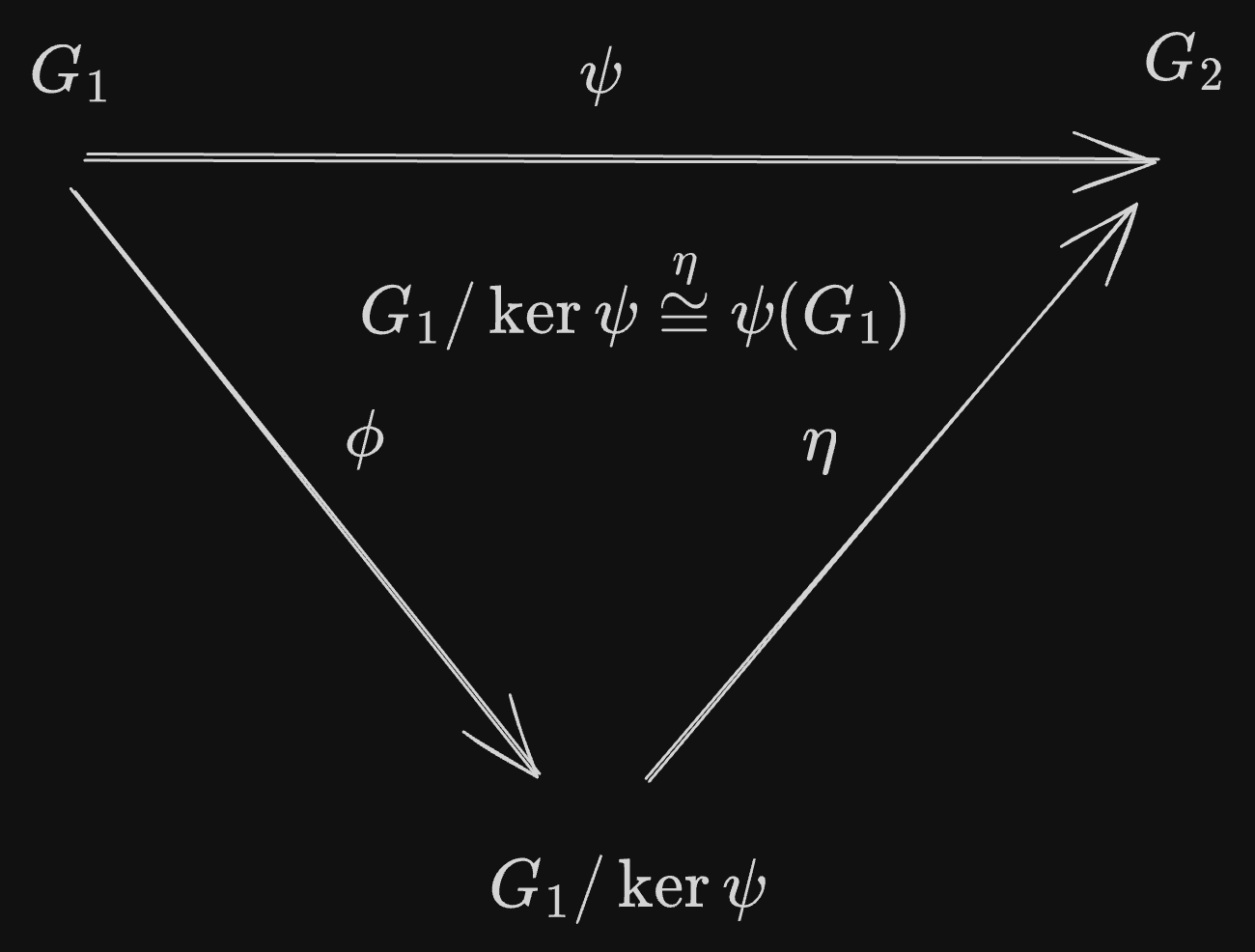
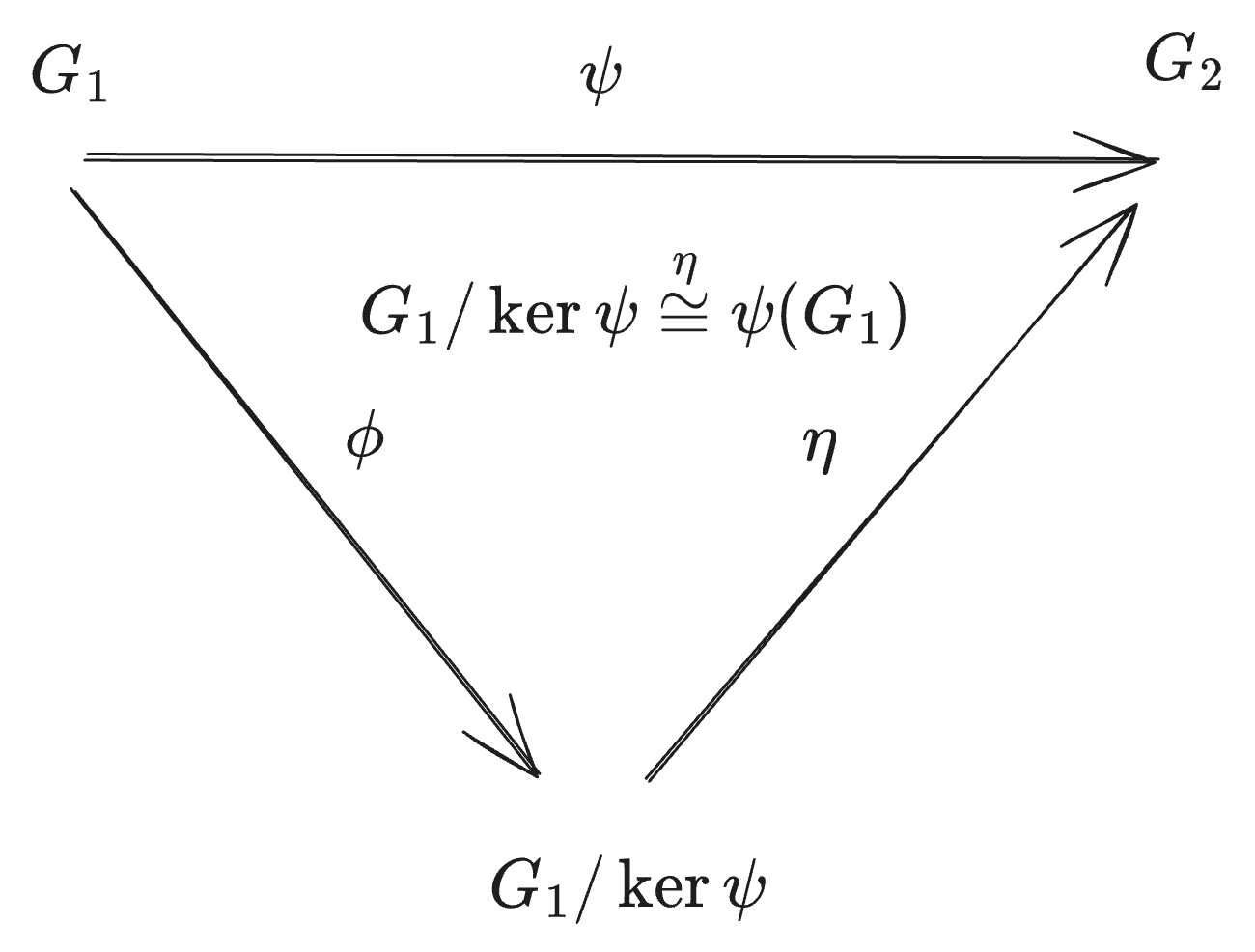
∢ G 1 , G 2 ∈ G G 1 ⇝ ψ G G 2 ϕ : G 1 → G 1 / ker ψ − natural homomorphism ∃ ! η : G 1 / ker ψ ≅ η G ψ ( G 1 ) , ψ = η ϕ \begin{align*}
&\sphericalangle \\
&G_1, G_2 \in \mathcal G \\
&G_1 \overset{\psi}{\rightsquigarrow}_G G_2 \\
&\phi:G_1 \to G_1/\ker \psi - \text{natural homomorphism}
\\
\hline
\\
&\exists! \eta: G_1/\ker \psi \overset{\eta}{\cong}_G \psi(G_1), \psi = \eta \phi
\end{align*} ∢ G 1 , G 2 ∈ G G 1 ⇝ ψ G G 2 ϕ : G 1 → G 1 / ker ψ − natural homomorphism ∃ ! η : G 1 / ker ψ ≅ η G ψ ( G 1 ) , ψ = η ϕ
Proof
Define unique η \eta η
Remeber that by ( 2.2.24 ) (2.2.24) ( 2.2.24 ) ker ψ ⊲ G G 1 \ker \psi \lhd_G G_1 ker ψ ⊲ G G 1 G 1 / ker ψ G_1 / \ker \psi G 1 / ker ψ
Now we define η : g ker ψ ↦ ψ ( g ) \eta: g\ker\psi \mapsto \psi(g) η : g ker ψ ↦ ψ ( g ) g 1 ker ψ = g 2 ker ψ ⟹ ∃ h ∈ ker ψ : g 1 = g 2 h ⟹ ψ ( g 1 ) = ψ ( g 2 h ) = ψ ( g 2 ) ψ ( h ) = ψ ( g 2 ) g_1\ker\psi = g_2\ker\psi \implies \exists h \in \ker\psi: g_1 = g_2h \implies \psi(g_1) = \psi(g_2 h)=\psi(g_2)\psi(h) = \psi(g_2) g 1 ker ψ = g 2 ker ψ ⟹ ∃ h ∈ ker ψ : g 1 = g 2 h ⟹ ψ ( g 1 ) = ψ ( g 2 h ) = ψ ( g 2 ) ψ ( h ) = ψ ( g 2 )
Next, η \eta η ψ = ϕ η \psi = \phi\eta ψ = ϕ η ψ ( g ) \psi(g) ψ ( g ) η \eta η G 1 / ker ψ G_1 / \ker \psi G 1 / ker ψ ψ ( G 1 ) \psi(G_1) ψ ( G 1 )
η \eta η
Obviously, η ( G 1 / ker ψ ) = ψ ( G 1 ) \eta(G_1/\ker \psi) = \psi(G_1) η ( G 1 / ker ψ ) = ψ ( G 1 )
η ( g ker ψ ) = e ⟺ ψ ( g ) = e ⟺ g ∈ ker ψ ⟹ η − 1 ( e ) = ker ψ \eta(g\ker\psi)=e \iff \psi(g)=e \iff g \in \ker \psi \implies \\
\eta^{-1}(e)=\ker \psi η ( g ker ψ ) = e ⟺ ψ ( g ) = e ⟺ g ∈ ker ψ ⟹ η − 1 ( e ) = ker ψ Since ker ψ \ker \psi ker ψ G 1 / ker ψ G_1 / \ker \psi G 1 / ker ψ ( 2.2.25 ) (2.2.25) ( 2.2.25 ) η \eta η
Thus, we proved that η : G 1 / ker ψ ↔ ψ ( G 1 ) \eta: G_1/\ker \psi \leftrightarrow \psi(G_1) η : G 1 / ker ψ ↔ ψ ( G 1 )
η \eta η
η ( g 1 ker ψ ⋅ g 2 ker ψ ) = η ( g 1 g 2 ker ψ ) = ψ ( g 1 g 2 ) = = ψ ( g 1 ) ψ ( g 2 ) = η ( g 1 ker ψ ) η ( g 2 ker ψ ) \eta(g_1\ker\psi \cdot
g_2\ker\psi)=\eta(g_1 g_2\ker\psi)=\psi(g_1g_2)=\\
=\psi(g_1)\psi(g_2) = \eta(g_1\ker \psi)\eta(g_2\ker \psi) η ( g 1 ker ψ ⋅ g 2 ker ψ ) = η ( g 1 g 2 ker ψ ) = ψ ( g 1 g 2 ) = = ψ ( g 1 ) ψ ( g 2 ) = η ( g 1 ker ψ ) η ( g 2 ker ψ ) □ \square □
Theorem 2.2.28: Second isomorphism theorem
∢ G ∈ G H ⊆ G G N ⊲ G G H N ⊆ G G H ∩ N ⊲ G H H N / N ≅ G H / ( H ∩ N ) \begin{align*}
&\sphericalangle \\
&G \in \mathcal G \\
&H \subseteq_G G \\
&N \lhd_G G
\\
\hline
\\
&\begin{align*}
& HN \subseteq_G G \tag{a}\\
& H \cap N \lhd_G H \tag{b}\\
& HN/N \cong_G H / (H \cap N) \hspace{1cm} \tag{c}\\
\end{align*}
\end{align*} ∢ G ∈ G H ⊆ G G N ⊲ G G H N ⊆ G G H ∩ N ⊲ G H H N / N ≅ G H / ( H ∩ N ) ( a ) ( b ) ( c ) Proof
a.
H N : = { h n , h ∈ H , n ∈ N } HN:=\{hn, h \in H, n \in N \} H N := { hn , h ∈ H , n ∈ N } h 1 , h 2 ∈ H , n 1 , n 2 ∈ N h_1, h_2 \in H, n_1, n_2 \in N h 1 , h 2 ∈ H , n 1 , n 2 ∈ N
e ∈ H N , N ⊲ G G ⟹ ( h 2 ) − 1 n 1 h 2 ∈ N ⟹ ( h 1 n 1 ) ( h 2 n 2 ) = h 1 h 2 ⏟ ∈ H ( h 2 − 1 n 1 h 2 ) n 2 ⏟ ∈ N ∈ H N , ( h 1 n 1 ) − 1 = n 1 − 1 h 1 − 1 = h 1 − 1 ( h 1 n 1 − 1 h 1 − 1 ) ∈ H N e \in HN, \\
N \lhd_G G \implies (h_2)^{-1}n_1h_2 \in N \implies \\
(h_1n_1)(h_2n_2)=\underbrace{h_1h_2}_{\in H}\underbrace{(h_2^{-1}n_1h_2)n_2}_{\in N} \in HN, \\
(h_1n_1)^{-1}=n_1^{-1}h_1^{-1}=h_1^{-1}(h_1n_1^{-1}h_1^{-1})\in HN e ∈ H N , N ⊲ G G ⟹ ( h 2 ) − 1 n 1 h 2 ∈ N ⟹ ( h 1 n 1 ) ( h 2 n 2 ) = ∈ H h 1 h 2 ∈ N ( h 2 − 1 n 1 h 2 ) n 2 ∈ H N , ( h 1 n 1 ) − 1 = n 1 − 1 h 1 − 1 = h 1 − 1 ( h 1 n 1 − 1 h 1 − 1 ) ∈ H N By ( 2.2.2 ) (2.2.2) ( 2.2.2 ) H N ⊆ G G HN \subseteq_G G H N ⊆ G G
b.
h ∈ H , l ∈ N ∩ H ⟹ h − 1 l h ∈ H , h − 1 l h ∈ N ⟹ N ∩ H ⊲ G H h \in H, l \in N \cap H \implies h^{-1}lh \in H, h^{-1}lh \in N \implies N \cap H \lhd_G H h ∈ H , l ∈ N ∩ H ⟹ h − 1 l h ∈ H , h − 1 l h ∈ N ⟹ N ∩ H ⊲ G H c.
ϕ : H → H N / N , h → h N ∀ h ∈ H , n ∈ N : ϕ − 1 ( h n N ) = ϕ − 1 ( h N ) = h ∈ H ⟹ ϕ ( H ) = H N / N \phi: H \to HN/N, h \to hN \\
\forall h \in H, n \in N: \phi^{-1}(hnN)=\phi^{-1}(hN)=h \in H \implies \phi(H) = HN/N \\ ϕ : H → H N / N , h → h N ∀ h ∈ H , n ∈ N : ϕ − 1 ( hn N ) = ϕ − 1 ( h N ) = h ∈ H ⟹ ϕ ( H ) = H N / N ∀ h 1 , h 2 ∈ H : ϕ ( h 1 h 2 ) = h 1 h 2 N = h 1 N h 2 N = ϕ ( h 1 ) ϕ ( h 2 ) ⟹ H ⇝ ϕ G H N / N \forall h_1, h_2 \in H: \phi(h_1h_2)=h_1h_2N=h_1Nh_2N =\phi(h_1)\phi(h_2) \implies \\
H \overset{\phi}{\rightsquigarrow}_G HN/N ∀ h 1 , h 2 ∈ H : ϕ ( h 1 h 2 ) = h 1 h 2 N = h 1 N h 2 N = ϕ ( h 1 ) ϕ ( h 2 ) ⟹ H ⇝ ϕ G H N / N Next, ker ϕ = { h ∈ H : h N = N } = H ∩ N \ker \phi = \{h\in H: hN=N\}=H\cap N ker ϕ = { h ∈ H : h N = N } = H ∩ N
H ⇝ ϕ H N / N , ker ϕ = H ∩ N , ϕ ( H ) = H N / N ⟹ ( 2.2.27 ) H / ( H ∩ N ) ≅ ϕ G H N / N H \overset{\phi}{\rightsquigarrow} HN/N, \ker \phi = H\cap N, \phi(H)=HN/N \overset{(2.2.27)}{\implies} \\
H/(H\cap N) \overset{\phi}{\cong}_G HN/N H ⇝ ϕ H N / N , ker ϕ = H ∩ N , ϕ ( H ) = H N / N ⟹ ( 2.2.27 ) H / ( H ∩ N ) ≅ ϕ G H N / N □ \square □
Theorem 2.2.29: Correspondence theorem (fourth isomorphism theorem)
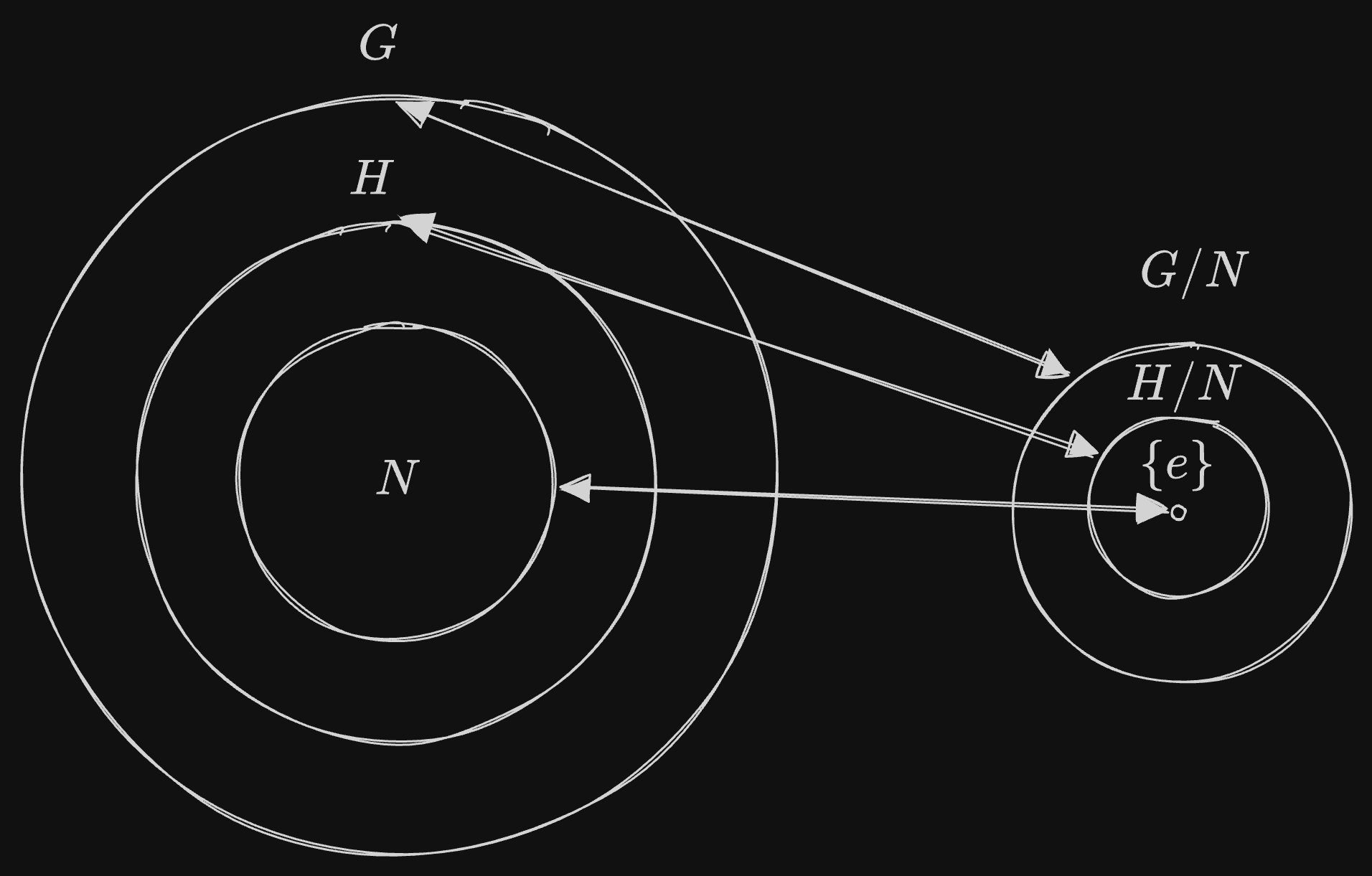
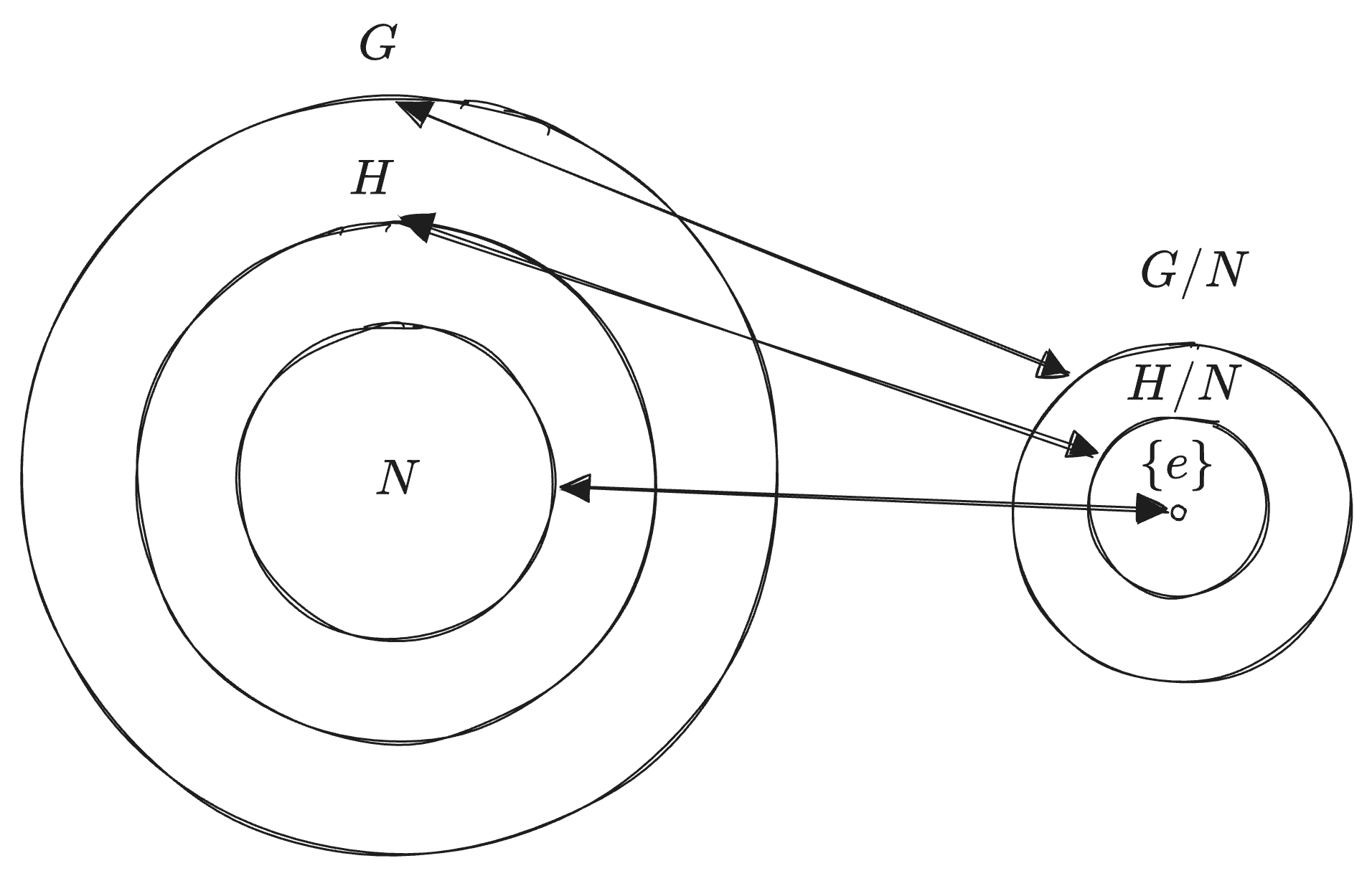
∢ G ∈ G N ⊲ G G H : = { H : N ⊆ G H ⊆ G G } H N : = { H N : H N ⊆ G G / N } ϕ : H → H N , H ↦ H / N ϕ − well-defined ϕ − 1 ( H N ) = { g ∈ G : g N ∈ H N } ϕ : H ↔ H N N ⊆ G H ⊲ G G ⟹ ϕ ( H ) ⊲ G G / N H N ⊲ G G / N ⟹ ϕ − 1 ( H N ) ⊲ G G \begin{align*}
&\sphericalangle \\
&G \in \mathcal G \\
&N \lhd_G G \\
&\mathfrak H :=\{H: N\subseteq_G H \subseteq_G G\} \\
&\mathfrak H_N :=\{H_N: H_N \subseteq_G G/N\} \\
&\phi: \mathfrak H \to \mathfrak H_N, H \mapsto H/N \\
\hline
\\
&\begin{align*}
& \phi - \text{well-defined} \tag{a} \\
& \phi^{-1}(H_N) =\{g \in G: gN \in H_N\} \tag{b}\\
& \phi: \mathfrak H \leftrightarrow \mathfrak H_N \tag{c}\\
&N \subseteq_G H \lhd_G G \implies \phi(H) \lhd_G G / N \hspace{1cm} \tag{d}\\
& H_N \lhd_G G/N \implies \phi^{-1}(H_N) \lhd_G G \hspace{1cm} \tag{e}\\
\end{align*}
\end{align*} ∢ G ∈ G N ⊲ G G H := { H : N ⊆ G H ⊆ G G } H N := { H N : H N ⊆ G G / N } ϕ : H → H N , H ↦ H / N ϕ − well-defined ϕ − 1 ( H N ) = { g ∈ G : g N ∈ H N } ϕ : H ↔ H N N ⊆ G H ⊲ G G ⟹ ϕ ( H ) ⊲ G G / N H N ⊲ G G / N ⟹ ϕ − 1 ( H N ) ⊲ G G ( a ) ( b ) ( c ) ( d ) ( e )
Proof
a.
To prove that that ϕ \phi ϕ
H / N H/N H / N H / N ∈ H N H/N \in \mathfrak H_N H / N ∈ H N
Assume H ∈ H H \in \mathfrak H H ∈ H N ⊲ G H N \lhd_G H N ⊲ G H H / N H/N H / N H / N H/N H / N h N hN h N H / N ⊆ G / N H/N \subseteq G/N H / N ⊆ G / N H / N ⊆ G G / N H/N \subseteq_G G/N H / N ⊆ G G / N
{ H / N ≠ ∅ ∀ a N , b N ∈ H / N : a N ( b N ) − 1 = a b − 1 N ∈ H / N ⟹ H / N ⊆ G G / N ⟹ H / N ∈ H N \begin{cases}
H/N \ne \empty \\
\forall aN, bN \in H/N: aN(bN)^{-1}=ab^{-1}N \in H/N
\end{cases} \implies \\
H/N \subseteq_G G/N \implies H/N \in \mathfrak H_N { H / N = ∅ ∀ a N , b N ∈ H / N : a N ( b N ) − 1 = a b − 1 N ∈ H / N ⟹ H / N ⊆ G G / N ⟹ H / N ∈ H N b., c.
Consider H N ⊆ G G / N H_N \subseteq_G G/N H N ⊆ G G / N
ϕ − 1 ( H N ) : = { g ∈ G : g N ∈ H N } \phi^{-1}(H_N):=\{g \in G: gN \in H_N\} ϕ − 1 ( H N ) := { g ∈ G : g N ∈ H N } Note that this definition is not yet telling us that ϕ − 1 ( H N ) \phi^{-1}(H_N) ϕ − 1 ( H N ) H N H_N H N ϕ : H ↦ H / N \phi: H \mapsto H/N ϕ : H ↦ H / N
Prove that ϕ − 1 ( H N ) ∈ H \phi^{-1}(H_N) \in \mathfrak H ϕ − 1 ( H N ) ∈ H
Prove that ϕ ( ϕ − 1 ( H N ) ) = H N \phi(\phi^{-1}(H_N))=H_N ϕ ( ϕ − 1 ( H N )) = H N
Prove that ϕ \phi ϕ
After proving each of these statements we see that ϕ − 1 ( H N ) \phi^{-1}(H_N) ϕ − 1 ( H N ) H N H_N H N ϕ \phi ϕ H N H_N H N ϕ \phi ϕ ( b ) (b) ( b ) ( c ) (c) ( c )
1. Prove that ϕ − 1 ( H N ) ∈ H \phi^{-1}(H_N) \in \mathfrak H ϕ − 1 ( H N ) ∈ H
We need to prove that N ⊆ G ϕ − 1 ( H N ) ⊆ G G N \subseteq_G \phi^{-1}(H_N) \subseteq_G G N ⊆ G ϕ − 1 ( H N ) ⊆ G G
N ∈ H N ⟹ e ∈ ϕ − 1 ( H N ) N \in H_N \implies e \in \phi^{-1}(H_N) N ∈ H N ⟹ e ∈ ϕ − 1 ( H N ) a , b ∈ ϕ − 1 ( H N ) ⟹ a N , b N ∈ H N ⟹ a b N ∈ H N ⟹ a b ∈ ϕ − 1 ( H N ) a, b \in \phi^{-1}(H_N) \implies aN, bN \in H_N \implies abN \in H_N \implies ab \in \phi^{-1}(H_N) a , b ∈ ϕ − 1 ( H N ) ⟹ a N , b N ∈ H N ⟹ ab N ∈ H N ⟹ ab ∈ ϕ − 1 ( H N ) a ∈ ϕ − 1 ( H N ) ⟹ a N ∈ H N ⟹ a − 1 N ∈ H N ⟹ a − 1 ∈ ϕ − 1 ( H N ) a \in \phi^{-1}(H_N) \implies aN \in H_N \implies a^{-1}N \in H_N \implies a^{-1} \in \phi^{-1}(H_N) a ∈ ϕ − 1 ( H N ) ⟹ a N ∈ H N ⟹ a − 1 N ∈ H N ⟹ a − 1 ∈ ϕ − 1 ( H N )
So we have ϕ − 1 ( H N ) ⊆ G G \phi^{-1}(H_N) \subseteq_G G ϕ − 1 ( H N ) ⊆ G G
n ∈ N ⟹ n N ∈ H N ⟹ n ∈ ϕ − 1 ( H N ) n \in N \implies nN \in H_N \implies n \in \phi^{-1}(H_N) n ∈ N ⟹ n N ∈ H N ⟹ n ∈ ϕ − 1 ( H N ) So N ⊆ G ϕ − 1 ( H N ) N \subseteq_G \phi^{-1}(H_N) N ⊆ G ϕ − 1 ( H N )
2. Prove that ϕ ( ϕ − 1 ( H N ) ) = H N \phi(\phi^{-1}(H_N))=H_N ϕ ( ϕ − 1 ( H N )) = H N
a N ∈ H N ⟺ a ∈ ϕ − 1 ( H N ) ⟺ a N ∈ ϕ − 1 ( H N ) / N = ϕ ( ϕ − 1 ( H N ) ) aN \in H_N \iff a \in \phi^{-1}(H_N) \iff \\
aN \in \phi^{-1}(H_N)/N = \phi(\phi^{-1}(H_N)) a N ∈ H N ⟺ a ∈ ϕ − 1 ( H N ) ⟺ a N ∈ ϕ − 1 ( H N ) / N = ϕ ( ϕ − 1 ( H N )) 3. Prove that ϕ \phi ϕ
ϕ ( H 1 ) = ϕ ( H 2 ) ⟹ H 1 / N = H 2 / N h 1 ∈ H 1 ⟺ h 1 N ∈ H 1 / N ⟺ h 1 N ∈ H 2 / N ⟺ h 1 ∈ H 2 H 1 = H 2
\phi(H_1)=\phi(H_2) \implies H_1/N = H_2/N \\
h_1 \in H_1 \iff h_1N \in H_1/N \iff \\
h_1N \in H_2/N \iff h_1 \in H_2 \\
H_1 = H_2 ϕ ( H 1 ) = ϕ ( H 2 ) ⟹ H 1 / N = H 2 / N h 1 ∈ H 1 ⟺ h 1 N ∈ H 1 / N ⟺ h 1 N ∈ H 2 / N ⟺ h 1 ∈ H 2 H 1 = H 2 d.
Assume N ⊆ G H ⊲ G G N \subseteq_G H \lhd_G G N ⊆ G H ⊲ G G ψ : G / N → G / H , g N ↦ g H \psi: G/N \to G/H, gN \mapsto gH ψ : G / N → G / H , g N ↦ g H
ψ ( a N b N ) = ψ ( a b N ) = a b H = a H b H = ψ ( a N ) ψ ( b N ) \psi(aNbN)=\psi(abN)=abH=aHbH=\psi(aN)\psi(bN) ψ ( a N b N ) = ψ ( ab N ) = ab H = a H b H = ψ ( a N ) ψ ( b N ) Next, ker ψ = { g N , g ∈ H } = H / N ⟹ ( 2.2.24 ) H / N ⊲ G G / N ⟹ ϕ ( H ) ⊲ G G / N \ker \psi=\{gN, g\in H\} = H/N \overset{(2.2.24)}{\implies} H/N \lhd_G G/N \implies \phi(H) \lhd_G G/N ker ψ = { g N , g ∈ H } = H / N ⟹ ( 2.2.24 ) H / N ⊲ G G / N ⟹ ϕ ( H ) ⊲ G G / N
e.
Assume ϕ ( H ) = H / N ⊲ G G / N \phi(H)=H/N\lhd_G G/N ϕ ( H ) = H / N ⊲ G G / N ψ \psi ψ G → G / N → G / N H / N G \to G/N \to \frac{G/N}{H/N} G → G / N → H / N G / N G / N H / N \frac{G/N}{H/N} H / N G / N { a N ∈ G / N : a N ∈ H / N } \{aN \in G/N: aN \in H/N\} { a N ∈ G / N : a N ∈ H / N } ker ψ = H ⟹ ( 2.2.24 ) H ⊲ G G \ker \psi = H \overset{(2.2.24)}{\implies} H \lhd_G G ker ψ = H ⟹ ( 2.2.24 ) H ⊲ G G
□ \square □
Theorem 2.2.30: Third isomorphism theorem
∢ G ∈ G H ⊲ G G N ⊲ G G N ⊆ H G / H ≅ G G / N H / N \begin{align*}
&\sphericalangle \\
&G \in \mathcal G \\
&H \lhd_G G \\
&N \lhd_G G \\
&N \subseteq H
\\
\hline
\\
&G/H \cong_G \frac{G/N}{H/N}
\end{align*} ∢ G ∈ G H ⊲ G G N ⊲ G G N ⊆ H G / H ≅ G H / N G / N Proof
Consider mapping ψ \psi ψ ( 2.2.29. e ) (2.2.29.e) ( 2.2.29. e ) ker ψ = H \ker \psi = H ker ψ = H ( 2.2.27 ) (2.2.27) ( 2.2.27 ) G / H ≅ G G / N H / N G/H \cong_G \frac{G/N}{H/N} G / H ≅ G H / N G / N
□ \square □
Abelian groups structure
Proposition 2.2.31: Cyclic groups are isomorphic to integers
∢ G ∈ G ↺ ∣ G ∣ = ∞ ⟹ G ≅ G Z ∣ G ∣ = n ⟹ G ≅ G Z n \begin{align*}
&\sphericalangle \\
&G \in \mathcal G^\circlearrowleft
\\
\hline
\\
&\begin{align*}
&|G| = \infty \implies G \cong_G \Z \hspace{1cm} \tag{a}\\
&|G| = n \implies G \cong_G \Z_n \tag{b}\\
\end{align*}
\end{align*} ∢ G ∈ G ↺ ∣ G ∣ = ∞ ⟹ G ≅ G Z ∣ G ∣ = n ⟹ G ≅ G Z n ( a ) ( b ) Proof
Let a a a G = ⟨ a ⟩ G G = \lang a \rang_G G = ⟨ a ⟩ G
a.
Define ϕ : Z → G , n ↦ a n \phi: \Z \to G, n \mapsto a^n ϕ : Z → G , n ↦ a n
Let's prove that
∣ G ∣ = ∞ , a x = e ⟹ x = 0 |G|=\infty, a^x=e \implies x = 0 ∣ G ∣ = ∞ , a x = e ⟹ x = 0 Assume otherwise:
∃ x ≠ 0 : a x = e ⟹ ∀ y ∈ Z : a y = a q x + r = a r , 0 ≤ r < x ⟹ ∣ G ∣ < ∞ \exists x \ne 0: a^x=e \implies \forall y \in \Z: a^y = a^{qx+r}=a^r, 0 \le r < x \implies \\
|G| < \infty ∃ x = 0 : a x = e ⟹ ∀ y ∈ Z : a y = a q x + r = a r , 0 ≤ r < x ⟹ ∣ G ∣ < ∞ Next,
ϕ ( m ) = ϕ ( n ) ⟹ a m = a n ⟹ a m − n = e ⟹ ∣ G ∣ = ∞ m = n ⟹ f : Z → 1 − 1 G ( 2.2.6 ) ⟹ f ( Z ) = G \phi(m) = \phi(n) \implies a^m = a^n \implies a^{m-n} =e \overset{|G|=\infty}{\implies} \\
m=n \implies f: \Z \overset{1-1}{\to} G\\
(2.2.6) \implies f(\Z)= G ϕ ( m ) = ϕ ( n ) ⟹ a m = a n ⟹ a m − n = e ⟹ ∣ G ∣ = ∞ m = n ⟹ f : Z → 1 − 1 G ( 2.2.6 ) ⟹ f ( Z ) = G So we proved that ϕ : Z ↔ G \phi: \Z \leftrightarrow G ϕ : Z ↔ G ϕ : Z ⇝ G \phi: \Z \rightsquigarrow G ϕ : Z ⇝ G
ϕ ( m + n ) = a m + n = a m a n = ϕ ( m ) ϕ ( n ) \phi(m+n)=a^{m+n}=a^ma^n = \phi(m)\phi(n) ϕ ( m + n ) = a m + n = a m a n = ϕ ( m ) ϕ ( n ) b.
∣ G ∣ = n |G|=n ∣ G ∣ = n ϕ : Z n → G , x ↦ a x \phi: \Z_n \to G, x \mapsto a^x ϕ : Z n → G , x ↦ a x ϕ \phi ϕ a n = e a^n=e a n = e
ϕ ( m ) = ϕ ( k ) ⟹ a m = a k ⟹ a k − m = e k − m = q n + r , 0 ≤ r < n ⟹ a r = e ⟹ ∣ G ∣ = n , G ∈ G ↺ , ( 2.2.6 ) r = 0 ⟹ k − m = q n ⟹ k ≡ m (mod n ) ⟹ f : Z n → 1 − 1 G ( 2.2.6 ) ⟹ ∀ b ∈ G : ∃ n ∈ Z : b = a n ⟹ f ( Z n ) = G \phi(m) = \phi(k) \implies a^m = a^k \implies a^{k-m} =e\\
k-m = qn+r, 0 \le r < n \implies a^r=e \overset{|G|=n, G \in \mathcal G^\circlearrowleft, (2.2.6)}{\implies} \\
r=0 \implies k-m = qn \implies k \equiv m \text{ (mod } n \text{)} \implies \\ f: \Z_n \overset{1-1}{\to} G \\
(2.2.6) \implies \forall b \in G: \exists n \in \Z:b = a^n \implies f(\Z_n)= G ϕ ( m ) = ϕ ( k ) ⟹ a m = a k ⟹ a k − m = e k − m = q n + r , 0 ≤ r < n ⟹ a r = e ⟹ ∣ G ∣ = n , G ∈ G ↺ , ( 2.2.6 ) r = 0 ⟹ k − m = q n ⟹ k ≡ m (mod n ) ⟹ f : Z n → 1 − 1 G ( 2.2.6 ) ⟹ ∀ b ∈ G : ∃ n ∈ Z : b = a n ⟹ f ( Z n ) = G We proved that ϕ : Z n ↔ G \phi: \Z_n \leftrightarrow G ϕ : Z n ↔ G ϕ : Z n ⇝ G \phi: \Z_n \rightsquigarrow G ϕ : Z n ⇝ G
ϕ ( m + n k ) = a m + k + q n = = a m a k = ϕ ( m ) ϕ ( n ) ⟹ \phi(m+_nk)=a^{m+k+qn}=\\
=a^ma^k=\phi(m)\phi(n) \implies ϕ ( m + n k ) = a m + k + q n = = a m a k = ϕ ( m ) ϕ ( n ) ⟹ □ \square □
Corrolary 2.2.32: Any group of a prime order is isomorphic to integers
∢ G ∈ G ∣ G ∣ = p ∈ P G ≅ G Z p \begin{align*}
&\sphericalangle \\
&G \in \mathcal G \\
&|G|=p \in \mathfrak P
\\
\hline
\\
&G \cong_G \Z_p
\end{align*} ∢ G ∈ G ∣ G ∣ = p ∈ P G ≅ G Z p Proof
From ( 2.2.19 ) (2.2.19) ( 2.2.19 ) G ∈ G ↺ G \in G^{\circlearrowleft} G ∈ G ↺ ( 2.2.31 ) (2.2.31) ( 2.2.31 )
□ \square □
Proposition 2.2.33: Internal direct product is isomorphic to external direct product
∢ G ∈ G H 1 , … , H n ⊆ G G H i ∩ H j = { e } ∀ h i ∈ H i , h j ∈ H j : h i h j = h j h i H 1 H 2 … H n ≅ G H 1 × H 2 × … × H n \begin{align*}
&\sphericalangle \\
&G \in \mathcal G \\
&H_1, \ldots, H_n \subseteq_G G \\
&H_i \cap H_j = \{e\} \\
&\forall h_i \in H_i, h_j \in H_j: h_ih_j=h_jh_i
\\
\hline
\\
&H_1H_2\ldots H_n \cong_G H_1 \times H_2 \times \ldots \times H_n
\end{align*} ∢ G ∈ G H 1 , … , H n ⊆ G G H i ∩ H j = { e } ∀ h i ∈ H i , h j ∈ H j : h i h j = h j h i H 1 H 2 … H n ≅ G H 1 × H 2 × … × H n Proof
We will make the proof for n = 2 n=2 n = 2 n n n
Define ϕ : H 1 H 2 → H 1 × H 2 , h 1 k 1 ↦ ( h 1 , k 1 ) \phi: H_1H_2 \to H_1 \times H_2, h_1k_1 \mapsto (h_1, k_1) ϕ : H 1 H 2 → H 1 × H 2 , h 1 k 1 ↦ ( h 1 , k 1 )
∀ h 1 , h 2 ∈ H 1 , k 1 , k 2 ∈ H 2 : h 1 k 1 = h 2 k 2 ⟹ H 1 ∩ H 2 = { e } h 2 − 1 h 1 = k 2 k 1 − 1 = e ⟹ h 1 = h 2 , k 1 = k 2 \forall h_1, h_2 \in H_1, k_1, k_2 \in H_2: h_1k_1=h_2k_2 \overset{H_1 \cap H_2 = \{e\} }\implies \\
h_2^{-1}h_1=k_2k_1^{-1} = e \implies h_1=h_2, k_1=k_2 ∀ h 1 , h 2 ∈ H 1 , k 1 , k 2 ∈ H 2 : h 1 k 1 = h 2 k 2 ⟹ H 1 ∩ H 2 = { e } h 2 − 1 h 1 = k 2 k 1 − 1 = e ⟹ h 1 = h 2 , k 1 = k 2 Now let's prove ϕ : H 1 H 2 ⇝ H 1 × H 2 \phi: H_1H_2 \rightsquigarrow H_1 \times H_2 ϕ : H 1 H 2 ⇝ H 1 × H 2
∀ g 1 , g 2 ∈ G , h 1 , h 2 ∈ H 1 , k 1 , k 2 ∈ H 2 : g 1 = h 1 k 1 , g 2 = h 2 k 2 : ϕ ( g 1 g 2 ) = ϕ ( h 1 k 1 h 2 k 2 ) = ϕ ( h 1 h 2 k 1 k 2 ) = ( h 1 h 2 , k 1 k 2 ) = = ( h 1 , k 1 ) ( h 2 , k 2 ) = ϕ ( g 1 ) ϕ ( g 2 ) \forall g_1, g_2 \in G, h_1, h_2 \in H_1, k_1, k_2 \in H_2: \\
g_1=h_1k_1, g_2=h_2k_2: \\
\phi(g_1g_2)=\phi(h_1k_1h_2k_2)=\phi(h_1h_2k_1k_2)=(h_1h_2, k_1k_2) = \\
= (h_1,k_1)(h_2,k_2)=\phi(g_1)\phi(g_2) ∀ g 1 , g 2 ∈ G , h 1 , h 2 ∈ H 1 , k 1 , k 2 ∈ H 2 : g 1 = h 1 k 1 , g 2 = h 2 k 2 : ϕ ( g 1 g 2 ) = ϕ ( h 1 k 1 h 2 k 2 ) = ϕ ( h 1 h 2 k 1 k 2 ) = ( h 1 h 2 , k 1 k 2 ) = = ( h 1 , k 1 ) ( h 2 , k 2 ) = ϕ ( g 1 ) ϕ ( g 2 ) Finally, let's prove that ϕ \phi ϕ
( h 1 , k 1 ) = ( h 2 , k 2 ) ⟹ h 1 k 1 = h 2 k 2 ϕ − 1 ( ( h 1 , k 1 ) ) = h 1 k 1 (h_1, k_1)=(h_2, k_2) \implies h_1k_1=h_2k_2 \\
\phi^{-1}((h_1, k_1))=h_1k_1 ( h 1 , k 1 ) = ( h 2 , k 2 ) ⟹ h 1 k 1 = h 2 k 2 ϕ − 1 (( h 1 , k 1 )) = h 1 k 1 □ \square □
Lemma 2.2.34: Existence of an element of a prime order
∢ G ∈ G A p ∈ P p ∣ ∣ G ∣ ∃ g ∈ G : ord g = p \begin{align*}
&\sphericalangle \\
&G \in \mathcal G^{\mathcal A} \\
&p \in \mathfrak P \\
&p \mid |G|
\\
\hline
\\
&\exists g \in G: \text{ord }g = p
\end{align*} ∢ G ∈ G A p ∈ P p ∣ ∣ G ∣ ∃ g ∈ G : ord g = p Proof
n : = ∣ G ∣ n:=|G| n := ∣ G ∣ n n n
n = 1 n=1 n = 1
Assume that the proposition is true ∀ k < n \forall k < n ∀ k < n
Only trivial subgroups of G G G
Non-trivial subgroup of G G G
1. Only trivial subgroups of G G G
Assume ∄ H ⊂ G G , H ≠ { e } \nexists H \subset_G G, H \ne \{e\} ∄ H ⊂ G G , H = { e } ∀ a ∈ G , a ≠ e : ⟨ a ⟩ G = G \forall a \in G, a \ne e: \lang a \rang_G = G ∀ a ∈ G , a = e : ⟨ a ⟩ G = G n ∈ P n \in \mathfrak P n ∈ P
n ∉ P ⟹ n = p q , 1 < p < n , p ∈ P ⟹ ( 2.2.7. e ) ord a p = n gcd ( n , p ) = n p ⟹ 1 < ∣ ⟨ a p ⟩ G ∣ < n n \notin \mathfrak P \implies n = pq, 1< p < n, p \in \mathfrak P \overset{(2.2.7.e)}\implies \\
\text{ord }a^p=\frac{n}{\gcd(n, p)}=\frac{n}{p} \implies 1 < |\lang a^p \rang_G| < n n ∈ / P ⟹ n = pq , 1 < p < n , p ∈ P ⟹ ( 2.2.7. e ) ord a p = g cd( n , p ) n = p n ⟹ 1 < ∣ ⟨ a p ⟩ G ∣ < n Which is a contraction to ∄ H ⊂ G , H ≠ { e } \nexists H \subset G, H \ne \{e\} ∄ H ⊂ G , H = { e }
So n ∈ P n \in \mathfrak P n ∈ P p ∣ n ⟹ n = p p \mid n \implies n=p p ∣ n ⟹ n = p ord a = p \text{ord }a=p ord a = p
2. Non-trivial subgroup of G G G
Now assume ∃ H ⊂ G G , H ≠ { e } \exists H \subset_G G, H \ne \{e\} ∃ H ⊂ G G , H = { e }
If p ∣ ∣ H ∣ p \mid |H| p ∣ ∣ H ∣
So we only need to consider the case p ∤ ∣ H ∣ p \nmid |H| p ∤ ∣ H ∣
G ∈ G A ⟹ H ⊲ G G ⟹ ( 2.2.17 ) , ( 2.2.22. b ) ∣ G ∣ = ∣ H ∣ ⋅ ∣ G / H ∣ ⟹ p ∣ ∣ G ∣ , p ∤ ∣ H ∣ p ∣ ∣ G / H ∣ ⟹ induction hypothesis ∃ a H ∈ G / H : ord ( a H ) = p ⟹ H = ( a H ) p = a p H ⟹ a p ∈ H , a ∉ H G \in \mathcal G^{\mathcal A} \implies H \lhd_GG \overset{(2.2.17), (2.2.22.b)}\implies |G|=|H|\cdot|G/H| \overset{p \mid |G|, p \nmid |H| }\implies p \mid |G/H| \overset{\text{induction hypothesis}} \implies \\
\exists aH \in G/H: \text{ord }(aH)=p \implies H=(aH)^p=a^pH \implies a^p \in H, a \notin H \\ G ∈ G A ⟹ H ⊲ G G ⟹ ( 2.2.17 ) , ( 2.2.22. b ) ∣ G ∣ = ∣ H ∣ ⋅ ∣ G / H ∣ ⟹ p ∣ ∣ G ∣ , p ∤ ∣ H ∣ p ∣ ∣ G / H ∣ ⟹ induction hypothesis ∃ a H ∈ G / H : ord ( a H ) = p ⟹ H = ( a H ) p = a p H ⟹ a p ∈ H , a ∈ / H Note that a ∉ H a \notin H a ∈ / H a H = H aH=H a H = H ord a H = 1 \text{ord }aH=1 ord a H = 1 r : = ∣ H ∣ r := |H| r := ∣ H ∣
( 2.2.18 ) ⟹ ord a p ∣ r ⟹ ( 2.2.7 ) 1 = ( a p ) r = ( a r ) p ⟹ ( 2.2.7 ) ord a r ∣ p ⟹ ( ord a r = 1 ) ∨ ( ord a r = p ) (2.2.18) \implies \text{ord }a^p \mid r \overset{(2.2.7)} \implies 1=(a^p)^r= (a^r)^p \overset{(2.2.7)}\implies \text{ord }a^r \mid p \implies \\
(\text{ord }a^r = 1) \vee (\text{ord }a^r = p) ( 2.2.18 ) ⟹ ord a p ∣ r ⟹ ( 2.2.7 ) 1 = ( a p ) r = ( a r ) p ⟹ ( 2.2.7 ) ord a r ∣ p ⟹ ( ord a r = 1 ) ∨ ( ord a r = p ) Thus all we need to prove is a r ≠ e a^r \ne e a r = e
p ∤ ∣ H ∣ ⟹ p ∤ r ⟹ gcd ( r , p ) = 1 ⟹ ∃ s , q : r s + p q = 1 ⟹ a = a r s + p q = ( a r ) s ( a p ) q p \nmid |H| \implies p \nmid r \implies \gcd(r, p)=1 \implies \exists s, q: rs+pq=1 \implies \\
a = a^{rs+pq}=(a^r)^s(a^p)^q p ∤ ∣ H ∣ ⟹ p ∤ r ⟹ g cd( r , p ) = 1 ⟹ ∃ s , q : rs + pq = 1 ⟹ a = a rs + pq = ( a r ) s ( a p ) q If we assume that a r = e a^r=e a r = e a = ( a p ) q ⟹ a p ∈ H a ∈ H a = (a^p)^q \overset{a^p \in H}\implies a \in H a = ( a p ) q ⟹ a p ∈ H a ∈ H
□ \square □
def: p-group
∢ G ∈ G A p ∈ P ∀ g ∈ G : ∃ k ∈ N ∪ { 0 } : ord g = p k G is a p -group \begin{align*}
&\sphericalangle \\
&G \in \mathcal G^{\mathcal A} \\
&p \in \mathfrak P \\
& \forall g \in G: \exists k \in \N \cup \{0\}: \text{ord }g = p^k
\\
\hline
\\
&G \text{ is a }p\text{-group}
\end{align*} ∢ G ∈ G A p ∈ P ∀ g ∈ G : ∃ k ∈ N ∪ { 0 } : ord g = p k G is a p -group Example: Cyclic group is a p p p
Any cyclic group of a prime order is a p p p
Example: Non-cyclic group
Z 2 × Z 2 \Z_2 \times \Z_2 Z 2 × Z 2 p p p p = 2 p=2 p = 2
Proposition 2.2.35: p-group criterion
∢ G ∈ G A ∣ G ∣ < ∞ p ∈ P G is a p -group ⟺ ∃ n : ∣ G ∣ = p n \begin{align*}
&\sphericalangle \\
&G \in \mathcal G^{\mathcal A} \\
&|G| < \infty \\
&p \in \mathfrak P
\\
\hline
\\
&G \text{ is a }p\text{-group}\iff \exists n: |G| = p^n
\end{align*} ∢ G ∈ G A ∣ G ∣ < ∞ p ∈ P G is a p -group ⟺ ∃ n : ∣ G ∣ = p n Proof
⟹ \implies ⟹
∣ G ∣ ≠ p n ⟹ ∃ q ∈ P : gcd ( p , q ) = 1 , q ∣ ∣ G ∣ ⟹ ( 2.2.34 ) ∃ a ∈ G : ∀ n : ord a = q ≠ p n |G| \ne p^n \implies \exists q \in \mathfrak P: \gcd(p, q) = 1, q \mid |G| \overset{(2.2.34)}\implies \exists a \in G: \forall n: \text{ord }a = q \ne p^n ∣ G ∣ = p n ⟹ ∃ q ∈ P : g cd( p , q ) = 1 , q ∣ ∣ G ∣ ⟹ ( 2.2.34 ) ∃ a ∈ G : ∀ n : ord a = q = p n ⟸ \impliedby ⟸
∣ G ∣ = p n ⟹ ∀ a ∈ G : ord a ∣ p n ⟹ p ∈ P ord a = p k |G| = p^n \implies \forall a \in G: \text{ord }a \mid p^n \overset{p \in \mathfrak P}\implies \text{ord }a = p^k ∣ G ∣ = p n ⟹ ∀ a ∈ G : ord a ∣ p n ⟹ p ∈ P ord a = p k □ \square □
Proposition 2.2.36: p-group structure
∢ G ∈ G A ∣ G ∣ = p n , p ∈ P , n ≥ 1 g ∈ G : ∀ h ∈ G : ord h ≤ ord g G = ⟨ g ⟩ G H ≅ G ⟨ g ⟩ G × H , H ⊂ G G , ⟨ g ⟩ G ∩ H = { e } \begin{align*}
&\sphericalangle \\
&G \in \mathcal G^{\mathcal A} \\
&|G| = p^n, p \in \mathfrak P, n \ge 1 \\
&g \in G: \forall h \in G: \text{ord } h \leq \text{ord } g\\
\hline
\\
&G = \lang g \rang_G H \cong_G \lang g \rang_G \times H, H \subset_G G, \lang g \rang_G \cap H = \{e\}
\end{align*} ∢ G ∈ G A ∣ G ∣ = p n , p ∈ P , n ≥ 1 g ∈ G : ∀ h ∈ G : ord h ≤ ord g G = ⟨ g ⟩ G H ≅ G ⟨ g ⟩ G × H , H ⊂ G G , ⟨ g ⟩ G ∩ H = { e } Proof
We'll make induction on n n n
n = 1 ⟹ ∣ G ∣ = p ⟹ ( 2.2.19 ) ⟨ g ⟩ G = G , H = { e } n=1 \implies |G|=p \overset{(2.2.19)}\implies \lang g \rang_G=G, H = \{e\} n = 1 ⟹ ∣ G ∣ = p ⟹ ( 2.2.19 ) ⟨ g ⟩ G = G , H = { e }
Assume the proposition is true for k < n k<n k < n G = ⟨ g ⟩ G G = \lang g \rang_G G = ⟨ g ⟩ G
So we only consider the case G ≠ ⟨ g ⟩ G G \ne \lang g \rang_G G = ⟨ g ⟩ G m m m p p p
m : ord g = p m m:\text{ord }g = p^m m : ord g = p m Since it's the maximal order we have:
∀ a ∈ G : a p m = e \forall a \in G: a^{p^m}=e \\ ∀ a ∈ G : a p m = e Now consider an element h ∈ G ∖ ⟨ g ⟩ G h \in G \setminus \lang g\rang_G h ∈ G ∖ ⟨ g ⟩ G G ∖ ⟨ g ⟩ G G \setminus \lang g\rang_G G ∖ ⟨ g ⟩ G
h ∈ G ∖ ⟨ g ⟩ G : ∀ x ∈ G ∖ ⟨ g ⟩ G : ord h ≤ ord x h \in G \setminus \lang g \rang_G: \forall x \in G \setminus \lang g \rang_G: \text{ord }h \leq \text{ord }x \\ h ∈ G ∖ ⟨ g ⟩ G : ∀ x ∈ G ∖ ⟨ g ⟩ G : ord h ≤ ord x Let's make a cyclic subgroup from this element:
H : = ⟨ h ⟩ G H:=\lang h \rang_G \\ H := ⟨ h ⟩ G Now we want to make an outline for the rest of the proof:
Prove that ord h = p \text{ord }h=p ord h = p
Prove that for g H ∈ G / H : ord g H = p m gH \in G/H: \text{ord } gH = p^m g H ∈ G / H : ord g H = p m
Consider factor group G / H G/H G / H
1. Prove that ord h = p \text{ord }h=p ord h = p
The idea of the proof is building an element a ∈ G ∖ ⟨ g ⟩ G a \in G \setminus \lang g \rang_G a ∈ G ∖ ⟨ g ⟩ G ord a = p \text{ord }a = p ord a = p h h h ord h = p \text{ord }h = p ord h = p G G G p l p^l p l l ≥ 0 l \ge 0 l ≥ 0 e ∉ G ∖ ⟨ g ⟩ G e \notin G \setminus \lang g \rang_G e ∈ / G ∖ ⟨ g ⟩ G
We'll construct the element a a a r ∈ N : h p = g r r \in \N: h^p=g^r r ∈ N : h p = g r p ∣ r p \mid r p ∣ r a : = g − r / p h a := g^{-r/p}h a := g − r / p h
Now let's make the actual proof:
ord h = p k ⟹ gcd ( ord h , p ) = p ord h p = ( 2.2.7 ) ord h p < ord h \text{ord }h=p^k \implies \gcd (\text{ord h}, p) = p \\
\text{ord } h^p \overset{(2.2.7)}= \frac{\text{ord }h}{p} < \text{ord } h ord h = p k ⟹ g cd( ord h , p ) = p ord h p = ( 2.2.7 ) p ord h < ord h Since h h h G ∖ ⟨ g ⟩ G G \setminus \lang g \rang_G G ∖ ⟨ g ⟩ G h p ∈ ⟨ g ⟩ G h^p \in \lang g \rang_G h p ∈ ⟨ g ⟩ G
h p ∈ ⟨ g ⟩ G ⟹ ∃ r ∈ Z : h p = g r ( g r ) p m − 1 = h p m = e ⟹ ( g p m − 1 ) r = e ⟹ ( 2.2.7. d ) ord g p m − 1 ∣ r ⟹ ∃ l ≥ 0 : p l ∣ r h^p \in \lang g \rang_G \implies \exists r \in \Z: h^p = g^r \\
(g^r)^{p^{m-1}}=h^{p^m}=e \implies (g^{p^{m-1}})^r=e \overset{(2.2.7.d)}\implies \text{ord }g^{p^{m-1}} \mid r \implies \\
\exists l \ge 0: p^l \mid r h p ∈ ⟨ g ⟩ G ⟹ ∃ r ∈ Z : h p = g r ( g r ) p m − 1 = h p m = e ⟹ ( g p m − 1 ) r = e ⟹ ( 2.2.7. d ) ord g p m − 1 ∣ r ⟹ ∃ l ≥ 0 : p l ∣ r Since ord g = p m \text{ord }g = p^m ord g = p m g p m − 1 ≠ e g^{p^{m-1}}\ne e g p m − 1 = e l ≥ 1 l \ge 1 l ≥ 1 p l ∣ r ⟹ p ∣ r ⟹ r = p s p^l \mid r \implies p \mid r \implies r = ps p l ∣ r ⟹ p ∣ r ⟹ r = p s s s s
Now we define:
a : = g − s h a:=g^{-s}h a := g − s h If a a a ⟨ g ⟩ G \lang g \rang_G ⟨ g ⟩ G h h h ⟨ g ⟩ G \lang g \rang_G ⟨ g ⟩ G a ∈ G ∖ ⟨ g ⟩ G ⟹ a ≠ e ⟹ ord a ≥ p a \in G \setminus \lang g \rang_G \implies a \ne e \implies \text{ord } a \ge p a ∈ G ∖ ⟨ g ⟩ G ⟹ a = e ⟹ ord a ≥ p ord a ≤ p \text{ord } a \le p ord a ≤ p
a p = g − s p h p = g − r h p = h − p h p = e ⟹ ord a ∣ p ⟹ ord a ≤ p a^p=g^{-sp}h^p=g^{-r}h^p=h^{-p}h^p=e \implies \text{ord }a \mid p \implies \text{ord a} \le p a p = g − s p h p = g − r h p = h − p h p = e ⟹ ord a ∣ p ⟹ ord a ≤ p So we proved ord a = p \text{ord }a = p ord a = p ord h = p \text{ord }h = p ord h = p ∣ H ∣ = p |H|=p ∣ H ∣ = p
2. Prove that for g H ∈ G / H : ord g H = p m gH \in G/H: \text{ord } gH = p^m g H ∈ G / H : ord g H = p m
∣ H ∣ = p , p ∈ P |H|=p, p \in \mathfrak P ∣ H ∣ = p , p ∈ P H H H { e } \{e\} { e } H H H ∀ y ∈ H , y ≠ e : ⟨ y ⟩ G = H \forall y \in H, y \ne e: \lang y \rang_G=H ∀ y ∈ H , y = e : ⟨ y ⟩ G = H y ∈ ⟨ g ⟩ G ∩ H , y ≠ e y \in \lang g \rang_G \cap H, y \ne e y ∈ ⟨ g ⟩ G ∩ H , y = e H = ⟨ y ⟩ G ⊆ ⟨ g ⟩ G H=\lang y \rang_G \subseteq \lang g \rang_G H = ⟨ y ⟩ G ⊆ ⟨ g ⟩ G h ∈ ⟨ g ⟩ G h \in \lang g \rang_G h ∈ ⟨ g ⟩ G h h h
⟨ g ⟩ G ∩ H = { e } \lang g \rang_G \cap H = \{e\} ⟨ g ⟩ G ∩ H = { e } We know that ( g H ) p m = g p m H = H ⟹ ord g H ∣ p m ⟹ ord g H = p l , l ≤ m (gH)^{p^m}=g^{p^m}H=H \implies \text{ord }gH \mid p^m \implies \text{ord }gH = p^l, l \leq m ( g H ) p m = g p m H = H ⟹ ord g H ∣ p m ⟹ ord g H = p l , l ≤ m
H = ( g H ) p l = g p l H ⟹ g p l ∈ ⟨ g ⟩ G ∩ H = { e } ⟹ g p l = e H = (gH)^{p^l}=g^{p^l}H \implies g^{p^l} \in \lang g \rang_G \cap H = \{e\} \implies g^{p^l} = e H = ( g H ) p l = g p l H ⟹ g p l ∈ ⟨ g ⟩ G ∩ H = { e } ⟹ g p l = e But l < m l<m l < m ord g = p m \text{ord }g = p^m ord g = p m l = m l=m l = m ord g H = p m \text{ord }gH = p^m ord g H = p m
3. Consider factor group G / H G/H G / H
First it's clear that g H gH g H G / H G / H G / H ∀ a ∈ G : ( a H ) p i = a p i H \forall a \in G: (aH)^{p^i}=a^{p^i}H ∀ a ∈ G : ( a H ) p i = a p i H G / H G / H G / H ∣ G / H ∣ = ∣ G ∣ / ∣ H ∣ = p n − 1 |G/H|=|G|/|H|=p^{n-1} ∣ G / H ∣ = ∣ G ∣/∣ H ∣ = p n − 1
G / H = ⟨ g H ⟩ G M ≅ G ⟨ g H ⟩ G × M G/H = \lang gH \rang_G M \cong_G \lang gH \rang_G \times M G / H = ⟨ g H ⟩ G M ≅ G ⟨ g H ⟩ G × M By ( 2.2.29 ) (2.2.29) ( 2.2.29 ) ∃ K ⊆ G G : M = K / H \exists K \subseteq_G G: M = K/H ∃ K ⊆ G G : M = K / H
G / H = ⟨ g H ⟩ G ( K / H ) ≅ G ⟨ g H ⟩ G × K / H G/H = \lang gH \rang_G (K/H) \cong_G \lang gH \rang_G \times K/H G / H = ⟨ g H ⟩ G ( K / H ) ≅ G ⟨ g H ⟩ G × K / H Fix b ∈ ⟨ g ⟩ G ∩ K b \in \lang g \rang_G \cap K b ∈ ⟨ g ⟩ G ∩ K b ∈ ⟨ g ⟩ G ⟹ b H ∈ ⟨ g H ⟩ G b \in \lang g \rang_G \implies bH \in \lang gH \rang_G b ∈ ⟨ g ⟩ G ⟹ b H ∈ ⟨ g H ⟩ G b ∈ K ⟹ b H ∈ K / H b \in K \implies bH \in K/H b ∈ K ⟹ b H ∈ K / H b H ∈ ⟨ g H ⟩ G ∩ K / H bH \in \lang gH \rang_G \cap K/H b H ∈ ⟨ g H ⟩ G ∩ K / H
b H ∈ ⟨ g H ⟩ G ∩ K / H = induction hypothesis { H } ⟹ b H = H ⟹ b ∈ H b ∈ ⟨ g ⟩ G ∩ H = { e } ⟹ b = e bH \in \lang gH \rang_G \cap K/H \overset{\text{induction hypothesis}}{=} \{ H \} \implies bH=H \implies b \in H\\
b \in \lang g \rang_G \cap H = \{e\} \implies b = e \\ b H ∈ ⟨ g H ⟩ G ∩ K / H = induction hypothesis { H } ⟹ b H = H ⟹ b ∈ H b ∈ ⟨ g ⟩ G ∩ H = { e } ⟹ b = e Since b b b ⟨ g ⟩ G ∩ K \lang g \rang_G \cap K ⟨ g ⟩ G ∩ K
⟨ g ⟩ G ∩ K = { e } \lang g \rang_G \cap K = \{e\} ⟨ g ⟩ G ∩ K = { e } Moreover:
G / H = ⟨ g H ⟩ G ( K / H ) ≅ G ⟨ g H ⟩ G × K / H ⟹ ∀ x ∈ G : ∃ h 1 , h 2 , h 3 ∈ H , k ∈ K , l ≥ 0 : x h 1 = g l h 2 k h 3 ⟹ x = g l k h 4 ⟹ H ⊆ K x = g l k 1 , k 1 ∈ K ⟹ G = ⟨ g ⟩ G K G/H = \lang gH \rang_G (K/H) \cong_G \lang gH \rang_G \times K/H \implies \\
\forall x \in G: \exists h_1, h_2, h_3 \in H, k \in K, l \ge 0: xh_1=g^lh_2kh_3 \implies \\
x = g^lkh_4 \overset{H \subseteq K}{\implies} x = g^lk_1, k_1 \in K \implies \\
G = \lang g \rang_G K G / H = ⟨ g H ⟩ G ( K / H ) ≅ G ⟨ g H ⟩ G × K / H ⟹ ∀ x ∈ G : ∃ h 1 , h 2 , h 3 ∈ H , k ∈ K , l ≥ 0 : x h 1 = g l h 2 k h 3 ⟹ x = g l k h 4 ⟹ H ⊆ K x = g l k 1 , k 1 ∈ K ⟹ G = ⟨ g ⟩ G K Finally
G = ⟨ g ⟩ G K , ⟨ g ⟩ G ∩ K = { e } ⟹ ( 2.2.33 ) G ≅ G ⟨ g ⟩ G × K G = \lang g \rang_G K, \lang g \rang_G \cap K = \{e\}\overset{(2.2.33)}\implies G \cong_G \lang g \rang_G \times K G = ⟨ g ⟩ G K , ⟨ g ⟩ G ∩ K = { e } ⟹ ( 2.2.33 ) G ≅ G ⟨ g ⟩ G × K □ \square □
It's clear that the group H H H p p p p p p
G = ⟨ g 1 ⟩ G × … × ⟨ g k ⟩ G G = \lang g_1 \rang_G \times \ldots \times \lang g_k \rang_G G = ⟨ g 1 ⟩ G × … × ⟨ g k ⟩ G Lemma 2.2.37: Internal direct product representation
∢ G ∈ G A ∣ G ∣ = p 1 α 1 ⋅ … ⋅ p k α k , p i ∈ P G i : = { g ∈ G : ∃ n ∈ N : ord g = p i n } G i ⊆ G G ∣ G i ∣ − p i -group G i ∩ G j = { e } G = G 1 G 2 … G k \begin{align*}
&\sphericalangle \\
&G \in \mathcal G^{\mathcal A} \\
&|G|=p_1^{\alpha_1}\cdot \ldots \cdot p_k^{\alpha_k}, p_i \in \mathfrak P \\
&G_i:=\{g \in G: \exists n \in \N: \text{ord }g=p_i^n\} \\
\hline
\\
&\begin{align*}
&G_i \subseteq_G G \tag{a}\\
&|G_i| - p_i\text{-group} \tag{b}\\
&G_i \cap G_j = \{e\} \tag{c}\\
&G=G_1G_2\ldots G_k \hspace{1cm} \tag{d}\\
\end{align*}
\end{align*} ∢ G ∈ G A ∣ G ∣ = p 1 α 1 ⋅ … ⋅ p k α k , p i ∈ P G i := { g ∈ G : ∃ n ∈ N : ord g = p i n } G i ⊆ G G ∣ G i ∣ − p i -group G i ∩ G j = { e } G = G 1 G 2 … G k ( a ) ( b ) ( c ) ( d ) Proof
a.
ord e = 1 = p i 0 ⟹ e ∈ G i \text{ord }e=1=p_i^0 \implies e \in G_i \\ ord e = 1 = p i 0 ⟹ e ∈ G i g ∈ G i ⟹ ord g = p i r ⟹ { g p i r = e ∀ k < p i r : g k ≠ e ⟹ { ( g − 1 ) p i r = e ∀ k < p i r : ( g − 1 ) k ≠ e ⟹ ord g − 1 = p i r ⟹ g − 1 ∈ G i g \in G_i \implies \text{ord }g = p_i^r \implies
\begin{cases}
g^{p_i^r}=e \\
\forall k < p_i^r: g^k \ne e
\end{cases} \implies \\
\begin{cases}
(g^{-1})^{p_i^r}=e \\
\forall k < p_i^r: (g^{-1})^k \ne e
\end{cases} \implies
\text{ord }g^{-1} = p_i^r \implies g^{-1} \in G_i g ∈ G i ⟹ ord g = p i r ⟹ { g p i r = e ∀ k < p i r : g k = e ⟹ { ( g − 1 ) p i r = e ∀ k < p i r : ( g − 1 ) k = e ⟹ ord g − 1 = p i r ⟹ g − 1 ∈ G i g , h ∈ G i ⟹ ord g = p i r , ord h = p i s ⟹ ( g h ) p i max ( r , s ) = g p i max ( r , s ) h p i max ( r , s ) = 1 ⟹ ord g h ∣ p i max ( r , s ) ⟹ ord g h = p i t ⟹ g h ∈ G i g, h \in G_i \implies \text{ord }g = p_i^r, \text{ord }h = p_i^s \implies \\
(gh)^{p_i^{\max(r, s)}}=g^{p_i^{\max(r, s)}}h^{p_i^{\max(r, s)}} = 1 \implies \text{ord }gh \mid p_i^{\max(r, s)} \implies \\
\text{ord }gh = p_i^t \implies gh \in G_i g , h ∈ G i ⟹ ord g = p i r , ord h = p i s ⟹ ( g h ) p i m a x ( r , s ) = g p i m a x ( r , s ) h p i m a x ( r , s ) = 1 ⟹ ord g h ∣ p i m a x ( r , s ) ⟹ ord g h = p i t ⟹ g h ∈ G i b.
Obvious by construction
c.
g ∈ G i ∩ G j ⟹ ∃ r , s : ord g = p i r , ord g = p j s ⟹ gcd ( p i , p j ) = 1 ord g = 1 ⟹ g = e g \in G_i \cap G_j \implies \exists r, s: \text{ord }g = p_i^r, \text{ord }g = p_j^s \overset{\gcd(p_i, p_j)=1} \implies \\
\text{ord }g = 1 \implies g = e g ∈ G i ∩ G j ⟹ ∃ r , s : ord g = p i r , ord g = p j s ⟹ g c d ( p i , p j ) = 1 ord g = 1 ⟹ g = e d.
g ∈ G ⟹ ord g ∣ ∣ G ∣ ⟹ ord g = p 1 β 1 … p k β k a i : = ord g / p i β i ⟹ gcd ( a 1 , … , a k ) = 1 ⟹ ∃ b i : ∑ i a i b i = 1 g = g ∑ i a i b i = g a 1 b 1 … g a k b k g a i b i p i β i = g b i ord g = e ⟹ ord g a i b i ∣ p i β i ⟹ ord g a i b i = p i γ i ⟹ g a i b i ∈ G i g \in G \implies \text{ord }g \mid |G| \implies \text{ord }g=p_1^{\beta_1}\ldots p_k^{\beta_k} \\
a_i:=\text{ord }g / p_i^{\beta_i} \implies \gcd(a_1, \ldots, a_k)=1 \implies \\
\exist b_i: \sum_i a_ib_i = 1 \\
g = g^{\sum_i a_ib_i}=g^{a_1b_1} \ldots g^{a_kb_k} \\
g^{a_ib_ip_i^{\beta_i}}=g^{b_i\text{ord }g} = e \implies \text{ord } g^{a_ib_i} \mid p_i^{\beta_i} \implies \\\text{ord } g^{a_ib_i} = p_i^{\gamma_i} \implies g^{a_ib_i} \in G_i g ∈ G ⟹ ord g ∣ ∣ G ∣ ⟹ ord g = p 1 β 1 … p k β k a i := ord g / p i β i ⟹ g cd( a 1 , … , a k ) = 1 ⟹ ∃ b i : i ∑ a i b i = 1 g = g ∑ i a i b i = g a 1 b 1 … g a k b k g a i b i p i β i = g b i ord g = e ⟹ ord g a i b i ∣ p i β i ⟹ ord g a i b i = p i γ i ⟹ g a i b i ∈ G i Now assuming g i : = g a i b i ∈ G i g_i:=g^{a_ib_i} \in G_i g i := g a i b i ∈ G i
□ \square □
Proposition 2.2.38: Fundamental Theorem of Finite Abelian Groups
∢ G ∈ G A ∣ G ∣ = p 1 α 1 … p n α n G ≅ G Z p i 1 β 1 × Z p i 2 β 2 × … × Z p i k β k , 1 ≤ i j ≤ n , β j ≤ α i j \begin{align*}
&\sphericalangle \\
&G \in \mathcal G^{\mathcal A} \\
&|G|= p_1^{\alpha_1}\ldots p_n^{\alpha_n}\\
\hline
\\
&G \cong_G \Z_{p_{i_1}^{\beta_1}}\times \Z_{p_{i_2}^{\beta_2}} \times \ldots \times \Z_{p_{i_k}^{\beta_k}}, 1 \le i_j \le n, \beta_j \le \alpha_{i_j}
\end{align*} ∢ G ∈ G A ∣ G ∣ = p 1 α 1 … p n α n G ≅ G Z p i 1 β 1 × Z p i 2 β 2 × … × Z p i k β k , 1 ≤ i j ≤ n , β j ≤ α i j Proof
By ( 2.2.37 ) (2.2.37) ( 2.2.37 ) G G G p i p_i p i G i G_i G i ( 2.2.33 ) (2.2.33) ( 2.2.33 ) ( 2.2.36 ) (2.2.36) ( 2.2.36 ) G i G_{i} G i ∣ G i ∣ = p i α i |G_i| = p_i^{\alpha_i} ∣ G i ∣ = p i α i ( 2.2.31 ) (2.2.31) ( 2.2.31 ) Z p i α i \Z_{p_i^{\alpha_i}} Z p i α i
□ \square □
Proposition 2.2.39: d-torsion group structure
∢ G ∈ G A ∣ G ∣ = n r G [ d ] : = { g ∈ G : g d = e } d ∣ n ⟹ ∣ G [ d ] ∣ = d r G ≅ G Z n r \begin{align*}
&\sphericalangle \\
&G \in \mathcal G^\mathcal A \\
&|G| = n^r \\
&G[d]:= \{g \in G: g^d=e\}\\
&d \mid n \implies |G[d]|=d^r
\\
\hline
\\
&G \cong_G \Z_n^r
\end{align*} ∢ G ∈ G A ∣ G ∣ = n r G [ d ] := { g ∈ G : g d = e } d ∣ n ⟹ ∣ G [ d ] ∣ = d r G ≅ G Z n r Proof
Let's start with proving that ∣ Z p a [ p b ] ∣ = p min ( a , b ) |\Z_{p^{a}}[p^b]|=p^{\min(a, b)} ∣ Z p a [ p b ] ∣ = p m i n ( a , b )
∀ b ≥ a : p a ∣ p b ⟹ ∣ Z p a [ p b ] ∣ = p a ∀ b < a : Z p a [ p b ] = { n ∈ Z p a : p b ⋅ n = 0 } = { 0 , p a − b , 2 p a − b , … , ( p b − 1 ) p a − b } ⟹ ∣ Z p a [ p b ] ∣ = p b \forall b \ge a: p^a \mid p^b \implies |\Z_{p^{a}}[p^b]|=p^a \\
\forall b < a:\Z_{p^{a}}[p^b]=\{n \in \Z_{p^a}:p^b\cdot n = 0\} = \{0, p^{a-b}, 2p^{a-b}, \ldots, (p^b-1)p^{a-b} \} \implies \\
|\Z_{p^{a}}[p^b]|=p^{b} \\ ∀ b ≥ a : p a ∣ p b ⟹ ∣ Z p a [ p b ] ∣ = p a ∀ b < a : Z p a [ p b ] = { n ∈ Z p a : p b ⋅ n = 0 } = { 0 , p a − b , 2 p a − b , … , ( p b − 1 ) p a − b } ⟹ ∣ Z p a [ p b ] ∣ = p b Now we will consider the case n = p β , p ∈ P n = p^{\beta}, p \in \mathfrak P n = p β , p ∈ P
By ( 2.2.38 ) (2.2.38) ( 2.2.38 )
G ≅ G Z p α 1 × Z p α 2 × … Z p α k , ∑ i α i = β r G \cong_G \Z_{p^{\alpha_{1}}} \times \Z_{p^{\alpha_{2}}} \times \ldots \Z_{{p}^{\alpha_{k}}}, \sum_i \alpha_i = \beta r G ≅ G Z p α 1 × Z p α 2 × … Z p α k , i ∑ α i = β r So we have ∣ G [ p b ] ∣ = p min ( α 1 , b ) … p min ( α k , b ) |G[p^b]|=p^{\min(\alpha_1, b)} \ldots p^{\min(\alpha_k, b)} ∣ G [ p b ] ∣ = p m i n ( α 1 , b ) … p m i n ( α k , b ) ∣ G [ p b ] ∣ = p b r |G[p^b]| = p^{br} ∣ G [ p b ] ∣ = p b r
∀ b : ∑ i = 1 k min ( α i , b ) = b r \forall b: \sum_{i=1}^k \min(\alpha_i, b)=br \\ ∀ b : i = 1 ∑ k min ( α i , b ) = b r From that we can derive:
b = min α i ⟹ b k = b r ⟹ k = r b = max α i ⟹ β r = ∑ i = 1 r α i = b r ⟹ max α i = b = β b = \min{\alpha_i} \implies bk=br \implies k = r \\
b = \max{\alpha_i} \implies \beta r = \sum_{i=1}^r \alpha_i=br \implies \max{\alpha_i} =b= \beta \\ b = min α i ⟹ bk = b r ⟹ k = r b = max α i ⟹ β r = i = 1 ∑ r α i = b r ⟹ max α i = b = β Since all α i ≥ 1 \alpha_i \ge 1 α i ≥ 1 max α i = β \max{\alpha_i} = \beta max α i = β ∑ i = 1 r α i = β r \sum_{i=1}^r \alpha_i = \beta r ∑ i = 1 r α i = β r α i = β \alpha_i = \beta α i = β
G ≅ G Z p β r G \cong_G \Z_{p^{\beta}}^r G ≅ G Z p β r So we finished the proof for the case n = p β , p ∈ P n = p^{\beta}, p \in \mathfrak P n = p β , p ∈ P
Now consider general case n = p 1 β 1 … p n β n n = p_1^{\beta_1}\ldots p_n^{\beta_n} n = p 1 β 1 … p n β n ( 2.2.38 ) (2.2.38) ( 2.2.38 )
G ≅ G Z p 1 α 1 , 1 × … × Z p 1 α 1 , k 1 ⏟ H 1 × … × Z p n α n , 1 × … × Z p n α n , k n ⏟ H n G \cong_G
\underbrace{\Z_{p_1^{\alpha_{1, 1}}} \times \ldots \times \Z_{p_1^{\alpha_{1, k_1}}}}_{H_1}
\times \ldots \times
\underbrace{\Z_{p_n^{\alpha_{n, 1}}} \times \ldots \times \Z_{p_n^{\alpha_{n, k_n}}}}_{H_n} G ≅ G H 1 Z p 1 α 1 , 1 × … × Z p 1 α 1 , k 1 × … × H n Z p n α n , 1 × … × Z p n α n , k n First note that ∀ g ∈ Z p i α : g p j β = e ⟹ ord g ∣ p j b , ord g ∣ p i α ⟹ ord g = 1 ⟹ g = e \forall g \in \Z_{p_i^\alpha}: g^{p_j^\beta} = e \implies \text{ord }g \mid p_j^b, \text{ord }g \mid p_i^\alpha \implies \text{ord } g = 1 \implies g = e ∀ g ∈ Z p i α : g p j β = e ⟹ ord g ∣ p j b , ord g ∣ p i α ⟹ ord g = 1 ⟹ g = e
∀ α , i : ∣ G [ p i α ] ∣ = ∣ H i [ p i α ] ∣ \forall \alpha, i: |G[p_i^\alpha]|=|H_i[p_i^\alpha]| ∀ α , i : ∣ G [ p i α ] ∣ = ∣ H i [ p i α ] ∣ But that means that the conditions of theorem holds for H i H_i H i ∣ H i ∣ = p i β i |H_i|=p_i^{\beta_i} ∣ H i ∣ = p i β i
H i ≅ G Z p i β i r H_i \cong_G \Z_{p_i^{\beta_i}}^r H i ≅ G Z p i β i r So we know that:
G ≅ G Z p 1 β 1 r × … × Z p n β n r G \cong_G \Z_{p_1^{\beta_1}}^r \times \ldots \times \Z_{p_n^{\beta_n}}^r G ≅ G Z p 1 β 1 r × … × Z p n β n r By the Chinese remainder theorem ( 2.3.14 ) (2.3.14) ( 2.3.14 )
Z n ≅ G Z p 1 β 1 × … × Z p k β k \Z_n \cong_G \Z_{p_1^{\beta_1}} \times \ldots \times \Z_{p_k^{\beta_k}} Z n ≅ G Z p 1 β 1 × … × Z p k β k And thus we finish the proof
□ \square □
Exercises
How many distinct groups (up to relabeling the elements, that is up to isomorphism) of order 4 exist?
How many non-trivial subgroups does the group Z 2 × Z 2 \Z_2 \times \Z_2 Z 2 × Z 2 { e } \{e\} { e }
Is Z 2 × Z 2 ≅ G Z 4 \Z_2 \times \Z_2 \cong_G \Z_4 Z 2 × Z 2 ≅ G Z 4
What is the order of 6 ∈ Z 15 6 \in \Z_{15} 6 ∈ Z 15
What is the order of 64 ∈ Z 257 ∗ 64 \in \Z^*_{257} 64 ∈ Z 257 ∗
What is the order of ( 6 , 15 , 4 ) ∈ Z 30 × Z 45 × Z 24 (6, 15, 4) \in \Z_{30} \times \Z_{45} \times \Z_{24} ( 6 , 15 , 4 ) ∈ Z 30 × Z 45 × Z 24
If a a a b b b ⟨ a ⟩ G ∩ ⟨ b ⟩ G \lang a \rang_G \cap \lang b \rang_G ⟨ a ⟩ G ∩ ⟨ b ⟩ G
Compute 5 3 999 + 3 999 + 3 ( m o d 3 1000 ) 5^{3^{999}+3^{999}+3}\pmod {3^{1000}} 5 3 999 + 3 999 + 3 ( mod 3 1000 )
Make a disjoint cycle representation of ( 1 4 2 3 ) ( 2 4 ) ( 5 6 ) ( 1 3 2 4 ) (1\, 4\, 2 \, 3)(2\, 4)(5\, 6)(1 \, 3 \, 2 \, 4) ( 1 4 2 3 ) ( 2 4 ) ( 5 6 ) ( 1 3 2 4 )
Is Z 8 ∗ ≅ G Z 4 \Z_8^* \cong_G \Z_4 Z 8 ∗ ≅ G Z 4
What is the number of different isomorphisms for Z 6 ≅ G Z 6 \Z_6 \cong_G \Z_6 Z 6 ≅ G Z 6
How many different abelian groups of order 720 exist?