2.1 Basics
This section serves as a quick introduction, where we establish the notation and fundamental mathematical concepts such as sets, functions, and various propositions. We will not dedicate time to proving these propositions, as they are already well-established and proven in the realm of school-level and university entry-level mathematics.
Theorems, propositions and definitions
Theorems, propositions, and definitions will be presented in a uniform style for clarity. Each presentation will begin with the formulation of the assumptions relevant to the theorem. Then, following a delineating line, we will state the theorem or definition itself:
∢Conditions and prerequisitedTheorem results / definition
Additionally, it is important to pay attention to any notes provided below each theorem or definition. These notes are designed to enhance clarity and contribute to a deeper understanding of the content.
Definitions
We will use the symbol := to indicate the definition of a term or concept. Specifically, this symbol signifies that we are establishing a definition rather than stating an incidental equality.
For instance, when we write Xk:={nk:n∈N}, it means that we are intentionally defining the set Xk in this particular manner. In this context, Xk is not merely "coincidentally" equal to the set {nk:n∈N}; rather, it is being specifically defined as such.
Logics
In our discussions, we will consistently use a set of traditional mathematical symbols:
-
∀x - This symbol represents the phrase "for all x," indicating that the statement that follows is true for every instance of x.
-
∃x - This notation denotes "there exists some x," which implies the existence of at least one instance of x that satisfies the given conditions. It is important to note that the existence is not necessarily unique
-
∃!x - This is used to express "there exists a unique x." It specifies that there is exactly one instance of x that fulfills the stated criteria
-
a∨b - This is interpreted as "a or b." For instance, the expression (r≥m)∨(r=0) should be understood as meaning either "r is greater than or equal to m" or "r equals 0," possibly including both conditions
-
a∧b - This stands for "a and b." As an example, the expression (r≤m)∧(r≥0) conveys the idea that "r is less than or equal to m and greater than or equal to 0," which can be succinctly expressed as 0≤r≤m
-
¬a - This notation represents the negation of the statement a. In logical terms, if a is false, then ¬a is true, and conversely, if a is true, then ¬a is false
Sets
For sets, our notation will use to the following conventions:
-
We typically use lowercase letters (such as a) to represent elements of a set
-
Uppercase letters (like A) denote sets themselves
-
Calligraphic letters (for instance, A) to denote classes. Class is a collection of sets (or sometimes other mathematical objects) that can be unambiguously defined by a property that all its members share. It could have been thought as "set of sets" but the latter have some problems in axiomatics (like Russel paradox) which class doesn't have
-
Fraktur letters will be used for denoting a special subclasses of a class, like maximal ideals M in the class of all ideals
We will use the notation X∈S to denote that X is a set
-
The expression a∈A means that the element a belongs to the set A.
-
The notation B⊆A indicates that B is a subset of or equal to A. In more formal terms: ∀b∈B:b∈A.
-
B⊂A denotes that B is a proper subset of A. This is defined as: (B⊆A)∧(B=A), meaning every element of B is in A, but B is not equal to A.
-
A∪B is a set union, A∪B:={x:(x∈A)∨(x∈B)}
-
A∩B is a set intersection, A∩B:={x:(x∈A)∧(x∈B)}
-
A∖B is a set difference, A∖B:={x:(x∈A)∧(x∈/B)}
-
∣A∣ denotes the number of elements in the set
A, and this number is also referred to as the cardinality of the set.
-
X×Y:={(x,y):x∈X,y∈Y} - a cartesian (external) product of two sets
-
XY:={xy:x∈X,y∈Y} - inner product of two sets.
-
xY:={x}Y
-
Paritition X=∑iXi means that X=⋃iXi,Xi∩Xj=∅.
Binary relations
def: Binary relation
∢X∈SU⊆X×XU−binary relation
def: Equivalence relation
Reflexifity:Symmetry:Transitivity:∢X∈SU⊆X×X∀x,y,z∈X:(x,x)∈U(x,y)∈U⟹(y,x)∈U(x,y)∈U,(y,z)∈U⟹(x,z)∈UX∈S∼,X−a set with equivalence relationx∼y:=(x,y)∈U
Proposition 2.1.1: Equivalence relation induces set parition
∢X∈S∼∃X1,X2,…:X=i∑Xi∀x,y:x∼y⟹x,y∈Xi¬(x∼y)⟹x∈Xi,y∈Xj,i=j[x]∼:=Xi−equivalence class
We can pick any representative of equivalence class to indicate this class. We use the notation [x]∼ for that.
def: Parital order
Reflexifity:Antisymmetry:Transitivity:∢X∈SU⊆X×X∀x,y,z∈X:(x,x)∈Ux=y,(x,y)∈U⟹(y,x)∈/U(x,y)∈U,(y,z)∈U⟹(x,z)∈UX∈S≤P,X−partially ordered setx≤Py:=(x,y)∈U
def: Total order
Strongly connected:∢X∈S≤P∀x,y∈X:(x≤Py)∨(y≤Px)X∈S≤T,X−totally ordered set
Proposition 2.1.2: Every partial order induces partial order on a subset
∢X∈S≤PY⊆XY∈S≤P
def: Chain
∢X∈S≤PY⊆XY∈S≤TY∈C(X),Y−chain
Proposition 2.1.3: Zorn's lemma
∢X∈S≤P∀Y∈C(X):∃x∈X:∀y∈Y:y≤x∃m∈X:∀x∈X:x≤m
Mappings
-
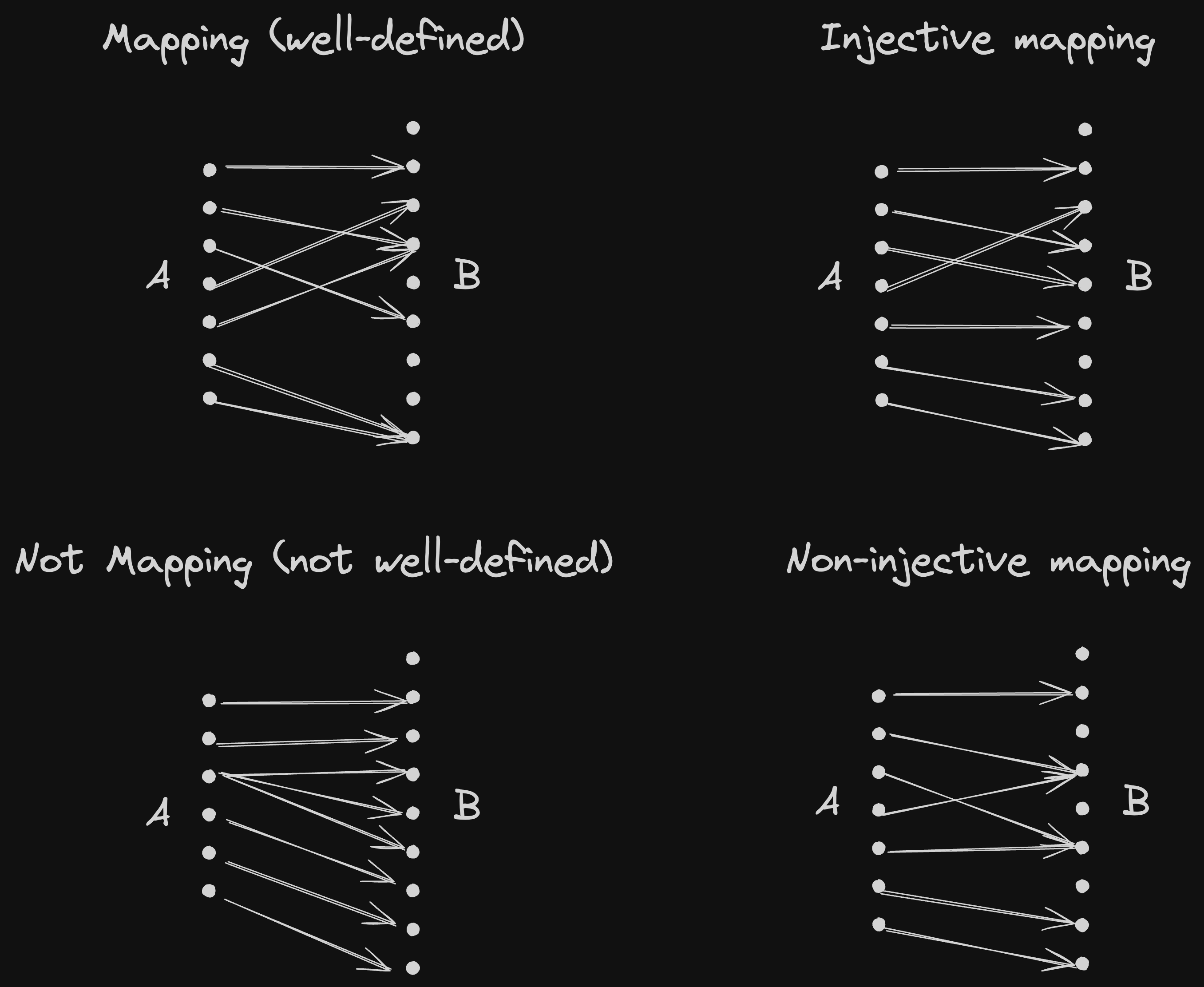
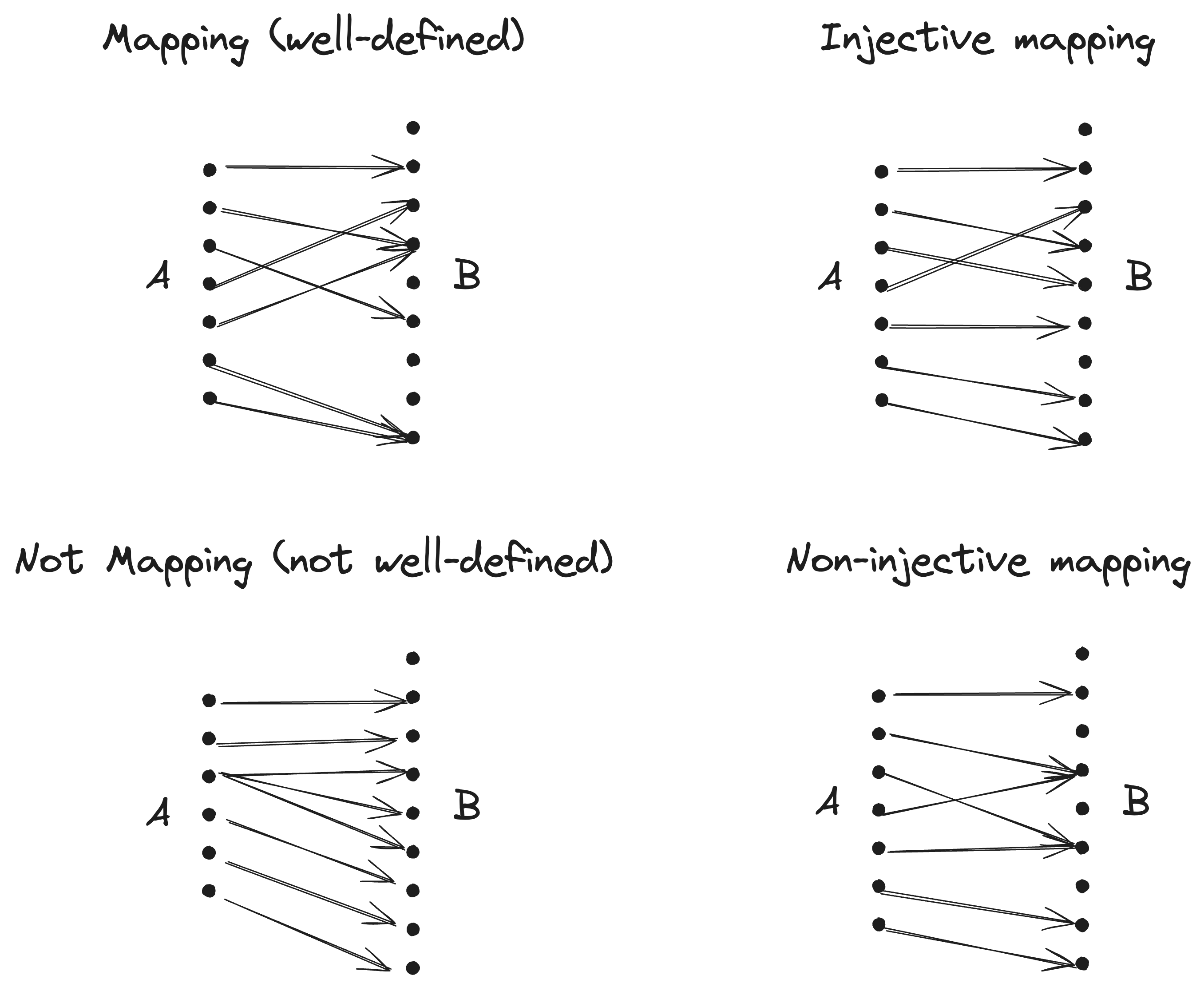
The notation f:A→B describes a mapping (or function) from set A to set B. A mapping establishes a correspondence between elements of set A and elements of set B. By definition, a mapping is well-defined, meaning that each element in A corresponds to exactly one element in B. However, the reverse is not necessarily true; it is possible for two elements in A to correspond to the same element in B.
-
f:a↦a2 specifies the precise mechanism of element correspondence in a mapping (note the different arrow used here compared to the one above). In this example, each element a∈A is mapped to the element a2∈A. Alternatively, this can be expressed using function notation as f(a)=a2.
-
Consider A′⊆A, we define image f(A′):={f(x),x∈A′}
-
Consider f:A→B and B′⊆B. Then we define pre-image ϕ−1(B′):={a∈A:ϕ(a)∈B′}.
-
If b∈B then ϕ−1(b):=ϕ−1({b})
def: Injective function
∢f:A→B∀a1,a2∈A:f(a1)=f(a2)⟹a1=a2f:A→1−1B,f−injective
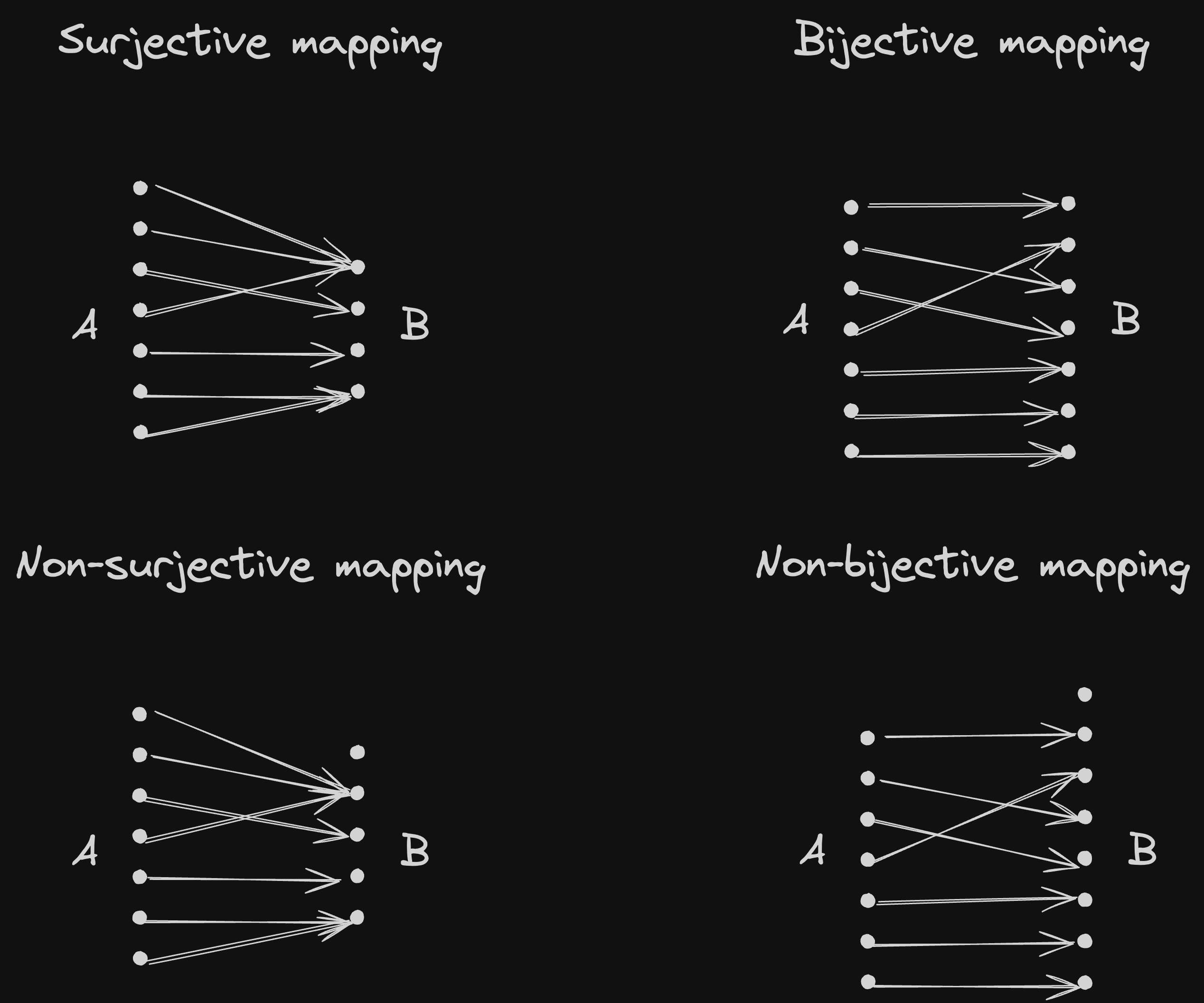
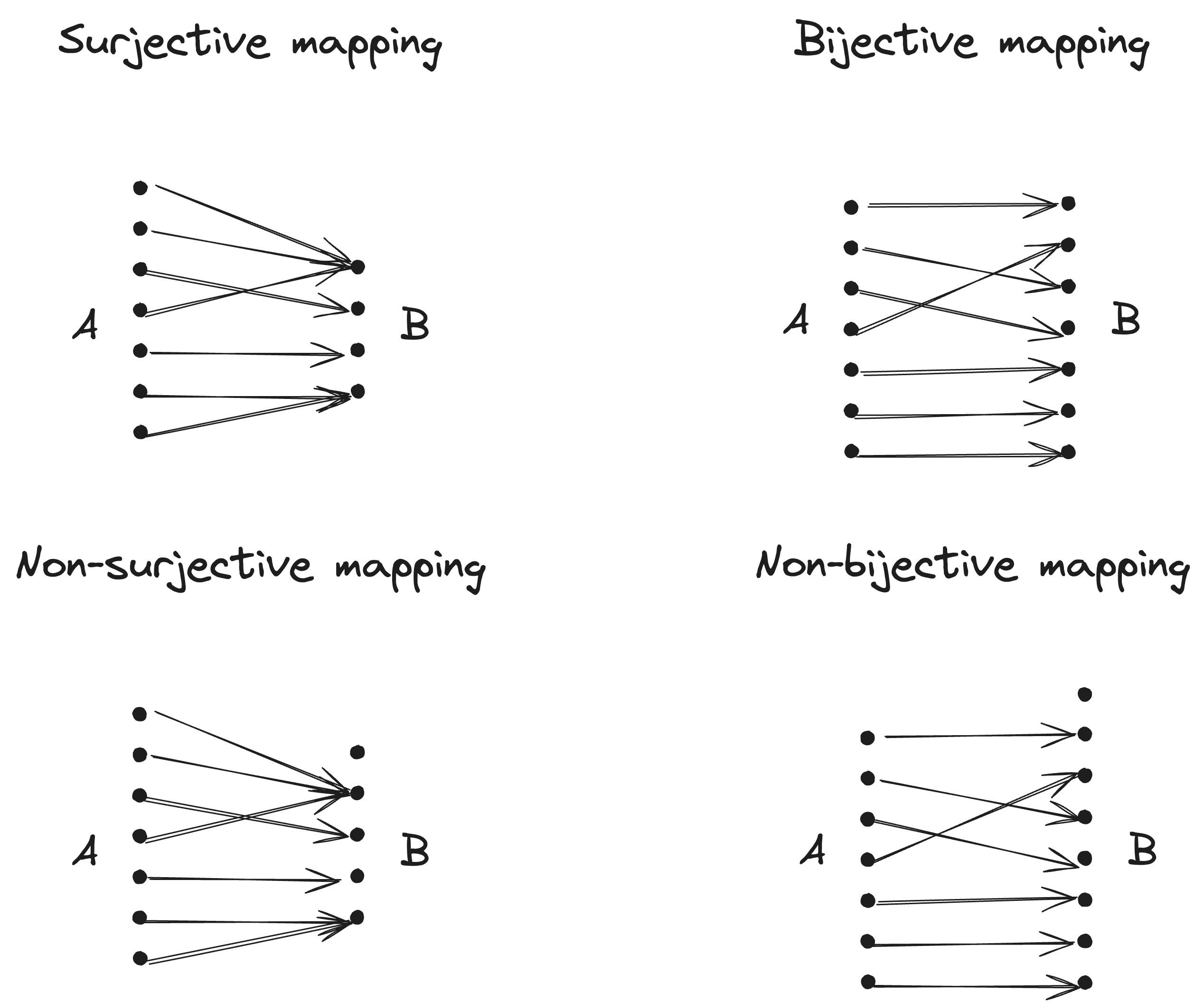
def: Surjective function
∢f:A→B∀b∈B:∃a∈A:f(a)=bf(A)=B,f−surjective
def: Bijective function
∢f:A→1−1B,f(A)=Bf:A↔B,f−bijective
Examples: Mappings
Numbers
Proposition 2.1.4: Principle of Well Ordering
∢X⊆NX=∅∃k∈X:∀n∈X:k≤n
In other words, every non-empty subset of natural numbers has a minimum element.
Propsition 2.1.5: Division algorithm
∢a,b∈Z,b=0∃!m,r∈Z,0≤r<b:a=bm+r
Proposition 2.1.6: Linear diophantine equation
∢a,b∈Z,a,b=0∃m,n∈Z:gcd(a,b)=am+bn
def: Prime number
∢p∈N,p>1a∈N,a∣p⟹(a=p)∨(a=1)∀p∈P,p−prime
Proposition 2.1.7
∢a,b∈Zp∈Pp∣ab⟹(p∣a)∨(p∣b)