2.8 Field extensions
def: Subfield
∢ E ∈ F L ⊆ ( G , + ) E L ∗ ⊆ ( G , ⋅ ) E ∗ L ⊆ F E \begin{align*}
&\sphericalangle \\
&E \in \mathcal F \\
&L \subseteq_{(G, +)} E \\
&L^* \subseteq_{(G, \cdot)} E^*
\\
\hline
\\
&L \subseteq_F E
\end{align*} ∢ E ∈ F L ⊆ ( G , + ) E L ∗ ⊆ ( G , ⋅ ) E ∗ L ⊆ F E def: Field homomorphism
∢ F , E ∈ F ϕ : F ⇝ R E ϕ ( 1 ) = 1 ϕ : F ⇝ F E \begin{align*}
&\sphericalangle \\
&F, E \in \mathcal F \\
&\phi: F \rightsquigarrow_R E \\
&\phi(1)=1 \\
\hline
\\
&\phi: F \rightsquigarrow_F E \\
\end{align*} ∢ F , E ∈ F ϕ : F ⇝ R E ϕ ( 1 ) = 1 ϕ : F ⇝ F E def: Field extension
∢ E ∈ F F ⊆ F E E / F ∈ F , E − extension of F , F − base field \begin{align*}
&\sphericalangle \\
&E \in \mathcal F \\
&F \subseteq_F E
\\
\hline
\\
& E/F \in \mathcal F,E - \text{extension of }F, F - \text{base field}
\end{align*} ∢ E ∈ F F ⊆ F E E / F ∈ F , E − extension of F , F − base field Do not confuse the notation E / F E/F E / F X / Y X/Y X / Y X X X Y Y Y
def: Extension degree
∢ E / F ∈ F ⟹ E ∈ M F [ E : F ] : = dim F E \begin{align*}
&\sphericalangle \\
&E / F \in \mathcal F \implies E \in \mathcal M_F \\
\hline
\\
&[E:F] := \dim_F E
\end{align*} ∢ E / F ∈ F ⟹ E ∈ M F [ E : F ] := dim F E Proposition 2.8.1: Evaluation homomorphism
∢ E / F ∈ F α ∈ E ε α : F [ x ] → E , f ↦ f ( α ) ε α : F [ x ] ⇝ F E \begin{align*}
&\sphericalangle \\
&E/F \in \mathcal F \\
&\alpha \in E \\
&\varepsilon_{\alpha}: F[x] \to E, f \mapsto f(\alpha)
\\
\hline
\\
&\varepsilon_{\alpha}: F[x] \rightsquigarrow_F E \hspace{1cm}
\end{align*} ∢ E / F ∈ F α ∈ E ε α : F [ x ] → E , f ↦ f ( α ) ε α : F [ x ] ⇝ F E Proof
∀ p , q ∈ F [ x ] : ε α ( p + q ) = ( p + q ) ( α ) = p ( α ) + q ( α ) = ε α ( p ) + ε α ( q ) ε α ( p q ) = ( p q ) ( α ) = p ( α ) q ( α ) = ε α ( p ) ε α ( q ) \forall p, q \in F[x]: \\
\varepsilon_\alpha(p+q) = (p+q)(\alpha)=p(\alpha)+q(\alpha)=\varepsilon_\alpha(p)+\varepsilon_\alpha(q) \\
\varepsilon_\alpha(pq)=(pq)(\alpha)=p(\alpha)q(\alpha)=\varepsilon_\alpha(p)\varepsilon_\alpha(q) ∀ p , q ∈ F [ x ] : ε α ( p + q ) = ( p + q ) ( α ) = p ( α ) + q ( α ) = ε α ( p ) + ε α ( q ) ε α ( pq ) = ( pq ) ( α ) = p ( α ) q ( α ) = ε α ( p ) ε α ( q ) □ \square □
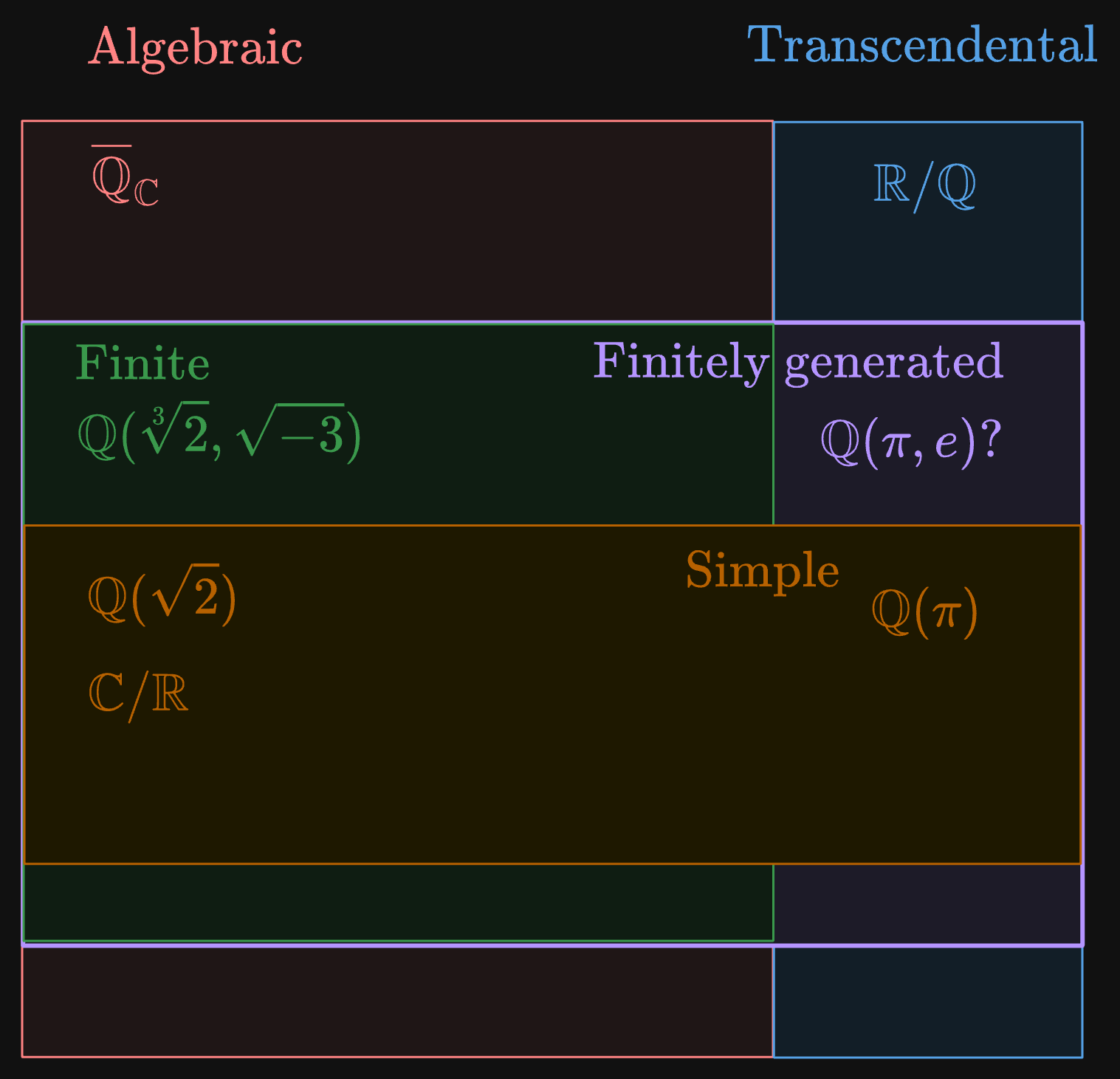
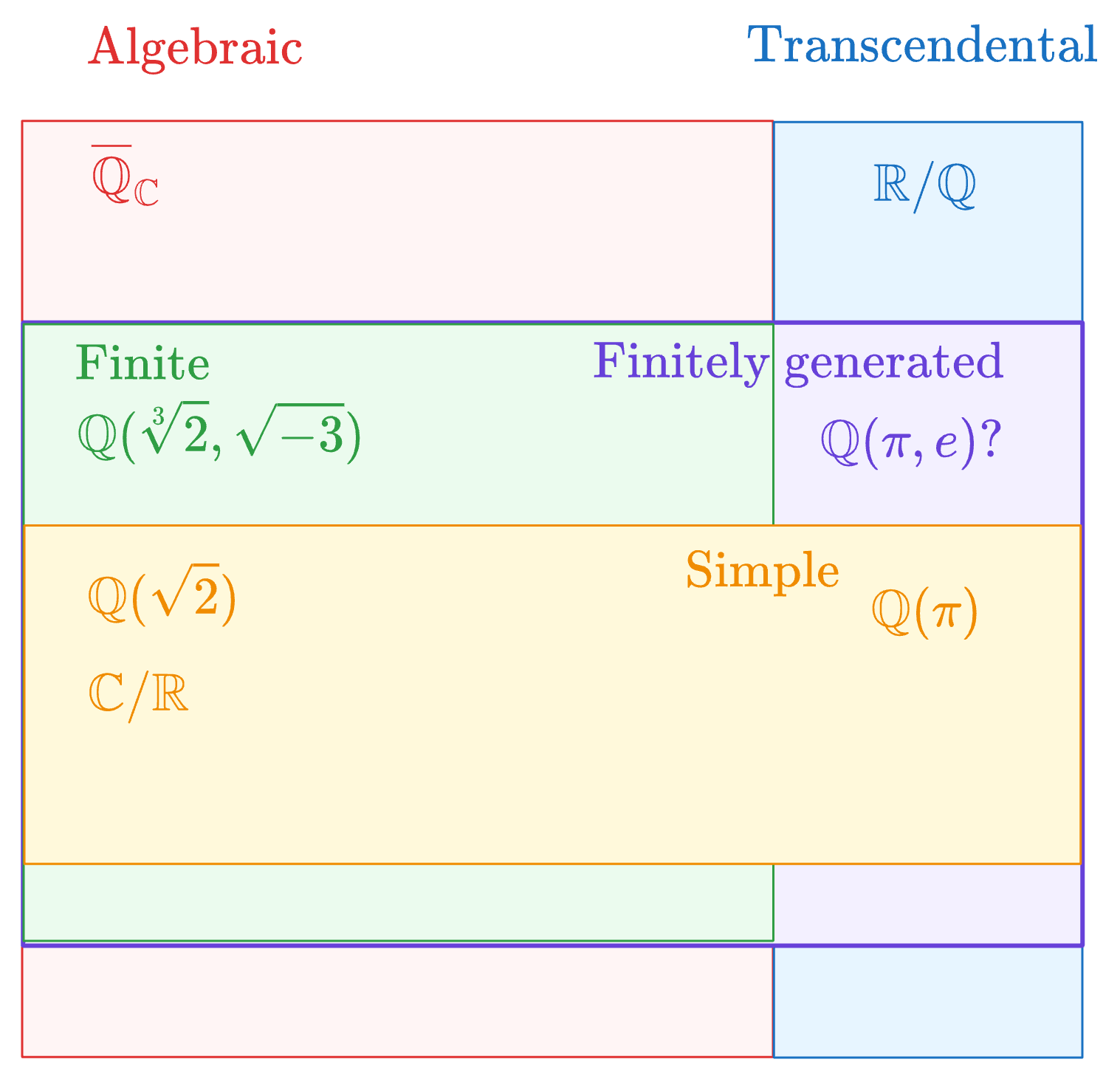
Extensions taxonomy
Finitely generated extensions
def: Finitely generated extension
∢ E / F ∈ F A ⊆ E , ∣ A ∣ < ∞ F ( A ) : F ⊆ F F ( A ) ⊆ F E , A ⊆ F ( A ) ∀ M : F ⊆ F M ⊆ F E , A ⊆ M ⟹ F ( A ) ⊆ M F ( A ) − finitely generated extension \begin{align*}
&\sphericalangle \\
& E/F \in \mathcal F \\
& A \subseteq E, |A| \lt \infty \\
& F(A): F \subseteq_F F(A) \subseteq_F E, A \subseteq F(A) \\
&\forall M: F \subseteq_F M \subseteq_F E, A \subseteq M \implies F(A) \subseteq M\\
\hline
\\
&F(A)- \text{finitely generated extension}
\end{align*} ∢ E / F ∈ F A ⊆ E , ∣ A ∣ < ∞ F ( A ) : F ⊆ F F ( A ) ⊆ F E , A ⊆ F ( A ) ∀ M : F ⊆ F M ⊆ F E , A ⊆ M ⟹ F ( A ) ⊆ M F ( A ) − finitely generated extension If A = { α 1 , … , α n } A=\{\alpha_1, \ldots, \alpha_n\} A = { α 1 , … , α n } F ( α 1 , … , α n ) F(\alpha_1, \ldots, \alpha_n) F ( α 1 , … , α n )
def: Simple extension
∢ E / F ∈ F α ∈ E F ( α ) − simple extension \begin{align*}
&\sphericalangle \\
& E/F \in \mathcal F \\
& \alpha \in E\\
\hline
\\
&F(\alpha)- \text{simple extension}
\end{align*} ∢ E / F ∈ F α ∈ E F ( α ) − simple extension Algebraic and transcendental elements
def: Algebraic closure, algebraic and transcendental elements
∢ E / F ∈ F F ‾ E : = { α ∈ E : ∃ p ( x ) ∈ F [ x ] ∖ F : p ( α ) = 0 } F ‾ E − algebraic closure of F in E α ∈ F ‾ E − algebraic element over F in the field E β ∈ E ∖ F ‾ E − transcendental element over F in the field E \begin{align*}
&\sphericalangle \\
&E/F \in \mathcal F \\
&\overline{F}_E:=\{\alpha \in E: \exists p(x) \in F[x] \setminus F: p(\alpha)=0\}
\\
\hline
\\
&\overline{F}_E - \text{algebraic closure of } F \text{ in } E \\
& \alpha \in \overline{F}_E - \text{algebraic element over } F \text{ in the field } E \\
&\beta \in E \setminus \overline{F}_E - \text{transcendental element over } F \text{ in the field } E \\
\end{align*} ∢ E / F ∈ F F E := { α ∈ E : ∃ p ( x ) ∈ F [ x ] ∖ F : p ( α ) = 0 } F E − algebraic closure of F in E α ∈ F E − algebraic element over F in the field E β ∈ E ∖ F E − transcendental element over F in the field E def: Minimal polynomial
∢ E / F ∈ F α ∈ F ‾ E p ∈ F [ x ] − , L C ( p ) = 1 , p ( α ) = 0 ∀ q ∈ F [ x ] , q ( α ) = 0 : p ∣ q p o l F ( α ) : = p − minimal polynomial for α over F \begin{align*}
&\sphericalangle \\
&E/F \in \mathcal F \\
& \alpha \in \overline{F}_E \\
&p \in F[x]^-, LC(p)=1, p(\alpha) = 0 \\
&\forall q \in F[x], q(\alpha) = 0: p \mid q
\\
\hline
\\
&\mathfrak{pol}_F(\alpha):= p - \text{minimal polynomial for } \alpha \text{ over }F\\
\end{align*} ∢ E / F ∈ F α ∈ F E p ∈ F [ x ] − , L C ( p ) = 1 , p ( α ) = 0 ∀ q ∈ F [ x ] , q ( α ) = 0 : p ∣ q pol F ( α ) := p − minimal polynomial for α over F Proposition 2.8.2: Minimal polynomial is unique
∢ E / F ∈ F α ∈ F ‾ E ∃ ! p o l F ( α ) p , q ∈ F [ x ] − , p ( α ) = q ( α ) = 0 ⟹ p ( x ) = u q ( x ) , u ∈ F ∗ \begin{align*}
&\sphericalangle \\
&E/F \in \mathcal F \\
& \alpha \in \overline{F}_E \\
\hline
\\
&\begin{align*}
&\exists! \mathfrak{pol}_F(\alpha) \hspace{0.5cm} \tag{a}\\
&p, q \in F[x]^-, p(\alpha)=q(\alpha)=0 \implies p(x)=uq(x), u \in F^* \hspace{0.5cm} \tag{b}\\
\end{align*}
&
\end{align*} ∢ E / F ∈ F α ∈ F E ∃ ! pol F ( α ) p , q ∈ F [ x ] − , p ( α ) = q ( α ) = 0 ⟹ p ( x ) = u q ( x ) , u ∈ F ∗ ( a ) ( b ) Proof
a.
ε α \varepsilon_\alpha ε α α \alpha α ker ϕ \ker \phi ker ϕ
( 2.5.13 ) ⟹ F [ x ] ∈ R P I D ⟹ ( 2.3.8 ) ∃ p ( x ) ∈ F [ x ] ∖ F : ker ε α = ⟨ p ( x ) ⟩ I (2.5.13) \implies F[x] \in \mathcal R^{\mathcal {PID}} \overset{(2.3.8)}\implies \\
\exists p(x) \in F[x] \setminus F: \ker \varepsilon_\alpha = \lang p(x) \rang_I ( 2.5.13 ) ⟹ F [ x ] ∈ R P I D ⟹ ( 2.3.8 ) ∃ p ( x ) ∈ F [ x ] ∖ F : ker ε α = ⟨ p ( x ) ⟩ I Thus q ∈ F [ x ] , q ( α ) = 0 ⟹ p ∣ q q \in F[x], q(\alpha) = 0 \implies p \mid q q ∈ F [ x ] , q ( α ) = 0 ⟹ p ∣ q a p ( x ) ap(x) a p ( x ) a ∈ F a \in F a ∈ F L C ( p ) = 1 LC(p)=1 L C ( p ) = 1
b.
p o l F ( α ) ∣ p , p o l F ( α ) ∣ q ⟹ p = u ⋅ p o l F ( α ) , q = v ⋅ p o l F ( α ) p , q , p o l F ( α ) ∈ F [ x ] − ⟹ u , v ∈ F ∗ ⟹ p = u v − 1 q = m q , m ∈ F ∗ \mathfrak{pol}_F(\alpha) \mid p, \mathfrak{pol}_F(\alpha) \mid q \implies p = u \cdot \mathfrak{pol}_F(\alpha), q = v \cdot \mathfrak{pol}_F(\alpha) \\
p, q, \mathfrak{pol}_F(\alpha) \in F[x]^- \implies u,v \in F^* \implies p=uv^{-1}q=mq, m \in F^* pol F ( α ) ∣ p , pol F ( α ) ∣ q ⟹ p = u ⋅ pol F ( α ) , q = v ⋅ pol F ( α ) p , q , pol F ( α ) ∈ F [ x ] − ⟹ u , v ∈ F ∗ ⟹ p = u v − 1 q = m q , m ∈ F ∗ □ \square □
def: Algebraic element degree
∢ E / F ∈ F α ∈ F ‾ E deg α : = deg p o l F ( α ) \begin{align*}
&\sphericalangle \\
&E/F \in \mathcal F \\
& \alpha \in \overline{F}_E \\
\hline
\\
&\deg \alpha := \deg \mathfrak{pol}_F(\alpha)
\end{align*} ∢ E / F ∈ F α ∈ F E deg α := deg pol F ( α ) Algebraic extensions
def: Algebraic extension
∢ E / F ∈ F E = F ‾ E E / A F , E − algebraic extension of F \begin{align*}
&\sphericalangle \\
&E/F \in \mathcal F \\
&E = \overline{F}_E \\
\hline
\\
&E/_AF, E - \text{algebraic extension of } F
\end{align*} ∢ E / F ∈ F E = F E E / A F , E − algebraic extension of F Proposition 2.8.3: Simple algebraic extension is a polynomials factor field
∢ E / F ∈ F α ∈ F ‾ E ∃ η : F [ x ] / ⟨ p o l F ( α ) ⟩ I ≅ F ( α ) ∀ a ∈ F : η ( a + ⟨ p o l F ( α ) ⟩ I ) = a η ( x + ⟨ p o l F ( α ) ⟩ I ) = α \begin{align*}
&\sphericalangle \\
&E/F \in \mathcal F \\
& \alpha \in \overline{F}_E \\
\hline
\\
&\begin{align*}
& \exists \eta: F[x] / \lang \mathfrak{pol}_F(\alpha) \rang_I \cong F(\alpha) \hspace{1cm} \tag{a}\\
& \forall a \in F: \eta(a+\lang \mathfrak{pol}_F(\alpha) \rang_I)=a \hspace{1cm} \tag{b}\\
& \eta(x + \lang \mathfrak{pol}_F(\alpha) \rang_I) = \alpha \tag{c}
\end{align*}
\end{align*} ∢ E / F ∈ F α ∈ F E ∃ η : F [ x ] / ⟨ pol F ( α ) ⟩ I ≅ F ( α ) ∀ a ∈ F : η ( a + ⟨ pol F ( α ) ⟩ I ) = a η ( x + ⟨ pol F ( α ) ⟩ I ) = α ( a ) ( b ) ( c ) Proof
a.
ε α \varepsilon_\alpha ε α ( 2.8.1 ) (2.8.1) ( 2.8.1 ) ker ε α = ⟨ p o l F ( α ) ⟩ I , ε α ( F [ x ] ) = F [ α ] \ker \varepsilon_{\alpha}=\lang \mathfrak{pol}_F(\alpha) \rang_I, \varepsilon_\alpha(F[x])=F[\alpha] ker ε α = ⟨ pol F ( α ) ⟩ I , ε α ( F [ x ]) = F [ α ]
( 2.3.9 ) ⟹ F [ α ] ≅ F [ x ] / ⟨ p o l F ( α ) ⟩ I ( 2.5.13 ) ⟹ F [ x ] ∈ R P I D F [ x ] ∈ R P I D , p o l F ( α ) ∈ F [ x ] − ⟹ ( 2.4.14 ) ⟨ p o l F ( α ) ⟩ I ∈ M I ( F [ x ] ) ⟹ ( 2.4.21 ) F [ x ] / ⟨ p o l F ( α ) ⟩ I ∈ F (2.3.9) \implies F[\alpha] \cong F[x] / \lang \mathfrak{pol}_F(\alpha)\rang_I \\
(2.5.13) \implies F[x] \in \mathcal R^{\mathcal{PID}}\\
F[x] \in \mathcal R^{\mathcal{PID}},
\mathfrak{pol}_F(\alpha) \in F[x]^- \overset{(2.4.14)}\implies \\\lang \mathfrak{pol}_F(\alpha)\rang_I \in \mathfrak M_I(F[x]) \overset{(2.4.21)}\implies F[x] / \lang \mathfrak{pol}_F(\alpha)\rang_I \in \mathcal F ( 2.3.9 ) ⟹ F [ α ] ≅ F [ x ] / ⟨ pol F ( α ) ⟩ I ( 2.5.13 ) ⟹ F [ x ] ∈ R P I D F [ x ] ∈ R P I D , pol F ( α ) ∈ F [ x ] − ⟹ ( 2.4.14 ) ⟨ pol F ( α ) ⟩ I ∈ M I ( F [ x ]) ⟹ ( 2.4.21 ) F [ x ] / ⟨ pol F ( α ) ⟩ I ∈ F So F [ α ] ≅ F [ x ] / ⟨ p o l F ( α ) ⟩ I ⟹ F [ α ] ∈ F F[\alpha] \cong F[x] / \lang \mathfrak{pol}_F(\alpha)\rang_I \implies F[\alpha] \in \mathcal F F [ α ] ≅ F [ x ] / ⟨ pol F ( α ) ⟩ I ⟹ F [ α ] ∈ F
F , α ∈ F [ α ] , F [ α ] ∈ F ⟹ F ( α ) ⊆ F [ α ] F, \alpha \in F[\alpha], F[\alpha] \in \mathcal F \implies F(\alpha) \subseteq F[\alpha] F , α ∈ F [ α ] , F [ α ] ∈ F ⟹ F ( α ) ⊆ F [ α ] But it's also obvious that every element of F [ α ] F[\alpha] F [ α ] F ( α ) F(\alpha) F ( α ) F ( α ) = F [ α ] ≅ F [ x ] / ⟨ p o l F ( α ) ⟩ I F(\alpha)=F[\alpha] \cong F[x] / \lang \mathfrak{pol}_F(\alpha)\rang_I F ( α ) = F [ α ] ≅ F [ x ] / ⟨ pol F ( α ) ⟩ I
b., c.
By construction of the isomorphism in the first isomorphism theorem we must have
∀ a ∈ F : η ( a + ⟨ p o l F ( α ) ⟩ I ) = ε α ( a ) = a η ( x + ⟨ p o l F ( α ) ⟩ I ) = ε α ( x ) = α \forall a \in F: \eta(a+\lang \mathfrak{pol}_F(\alpha) \rang_I)=\varepsilon_\alpha(a)=a \\
\eta(x+\lang \mathfrak{pol}_F(\alpha) \rang_I)=\varepsilon_\alpha(x)=\alpha ∀ a ∈ F : η ( a + ⟨ pol F ( α ) ⟩ I ) = ε α ( a ) = a η ( x + ⟨ pol F ( α ) ⟩ I ) = ε α ( x ) = α □ \square □
From the proposition it's also clear that no matter what root of the polynomial we take to build an extensions, all such extensions are isomorphic
Example: α = 2 \alpha=\sqrt 2 α = 2
Consider Q ( 2 ) \mathbb Q(\sqrt 2) Q ( 2 ) Q \mathbb Q Q p ( x ) : = x 2 − 2 p(x):=x^2-2 p ( x ) := x 2 − 2 p ( x ) = ( x − a ) ( x − b ) p(x)=(x-a)(x-b) p ( x ) = ( x − a ) ( x − b ) a , b ∈ Q : a b = 2 a, b \in \mathbb Q: ab=\sqrt 2 a , b ∈ Q : ab = 2 Q ( 2 ) ≅ Q [ x ] / ⟨ x 2 − 2 ⟩ I \mathbb Q(\sqrt 2)\cong \mathbb Q[x]/\lang x^2-2 \rang_I Q ( 2 ) ≅ Q [ x ] / ⟨ x 2 − 2 ⟩ I Q ( 2 ) = { a + b 2 , a , b ∈ Q } \mathbb Q(\sqrt 2)=\{a+b\sqrt 2, a, b \in \mathbb Q\} Q ( 2 ) = { a + b 2 , a , b ∈ Q } Q [ x ] / ⟨ x 2 − 2 ⟩ I = { a + b x , a , b , ∈ Q } \mathbb Q[x]/\lang x^2-2 \rang_I = \{a+bx, a, b, \in \mathbb Q\} Q [ x ] / ⟨ x 2 − 2 ⟩ I = { a + b x , a , b , ∈ Q } a ∈ Q ↦ a a\in \mathbb Q \mapsto a a ∈ Q ↦ a 2 ↦ x \sqrt 2 \mapsto x 2 ↦ x ( 2.8.3 ) (2.8.3) ( 2.8.3 )
It may come as a surprise that a field F ( α ) F(\alpha) F ( α ) 1 α \frac{1}{\alpha} α 1 Q ( 2 ) \mathbb Q(\sqrt{2}) Q ( 2 ) Q \mathbb Q Q α = 2 \alpha = \sqrt{2} α = 2 1 2 \frac{1}{\sqrt{2}} 2 1 2 2 \frac{\sqrt{2}}{2} 2 2 α \alpha α
Finite extensions
def: Finite extension
∢ E / F ∈ F [ E : F ] < ∞ E − finite extension of F \begin{align*}
&\sphericalangle \\
&E/F \in \mathcal F \\
&[E: F] < \infty \\
\hline
\\
&E - \text{finite extension of } F \\
\end{align*} ∢ E / F ∈ F [ E : F ] < ∞ E − finite extension of F Proposition 2.8.4: Simple algebraic extension is finite
∢ E / F ∈ F α ∈ F ‾ E [ F ( α ) : F ] = deg α n : = deg α , { 1 , α , … , α n − 1 } ∈ B F ( F ( α ) ) \begin{align*}
&\sphericalangle \\
&E/F \in \mathcal F \\
& \alpha \in \overline{F}_E \\
\hline
\\
&\begin{align*}
&[F(\alpha):F] = \deg \alpha \tag{a}\\
&n:=\deg \alpha, \{1, \alpha, \ldots, \alpha^{n-1} \} \in \mathfrak B_F(F(\alpha)) \hspace{1cm} \tag{b}\\
\end{align*}
\end{align*} ∢ E / F ∈ F α ∈ F E [ F ( α ) : F ] = deg α n := deg α , { 1 , α , … , α n − 1 } ∈ B F ( F ( α )) ( a ) ( b ) Proof
From ( 2.8.3 ) (2.8.3) ( 2.8.3 ) F ( α ) ≅ F [ x ] / ⟨ p o l F ( α ) ⟩ I F(\alpha) \cong F[x]/\lang \mathfrak{pol}_F(\alpha) \rang_I F ( α ) ≅ F [ x ] / ⟨ pol F ( α ) ⟩ I p o l F ( α ) = x n + a n − 1 x n − 1 + … + a 0 \mathfrak{pol}_F(\alpha) = x^n+a_{n-1}x^{n-1} + \ldots+a_0 pol F ( α ) = x n + a n − 1 x n − 1 + … + a 0 b x n + ⟨ p o l F ( α ) ⟩ I = b x n − b ( x n + a n − 1 x n − 1 + … + a 0 ) + ⟨ p o l F ( α ) ⟩ I = b a n − 1 x n − 1 + … + b a 0 + ⟨ p o l F ( α ) ⟩ I bx^n + \lang \mathfrak{pol}_F(\alpha) \rang_I=bx^n - b(x^n+a_{n-1}x^{n-1} + \ldots+a_0) + \lang \mathfrak{pol}_F(\alpha) \rang_I=ba_{n-1}x^{n-1} + \ldots+ba_0 + \lang \mathfrak{pol}_F(\alpha) \rang_I b x n + ⟨ pol F ( α ) ⟩ I = b x n − b ( x n + a n − 1 x n − 1 + … + a 0 ) + ⟨ pol F ( α ) ⟩ I = b a n − 1 x n − 1 + … + b a 0 + ⟨ pol F ( α ) ⟩ I ≥ n \ge n ≥ n ≤ n − 1 \leq n-1 ≤ n − 1 ⟨ 1 + ⟨ p o l F ( α ) ⟩ I , x + ⟨ p o l F ( α ) ⟩ I , … , x n − 1 + ⟨ p o l F ( α ) ⟩ I ⟩ M = F [ x ] / ⟨ p o l F ( α ) ⟩ I \lang 1 + \lang \mathfrak{pol}_F(\alpha) \rang_I, x+\lang \mathfrak{pol}_F(\alpha) \rang_I, \ldots, x^{n-1} + \lang \mathfrak{pol}_F(\alpha) \rang_I \rang_M=F[x]/\lang \mathfrak{pol}_F(\alpha) \rang_I ⟨ 1 + ⟨ pol F ( α ) ⟩ I , x + ⟨ pol F ( α ) ⟩ I , … , x n − 1 + ⟨ pol F ( α ) ⟩ I ⟩ M = F [ x ] / ⟨ pol F ( α ) ⟩ I ( 2.8.3 ) (2.8.3) ( 2.8.3 )
⟨ 1 , α , … , α n − 1 ⟩ I = F ( α ) \lang 1, \alpha, \ldots, \alpha^{n-1} \rang_I = F(\alpha) ⟨ 1 , α , … , α n − 1 ⟩ I = F ( α ) Because n = deg α = deg p o l F ( α ) n=\deg \alpha = \deg \mathfrak {pol}_F(\alpha) n = deg α = deg pol F ( α ) α \alpha α n n n a n − 1 α n − 1 + … + a 0 ⟹ a n − 1 = … = a 0 a_{n-1}\alpha^{n-1} + \ldots+a_0 \implies a_{n-1} = \ldots = a_0 a n − 1 α n − 1 + … + a 0 ⟹ a n − 1 = … = a 0
Thus we proved { 1 , α , … , α n − 1 } ∈ B F ( F ( α ) ) \{1, \alpha, \ldots, \alpha^{n-1} \} \in \mathfrak B_F(F(\alpha)) { 1 , α , … , α n − 1 } ∈ B F ( F ( α ))
□ \square □
Proposition 2.8.5: Finite extension is algebraic
∢ E / F ∈ F [ E : F ] < ∞ E / A F \begin{align*}
&\sphericalangle \\
&E/F \in \mathcal F \\
&[E:F] \lt \infty \\
\hline
\\
&E /_A F
\end{align*} ∢ E / F ∈ F [ E : F ] < ∞ E / A F Proof
n : = [ E : F ] ∀ α ∈ E ⟹ { 1 , α , … , α n } − linearly dependent in M F ⟹ ∃ a 1 , … , a n ∈ F , ∃ a i ≠ 0 : a 0 + a 1 α + … + a n α n = 0 ⟹ ∃ p ∈ F [ x ] ∖ F : p ( α ) = 0 n:=[E:F] \\
\forall \alpha \in E \implies \{1, \alpha, \ldots , \alpha^n\} - \text{linearly dependent in } \mathcal M_F \implies\\
\exist a_1, \ldots, a_n \in F, \exists a_i \ne 0: a_0+a_1 \alpha + \ldots + a_n \alpha^n=0 \implies \\
\exists p \in F[x] \setminus F: p(\alpha) = 0
n := [ E : F ] ∀ α ∈ E ⟹ { 1 , α , … , α n } − linearly dependent in M F ⟹ ∃ a 1 , … , a n ∈ F , ∃ a i = 0 : a 0 + a 1 α + … + a n α n = 0 ⟹ ∃ p ∈ F [ x ] ∖ F : p ( α ) = 0 □ \square □
Proposition 2.8.6: Finite extension chain: dimension and basis
∢ E / F / K ∈ F [ E : F ] < ∞ , [ F : K ] < ∞ B K ( E ) = B F ( E ) B K ( F ) [ E : K ] = [ E : F ] [ F : K ] \begin{align*}
&\sphericalangle \\
&E/F/K \in \mathcal F \\
&[E:F] \lt \infty, [F:K] \lt \infty \\
\hline
\\
&\begin{align*}
&\mathfrak B_K(E)=\mathfrak B_F(E)\mathfrak B_K(F) \tag{a}\\
&[E:K]=[E:F][F:K] \hspace{1cm} \tag{b}\\
\end{align*}
\end{align*} ∢ E / F / K ∈ F [ E : F ] < ∞ , [ F : K ] < ∞ B K ( E ) = B F ( E ) B K ( F ) [ E : K ] = [ E : F ] [ F : K ] ( a ) ( b ) Proof
a.
B K ( F ) = { x 1 , … , x n } , B F ( E ) = { y 1 , … , y m } \mathfrak B_K(F)=\{x_1, \ldots, x_n\}, \mathfrak B_F(E)=\{y_1, \ldots, y_m\} \\ B K ( F ) = { x 1 , … , x n } , B F ( E ) = { y 1 , … , y m } u ∈ E ⟹ u = ∑ i b i y i , b i ∈ F b i ∈ F ⟹ b i = ∑ j c i j x j ⟹ u = ∑ i ( ∑ j c i j x j ) y i = ∑ i , j c i j ( x j y i ) ⟹ ⟨ B K ( F ) B F ( E ) ⟩ M = E u \in E \implies u = \sum_i b_iy_i, b_i \in F \\
b_i \in F \implies b_i = \sum_jc_{ij}x_j \implies \\
u = \sum_i(\sum_jc_{ij}x_j)y_i =\sum_{i,j}c_{ij}(x_jy_i) \implies \\
\lang \mathfrak B_K(F)\mathfrak B_F(E) \rang_M =E u ∈ E ⟹ u = i ∑ b i y i , b i ∈ F b i ∈ F ⟹ b i = j ∑ c ij x j ⟹ u = i ∑ ( j ∑ c ij x j ) y i = i , j ∑ c ij ( x j y i ) ⟹ ⟨ B K ( F ) B F ( E ) ⟩ M = E ∑ i , j c i j x i y j = ∑ j ( ∑ i c i j x i ) y j ⟹ ∀ j : ∑ i c i j x i = 0 ⟹ ∀ i , j : c i j = 0 ⟹ B K ( E ) = B K ( F ) B F ( E ) \sum_{i, j}c_{ij}x_iy_j = \sum_{j}(\sum_{i}c_{ij}x_i)y_j \implies \\
\forall j: \sum_{i}c_{ij}x_i=0 \implies \forall i,j: c_{ij}=0 \implies \\
\mathfrak B_K(E)=\mathfrak B_K(F)\mathfrak B_F(E) i , j ∑ c ij x i y j = j ∑ ( i ∑ c ij x i ) y j ⟹ ∀ j : i ∑ c ij x i = 0 ⟹ ∀ i , j : c ij = 0 ⟹ B K ( E ) = B K ( F ) B F ( E ) b.
Follows from ( a ) (a) ( a )
□ \square □
Proposition 2.8.7: Finite extension is finitely generated algebraic extension
∢ E ∈ F F ⊆ F E [ E : F ] < ∞ ⟺ ∃ α 1 , … , α n ∈ F ‾ E : E = F ( α 1 , … , α n ) \begin{align*}
&\sphericalangle \\
&E \in \mathcal F \\
&F \subseteq_F E\\
\hline
\\
&[E:F]<\infty \iff \exists \alpha_1, \ldots, \alpha_n \in \overline{F}_E: E = F(\alpha_1, \ldots, \alpha_n)\\
\end{align*} ∢ E ∈ F F ⊆ F E [ E : F ] < ∞ ⟺ ∃ α 1 , … , α n ∈ F E : E = F ( α 1 , … , α n ) Proof
⟹ \implies ⟹
B F ( E ) = { α 1 , … , α n } B F ( E ) ⊆ E ⟹ E / F ( α 1 , … , α n ) ⟨ B F ( E ) ⟩ M = E ⟹ E = F ( α 1 , … , α n ) ( 2.8.5 ) ⟹ α i ∈ F ‾ E \mathfrak B_F(E)=\{\alpha_1, \ldots, \alpha_n\} \\
\mathfrak B_F(E) \subseteq E \implies E/F(\alpha_1, \ldots, \alpha_n)\\
\lang \mathfrak B_F(E) \rang_M=E \implies E = F(\alpha_1, \ldots, \alpha_n) \\
(2.8.5) \implies \alpha_i \in \overline{F}_E B F ( E ) = { α 1 , … , α n } B F ( E ) ⊆ E ⟹ E / F ( α 1 , … , α n ) ⟨ B F ( E ) ⟩ M = E ⟹ E = F ( α 1 , … , α n ) ( 2.8.5 ) ⟹ α i ∈ F E ⟸ \impliedby ⟸
Since F ( α 1 , … , α i − 1 ) ( α i ) = F ( α 1 , … , α i ) F(\alpha_1, \ldots, \alpha_{i-1})(\alpha_i) = F(\alpha_1, \ldots, \alpha_i) F ( α 1 , … , α i − 1 ) ( α i ) = F ( α 1 , … , α i ) F ( α 1 , … , α i ) / A F ( α 1 , … , α i − 1 ) F(\alpha_1, \ldots, \alpha_i) /_A F(\alpha_1, \ldots, \alpha_{i-1}) F ( α 1 , … , α i ) / A F ( α 1 , … , α i − 1 ) ( 2.8.4 ) (2.8.4) ( 2.8.4 ) [ F ( α 1 , … , α i ) : F ( α 1 , … , α i − 1 ) ] < ∞ [F(\alpha_1, \ldots, \alpha_i): F(\alpha_1, \ldots, \alpha_{i-1})]< \infty [ F ( α 1 , … , α i ) : F ( α 1 , … , α i − 1 )] < ∞
( 2.8.6. b ) ⟹ [ E : F ] = = [ F ( α 1 , … , α n ) : F ( α 1 , … , α n − 1 ) ] ⋅ … ⋅ [ F ( α 1 ) : F ] < ∞ (2.8.6.b) \implies [E : F]= \\
=[F(\alpha_1, \ldots, \alpha_n) : F(\alpha_1, \ldots, \alpha_{n-1})] \cdot \ldots \cdot [F(\alpha_1) : F] \lt \infty ( 2.8.6. b ) ⟹ [ E : F ] = = [ F ( α 1 , … , α n ) : F ( α 1 , … , α n − 1 )] ⋅ … ⋅ [ F ( α 1 ) : F ] < ∞ □ \square □
Splitting fields
def: Polynomials split in the field
∢ F ∈ F P ⊆ F [ x ] ∀ p ( x ) ∈ P : p ( x ) = u ( x − α 1 ) … ( x − α n ) , u , α i ∈ F , n ≥ 0 P ∥ F , P splits in F \begin{align*}
&\sphericalangle \\
&F \in \mathcal F \\
&P \subseteq F[x] \\
&\forall p(x) \in P: p(x)= u(x-\alpha_1)\ldots(x-\alpha_n), u, \alpha_i \in F, n \ge 0\\
\hline
\\
&P \parallel F, P \text{ splits in } F
\end{align*} ∢ F ∈ F P ⊆ F [ x ] ∀ p ( x ) ∈ P : p ( x ) = u ( x − α 1 ) … ( x − α n ) , u , α i ∈ F , n ≥ 0 P ∥ F , P splits in F Similarly, for p ∈ F [ x ] p \in F[x] p ∈ F [ x ] p ∥ F p \parallel F p ∥ F { p } ∥ F \{p\} \parallel F { p } ∥ F
def: Splitting field
∢ E / F ∈ F P ⊆ F [ x ] ∖ F R : = { α ∈ E : ∃ p ∈ P : p ( α ) = 0 } E = F ( R ) P ∥ E F ( ∥ P ) : = E − splitting field for P over F \begin{align*}
&\sphericalangle \\
&E/F \in \mathcal F \\
&P \subseteq F[x] \setminus F \\
&R:= \{\alpha \in E: \exists p \in P: p(\alpha) = 0\}\\
&E=F(R) \\
&P \parallel E \\
\hline
\\
&F(\parallel P):=E - \text{splitting field for }P \text{ over } F
\end{align*} ∢ E / F ∈ F P ⊆ F [ x ] ∖ F R := { α ∈ E : ∃ p ∈ P : p ( α ) = 0 } E = F ( R ) P ∥ E F ( ∥ P ) := E − splitting field for P over F Obviously F ( ∥ P ) / A F F(\parallel P) /_A F F ( ∥ P ) / A F
The notation assumes that the splitting field exists and unique. We will prove that the splitting field is indeed exists and unique up to isomorphism later in this section.
Proposition 2.8.8: Splitting field exists
∢ F ∈ F p ( x ) ∈ F [ x ] ∖ F P ⊆ F [ x ] ∖ F ∃ E / F , ∃ α ∈ E : p ( α ) = 0 , [ E : F ] ≤ deg p , E = F ( α ) ∃ E / F : p ∥ E , [ E : F ] ≤ deg p ! , E = F ( ∥ p ) ∃ F ( ∥ P ) \begin{align*}
&\sphericalangle \\
&F \in \mathcal F \\
&p(x) \in F[x] \setminus F \\
&P \subseteq F[x] \setminus F \\
\hline
\\
&\begin{align*}
&\exists E/F, \exists \alpha \in E: p(\alpha) = 0, [E:F] \leq \deg p, E = F(\alpha) \hspace{0.5cm} \tag{a}\\
&\exists E/F: p \parallel E, [E: F] \le \deg p!, E= F(\parallel p)\tag b \\
&\exists F(\parallel P) \tag c \\
\end{align*}
\end{align*} ∢ F ∈ F p ( x ) ∈ F [ x ] ∖ F P ⊆ F [ x ] ∖ F ∃ E / F , ∃ α ∈ E : p ( α ) = 0 , [ E : F ] ≤ deg p , E = F ( α ) ∃ E / F : p ∥ E , [ E : F ] ≤ deg p ! , E = F ( ∥ p ) ∃ F ( ∥ P ) ( a ) ( b ) ( c ) Proof
a.
By ( 2.5.13 ) (2.5.13) ( 2.5.13 ) F [ x ] ∈ R U F D F[x] \in \mathcal R^{\mathcal {UFD}} F [ x ] ∈ R U F D p ( x ) = p 1 ( x ) … p n ( x ) , p i ∈ F − [ x ] p(x) = p_1(x)\ldots p_n(x), p_i \in F^{-}[x] p ( x ) = p 1 ( x ) … p n ( x ) , p i ∈ F − [ x ] p 1 ( x ) p_1(x) p 1 ( x )
E : = F [ x ] / ⟨ p 1 ( x ) ⟩ I
E:=F[x] / \lang p_1(x) \rang_I
E := F [ x ] / ⟨ p 1 ( x ) ⟩ I By ( 2.4.14 ) (2.4.14) ( 2.4.14 ) ⟨ p 1 ( x ) ⟩ I ∈ M I ( F [ x ] ) \lang p_1(x) \rang_I \in \mathfrak M_I(F[x]) ⟨ p 1 ( x ) ⟩ I ∈ M I ( F [ x ]) ( 2.4.21 ) (2.4.21) ( 2.4.21 ) E ∈ F E \in \mathcal F E ∈ F
Consider a natural homomorphism ϕ : F → E , a ↦ a + ⟨ p 1 ( x ) ⟩ I \phi: F \to E, a \mapsto a + \lang p_1(x) \rang_I ϕ : F → E , a ↦ a + ⟨ p 1 ( x ) ⟩ I ker ϕ = { 0 } \ker \phi = \{0\} ker ϕ = { 0 } F ≅ ϕ ( F ) ⊆ E F \cong \phi(F) \subseteq E F ≅ ϕ ( F ) ⊆ E E / F E / F E / F
Next define
α : = x + ⟨ p 1 ( x ) ⟩ I \alpha: = x + \lang p_1(x) \rang_I α := x + ⟨ p 1 ( x ) ⟩ I We have p 1 ( α ) = p 1 ( x + ⟨ p ( x ) ⟩ I ) = p 1 ( x ) + ⟨ p ( x ) ⟩ I = 0 + ⟨ p 1 ( x ) ⟩ I p_1(\alpha)=p_1(x+\lang p(x) \rang_I)=p_1(x)+\lang p(x) \rang_I = 0 + \lang p_1(x) \rang_I p 1 ( α ) = p 1 ( x + ⟨ p ( x ) ⟩ I ) = p 1 ( x ) + ⟨ p ( x ) ⟩ I = 0 + ⟨ p 1 ( x ) ⟩ I 0 + ⟨ p 1 ( x ) ⟩ I 0 + \lang p_1(x) \rang_I 0 + ⟨ p 1 ( x ) ⟩ I 0 0 0 E E E p 1 ( α ) = 0 ⟹ p ( α ) = 0 p_1(\alpha)=0 \implies p(\alpha) = 0 p 1 ( α ) = 0 ⟹ p ( α ) = 0 α ∈ F ‾ E \alpha \in \overline F_E α ∈ F E ( 2.8.3 ) (2.8.3) ( 2.8.3 ) E = F ( α ) E = F(\alpha) E = F ( α )
By ( 2.8.2 ) (2.8.2) ( 2.8.2 ) p 1 ( x ) = u ⋅ p o l F ( α ) , u ∈ F ∗ p_1(x)=u\cdot \mathfrak{pol}_F(\alpha), u \in F^* p 1 ( x ) = u ⋅ pol F ( α ) , u ∈ F ∗ ( 2.8.4 ) (2.8.4) ( 2.8.4 ) [ E : F ] = deg α = deg p 1 ( x ) ≤ deg p [E:F]=\deg \alpha = \deg p_1(x) \leq \deg p [ E : F ] = deg α = deg p 1 ( x ) ≤ deg p
b.
By induction on deg p \deg p deg p deg p = 1 \deg p=1 deg p = 1 E : = F E:=F E := F [ E : F ] = 1 = 1 ! [E:F]=1=1! [ E : F ] = 1 = 1 ! p ∥ E p \parallel E p ∥ E
If deg p = n \deg p = n deg p = n ( a ) (a) ( a ) E / F , [ E : F ] ≤ n E/F, [E:F] \leq n E / F , [ E : F ] ≤ n ∃ α ∈ E : p ( α ) = 0 \exists \alpha \in E: p(\alpha) = 0 ∃ α ∈ E : p ( α ) = 0 p ( x ) = ( x − α ) g ( x ) p(x) = (x-\alpha)g(x) p ( x ) = ( x − α ) g ( x ) L / E : [ L : E ] ≤ ( n − 1 ) ! , g ∥ L L/E: [L:E] \le (n-1)!, g \parallel L L / E : [ L : E ] ≤ ( n − 1 )! , g ∥ L p ∥ L p \parallel L p ∥ L [ L : F ] = [ L : E ] [ E : F ] ≤ n ! [L:F]=[L:E][E:F] \le n! [ L : F ] = [ L : E ] [ E : F ] ≤ n !
Finally by construction on each induction step we built an extension F ( α 1 , … , α i ) F(\alpha_1, \ldots, \alpha_i) F ( α 1 , … , α i ) E = F ( ∥ p ) E= F(\parallel p) E = F ( ∥ p )
c.
This part we'll only prove with for ∣ P ∣ < ∞ |P|<\infty ∣ P ∣ < ∞ P P P
In ( b ) (b) ( b ) p ( x ) ∈ F [ x ] ⟹ ∃ F ( ∥ p ) p(x) \in F[x] \implies \exists F(\parallel p) p ( x ) ∈ F [ x ] ⟹ ∃ F ( ∥ p ) P = { p 1 , … , p n } P = \{p_1, \ldots, p_n\} P = { p 1 , … , p n } F ( ∥ P ) = F ( ∥ p 1 ⋅ … ⋅ p n ) F(\parallel P)=F(\parallel p_1\cdot \ldots \cdot p_n) F ( ∥ P ) = F ( ∥ p 1 ⋅ … ⋅ p n )
□ \square □
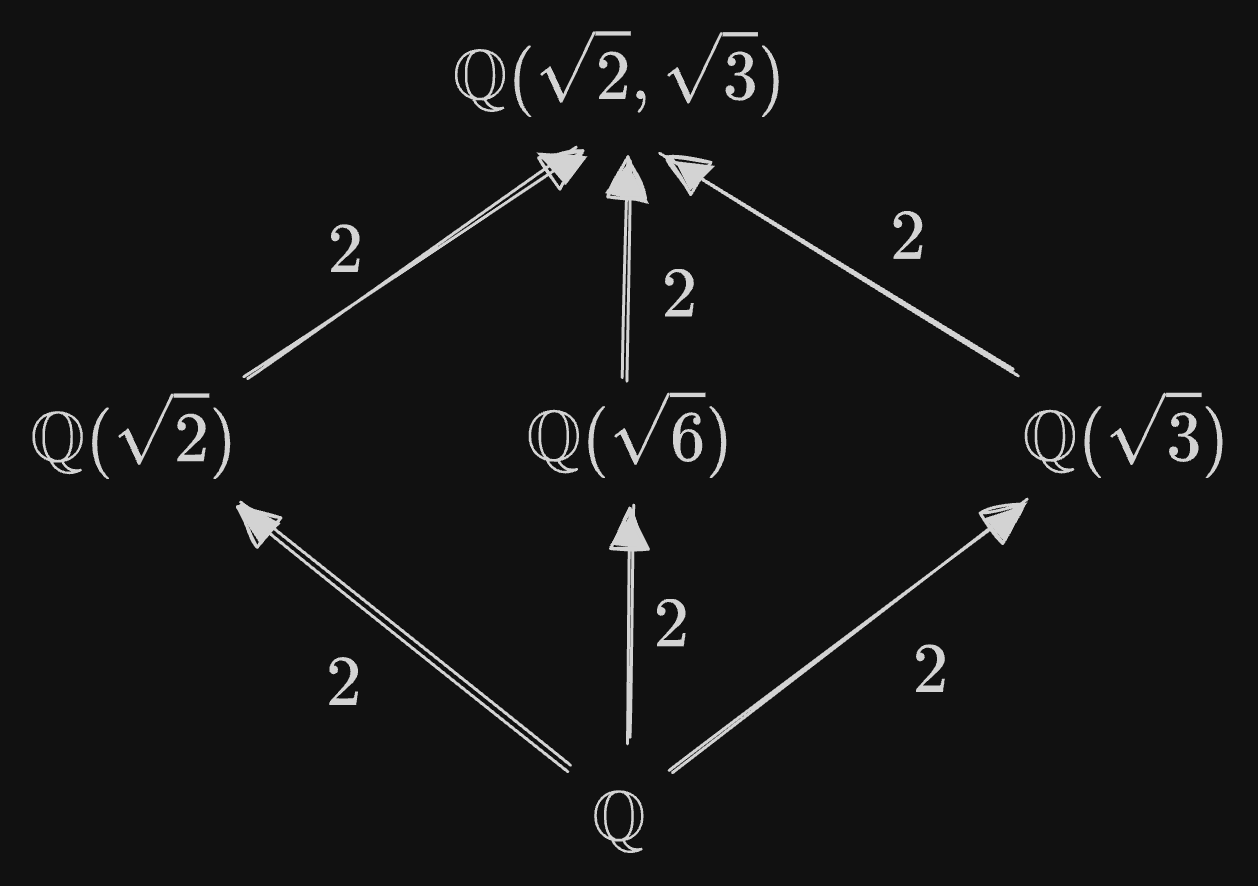
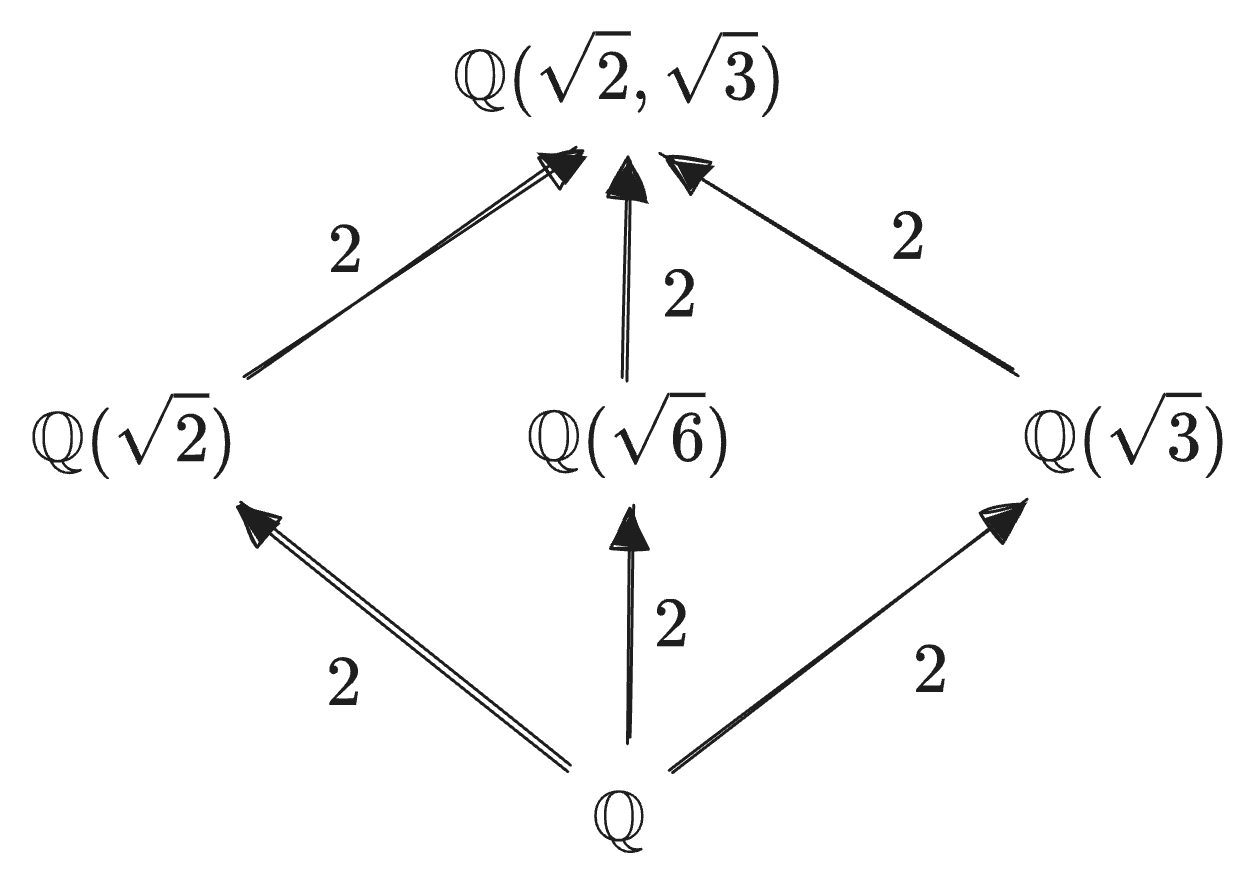
Example: Splitting field of ( x 2 − 2 ) ( x 2 − 3 ) (x^2-2)(x^2-3) ( x 2 − 2 ) ( x 2 − 3 )
Q ( ∥ ( x 2 − 2 ) ( x 2 − 3 ) ) = Q ( 2 , 3 ) \mathbb Q(\parallel (x^2-2)(x^2-3)) = \mathbb Q(\sqrt 2, \sqrt 3) Q ( ∥ ( x 2 − 2 ) ( x 2 − 3 )) = Q ( 2 , 3 )
[ Q ( 2 , 3 ) : Q ] = [ Q ( 2 , 3 ) : Q ( 2 ) ] [ Q ( 2 ) : Q ] = 2 ⋅ 2 = 4 [\mathbb Q(\sqrt 2, \sqrt 3):\mathbb Q]=[\mathbb Q(\sqrt 2, \sqrt 3):\mathbb Q(\sqrt 2)][\mathbb Q(\sqrt 2):\mathbb Q]=\\
2\cdot 2 = 4 [ Q ( 2 , 3 ) : Q ] = [ Q ( 2 , 3 ) : Q ( 2 )] [ Q ( 2 ) : Q ] = 2 ⋅ 2 = 4
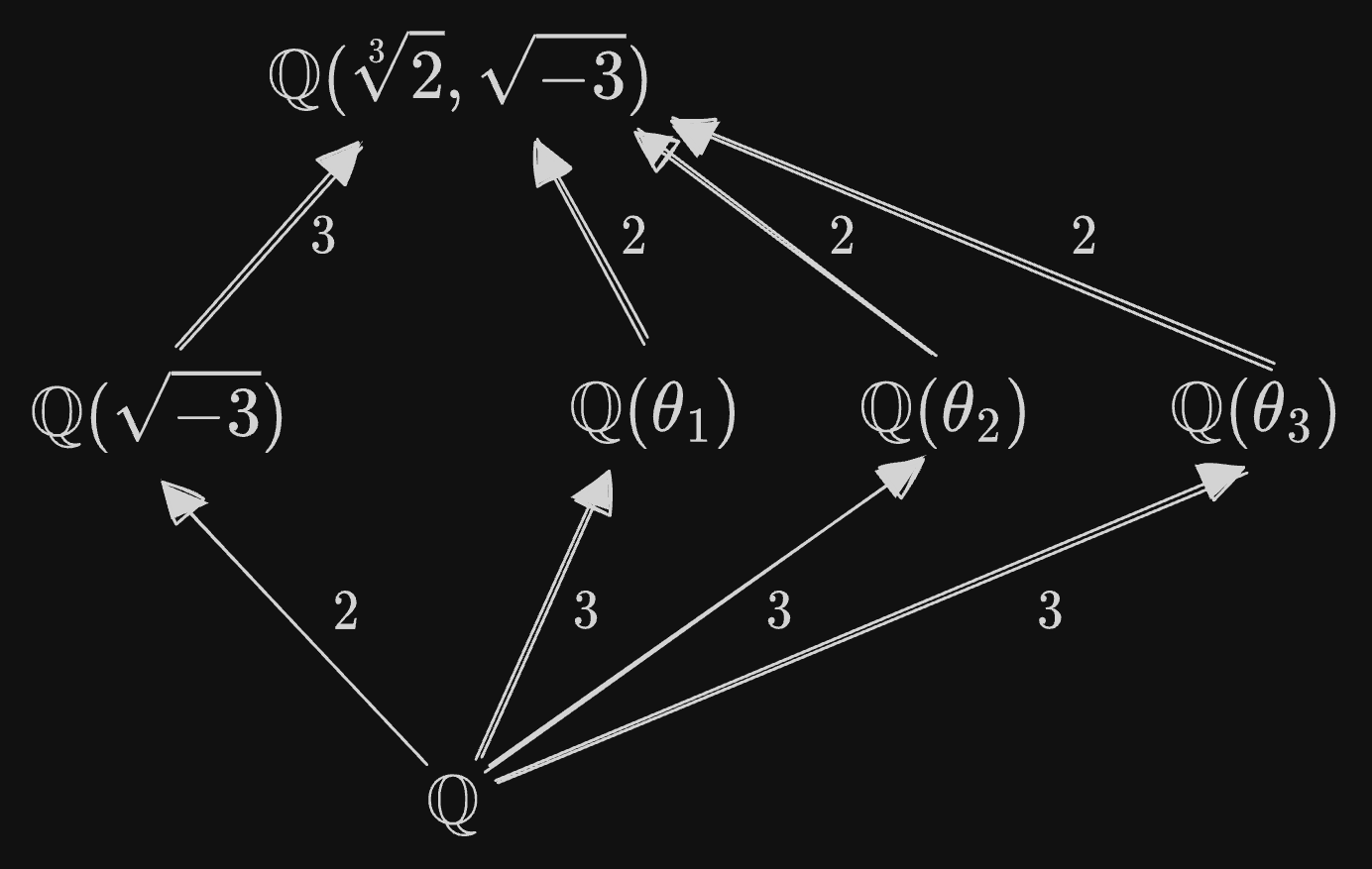
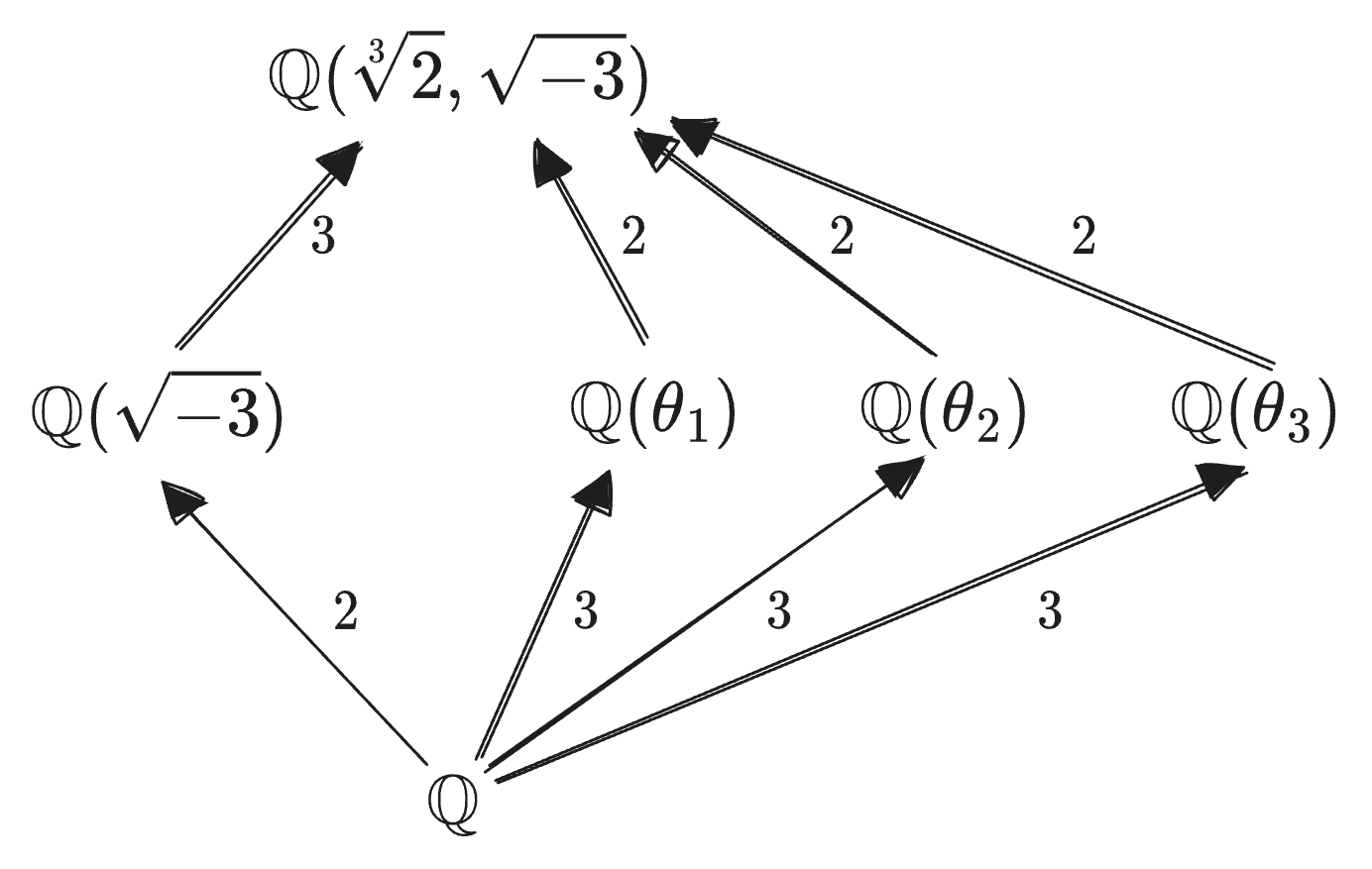
Example: Splitting field of x 3 − 2 x^3-2 x 3 − 2
The roots of x 3 − 2 x^3-2 x 3 − 2
θ 1 = 2 3 , θ 2 = 2 3 ⋅ i 3 − 1 2 , θ 3 = 2 3 ⋅ − i 3 − 1 2 \theta_1 = \sqrt[3]{2}, \theta_2 = \sqrt[3]{2}\cdot\frac{i\sqrt{3}-1}{2}, \theta_3 = \sqrt[3]{2}\cdot\frac{-i\sqrt{3}-1}{2} θ 1 = 3 2 , θ 2 = 3 2 ⋅ 2 i 3 − 1 , θ 3 = 3 2 ⋅ 2 − i 3 − 1 Q ( ∥ x 3 − 2 ) = Q ( θ 1 , θ 2 , θ 3 ) = Q ( 2 3 , − 3 ) \mathbb Q(\parallel x^3-2)=\mathbb Q(\theta_1, \theta_2, \theta_3)=\mathbb Q(\sqrt[3]2, \sqrt{-3}) Q ( ∥ x 3 − 2 ) = Q ( θ 1 , θ 2 , θ 3 ) = Q ( 3 2 , − 3 )
[ Q ( 2 3 , − 3 ) : Q ] = 6 [\mathbb Q(\sqrt[3]2, \sqrt{-3}):\mathbb Q]=6 [ Q ( 3 2 , − 3 ) : Q ] = 6 [ Q ( θ 1 , θ 2 , θ 3 ) : Q ] = [ Q ( θ 1 ) : Q ] ⏟ 3 [ Q ( θ 1 , θ 2 ) : Q ( θ 1 ) ] ⏟ 2 [ Q ( θ 1 , θ 2 , θ 3 ) : Q ( θ 1 , θ 2 ) ] ⏟ 1 [\mathbb Q(\theta_1, \theta_2, \theta_3):\mathbb Q]=\underbrace{[\mathbb Q(\theta_1) : \mathbb Q]}_3\underbrace{[\mathbb Q(\theta_1, \theta_2):\mathbb Q(\theta_1)]}_2\underbrace{[\mathbb Q(\theta_1, \theta_2, \theta_3):\mathbb Q(\theta_1, \theta_2)]}_1 [ Q ( θ 1 , θ 2 , θ 3 ) : Q ] = 3 [ Q ( θ 1 ) : Q ] 2 [ Q ( θ 1 , θ 2 ) : Q ( θ 1 )] 1 [ Q ( θ 1 , θ 2 , θ 3 ) : Q ( θ 1 , θ 2 )]
Proposition 2.8.9: Isomorphism of field extensions
∢ E 1 / A F 1 , E 2 / A F 2 ∈ F σ : F 1 ≅ F 2 α ∈ E 1 : p ( x ) : = p o l F ( α ) β ∈ E 2 : p σ ( β ) = 0 ∃ ϕ : F 1 ( α ) ≅ F 2 ( β ) , ϕ ( α ) = β , ∀ x ∈ F 1 : ϕ ( x ) = σ ( x ) \begin{align*}
&\sphericalangle \\
&E_1/_AF_1, E_2/_AF_2 \in \mathcal F \\
&\sigma: F_1 \cong F_2 \\
&\alpha \in E_1: p(x):=\mathfrak{pol}_F(\alpha)\\
&\beta \in E_2: p^{\sigma}(\beta) = 0
\\
\hline
\\
&\exists \phi:F_1(\alpha) \cong F_2(\beta), \phi(\alpha) = \beta, \forall x \in F_1:\phi(x)= \sigma(x)
\end{align*} ∢ E 1 / A F 1 , E 2 / A F 2 ∈ F σ : F 1 ≅ F 2 α ∈ E 1 : p ( x ) := pol F ( α ) β ∈ E 2 : p σ ( β ) = 0 ∃ ϕ : F 1 ( α ) ≅ F 2 ( β ) , ϕ ( α ) = β , ∀ x ∈ F 1 : ϕ ( x ) = σ ( x ) Proof
First, L C ( p ( x ) ) = 1 ⟹ L C ( p σ ( x ) ) = σ ( L C ( p ( x ) ) ) = σ ( 1 ) = 1 LC(p(x))=1 \implies LC(p^{\sigma}(x))=\sigma(LC(p(x))) = \sigma(1)=1 L C ( p ( x )) = 1 ⟹ L C ( p σ ( x )) = σ ( L C ( p ( x ))) = σ ( 1 ) = 1 p σ ( x ) ∈ F 2 [ x ] − p^{\sigma}(x) \in F_2[x]^- p σ ( x ) ∈ F 2 [ x ] − p σ ( x ) = p o l F ( β ) p^{\sigma}(x)=\mathfrak{pol}_F(\beta) p σ ( x ) = pol F ( β )
( 2.5.1 ) ⟹ σ x : F 1 [ x ] ≅ F 2 [ x ] , p ( x ) ↦ p σ ( x ) (2.5.1) \implies \sigma_x: F_1[x]\cong F_2[x], p(x) \mapsto p^{\sigma}(x) \\ ( 2.5.1 ) ⟹ σ x : F 1 [ x ] ≅ F 2 [ x ] , p ( x ) ↦ p σ ( x ) Additionally it's obvious that if rings R 1 R_1 R 1 R 2 R_2 R 2 I 1 I_1 I 1 I 2 I_2 I 2 R 1 / I 1 ≅ R 2 / I 2 R_1/I_1 \cong R_2/I_2 R 1 / I 1 ≅ R 2 / I 2
So we have
σ ( ⟨ p ( x ) ⟩ I ) = ⟨ p σ ( x ) ⟩ I ( 2.4.14 ) ⟹ ⟨ p ( x ) ⟩ I ∈ M I ( F 1 [ x ] ) , ⟨ p σ ( x ) ⟩ I ∈ M I ( F 2 [ x ] ) F 1 [ x ] / ⟨ p ( x ) ⟩ I ≅ σ x F 2 [ x ] / ⟨ p σ ( x ) ⟩ I ⟹ ( 2.8.3 ) F 1 ( α ) ≅ η F 1 [ x ] / ⟨ p ( x ) ⟩ I ≅ σ x F 2 [ x ] / ⟨ p σ ( x ) ⟩ I ≅ τ F 2 ( β ) \sigma(\lang p(x) \rang_I) = \lang p^{\sigma}(x) \rang_I\\
(2.4.14) \implies \lang p(x) \rang_I \in \mathfrak M_I(F_1[x]),\lang p^{\sigma}(x) \rang_I \in \mathfrak M_I(F_2[x]) \\
F_1[x]/\lang p(x) \rang_I \overset{\sigma_x}\cong F_2[x]/\lang p^{\sigma}(x) \rang_I \overset{(2.8.3)}\implies \\
F_1(\alpha) \overset{\eta}\cong F_1[x]/\lang p(x) \rang_I \overset{\sigma_x}\cong F_2[x]/\lang p^{\sigma}(x) \rang_I \overset{\tau}\cong F_2(\beta) σ (⟨ p ( x ) ⟩ I ) = ⟨ p σ ( x ) ⟩ I ( 2.4.14 ) ⟹ ⟨ p ( x ) ⟩ I ∈ M I ( F 1 [ x ]) , ⟨ p σ ( x ) ⟩ I ∈ M I ( F 2 [ x ]) F 1 [ x ] / ⟨ p ( x ) ⟩ I ≅ σ x F 2 [ x ] / ⟨ p σ ( x ) ⟩ I ⟹ ( 2.8.3 ) F 1 ( α ) ≅ η F 1 [ x ] / ⟨ p ( x ) ⟩ I ≅ σ x F 2 [ x ] / ⟨ p σ ( x ) ⟩ I ≅ τ F 2 ( β ) So we define ϕ : = τ σ x η \phi:=\tau\sigma_x\eta ϕ := τ σ x η
Consider some a ∈ F 1 a \in F_1 a ∈ F 1 ϕ \phi ϕ ( 2.8.3 ) (2.8.3) ( 2.8.3 )
a ↦ η a + ⟨ p ( x ) ⟩ I ↦ σ x σ ( a ) + ⟨ p σ ( x ) ⟩ I ↦ τ σ ( a ) α ↦ η x + ⟨ p ( x ) ⟩ I ↦ σ x x + ⟨ p σ ( x ) ⟩ I ↦ τ β a \overset{\eta}\mapsto a+\lang p(x) \rang_I \overset{\sigma_x}\mapsto \sigma(a)+\lang p^{\sigma}(x) \rang_I \overset{\tau}\mapsto \sigma(a) \\
\alpha \overset{\eta}\mapsto x+\lang p(x) \rang_I \overset{\sigma_x}\mapsto x+\lang p^{\sigma}(x) \rang_I \overset{\tau}\mapsto \beta \\
a ↦ η a + ⟨ p ( x ) ⟩ I ↦ σ x σ ( a ) + ⟨ p σ ( x ) ⟩ I ↦ τ σ ( a ) α ↦ η x + ⟨ p ( x ) ⟩ I ↦ σ x x + ⟨ p σ ( x ) ⟩ I ↦ τ β So ∀ a ∈ F 1 : ϕ ( x ) = σ ( x ) \forall a \in F_1: \phi(x)=\sigma(x) ∀ a ∈ F 1 : ϕ ( x ) = σ ( x ) ϕ ( α ) = β \phi(\alpha) = \beta ϕ ( α ) = β
□ \square □
Propostion 2.8.10: Isomorphism extension theorem for one polynomial
∢ F 1 , F 2 ∈ F σ : F 1 ≅ F 2 p ( x ) ∈ F 1 [ x ] ∃ ϕ : F 1 ( ∥ p ( x ) ) ≅ F 2 ( ∥ p σ ( x ) ) , ∀ x ∈ F 1 : ϕ ( x ) = σ ( x ) \begin{align*}
&\sphericalangle \\
&F_1, F_2 \in \mathcal F \\
&\sigma: F_1\cong F_2 \\
&p(x) \in F_1[x] \\
\hline
\\
&\exists \phi: F_1 (\parallel p(x)) \cong F_2 (\parallel p^{\sigma}(x)), \forall x \in F_1: \phi(x)=\sigma(x)
\end{align*} ∢ F 1 , F 2 ∈ F σ : F 1 ≅ F 2 p ( x ) ∈ F 1 [ x ] ∃ ϕ : F 1 ( ∥ p ( x )) ≅ F 2 ( ∥ p σ ( x )) , ∀ x ∈ F 1 : ϕ ( x ) = σ ( x ) Proof
We'll make a proof by the induction on n : = deg p ( x ) n:=\deg p(x) n := deg p ( x )
If n = 1 n=1 n = 1 F 1 ( ∥ p ) = F 1 , F 2 ( ∥ p σ ) = F 2 F_1( \parallel p)=F_1, F_2( \parallel p^{\sigma}) = F_2 F 1 ( ∥ p ) = F 1 , F 2 ( ∥ p σ ) = F 2
Now assume the proposition holds for any k < n k<n k < n p ∥ F 1 p \parallel F_1 p ∥ F 1 n = 1 n=1 n = 1 1 1 1 q ( x ) q(x) q ( x ) q σ ( x ) q^{\sigma}(x) q σ ( x ) p σ ( x ) p^{\sigma}(x) p σ ( x ) ( 2.8.10 ) (2.8.10) ( 2.8.10 ) α ∈ E 1 \alpha \in E_1 α ∈ E 1 β ∈ E 2 \beta \in E_2 β ∈ E 2 ∃ η : F 1 ( α ) ≅ F 2 ( β ) , p ( x ) = ( x − α ) p 1 ( x ) , p σ ( x ) = ( x − β ) p 2 ( x ) \exists \eta: F_1(\alpha) \cong F_2(\beta), p(x)=(x-\alpha)p_1(x), p^{\sigma}(x)=(x-\beta)p_2(x) ∃ η : F 1 ( α ) ≅ F 2 ( β ) , p ( x ) = ( x − α ) p 1 ( x ) , p σ ( x ) = ( x − β ) p 2 ( x )
E 1 → ϕ E 2 ↑ ↑ F 1 ( α ) → η F 2 ( β ) ↑ ↑ F 1 → σ F 2
\begin{CD}
E_1 @>\phi>> E_2 \\
@AAA @AAA \\
F_1(\alpha) @>\eta>> F_2(\beta) \\
@AAA @AAA \\
F_1 @>\sigma>> F_2
\end{CD}
E 1 ⏐ ↑ F 1 ( α ) ⏐ ↑ F 1 ϕ η σ E 2 ⏐ ↑ F 2 ( β ) ⏐ ↑ F 2 Now if we consider E 1 : = F 1 ( α ) ( ∥ p 1 ) , E 2 : = F 2 ( β ) ( ∥ p 2 ) E_1:=F_1(\alpha)(\parallel p_1), E_2:=F_2(\beta)(\parallel p_2) E 1 := F 1 ( α ) ( ∥ p 1 ) , E 2 := F 2 ( β ) ( ∥ p 2 ) ∃ ϕ : E 1 ≅ E 2 : ∀ x ∈ F 1 ( α ) : ϕ ( x ) = η ( x ) \exists \phi: E_1\cong E_2: \forall x \in F_1(\alpha): \phi(x)=\eta(x) ∃ ϕ : E 1 ≅ E 2 : ∀ x ∈ F 1 ( α ) : ϕ ( x ) = η ( x ) ∀ x ∈ F 1 : η ( x ) = σ ( x ) \forall x \in F_1: \eta(x)=\sigma(x) ∀ x ∈ F 1 : η ( x ) = σ ( x )
□ \square □
Theorem 2.8.11: Isomorphism extension theorem
∢ F 1 , F 2 ∈ F σ : F 1 ≅ F 2 P ⊆ F 1 [ x ] ∖ F P σ : = { p σ , p ∈ P } ∃ ϕ : F 1 ( ∥ P ) ≅ F 2 ( ∥ P σ ) , ∀ x ∈ F 1 : ϕ ( x ) = σ ( x ) \begin{align*}
&\sphericalangle \\
&F_1, F_2 \in \mathcal F \\
&\sigma: F_1\cong F_2 \\
&P \subseteq F_1[x] \setminus F \\
&P^{\sigma}:= \{p^{\sigma}, p \in P\}\\
\hline
\\
&\exists \phi: F_1 (\parallel P) \cong F_2 (\parallel P^{\sigma}), \forall x \in F_1: \phi(x)=\sigma(x)
\end{align*} ∢ F 1 , F 2 ∈ F σ : F 1 ≅ F 2 P ⊆ F 1 [ x ] ∖ F P σ := { p σ , p ∈ P } ∃ ϕ : F 1 ( ∥ P ) ≅ F 2 ( ∥ P σ ) , ∀ x ∈ F 1 : ϕ ( x ) = σ ( x ) Proof
The proof uses the fact that if ∣ P ∣ < ∞ |P|<\infty ∣ P ∣ < ∞ F ( ∥ { p 1 , … , p n } ) = F ( ∥ p 1 ⋅ … ⋅ p n ) F(\parallel \{p_1, \ldots, p_n\})=F(\parallel p_1 \cdot \ldots \cdot p_n) F ( ∥ { p 1 , … , p n }) = F ( ∥ p 1 ⋅ … ⋅ p n ) ∣ P ∣ = ∞ |P|=\infty ∣ P ∣ = ∞
□ \square □
Corrolary 2.8.12: Splitting field is unique up to isomorphism
∢ F ∈ F P ⊆ F [ x ] ∖ F ∃ ! F ( ∥ P ) \begin{align*}
&\sphericalangle \\
&F \in \mathcal F \\
&P \subseteq F[x] \setminus F \\
\hline
\\
&\exists! F (\parallel P)
\end{align*} ∢ F ∈ F P ⊆ F [ x ] ∖ F ∃ ! F ( ∥ P ) Proof
Follows directly from ( 2.8.11 ) (2.8.11) ( 2.8.11 ) F 1 = F 2 = F F_1=F_2=F F 1 = F 2 = F
□ \square □
Lemma 2.8.13: Splitting fields under isomopshism
∢ E 1 / F 1 , E 2 / F 2 ∈ F σ : F 1 ≅ F 2 τ : E 1 ⇝ F E 2 , τ ∣ F 1 = σ P ⊆ F 1 [ x ] : E 1 = F 1 ( ∥ P ) P σ : = { p σ , p ∈ P } τ ( E 1 ) = F 2 ( ∥ P σ ) \begin{align*}
&\sphericalangle \\
&E_1/F_1, E_2/F_2 \in \mathcal F \\
&\sigma: F_1 \cong F_2 \\
&\tau: E_1 \rightsquigarrow_F E_2, \tau|_{F_1} = \sigma \\
&P \subseteq F_1[x]: E_1 = F_1(\parallel P) \\
&P^{\sigma} := \{p^{\sigma}, p \in P\}
\\
\hline
\\
&\tau(E_1)=F_2(\parallel P^{\sigma})
\end{align*} ∢ E 1 / F 1 , E 2 / F 2 ∈ F σ : F 1 ≅ F 2 τ : E 1 ⇝ F E 2 , τ ∣ F 1 = σ P ⊆ F 1 [ x ] : E 1 = F 1 ( ∥ P ) P σ := { p σ , p ∈ P } τ ( E 1 ) = F 2 ( ∥ P σ ) Proof
Consider some p i ∈ P p_i \in P p i ∈ P E 1 E_1 E 1 p i ( x ) = u ∏ j ( x − α j ) , u ∈ F 1 ∗ , α j ∈ E 1 p_i(x)=u\prod_j(x-\alpha_j), u \in F_1^*, \alpha_j \in E_1 p i ( x ) = u ∏ j ( x − α j ) , u ∈ F 1 ∗ , α j ∈ E 1 ( 2.5.1 ) (2.5.1) ( 2.5.1 ) p i σ = σ x ( p i ) = τ x ( p i ) = σ ( u ) ∏ j ( x − τ ( α j ) ) p_i^{\sigma}=\sigma_x(p_i)=\tau_x(p_i)=\sigma(u)\prod_j(x-\tau(\alpha_j)) p i σ = σ x ( p i ) = τ x ( p i ) = σ ( u ) ∏ j ( x − τ ( α j )) p i σ ∥ τ ( E 1 ) p_i^{\sigma} \parallel \tau(E_1) p i σ ∥ τ ( E 1 ) τ ( α 1 ) , … , τ ( α n ) \tau(\alpha_1), \ldots, \tau(\alpha_n) τ ( α 1 ) , … , τ ( α n )
Now take all roots of P P P α 1 , … , α k \alpha_1, \ldots, \alpha_k α 1 , … , α k τ ( E 1 ) = τ ( F 1 ( α 1 , … , α k ) ) = τ ( F 1 ) ( τ ( α 1 ) , … , τ ( α k ) ) = σ ( F 1 ) ( τ ( α 1 ) , … , τ ( α k ) ) = F 2 ( τ ( α 1 ) , … , τ ( α k ) ) \tau(E_1)=\tau (F_1(\alpha_1, \ldots, \alpha_k))=\tau(F_1)(\tau(\alpha_1),\ldots, \tau(\alpha_k))=\sigma(F_1)(\tau(\alpha_1),\ldots, \tau(\alpha_k)) = F_2(\tau(\alpha_1),\ldots, \tau(\alpha_k)) τ ( E 1 ) = τ ( F 1 ( α 1 , … , α k )) = τ ( F 1 ) ( τ ( α 1 ) , … , τ ( α k )) = σ ( F 1 ) ( τ ( α 1 ) , … , τ ( α k )) = F 2 ( τ ( α 1 ) , … , τ ( α k ))
So we have τ ( E 1 ) / F 2 \tau(E_1)/F_2 τ ( E 1 ) / F 2 P σ ∥ τ ( E 1 ) , τ ( E 1 ) P^{\sigma} \parallel \tau(E_1), \tau(E_1) P σ ∥ τ ( E 1 ) , τ ( E 1 ) P σ P^{\sigma} P σ τ ( E 1 ) = F 2 ( ∥ P σ ) \tau(E_1)=F_2(\parallel P^{\sigma}) τ ( E 1 ) = F 2 ( ∥ P σ )
□ \square □
Algebraic Closures
Proposition 2.8.14: Algebraic closure is a field
∢ E / F ∈ F E / F ‾ E / F \begin{align*}
&\sphericalangle \\
&E / F \in \mathcal F
\\
\hline
\\
&E/\overline{F}_E/F
\end{align*} ∢ E / F ∈ F E / F E / F Proof
By definition of F ‾ E \overline{F}_E F E F ⊆ F ‾ E ⊆ E F \subseteq \overline{F}_E \subseteq E F ⊆ F E ⊆ E F ‾ E ∈ F \overline{F}_E \in \mathcal F F E ∈ F
Consider some a , b ∈ F ‾ E a, b \in \overline{F}_E a , b ∈ F E ( 2.8.7 ) (2.8.7) ( 2.8.7 ) [ F ( a , b ) : F ] < ∞ [F(a, b): F] < \infty [ F ( a , b ) : F ] < ∞ ( 2.8.5 ) (2.8.5) ( 2.8.5 ) F ( a , b ) / A F F(a, b)/_AF F ( a , b ) / A F
F ( a , b ) ⊆ E ⟹ F ( a , b ) = F ‾ F ( a , b ) ⊆ F ‾ E ⟹ a ± b , a b , a b − 1 ∈ F ( a , b ) ⊆ F ‾ E
F(a, b) \subseteq E \implies F(a, b) =\overline F_{F(a, b)} \subseteq \overline F_E \implies \\
a\pm b, ab, ab^{-1} \in F(a, b) \subseteq \overline{F}_E F ( a , b ) ⊆ E ⟹ F ( a , b ) = F F ( a , b ) ⊆ F E ⟹ a ± b , ab , a b − 1 ∈ F ( a , b ) ⊆ F E □ \square □
Proposition 2.8.15: Algebraically closed field properties
∢ F ∈ F The following are equivalent: E / A F ⟹ E = F E / F , [ E : F ] < ∞ ⟹ E = F E / F ⟹ F ‾ E = F p ∈ F [ x ] ∖ F ⟹ F ( ∥ p ) = F p ∈ F [ x ] ∖ F ⟹ ∃ α ∈ F : p ( α ) = 0 p ∈ F [ x ] − ⟹ deg p ( x ) = 1 \begin{align*}
&\sphericalangle \\
&F \in \mathcal F
\\
\hline
\\
&\text{The following are equivalent:} \\
&\begin{align*}
& E/_AF \implies E =F\tag{a}\\
& E/F, [E:F]\lt \infty \implies E = F \tag{b}\\
& E/F \implies \overline{F}_E=F\tag{c}\\
& p \in F[x] \setminus F \implies F(\parallel p)=F \tag{d}\\
& p \in F[x] \setminus F \implies \exists \alpha \in F: p(\alpha) =0 \hspace{1cm} \tag{e}\\
& p \in F[x]^- \implies \deg p(x)=1 \tag{f}\\
\end{align*}
\end{align*} ∢ F ∈ F The following are equivalent: E / A F ⟹ E = F E / F , [ E : F ] < ∞ ⟹ E = F E / F ⟹ F E = F p ∈ F [ x ] ∖ F ⟹ F ( ∥ p ) = F p ∈ F [ x ] ∖ F ⟹ ∃ α ∈ F : p ( α ) = 0 p ∈ F [ x ] − ⟹ deg p ( x ) = 1 ( a ) ( b ) ( c ) ( d ) ( e ) ( f ) Proof
( a ) ⟹ ( b ) (a) \implies (b) ( a ) ⟹ ( b )
By ( 2.8.5 ) : [ E : F ] < ∞ ⟹ E / A F ⟹ E = F (2.8.5): [E:F]\lt \infty \implies E /_A F \implies E = F ( 2.8.5 ) : [ E : F ] < ∞ ⟹ E / A F ⟹ E = F
( b ) ⟹ ( c ) (b) \implies (c) ( b ) ⟹ ( c )
Obviously F ⊆ F ‾ E F \subseteq \overline{F}_E F ⊆ F E
a ∈ F ‾ E ⟹ [ F ( a ) : F ] < ∞ ⟹ F ( a ) = F ⟹ a ∈ F a \in \overline{F}_E \implies [F(a) : F] < \infty \implies F(a) = F \implies a \in F a ∈ F E ⟹ [ F ( a ) : F ] < ∞ ⟹ F ( a ) = F ⟹ a ∈ F
So F ⊇ F ‾ E F \supseteq \overline{F}_E F ⊇ F E
( c ) ⟹ ( d ) (c) \implies (d) ( c ) ⟹ ( d )
Consider some p ∈ F [ x ] p \in F[x] p ∈ F [ x ]
E : = F ( ∥ p ) ⟹ E / A F ( a ∈ E ⟹ a ∈ F ‾ E = F ) ⟹ F / E E: = F (\parallel p) \implies E /_A F \\
(a \in E \implies a \in \overline{F}_{E} =F) \implies F/E \\ E := F ( ∥ p ) ⟹ E / A F ( a ∈ E ⟹ a ∈ F E = F ) ⟹ F / E So F ( ∥ p ) = F F(\parallel p)=F F ( ∥ p ) = F
( d ) ⟹ ( e ) (d) \implies (e) ( d ) ⟹ ( e )
Obvoius
( e ) ⟹ ( f ) (e) \implies (f) ( e ) ⟹ ( f )
p ∈ F [ x ] − ⟹ ∃ α ∈ F : p ( α ) = 0 p \in F[x]^- \implies \exists \alpha \in F: p(\alpha) =0 p ∈ F [ x ] − ⟹ ∃ α ∈ F : p ( α ) = 0 p p p deg p = 1 \deg p = 1 deg p = 1
( f ) ⟹ ( a ) (f) \implies (a) ( f ) ⟹ ( a )
Obviously F ⊆ E F \subseteq E F ⊆ E
a ∈ E , p : = p o l F ( a ) ⟹ deg p = 1 ⟹ ( 2.8.4. b ) [ F ( a ) : F ] = 1 ⟹ a ∈ F E ⊆ F a \in E, p:=\mathfrak{pol}_F(a) \implies \deg p = 1 \overset{(2.8.4.b)} \implies \\
[F(a):F]=1 \implies a \in F \\
E \subseteq F a ∈ E , p := pol F ( a ) ⟹ deg p = 1 ⟹ ( 2.8.4. b ) [ F ( a ) : F ] = 1 ⟹ a ∈ F E ⊆ F □ \square □
def: Algebraically closed field
∢ F ∈ F F satisfies any condition of ( 2.8.15 ) F − algebraically closed field \begin{align*}
&\sphericalangle \\
&F \in \mathcal F \\
&F \text{ satisfies any condition of }(2.8.15) \\
\hline
\\
&F - \text{algebraically closed field}
\end{align*} ∢ F ∈ F F satisfies any condition of ( 2.8.15 ) F − algebraically closed field def: Algebraic closure
∢ F ‾ / A F ∈ F F ‾ − algebraically closed field F ‾ − algebraic closure of F \begin{align*}
&\sphericalangle \\
&\overline{F}/_AF \in \mathcal F \\
&\overline{F} - \text{algebraically closed field}\\
\hline
\\
&\overline{F} - \text{algebraic closure of } F
\end{align*} ∢ F / A F ∈ F F − algebraically closed field F − algebraic closure of F Proposition 2.8.16: Every field has a unique algebraic closure
∢ F ∈ F ∃ ! F ‾ \begin{align*}
&\sphericalangle \\
&F \in \mathcal F
\\
\hline
\\
&\exists! \overline F
\end{align*} ∢ F ∈ F ∃ ! F Proof
The following proof for agebraic closures use infinite extensions or extensions of infinite set. If we wanted to make it strict we would need to introduce some notions from the set theory like cardinal numbers and associated theorems. Essentially we want to prove existence and uniqueness of algebraic closures not diving deep into its structure. So we'll rather give a semi-strict proof which conveys the main idea and does not involve additional notions from the set theory.
Consider E \mathcal E E F F F X ≤ Y : = X ⊆ Y X \le Y := X\subseteq Y X ≤ Y := X ⊆ Y
Each chain E 1 , E 2 , … E_1, E_2, \ldots E 1 , E 2 , … E \mathcal E E E = ⋃ i E i E = \bigcup_i E_i E = ⋃ i E i E ∈ E E \in \mathcal E E ∈ E ∀ a ∈ E : ∃ i : a ∈ E i \forall a \in E : \exists i: a \in E_i ∀ a ∈ E : ∃ i : a ∈ E i F ‾ ∈ E \overline{F} \in E F ∈ E
Any extension E / A F ‾ = F ‾ E/_A\overline F = \overline F E / A F = F F ‾ \overline F F F ‾ \overline{F} F
By ( 2.8.15. d ) (2.8.15.d) ( 2.8.15. d ) F F F F ( ∥ F [ x ] ∖ F ) = F ‾ F(\parallel F[x] \setminus F) = \overline{F} F ( ∥ F [ x ] ∖ F ) = F ( 2.8.12 ) (2.8.12) ( 2.8.12 ) F ( ∥ F [ x ] ∖ F ) F(\parallel F[x] \setminus F) F ( ∥ F [ x ] ∖ F ) F ‾ \overline F F
□ \square □
Transcendental extensions
def: Transcendental extension
∢ E / F ∈ F ∃ a ∈ E ∖ F ‾ E E / T F , E − transcendental extension of F \begin{align*}
&\sphericalangle \\
&E/F \in \mathcal F \\
&\exists a \in E \setminus \overline F_E\\
\hline
\\
&E/_TF, E - \text{transcendental extension of } F
\end{align*} ∢ E / F ∈ F ∃ a ∈ E ∖ F E E / T F , E − transcendental extension of F Proposition 2.8.17: Simple transcendental extension is a polynomials field of fractions
∢ E / F ∈ F α ∈ E ∖ F ‾ E ⟺ F ( α ) ≅ F ( F [ x ] ) \begin{align*}
&\sphericalangle \\
&E/F \in \mathcal F \\
\hline
\\
&\alpha \in E \setminus \overline F_E \iff F(\alpha) \cong \mathfrak F(F[x])
\end{align*} ∢ E / F ∈ F α ∈ E ∖ F E ⟺ F ( α ) ≅ F ( F [ x ]) Proof
ε α \varepsilon_\alpha ε α ( 2.8.1 ) (2.8.1) ( 2.8.1 )
α ∈ E ∖ F ‾ E ⟺ ∀ p ∈ F [ x ] ∖ F : p ( α ) ≠ 0 ⟺ ker ε α = { 0 } ⟺ F [ x ] ≅ ε α ( F [ x ] ) = F [ α ] ⟺ F ( F [ x ] ) ≅ F ( F [ α ] ) \alpha \in E \setminus \overline F_E \iff \forall p \in F[x] \setminus F: p(\alpha) \ne 0 \iff \\
\ker \varepsilon_{\alpha} = \{0\} \iff F[x] \cong \varepsilon_\alpha(F[x]) = F[\alpha] \iff \\
\mathfrak F(F[x]) \cong \mathfrak F(F[\alpha]) α ∈ E ∖ F E ⟺ ∀ p ∈ F [ x ] ∖ F : p ( α ) = 0 ⟺ ker ε α = { 0 } ⟺ F [ x ] ≅ ε α ( F [ x ]) = F [ α ] ⟺ F ( F [ x ]) ≅ F ( F [ α ]) Finally note that obviously F ∈ F ( F [ α ] ) , α ∈ F ( F [ α ] ) F \in \mathfrak F(F[\alpha]), \alpha \in \mathfrak F(F[\alpha]) F ∈ F ( F [ α ]) , α ∈ F ( F [ α ]) F ( F [ α ] ) ∈ F \mathfrak F(F[\alpha]) \in \mathcal F F ( F [ α ]) ∈ F F ( α ) ⊆ F ( F [ α ] ) . F(\alpha) \subseteq \mathfrak F(F[\alpha]). F ( α ) ⊆ F ( F [ α ]) . F ( F [ α ] ) \mathfrak F(F[\alpha]) F ( F [ α ]) f ( α ) g ( α ) \frac{f(\alpha)}{g(\alpha)} g ( α ) f ( α ) F ( α ) F(\alpha) F ( α )
□ \square □
This theorem also states that if E : = F ( F [ x ] ) E:=\mathfrak F(F[x]) E := F ( F [ x ]) F ( x ) = F ( F [ x ] ) F(x)=\mathfrak F(F[x]) F ( x ) = F ( F [ x ]) F ( x ) F(x) F ( x ) F ( x ) F(x) F ( x )
def: Algebraically independent set
∢ E / F ∈ F T : = { t 1 , … , t k } ∀ p ∈ F [ x 1 , … , x k ] : p ( t 1 , … , t k ) = 0 ⟹ p = 0 T ∈ ⊥ A ( F ) T − algebraically independent over F \begin{align*}
&\sphericalangle \\
&E/F \in \mathcal F \\
&T:= \{t_1, \ldots, t_k\}\\
&\forall p \in F[x_1, \ldots, x_k]: p(t_1, \ldots, t_k)=0 \implies p = 0 \\
\hline
\\
&T \in \perp_A(F) \\
&T - \text{algebraically independent over } F
\end{align*} ∢ E / F ∈ F T := { t 1 , … , t k } ∀ p ∈ F [ x 1 , … , x k ] : p ( t 1 , … , t k ) = 0 ⟹ p = 0 T ∈ ⊥ A ( F ) T − algebraically independent over F This is a generalization of linear indepence which operates only on linear polynomials to arbitrary polynomials. If we consider F [ x 1 , … , x k ] = ⨁ i F i [ x 1 , … , x k ] F[x_1, \ldots, x_k]=\bigoplus_iF_i[x_1, \ldots, x_k] F [ x 1 , … , x k ] = ⨁ i F i [ x 1 , … , x k ] F [ x 1 , … , x k ] F[x_1, \ldots, x_k] F [ x 1 , … , x k ] F 1 [ x 1 , … , x k ] F_1[x_1, \ldots, x_k] F 1 [ x 1 , … , x k ]
Example: Algebraically independent set
Consider function field F ( x 1 , … , x n ) F(x_1, \ldots, x_n) F ( x 1 , … , x n ) { x 1 , … , x n } \{x_1, \ldots, x_n\} { x 1 , … , x n }
Example: Algebraically independece over chain of fields
E / L / F , S ⊆ E E/L/F, S \subseteq E E / L / F , S ⊆ E S ⊥ A ( L ) S \bot_A(L) S ⊥ A ( L ) S ⊥ A ( F ) S \bot_A(F) S ⊥ A ( F )
Lemma 2.8.18: Transcendence basis and transcendental element
∢ E / F ∈ F T ∈ ⊥ A ( F ) t ∈ E ∖ F ( T ) ‾ E T ∪ { t } ∈ ⊥ A ( F ) \begin{align*}
&\sphericalangle \\
&E/F \in \mathcal F \\
&T \in \bot_A(F) \\
& t \in E \setminus \overline {F(T)}_E
\\
\hline
\\
&T \cup \{t\} \in \bot_A(F)
\end{align*} ∢ E / F ∈ F T ∈ ⊥ A ( F ) t ∈ E ∖ F ( T ) E T ∪ { t } ∈ ⊥ A ( F ) Proof
Assume the proposition is false:
T ∪ { t } ∉ ⊥ A ( F ) ⟹ ∃ p ∈ F [ x 1 , … , x n , y ] ∖ { 0 } , t 1 , … , t n ∈ T : p ( t 1 , … , t n , t ) = 0 T \cup \{t\} \notin \bot_A(F) \implies \\ \exists p \in F[x_1, \ldots, x_n, y] \setminus \{0\}, t_1, \ldots, t_n \in T: p(t_1, \ldots, t_n, t) = 0 T ∪ { t } ∈ / ⊥ A ( F ) ⟹ ∃ p ∈ F [ x 1 , … , x n , y ] ∖ { 0 } , t 1 , … , t n ∈ T : p ( t 1 , … , t n , t ) = 0 Consider p ( y ) = p ( t 1 , … , t n , y ) = ∑ j = 0 m a j y j , a j ∈ F [ t 1 , … , t n ] , a m ≠ 0 p(y) = p(t_1, \ldots , t_n, y) = \sum_{j=0}^{m}a_jy^j, a_j \in F[t_1, \ldots, t_n], a_m \ne 0 p ( y ) = p ( t 1 , … , t n , y ) = ∑ j = 0 m a j y j , a j ∈ F [ t 1 , … , t n ] , a m = 0 m ≥ 1 m \ge 1 m ≥ 1 T T T p ( t ) = 0 p(t) = 0 p ( t ) = 0 t ∈ F ( t 1 , … , t n ) ‾ E ⊆ F ( T ) ‾ E t \in \overline {F(t_1 , \ldots , t_n)}_E \subseteq \overline {F(T)}_E t ∈ F ( t 1 , … , t n ) E ⊆ F ( T ) E
□ \square □
def: Transcendence basis
∢ E / F ∈ F T ⊆ E T ∈ ⊥ A ( F ) E / A F ( T ) T ∈ B F tr ( E ) , T − transcendence basis \begin{align*}
&\sphericalangle \\
&E/F \in \mathcal F \\
&T \subseteq E\\
&T \in \bot_A(F)\\
& E/_A F(T)\\
\hline
\\
&T \in \mathfrak {B}^{\text{tr}}_F(E), T - \text{transcendence basis} \\
\end{align*} ∢ E / F ∈ F T ⊆ E T ∈ ⊥ A ( F ) E / A F ( T ) T ∈ B F tr ( E ) , T − transcendence basis Example: Transcendence basis in function field
Consder E : = F ( x 1 , … , x n ) E:=F(x_1, \ldots, x_n) E := F ( x 1 , … , x n ) { x 1 , … , x n } ∈ ⊥ A ( F ) \{x_1, \ldots, x_n\} \in \bot_A(F) { x 1 , … , x n } ∈ ⊥ A ( F ) { x 1 , … , x n } ∈ B F tr ( E ) \{x_1, \ldots, x_n\} \in \mathfrak {B}^{\text{tr}}_F(E) { x 1 , … , x n } ∈ B F tr ( E )
Additionally T : = { x 1 r 1 , … , x n r n } , r i ≥ 1 T:=\{x_1^{r_1}, \ldots, x_n^{r_n}\}, r_i \ge 1 T := { x 1 r 1 , … , x n r n } , r i ≥ 1 E E E T ∈ ⊥ A ( F ) T \in \bot_A(F) T ∈ ⊥ A ( F ) L : = F ( T ) L:=F(T) L := F ( T ) E / A L E/_AL E / A L x i x_i x i p ( t ) = t r i − x r i ∈ L [ t ] p(t)=t^{r_i}-x^{r_i} \in L[t] p ( t ) = t r i − x r i ∈ L [ t ]
Proposition 2.8.19: Transcendence basis exists
∢ E / F ∈ F S ⊆ T ⊆ E S ∈ ⊥ A ( F ) E / A F ( T ) ∃ M ∈ B F tr ( E ) , S ⊆ M ⊆ T \begin{align*}
&\sphericalangle \\
&E/F \in \mathcal F \\
&S \subseteq T \subseteq E \\
&S \in \bot_A(F) \\
& E /_A F(T)
\\
\hline
\\
&\exists M \in \mathfrak {B}^{\text{tr}}_F(E), S \subseteq M\subseteq T
\end{align*} ∢ E / F ∈ F S ⊆ T ⊆ E S ∈ ⊥ A ( F ) E / A F ( T ) ∃ M ∈ B F tr ( E ) , S ⊆ M ⊆ T Proof
X : = { Y : S ⊆ Y ⊆ T , Y ∈ ⊥ A ( F ) } S ∈ X ⟹ X ≠ ∅ X:=\{Y: S \subseteq Y \subseteq T, Y \in \bot_A(F) \} \\
S \in X \implies X \ne \empty X := { Y : S ⊆ Y ⊆ T , Y ∈ ⊥ A ( F )} S ∈ X ⟹ X = ∅ ( X , ≤ P ) : = ( X , ⊆ ) C = Y 1 , Y 2 , … ∈ C ( X ) ⟹ ∀ i : Y i ≤ P ⋃ j Y j ∈ X (X, \leq_P):=(X, \subseteq) \\
C = Y_1, Y_2, \ldots \in \mathfrak C(X) \implies \forall i: Y_i \leq_P \bigcup_jY_j \in X ( X , ≤ P ) := ( X , ⊆ ) C = Y 1 , Y 2 , … ∈ C ( X ) ⟹ ∀ i : Y i ≤ P j ⋃ Y j ∈ X Let's prove that ⋃ j Y j ∈ X \bigcup_jY_j \in X ⋃ j Y j ∈ X ⋃ j Y j ∉ ⊥ A ( F ) \bigcup_jY_j \notin \bot_A(F) ⋃ j Y j ∈ / ⊥ A ( F ) { y 1 , … , y n } ∈ ⋃ j Y j : ∃ p ∈ F [ x 1 , … , x n ] : p ( y 1 , … y n ) = 0 \{y_1, \ldots, y_n\}\in \bigcup_jY_j:\exists p \in F[x_1, \ldots, x_n]:p(y_1, \ldots y_n)=0 { y 1 , … , y n } ∈ ⋃ j Y j : ∃ p ∈ F [ x 1 , … , x n ] : p ( y 1 , … y n ) = 0 ∃ k : { y 1 , … , y n } ∈ Y k \exists k: \{y_1, \ldots, y_n\} \in Y_k ∃ k : { y 1 , … , y n } ∈ Y k Y k ∈ C ( X ) Y_k \in \mathfrak C(X) Y k ∈ C ( X )
Thus ⋃ j Y j ∈ X \bigcup_jY_j \in X ⋃ j Y j ∈ X
( 2.1.3 ) ⟹ ∃ M : = max ≤ P X (2.1.3) \implies \exists M:=\max_{\leq_P} X ( 2.1.3 ) ⟹ ∃ M := ≤ P max X Assume E / T F ( M ) E/_T F(M) E / T F ( M ) E / A F ( T ) / A F ( M ) E /_A F(T) /_A F(M) E / A F ( T ) / A F ( M ) E / A F ( M ) E/_A F(M) E / A F ( M ) F ( T ) / T F ( M ) F(T) /_T F(M) F ( T ) / T F ( M ) ∀ t ∈ T : t ∈ F ( M ) ‾ F ( T ) \forall t \in T: t \in \overline{F(M)}_{F(T)} ∀ t ∈ T : t ∈ F ( M ) F ( T ) ( 2.8.7 ) (2.8.7) ( 2.8.7 ) [ F ( T ) : F ( M ) ] < ∞ [F(T): F(M)]<\infty [ F ( T ) : F ( M )] < ∞ ( 2.8.5 ) (2.8.5) ( 2.8.5 ) F ( T ) / A F ( M ) F(T)/_AF(M) F ( T ) / A F ( M ) t ∈ T , t ∈ F ( T ) ∖ F ( M ) ‾ F ( T ) t \in T, t \in F(T) \setminus \overline{F(M)}_{F(T)} t ∈ T , t ∈ F ( T ) ∖ F ( M ) F ( T ) ( 2.8.18 ) (2.8.18) ( 2.8.18 ) E : = F ( T ) , T : = M , F : = F E:=F(T), T:=M, F:=F E := F ( T ) , T := M , F := F M ∪ { t } ∈ ⊥ A ( F ) M \cup \{t\} \in \bot_A(F) M ∪ { t } ∈ ⊥ A ( F ) M M M E / A F ( M ) E/_AF(M) E / A F ( M ) M ∈ ⊥ A ( F ) M \in \bot_A(F) M ∈ ⊥ A ( F ) M ∈ B F tr ( E ) M \in \mathfrak {B}^{\text{tr}}_F(E) M ∈ B F tr ( E )
□ \square □
The existence of basis follows from assuming S = ∅ S=\empty S = ∅ T = E T=E T = E S ∈ ⊥ A ( E ) , E / A F ( T ) S \in \bot_A(E), E/_AF(T) S ∈ ⊥ A ( E ) , E / A F ( T )
Proposition 2.8.20: Transcendence bases have the same cardinality
∢ E / F ∈ F S , T ∈ B F tr ( E ) ∣ S ∣ < ∞ ∣ S ∣ = ∣ T ∣ \begin{align*}
&\sphericalangle \\
&E/F \in \mathcal F \\
&S, T \in \mathfrak {B}^{\text{tr}}_F(E) \\
&|S| \lt \infty \\
\hline
\\
&|S|=|T|
\end{align*} ∢ E / F ∈ F S , T ∈ B F tr ( E ) ∣ S ∣ < ∞ ∣ S ∣ = ∣ T ∣ Proof
S : = { s 1 , … , s n } S:=\{s_1, \ldots, s_n\} S := { s 1 , … , s n }
E / T F ( S ∖ { s 1 } ) E /_T F(S \setminus \{s_1\}) E / T F ( S ∖ { s 1 }) s 1 s_1 s 1 F ( S ∖ { s 1 } ) F(S \setminus \{s_1\}) F ( S ∖ { s 1 }) S ∉ ⊥ A ( F ) S \notin \bot_A(F) S ∈ / ⊥ A ( F )
E / A F ( T ) ⟹ ∃ t ∈ T : t ∈ E ∖ F ( S ∖ { s 1 } ) ‾ E ⟹ { s 2 , … , s n , t } ∈ ⊥ A ( F ) E/_A F(T) \implies \exists t \in T: t \in E \setminus \overline{F(S \setminus \{s_1\})}_E \implies \{s_2, \ldots, s_n, t\} \in \bot_A(F) E / A F ( T ) ⟹ ∃ t ∈ T : t ∈ E ∖ F ( S ∖ { s 1 }) E ⟹ { s 2 , … , s n , t } ∈ ⊥ A ( F )
Now note that { s 1 , … , s n , t } ∉ ⊥ A ( F ) \{s_1, \ldots, s_n, t\} \notin \bot_A(F) { s 1 , … , s n , t } ∈ / ⊥ A ( F ) s 1 ∈ F ( s 2 , … , s n , t ) ‾ E s_1 \in \overline{F(s_2, \ldots, s_n, t)}_E s 1 ∈ F ( s 2 , … , s n , t ) E { t , s 2 , … , s n } ∈ B F tr ( E ) \{t, s_2, \ldots, s_n\} \in \mathfrak{B}^{\text{tr}}_F(E) { t , s 2 , … , s n } ∈ B F tr ( E )
Repeating this procedure we arrive at the basis { t 1 , … , t n } \{t_1, \ldots, t_n\} { t 1 , … , t n } ∣ T ∣ = ∣ S ∣ = n |T|=|S|=n ∣ T ∣ = ∣ S ∣ = n
□ \square □
This theorem is also true for infinte bases. However for our purposes a finite case will do.
def: Transcendence degree
∢ E / F ∈ F T ∈ B F tr ( E ) trdeg F ( E ) : = ∣ T ∣ \begin{align*}
&\sphericalangle \\
&E/F \in \mathcal F \\
& T \in \mathfrak {B}^{\text{tr}}_F(E)
\\
\hline
\\
&\text{trdeg}_F(E):=|T| \\
\end{align*} ∢ E / F ∈ F T ∈ B F tr ( E ) trdeg F ( E ) := ∣ T ∣ Example: Transcendence basis for a function field over elliptic curve
Consider some field F F F p ( x , y ) : = y 2 − x 3 + x ∈ F [ x , y ] p(x, y):=y^2-x^3+x \in F[x, y] p ( x , y ) := y 2 − x 3 + x ∈ F [ x , y ] p ∈ F [ x ] − p \in F[x]^- p ∈ F [ x ] −
A : = F [ x , y ] / ⟨ p ⟩ I , A ∈ R I D
A:=F[x, y]/\lang p \rang_I, A \in \mathcal R^{\mathcal ID}
A := F [ x , y ] / ⟨ p ⟩ I , A ∈ R I D Below is the proof that it's indeed an integral domain:
( 2.5.13 ) ⟹ F [ x , y ] ∈ R U F D ( 2.4.12 ) ⟹ p ∈ P ( F [ x , y ] ) ( 2.4.1 ) ⟹ ⟨ p ⟩ I ∈ P I ( F [ x , y ] ) ( 2.4.8 ) ⟹ A ∈ R I D (2.5.13) \implies F[x, y] \in \mathcal R^{\mathcal {UFD}} \\
(2.4.12) \implies p \in \mathfrak P(F[x, y]) \\
(2.4.1) \implies \lang p \rang_I \in \mathfrak P_I(F[x, y]) \\
(2.4.8) \implies A \in \mathcal R^{\mathcal{ID}} ( 2.5.13 ) ⟹ F [ x , y ] ∈ R U F D ( 2.4.12 ) ⟹ p ∈ P ( F [ x , y ]) ( 2.4.1 ) ⟹ ⟨ p ⟩ I ∈ P I ( F [ x , y ]) ( 2.4.8 ) ⟹ A ∈ R I D Since A ∈ R I D A \in \mathcal R^{\mathcal{ID}} A ∈ R I D
E : = F ( A ) E:=\mathfrak F(A) E := F ( A ) Note that E / F E/F E / F F F F E E E
u : = x + ⟨ p ⟩ I , v : = y + ⟨ p ⟩ I u:= x + \lang p \rang_I, v:=y+\lang p \rang_I u := x + ⟨ p ⟩ I , v := y + ⟨ p ⟩ I Then
E = F ( u , v ) E = F(u, v) E = F ( u , v )
Let's prove that { u } ∈ B F tr ( E ) \{u\} \in \mathfrak {B}^{\text{tr}}_F(E) { u } ∈ B F tr ( E ) E / A F ( u ) E/_A F(u) E / A F ( u ) v 2 = u 3 − u v^2=u^3-u v 2 = u 3 − u v v v t 2 − ( u 3 − u ) ∈ ( F ( u ) ) [ t ] t^2 - (u^3-u) \in (F(u))[t] t 2 − ( u 3 − u ) ∈ ( F ( u )) [ t ] u ∈ E ∖ F ‾ E u \in E \setminus \overline F_E u ∈ E ∖ F E
Assume otherwise: u ∈ F ‾ E u \in \overline F_E u ∈ F E E = F ‾ E E = \overline F_E E = F E A ∈ F A \in \mathcal F A ∈ F
α ∈ A , α ≠ 0 α − 1 ∈ E = F ‾ E ⟹ α − n + a 1 α − n + 1 + … + a n = 0 , a i ∈ F ⟹ α − 1 = − ( a 1 + a 2 α + … + a n α n − 1 ) ∈ A \alpha \in A, \alpha \ne 0 \\
\alpha^{-1} \in E=\overline F_E \implies \\
\alpha^{-n}+a_1\alpha^{-n+1}+\ldots + a_n=0, a_i \in F \implies \alpha^{-1}=-(a_1 + a_2\alpha+\ldots + a_{n}\alpha^{n-1}) \in A α ∈ A , α = 0 α − 1 ∈ E = F E ⟹ α − n + a 1 α − n + 1 + … + a n = 0 , a i ∈ F ⟹ α − 1 = − ( a 1 + a 2 α + … + a n α n − 1 ) ∈ A Since A ∈ F A\in \mathcal F A ∈ F ⟨ p ⟩ I ∈ M ( F [ x , y ] ) \lang p \rang_I \in \mathfrak M(F[x,y]) ⟨ p ⟩ I ∈ M ( F [ x , y ]) ⟨ p ⟩ I ⊂ ⟨ x , y ⟩ I \lang p \rang_I \subset \lang x, y \rang_I ⟨ p ⟩ I ⊂ ⟨ x , y ⟩ I
Proposition 2.8.21: Basis and transcendence degree of chain extensions
∢ E / L / F ∈ F B F tr ( E ) = B F tr ( L ) + B L tr ( E ) trdeg F ( E ) = trdeg F ( E ) + trdeg F ( E ) \begin{align*}
&\sphericalangle \\
&E/L/F \in \mathcal F
\\
\hline
\\
&\begin{align*}
& \mathfrak {B}^{\text{tr}}_F(E) = \mathfrak {B}^{\text{tr}}_F(L) + \mathfrak {B}^{\text{tr}}_L(E) \tag{a}\\
&\text{trdeg}_F(E)=\text{trdeg}_F(E)+\text{trdeg}_F(E) \tag{b} \hspace{1cm}\\
\end{align*}
\end{align*} ∢ E / L / F ∈ F B F tr ( E ) = B F tr ( L ) + B L tr ( E ) trdeg F ( E ) = trdeg F ( E ) + trdeg F ( E ) ( a ) ( b ) Exercises
Which of the following is true?
a. Q ( 2 ) ≅ M Q Q ( 3 ) \mathbb Q(\sqrt 2) \cong_{M_\mathbb Q} \mathbb Q(\sqrt 3) Q ( 2 ) ≅ M Q Q ( 3 )
b. Q ( 2 ) ≅ F Q ( 3 ) \mathbb Q(\sqrt 2) \cong_{F} \mathbb Q(\sqrt 3) Q ( 2 ) ≅ F Q ( 3 )
c. Is Q ( 2 , 3 ) ≅ F Q ( 2 + 3 ) \mathbb Q(\sqrt 2, \sqrt 3) \cong_F \mathbb Q(\sqrt 2 + \sqrt 3) Q ( 2 , 3 ) ≅ F Q ( 2 + 3 )
Consider field extension E / L / K / F ∈ F E/L/K/F \in \mathcal F E / L / K / F ∈ F
q : = 400240955522166739341778982573590415655688281993900788533205813 6124031650490837864442687629129015664037894272559787 F : = F q K : = F ( α ) , α 2 + 1 = 0 L : = K ( β ) , β 3 − α − 1 = 0 E : = L ( γ ) , γ 2 − β = 0 q: = 400240955522166739341778982573590415655688281993900788533205813\\6124031650490837864442687629129015664037894272559787 \\
F: = \mathbb F_q \\
K:= F(\alpha), \alpha^2+1 = 0 \\
L:= K(\beta), \beta^3- \alpha - 1 = 0 \\
E:= L(\gamma), \gamma^2-\beta = 0 \\ q := 400240955522166739341778982573590415655688281993900788533205813 6124031650490837864442687629129015664037894272559787 F := F q K := F ( α ) , α 2 + 1 = 0 L := K ( β ) , β 3 − α − 1 = 0 E := L ( γ ) , γ 2 − β = 0 a. What is [ E : F ] [E:F] [ E : F ]
b. What is the basis of E / F E/F E / F
c. Calculate 14 α 3 + ( β 2 + 2 γ ) 3 14\alpha^3 + (\beta^2+ 2\gamma)^3 14 α 3 + ( β 2 + 2 γ ) 3
Consider field F 5 \mathbb F_5 F 5
a. Is F 5 [ x ] / ⟨ x 2 + 1 ⟩ I ≅ F 5 [ x ] / ⟨ x 2 + 3 ⟩ I \mathbb F_5[x]/\lang x^2+1\rang_I \cong \mathbb F_5[x]/\lang x^2+3\rang_I F 5 [ x ] / ⟨ x 2 + 1 ⟩ I ≅ F 5 [ x ] / ⟨ x 2 + 3 ⟩ I
b. Build an isomopshism between
extenstions F 5 [ x ] / ⟨ x 2 + 2 ⟩ I = F 5 ( a ) \mathbb F_5[x]/\lang x^2+2\rang_I = \mathbb F_5(a) F 5 [ x ] / ⟨ x 2 + 2 ⟩ I = F 5 ( a ) F 5 [ x ] / ⟨ x 2 + 3 ⟩ I = F 5 ( b ) \mathbb F_5[x]/\lang x^2+3\rang_I= \mathbb F_5(b) F 5 [ x ] / ⟨ x 2 + 3 ⟩ I = F 5 ( b ) 2 + 3 a 2+3a 2 + 3 a
If E = Q ( ∥ x 5 − x 4 − 2 x + 2 ) E=\mathbb Q(\parallel x^5-x^4-2x+2) E = Q ( ∥ x 5 − x 4 − 2 x + 2 ) [ E : Q ] [E:\mathbb Q] [ E : Q ]