2.9 Galois theory
Galois group
def: Mapping restrictions
∢ f : X → Y Z ⊆ X f ∣ Z : Z → Y , x ↦ f ( x ) f ∣ Z − restriction of f to Z \begin{align*}
&\sphericalangle \\
&f: X \to Y \\
&Z \subseteq X\\
&f_{|Z}: Z \to Y, x \mapsto f(x)
\\
\hline
\\
&f_{|Z} - \text{restriction of } f \text{ to }Z
\end{align*} ∢ f : X → Y Z ⊆ X f ∣ Z : Z → Y , x ↦ f ( x ) f ∣ Z − restriction of f to Z def: Endomorphism
∢ ϕ : E ⇝ F E ϕ ∈ End F ( E ) , ϕ − endomorphism on E \begin{align*}
&\sphericalangle \\
&\phi: E \rightsquigarrow_F E \\
\hline
\\
&\phi \in \text{End}_F(E), \phi - \text{ endomorphism on } E
\end{align*} ∢ ϕ : E ⇝ F E ϕ ∈ End F ( E ) , ϕ − endomorphism on E def: Automorphism
∢ ϕ : E ≅ F E ϕ ∈ Aut F ( E ) , ϕ − automorphism on E \begin{align*}
&\sphericalangle \\
&\phi: E \cong_F E \\
\hline
\\
&\phi \in \text{Aut}_F(E), \phi - \text{ automorphism on } E
\end{align*} ∢ ϕ : E ≅ F E ϕ ∈ Aut F ( E ) , ϕ − automorphism on E def: F-homomorphism
∢ E 1 / F , E 2 / F − extension field ϕ : E 1 ⇝ F E 2 ϕ ∣ F : x ↦ x ϕ : E 1 ⇝ ∣ F E 2 − F -homomorphism \begin{align*}
&\sphericalangle \\
&E_1/F, E_2/F - \text{extension field} \\
&\phi: E_1 \rightsquigarrow_F E_2 \\
&\phi_{|F}: x \mapsto x
\\
\hline
\\
&\phi: E_1 \rightsquigarrow_{|F} E_2 - F\text{-homomorphism}
\end{align*} ∢ E 1 / F , E 2 / F − extension field ϕ : E 1 ⇝ F E 2 ϕ ∣ F : x ↦ x ϕ : E 1 ⇝ ∣ F E 2 − F -homomorphism def: F-isomorphism, F-automorphism
∢ E 1 / F , E 2 / F ∈ F ϕ : E 1 ⇝ ∣ F E 2 ϕ : E 1 ↔ E 2 ϕ : E 1 ≅ ∣ F E 2 − F -isomopshism E 1 = E 2 ⟹ ϕ − F -automorphism \begin{align*}
&\sphericalangle \\
&E_1/F, E_2/F \in \mathcal F \\
&\phi: E_1 \rightsquigarrow_{|F} E_2 \\
&\phi: E_1 \leftrightarrow E_2 \\
\hline
\\
&\phi: E_1 \cong_{|F} E_2 - F\text{-isomopshism} \\
& E_1 = E_2 \implies \phi - F\text{-automorphism}
\end{align*} ∢ E 1 / F , E 2 / F ∈ F ϕ : E 1 ⇝ ∣ F E 2 ϕ : E 1 ↔ E 2 ϕ : E 1 ≅ ∣ F E 2 − F -isomopshism E 1 = E 2 ⟹ ϕ − F -automorphism def: Galois group
∢ E / F ∈ F Gal ( E / F ) : = { σ : E ≅ ∣ F E } − Galois group of E / F \begin{align*}
&\sphericalangle \\
&E / F \in \mathcal F
\\
\hline
\\
&\text{Gal}(E/F):=\{\sigma: E \cong_{|F}E\} - \text{Galois group of } E/F
\end{align*} ∢ E / F ∈ F Gal ( E / F ) := { σ : E ≅ ∣ F E } − Galois group of E / F It's pretty easy to show that Galois group is indeed a group. A composition of automorphism is still automorphism and the field F F F σ − 1 \sigma^{-1} σ − 1
Proposition 2.9.1: F-homomorphism properties
∢ E 1 / F , E 2 / F ∈ F ϕ : E 1 ⇝ ∣ F E 2 E 1 ⇝ M F E 2 E = E 1 = E 2 , [ E : F ] < ∞ ⟹ ϕ : E ≅ M F E ∀ p ∈ F [ x 1 , … , x n ] : ϕ ( p ( y 1 , … , y n ) ) = p ( ϕ ( y 1 ) , … , ϕ ( y n ) ) \begin{align*}
&\sphericalangle \\
&E_1/F, E_2/F \in \mathcal F \\
&\phi: E_1 \rightsquigarrow_{|F} E_2 \\
\hline
\\
&\begin{align*}
& E_1 \rightsquigarrow_{M_F} E_2 \tag{a}\\
& E=E_1=E_2, [E: F] < \infty \implies \phi: E \cong_{M_F} E \tag{b}\\
& \forall p \in F[x_1, \ldots, x_n]: \phi(p(y_1, \ldots, y_n))=p(\phi(y_1), \ldots, \phi(y_n)) \hspace{0.5cm}\tag{c}
\end{align*}
\end{align*} ∢ E 1 / F , E 2 / F ∈ F ϕ : E 1 ⇝ ∣ F E 2 E 1 ⇝ M F E 2 E = E 1 = E 2 , [ E : F ] < ∞ ⟹ ϕ : E ≅ M F E ∀ p ∈ F [ x 1 , … , x n ] : ϕ ( p ( y 1 , … , y n )) = p ( ϕ ( y 1 ) , … , ϕ ( y n )) ( a ) ( b ) ( c ) Proof
a.
∀ α ∈ F , x ∈ E 1 : ϕ ( α x ) = ϕ ( α ) ϕ ( x ) = α ϕ ( x ) \forall \alpha \in F, x \in E_1: \phi(\alpha x)=\phi(\alpha)\phi(x)=\alpha \phi(x) ∀ α ∈ F , x ∈ E 1 : ϕ ( αx ) = ϕ ( α ) ϕ ( x ) = α ϕ ( x )
b.
By ( 2.4.20 ) (2.4.20) ( 2.4.20 ) ker ϕ = { 0 } \ker \phi = \{0\} ker ϕ = { 0 } dim F ( E ) = dim F ( ϕ ( E ) ) \dim_F(E)=\dim_F(\phi(E)) dim F ( E ) = dim F ( ϕ ( E )) ϕ ( E ) ⊆ E \phi(E) \subseteq E ϕ ( E ) ⊆ E E = ϕ ( E ) E = \phi(E) E = ϕ ( E )
c.
ϕ ( p ( x 1 , … , x n ) ) = ϕ ( ∑ a i x 1 d i 1 … x n d i n ) = ∑ ϕ ( a i ) ϕ ( x 1 ) d i 1 … ϕ ( x n ) d i n = ∑ a i ϕ ( x 1 ) d i 1 … ϕ ( x n ) d i n = p ( ϕ ( x 1 ) , … , ϕ ( x n ) ) \phi(p(x_1, \ldots, x_n))=\phi(\sum a_ix_1^{d_{i_1}}\ldots x_n^{d_{i_n}}) = \\
\sum \phi(a_i)\phi(x_1)^{d_{i_1}}\ldots \phi(x_n)^{d_{i_n}} = \\
\sum a_i\phi(x_1)^{d_{i_1}}\ldots \phi(x_n)^{d_{i_n}} = \\
p(\phi(x_1), \ldots, \phi(x_n)) ϕ ( p ( x 1 , … , x n )) = ϕ ( ∑ a i x 1 d i 1 … x n d i n ) = ∑ ϕ ( a i ) ϕ ( x 1 ) d i 1 … ϕ ( x n ) d i n = ∑ a i ϕ ( x 1 ) d i 1 … ϕ ( x n ) d i n = p ( ϕ ( x 1 ) , … , ϕ ( x n )) □ \square □
Proposition 2.9.2: F-automorphism is defined by its action on the generating set
∢ X ∈ S , ∣ X ∣ < ∞ F ( X ) / F ∈ F σ , τ ∈ Gal ( F ( X ) / F ) σ ∣ X = τ ∣ X σ = τ \begin{align*}
&\sphericalangle \\
&X \in \mathcal S, |X| < \infty \\
&F(X)/F \in \mathcal F \\
&\sigma, \tau \in \text{Gal}(F(X)/F) \\
&\sigma_{|X}=\tau_{|X} \\
\hline
\\
&\sigma = \tau
\end{align*} ∢ X ∈ S , ∣ X ∣ < ∞ F ( X ) / F ∈ F σ , τ ∈ Gal ( F ( X ) / F ) σ ∣ X = τ ∣ X σ = τ Proof
Consider x ∈ F ( X ) x \in F(X) x ∈ F ( X ) ∃ α 1 , … , α n ∈ X \exists \alpha_1, \ldots,\alpha_n \in X ∃ α 1 , … , α n ∈ X x ∈ F ( α 1 , … , α n ) ⟹ x = f ( α 1 , … , α n ) / g ( α 1 , … , α n ) , f , g ∈ F [ x 1 , … , x n ] x \in F(\alpha_1, \ldots, \alpha_n) \implies x = f(\alpha_1, \ldots, \alpha_n)/g(\alpha_1, \ldots, \alpha_n), f, g \in F[x_1, \ldots, x_n] x ∈ F ( α 1 , … , α n ) ⟹ x = f ( α 1 , … , α n ) / g ( α 1 , … , α n ) , f , g ∈ F [ x 1 , … , x n ]
σ ( x ) = σ ( f ( α 1 , … , α n ) g ( α 1 , … , α n ) ) = ( 2.9.1. c ) f ( σ ( α 1 ) , … , σ ( α n ) ) g ( σ ( α 1 ) , … , σ ( α n ) ) = σ ∣ X = τ ∣ X f ( τ ( α 1 ) , … , τ ( α n ) ) g ( τ ( α 1 ) , … , τ ( α n ) ) = ( 2.9.1. c ) τ ( x ) \sigma(x)=\sigma(\frac{f(\alpha_1, \ldots, \alpha_n)}{g(\alpha_1, \ldots, \alpha_n)}) \overset{(2.9.1.c)}= \frac{f(\sigma(\alpha_1), \ldots, \sigma(\alpha_n))}{g(\sigma(\alpha_1), \ldots, \sigma(\alpha_n))} \overset{\sigma_{|X}=\tau_{|X}}= \\
\frac{f(\tau(\alpha_1), \ldots, \tau(\alpha_n))}{g(\tau(\alpha_1), \ldots, \tau(\alpha_n))} \overset{(2.9.1.c)}=\tau(x) σ ( x ) = σ ( g ( α 1 , … , α n ) f ( α 1 , … , α n ) ) = ( 2.9.1. c ) g ( σ ( α 1 ) , … , σ ( α n )) f ( σ ( α 1 ) , … , σ ( α n )) = σ ∣ X = τ ∣ X g ( τ ( α 1 ) , … , τ ( α n )) f ( τ ( α 1 ) , … , τ ( α n )) = ( 2.9.1. c ) τ ( x ) □ \square □
Proposition 2.9.3: F-automorphism permutes the roots of minimal polynomials
∢ E / F ∈ F σ ∈ Gal ( E / F ) α ∈ F ‾ E p : = p o l F ( α ) R ( α ) : = { x ∈ E : p ( x ) = 0 } f ∈ F [ x ] , f ( α ) = 0 ⟹ f ( σ ( α ) ) = 0 σ ∣ R ( α ) : R ( α ) ↔ R ( α ) ∀ α ∈ E : p o l F ( α ) = p o l F ( σ ( α ) ) \begin{align*}
&\sphericalangle \\
&E/F \in \mathcal F \\
&\sigma \in \text{Gal}(E/F) \\
&\alpha \in \overline F_E \\
&p:=\mathfrak{pol}_F(\alpha) \\
&R(\alpha) := \{x \in E: p(x) = 0\} \\
\hline
\\
&\begin{align*}
&f \in F[x], f(\alpha) = 0 \implies f(\sigma(\alpha))=0 \hspace{1cm}\tag{a}\\
&\sigma_{|R(\alpha)}: R(\alpha) \leftrightarrow R(\alpha) \tag{b}\\
&\forall \alpha\in E: \mathfrak{pol}_F(\alpha) = \mathfrak{pol}_F(\sigma(\alpha)) \hspace{0.5cm} \tag{c}\\
\end{align*}
\end{align*} ∢ E / F ∈ F σ ∈ Gal ( E / F ) α ∈ F E p := pol F ( α ) R ( α ) := { x ∈ E : p ( x ) = 0 } f ∈ F [ x ] , f ( α ) = 0 ⟹ f ( σ ( α )) = 0 σ ∣ R ( α ) : R ( α ) ↔ R ( α ) ∀ α ∈ E : pol F ( α ) = pol F ( σ ( α )) ( a ) ( b ) ( c ) Proof
a.
∀ α ∈ R ( f ) : 0 = σ ( 0 ) = σ ( f ( α ) ) = ( 2.9.3. c ) f ( σ ( α ) )
\forall \alpha \in R(f): 0 = \sigma(0) = \sigma(f(\alpha))\overset{(2.9.3.c)}=f(\sigma(\alpha))
∀ α ∈ R ( f ) : 0 = σ ( 0 ) = σ ( f ( α )) = ( 2.9.3. c ) f ( σ ( α )) b.
From ( a ) (a) ( a ) σ ∣ R ( α ) \sigma_{|R(\alpha)} σ ∣ R ( α ) R ( α ) R(\alpha) R ( α ) σ \sigma σ E E E
c.
∀ α ∈ E : p ( σ ( α ) ) = 0 ⟹ p o l F ( σ ( α ) ) ∣ p ⟹ p ∈ F [ x ] − p o l F ( σ ( α ) ) = p \forall \alpha \in E: p(\sigma(\alpha)) = 0 \implies \\
\mathfrak{pol}_F(\sigma(\alpha)) \mid p \overset{p \in F[x]^-}\implies \mathfrak{pol}_F(\sigma(\alpha)) = p ∀ α ∈ E : p ( σ ( α )) = 0 ⟹ pol F ( σ ( α )) ∣ p ⟹ p ∈ F [ x ] − pol F ( σ ( α )) = p □ \square □
Example: Galois group for the complex numbers
We claim that Gal ( C / R ) = { id , σ } \text{Gal}(\mathbb C / \mathbb R)=\{\text{id}, \sigma\} Gal ( C / R ) = { id , σ } ∀ a , b ∈ R : id ( a + b i ) = a + b i , σ ( a + b i ) = a − b i \forall a, b \in R: \text{id}(a+bi)=a+bi, \sigma(a+bi) = a-bi ∀ a , b ∈ R : id ( a + bi ) = a + bi , σ ( a + bi ) = a − bi C = R ( i ) \mathbb C = \mathbb R(i) C = R ( i ) ( 2.9.2 ) (2.9.2) ( 2.9.2 ) Gal ( C / R ) \text{Gal}(\mathbb C / \mathbb R) Gal ( C / R ) i i i ( 2.9.3 ) (2.9.3) ( 2.9.3 ) i i i id : i ↦ i \text{id}: i \mapsto i id : i ↦ i σ : i ↦ − i \sigma: i \mapsto -i σ : i ↦ − i
Example: Galois group for Q ( 2 3 ) / Q \mathbb Q(\sqrt[3]2)/\mathbb Q Q ( 3 2 ) / Q
Consider minimal polynomial p ( x ) : = p o l ( 2 3 ) = x 3 − 2 p(x):= \mathfrak {pol}(\sqrt[3]2)=x^3-2 p ( x ) := pol ( 3 2 ) = x 3 − 2 2 3 , ω 2 3 , ω 2 2 3 \sqrt[3]2,\omega\sqrt[3]2, \omega^2\sqrt[3]2 3 2 , ω 3 2 , ω 2 3 2 ω = e 2 π i / 3 \omega = e^{2\pi i/3} ω = e 2 πi /3 2 3 \sqrt[3]2 3 2 x 3 − 2 x^3-2 x 3 − 2 Q ( 2 3 ) \mathbb Q(\sqrt[3]2) Q ( 3 2 ) 2 3 \sqrt[3]2 3 2 Gal ( Q ( 2 3 ) / Q ) = { id } \text{Gal}(\mathbb Q(\sqrt[3]2)/\mathbb Q)=\{\text{id}\} Gal ( Q ( 3 2 ) / Q ) = { id }
Example: Galois group for ( F 2 [ x ] / ⟨ x 2 + x + 1 ⟩ I ) / F 2 (\mathbb F_2[x] / \lang x^2+x+1 \rang_I)/\mathbb F_2 ( F 2 [ x ] / ⟨ x 2 + x + 1 ⟩ I ) / F 2
Consider F : = F 2 ≡ Z 2 F:=\mathbb F_2 \equiv \Z_2 F := F 2 ≡ Z 2 p ( x ) : = x 2 + x + 1 p(x):=x^2+x+1 p ( x ) := x 2 + x + 1 F 2 \mathbb F_2 F 2 E : = F 2 [ x ] / ⟨ p ( x ) ⟩ I E:=\mathbb F_2[x] / \lang p(x) \rang_I E := F 2 [ x ] / ⟨ p ( x ) ⟩ I α \alpha α β \beta β p ( x ) p(x) p ( x ) E E E
( x − α ) ( x − β ) = x 2 + x + 1 ⟹ − α − β = 1 ⟹ β = − 1 − α = 1 + α (x-\alpha)(x-\beta)=x^2+x+1 \implies -\alpha-\beta=1
\implies \\
\beta = -1-\alpha = 1 + \alpha ( x − α ) ( x − β ) = x 2 + x + 1 ⟹ − α − β = 1 ⟹ β = − 1 − α = 1 + α So again we have E = F ( α ) E = F(\alpha) E = F ( α ) Gal ( E / F ) = { id , σ } \text{Gal}(E/F)=\{\text{id}, \sigma\} Gal ( E / F ) = { id , σ } σ ( α ) = 1 + α \sigma(\alpha) = 1+\alpha σ ( α ) = 1 + α
Example: Galois group for F 2 ( x ) / F 2 ( x 2 ) \mathbb F_2(x) / \mathbb F_2(x^2) F 2 ( x ) / F 2 ( x 2 )
Let F : = F 2 ( x 2 ) , E : = F 2 ( x ) F:=\mathbb F_2(x^2), E:=\mathbb F_2(x) F := F 2 ( x 2 ) , E := F 2 ( x ) E / F E/F E / F E = F ( x ) E=F(x) E = F ( x ) x ∈ F ‾ E , p o l F ( x ) = t 2 − x 2 x \in \overline F_E, \mathfrak {pol}_F(x) = t^2-x^2 x ∈ F E , pol F ( x ) = t 2 − x 2 F 2 : t 2 − x 2 = t 2 − 2 t x + x 2 = ( t − x ) 2 \mathbb F_2: t^2-x^2=t^2-2tx+x^2=(t-x)^2 F 2 : t 2 − x 2 = t 2 − 2 t x + x 2 = ( t − x ) 2 x x x Gal ( E / F ) = { id } \text{Gal}(E/F) = \{\text{id}\} Gal ( E / F ) = { id }
Corrolary 2.9.4: Galois group of a finite extension is finite
∢ E / F ∈ F [ E : F ] < ∞ ∣ Gal ( E / F ) ∣ < ∞ \begin{align*}
&\sphericalangle \\
&E / F \in \mathcal F \\
&[E:F] < \infty
\\
\hline
\\
&|\text{Gal}(E/F)| < \infty
\end{align*} ∢ E / F ∈ F [ E : F ] < ∞ ∣ Gal ( E / F ) ∣ < ∞ Proof
Since [ E : F ] < ∞ [E:F]<\infty [ E : F ] < ∞ E = F ( α 1 , … , α n ) , α i ∈ F ‾ E E=F(\alpha_1, \ldots, \alpha_n), \alpha_i \in \overline F_E E = F ( α 1 , … , α n ) , α i ∈ F E ( 2.9.3 ) (2.9.3) ( 2.9.3 ) E E E α i \alpha_i α i p o l F ( α ) \mathfrak{pol}_F(\alpha) pol F ( α ) ( 2.9.2 ) (2.9.2) ( 2.9.2 ) σ \sigma σ { α 1 , … , α n } \{\alpha_1, \ldots, \alpha_n\} { α 1 , … , α n }
□ \square □
So far we converted field extensions to Galois group, a subset of all automorphisms. Now we will make the reverse conversion - from automorphism to a subfield of a field:
def: Fixed subfield
∢ E ∈ F S ⊆ Aut F ( E ) Fix S ( E ) : = { x ∈ E : ∀ σ ∈ S : σ ( x ) = x } \begin{align*}
&\sphericalangle \\
& E \in \mathcal F \\
&S \subseteq \text{Aut}_F(E)
\\
\hline
\\
&\text{Fix}_S(E):=\{x \in E: \forall \sigma \in S: \sigma(x)=x\}
\end{align*} ∢ E ∈ F S ⊆ Aut F ( E ) Fix S ( E ) := { x ∈ E : ∀ σ ∈ S : σ ( x ) = x } It's easy to check that it is indeed a subfield of E E E
Proposition 2.9.5: Fixed fields and galois groups dual properties
∢ E ∈ F F 1 ⊆ F F 2 ⊆ F E ⟹ Gal ( E / F 1 ) ⊇ Gal ( E / F 2 ) S 1 ⊆ S 2 ⊆ Aut ( E ) ⟹ Fix S 1 ( E ) ⊇ Fix S 2 ( E ) E / F ⟹ F ⊆ Fix Gal(E/F) ( E ) S ⊆ Aut ( E ) ⟹ S ⊆ Gal ( E / Fix S ( E ) ) E / F , ∃ S ⊆ Aut ( E ) : F = Fix S ( E ) ⟹ F = Fix Gal ( E / F ) ( E ) S ⊆ Aut ( E ) , ∃ F ⊆ F E : S = Gal ( E / F ) ⟹ S = Gal ( E / Fix S ( E ) ) \begin{align*}
&\sphericalangle \\
&E \in \mathcal F
\\
\hline
\\
&\begin{align*}
&F_1 \subseteq_F F_2 \subseteq_F E \implies \text{Gal}(E/F_1) \supseteq \text{Gal}(E/F_2) \tag{a}\\
&S_1 \subseteq S_2 \subseteq \text{Aut}(E) \implies \text{Fix}_{S_1}(E) \supseteq \text{Fix}_{S_2}(E) \tag{b} \\
&E/F \implies F \subseteq \text{Fix}_{\text{Gal(E/F)}}(E) \tag{c}\\
&S \subseteq \text{Aut}(E) \implies S \subseteq \text{Gal}(E / \text{Fix}_S(E)) \tag{d} \\
&E/F, \exists S \subseteq \text{Aut}(E): F = \text{Fix}_S(E) \implies F = \text{Fix}_{\text{Gal}(E/F)}(E) \hspace{0.5cm} \tag{e}\\
&S \subseteq \text{Aut}(E), \exists F \subseteq_F E : S = \text{Gal}(E/F) \implies S = \text{Gal}(E/\text{Fix}_S(E)) \hspace{0.1cm} \tag{f}\\
\end{align*}
\end{align*} ∢ E ∈ F F 1 ⊆ F F 2 ⊆ F E ⟹ Gal ( E / F 1 ) ⊇ Gal ( E / F 2 ) S 1 ⊆ S 2 ⊆ Aut ( E ) ⟹ Fix S 1 ( E ) ⊇ Fix S 2 ( E ) E / F ⟹ F ⊆ Fix Gal(E/F) ( E ) S ⊆ Aut ( E ) ⟹ S ⊆ Gal ( E / Fix S ( E )) E / F , ∃ S ⊆ Aut ( E ) : F = Fix S ( E ) ⟹ F = Fix Gal ( E / F ) ( E ) S ⊆ Aut ( E ) , ∃ F ⊆ F E : S = Gal ( E / F ) ⟹ S = Gal ( E / Fix S ( E )) ( a ) ( b ) ( c ) ( d ) ( e ) ( f ) Proof
a., b.
Follows directly from the definition
c.
Gal ( E / F ) \text{Gal}(E/F) Gal ( E / F ) F F F F ⊆ Fix Gal ( E / F ) ( E ) F \subseteq \text{Fix}_{\text{Gal}(E/F)}(E) F ⊆ Fix Gal ( E / F ) ( E )
d.
Each element of Fix S ( E ) \text{Fix}_S(E) Fix S ( E ) S S S Aut ( E ) \text{Aut}(E) Aut ( E ) S ⊆ Gal ( E / Fix S ( E ) ) S \subseteq \text{Gal}(E / \text{Fix}_S(E)) S ⊆ Gal ( E / Fix S ( E ))
e.
( c ) ⟹ F ⊆ Fix Gal ( E / F ) ( E ) ( d ) ⟹ S ⊆ Gal ( E / Fix S ( E ) ) ⟹ ( b ) F = Fix S ( E ) ⊇ Fix Gal ( E / Fix S ( E ) ) ( E ) = Fix Gal ( E / F ) ( E ) (c) \implies F \subseteq \text{Fix}_{\text{Gal}(E/F)}(E) \\
(d) \implies S \subseteq \text{Gal}(E / \text{Fix}_S(E)) \overset{(b)}\implies \\
F=\text{Fix}_S(E) \supseteq \text{Fix}_{\text{Gal}(E / \text{Fix}_S(E))}(E)=\text{Fix}_{\text{Gal}(E / F)}(E) \\ ( c ) ⟹ F ⊆ Fix Gal ( E / F ) ( E ) ( d ) ⟹ S ⊆ Gal ( E / Fix S ( E )) ⟹ ( b ) F = Fix S ( E ) ⊇ Fix Gal ( E / Fix S ( E )) ( E ) = Fix Gal ( E / F ) ( E ) f.
( d ) ⟹ S ⊆ Gal ( E / Fix S ( E ) ) ( c ) ⟹ F ⊆ Fix Gal ( E / F ) ( E ) ⟹ ( a ) S = Gal ( E / F ) ⊇ Gal ( E / Fix Gal ( E / F ) ( E ) ) = Gal ( E / Fix S ( E ) ) (d) \implies S \subseteq \text{Gal}(E / \text{Fix}_S(E)) \\
(c) \implies F \subseteq \text{Fix}_{\text{Gal}(E/F)}(E) \overset{(a)}\implies \\ S=\text{Gal}(E/F) \supseteq \text{Gal}(E/\text{Fix}_{\text{Gal}(E/F)}(E)) = \text{Gal}(E/\text{Fix}_S(E)) ( d ) ⟹ S ⊆ Gal ( E / Fix S ( E )) ( c ) ⟹ F ⊆ Fix Gal ( E / F ) ( E ) ⟹ ( a ) S = Gal ( E / F ) ⊇ Gal ( E / Fix Gal ( E / F ) ( E )) = Gal ( E / Fix S ( E )) □ \square □
Normal extensions
def: Normal extension
∢ E / F ∈ F ∃ P ⊆ F [ x ] ∖ F : E = F ( ∥ P ) E / ⊲ F − E is a normal extension of F \begin{align*}
&\sphericalangle \\
&E/F \in \mathcal F \\
&\exists P \subseteq F[x] \setminus F: E = F(\parallel P)
\\
\hline
\\
&E/_{\lhd}F - E \text{ is a normal extension of }F
\end{align*} ∢ E / F ∈ F ∃ P ⊆ F [ x ] ∖ F : E = F ( ∥ P ) E / ⊲ F − E is a normal extension of F Proposition 2.9.6: Normal extension criteria
∢ E / A F ∈ F The following are equivalent: E / ⊲ F τ : E ⇝ ∣ F E ‾ ⟹ τ ( E ) = E N / E / L / F ∈ F , σ : L ⇝ ∣ F N ⟹ σ ( L ) ⊆ E , ∃ τ ∈ Gal ( E / F ) , τ ∣ L = σ p ∈ F [ x ] − , ∃ α ∈ E : p ( α ) = 0 ⟹ p ∥ E \begin{align*}
&\sphericalangle \\
&E/_AF \in \mathcal F \\
\hline
\\
&\text{The following are equivalent:} \\
&\begin{align*}
&E/_{\lhd}F \hspace{0.5cm} \tag{a}\\
&\tau: E \rightsquigarrow_{|F} \overline E \implies \tau(E)=E \hspace{0.5cm} \tag{b}\\
&N/E/L/F \in \mathcal F, \sigma: L \rightsquigarrow_{|F} N \implies \sigma(L) \subseteq E, \exists \tau \in \text{Gal}(E/F), \tau|_L=\sigma \hspace{0.5cm} \tag{c}\\
& p \in F[x]^{-}, \exists \alpha \in E: p(\alpha) = 0 \implies p \parallel E \hspace{0.5cm} \tag{d}\\
\end{align*}
\end{align*} ∢ E / A F ∈ F The following are equivalent: E / ⊲ F τ : E ⇝ ∣ F E ⟹ τ ( E ) = E N / E / L / F ∈ F , σ : L ⇝ ∣ F N ⟹ σ ( L ) ⊆ E , ∃ τ ∈ Gal ( E / F ) , τ ∣ L = σ p ∈ F [ x ] − , ∃ α ∈ E : p ( α ) = 0 ⟹ p ∥ E ( a ) ( b ) ( c ) ( d ) Proof
( a ) ⟹ ( b ) (a) \implies (b) ( a ) ⟹ ( b )
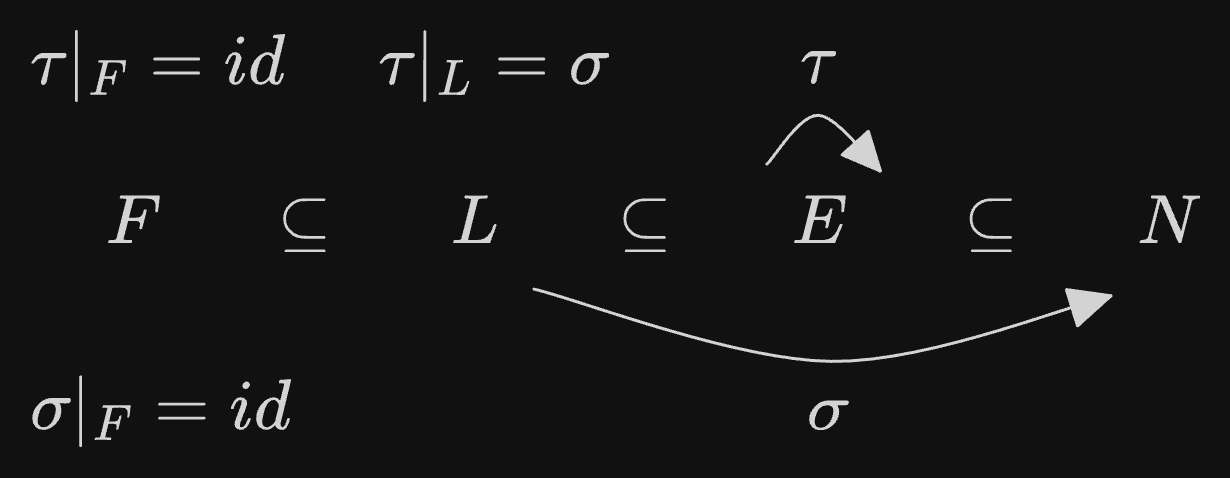
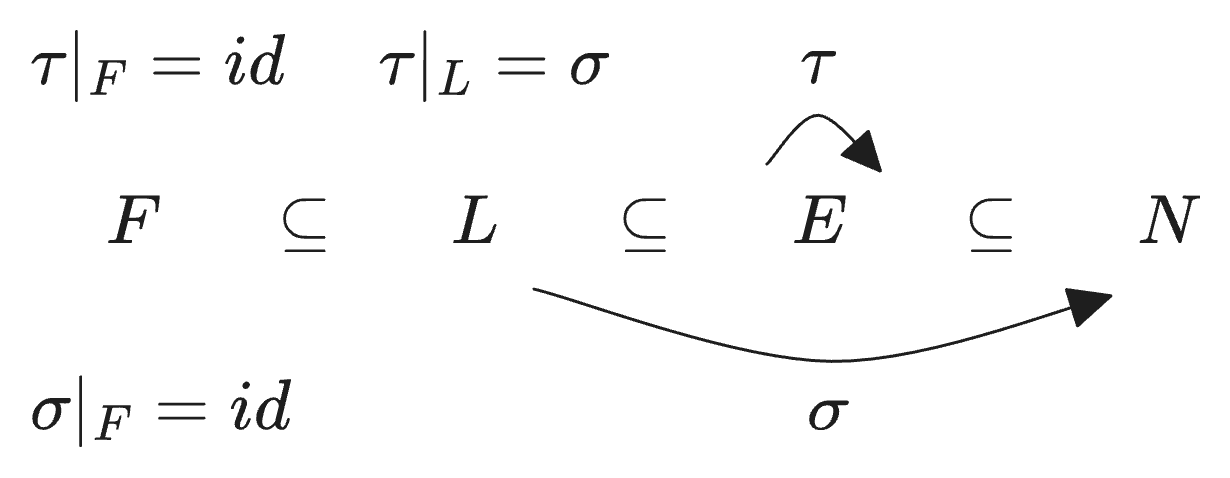
Since E / ⊲ F E/_{\lhd}F E / ⊲ F P ⊆ F [ x ] : E = F ( ∥ P ) P \subseteq F[x]:E = F(\parallel P) P ⊆ F [ x ] : E = F ( ∥ P ) ( 2.8.13 ) (2.8.13) ( 2.8.13 ) F 1 = F 2 = F , E 1 = E , E 2 = ϕ ( E ) , σ = id F_1=F_2=F, E_1 = E, E_2 = \phi(E), \sigma=\text{id} F 1 = F 2 = F , E 1 = E , E 2 = ϕ ( E ) , σ = id τ ( E ) = F ( ∥ P σ ) = F ( ∥ P ) = E \tau(E)=F(\parallel P^{\sigma})=F(\parallel P)=E τ ( E ) = F ( ∥ P σ ) = F ( ∥ P ) = E
( b ) ⟹ ( c ) (b) \implies (c) ( b ) ⟹ ( c )
First note that by ( 2.4.20 ) (2.4.20) ( 2.4.20 ) σ \sigma σ
L ≅ σ σ ( L )
L \overset{\sigma}\cong \sigma(L)
L ≅ σ σ ( L ) Next, obviously L ⊆ E , E / A F ⟹ L / A F L \subseteq E, E/_AF \implies L/_AF L ⊆ E , E / A F ⟹ L / A F σ \sigma σ F F F σ ( L ) / A F \sigma(L)/_AF σ ( L ) / A F E / A F , L / A F , σ ( L ) / A F E/_AF, L/_AF, \sigma(L)/_AF E / A F , L / A F , σ ( L ) / A F
E ‾ = L ‾ = σ ( L ) ‾ = F ‾ = F ( ∥ F [ x ] ∖ F )
\overline E = \overline L= \overline {\sigma(L)}=\overline F = F(\parallel F[x] \setminus F)
E = L = σ ( L ) = F = F ( ∥ F [ x ] ∖ F ) Now consider under ( 2.8.11 ) (2.8.11) ( 2.8.11 ) F 1 : = L , F 2 : = σ ( L ) , E 1 = E 2 = E ‾ F_1:=L, F_2:=\sigma(L), E_1=E_2 = \overline E F 1 := L , F 2 := σ ( L ) , E 1 = E 2 = E ρ : E ‾ ≅ F E ‾ \rho: \overline E \cong_F \overline E ρ : E ≅ F E ρ ∣ L = σ \rho|_L=\sigma ρ ∣ L = σ
ρ ∣ F = ( ρ ∣ L ) ∣ F = σ ∣ F = id \rho|_F = (\rho|_L)|_F = \sigma|_F=\text{id} ρ ∣ F = ( ρ ∣ L ) ∣ F = σ ∣ F = id
Now define τ : = ρ ∣ E \tau:=\rho|_E τ := ρ ∣ E σ = ρ ∣ L = ( ρ ∣ E ) ∣ L = τ ∣ L \sigma=\rho|_L=(\rho|_E)|_L=\tau|_L σ = ρ ∣ L = ( ρ ∣ E ) ∣ L = τ ∣ L ( b ) (b) ( b ) τ ( E ) = E \tau(E)=E τ ( E ) = E σ ( L ) = τ ( L ) ⊆ τ ( E ) = E \sigma(L)=\tau(L)\subseteq \tau(E)=E σ ( L ) = τ ( L ) ⊆ τ ( E ) = E
Finally we have τ : E ⇝ F E \tau: E \rightsquigarrow_F E τ : E ⇝ F E τ ∣ F = ( ρ ∣ E ) ∣ F = ρ ∣ F = id \tau|_F=(\rho|_E)|_F = \rho|_F=\text{id} τ ∣ F = ( ρ ∣ E ) ∣ F = ρ ∣ F = id τ ∈ Gal ( E / F ) \tau \in \text{Gal}(E/F) τ ∈ Gal ( E / F )
( c ) ⟹ ( d ) (c) \implies (d) ( c ) ⟹ ( d )
Let p ∈ F [ x ] − , α ∈ E : p ( α ) = 0 p \in F[x]^{-}, \alpha \in E: p(\alpha) = 0 p ∈ F [ x ] − , α ∈ E : p ( α ) = 0 L : = F ( α ) , N : = E ‾ L:=F(\alpha), N:=\overline E L := F ( α ) , N := E
Consider β ∈ E ‾ : p ( β ) = 0 \beta \in \overline E: p(\beta) = 0 β ∈ E : p ( β ) = 0 σ : F ( α ) ⇝ ∣ F E ‾ : α ↦ β \sigma: F(\alpha) \rightsquigarrow_{|F} \overline E: \alpha \mapsto \beta σ : F ( α ) ⇝ ∣ F E : α ↦ β ( c ) (c) ( c ) σ ( F ( α ) ) ⊆ E ⟹ β ∈ E \sigma(F(\alpha))\subseteq E \implies \beta \in E σ ( F ( α )) ⊆ E ⟹ β ∈ E β \beta β p ∥ E p \parallel E p ∥ E
( d ) ⟹ ( a ) (d) \implies (a) ( d ) ⟹ ( a ) α ∈ E : p o l F ( α ) ∥ E \alpha \in E: \mathfrak {pol}_F(\alpha) \parallel E α ∈ E : pol F ( α ) ∥ E P : = { p o l F ( α ) , α ∈ E } P:=\{\mathfrak {pol}_F(\alpha), \alpha \in E\} P := { pol F ( α ) , α ∈ E } E = F ( ∥ P ) E = F(\parallel P) E = F ( ∥ P )
□ \square □
Example: Normal extension
C / R \mathbb C / \mathbb R C / R C = R ( ∥ x 2 + 1 ) \mathbb C=\mathbb R(\parallel x^2+1) C = R ( ∥ x 2 + 1 )
Example: Not normal extension
Q ( 2 3 ) / Q \mathbb Q(\sqrt[3]2)/\mathbb Q Q ( 3 2 ) / Q p o l Q ( 2 3 ) = x 3 − 2 \mathfrak {pol}_{\mathbb Q}(\sqrt[3]2) = x^3-2 pol Q ( 3 2 ) = x 3 − 2 Q ( ∥ x 3 − 2 ) = Q ( 2 3 , − 3 ) \mathbb Q(\parallel x^3-2)=\mathbb Q(\sqrt[3]2, \sqrt{-3}) Q ( ∥ x 3 − 2 ) = Q ( 3 2 , − 3 )
Separable extensions
def: Multiplicity of root
∢ F ∈ F p ∈ F [ x ] α ∈ F ( ∥ p ) ( x − α ) m ∣ p , ( x − α ) m + 1 ∤ p ord α p : = m , root α has multiplicity m \begin{align*}
&\sphericalangle \\
&F \in \mathcal F \\
&p \in F[x] \\
&\alpha \in F(\parallel p) \\
&(x-\alpha)^m \mid p, (x-\alpha)^{m+1} \nmid p
\\
\hline
\\
&\text{ord}_{\alpha}p:=m, \text{ root } \alpha \text{ has multiplicity } m
\end{align*} ∢ F ∈ F p ∈ F [ x ] α ∈ F ( ∥ p ) ( x − α ) m ∣ p , ( x − α ) m + 1 ∤ p ord α p := m , root α has multiplicity m Example: Root multiplicity of 1
x 3 − 2 x^3 - 2 x 3 − 2 ord 2 3 ( x 3 − 2 ) = 1 \text{ord}_{\sqrt[3]2}(x^3-2)=1 ord 3 2 ( x 3 − 2 ) = 1 Q \mathbb Q Q x − 2 3 ∣ ( x 3 − 2 ) x-\sqrt[3]2 \mid (x^3-2) x − 3 2 ∣ ( x 3 − 2 ) ( x − 2 3 ) 2 ∤ ( x 3 − 2 ) (x-\sqrt[3]2)^2 \nmid (x^3-2) ( x − 3 2 ) 2 ∤ ( x 3 − 2 )
Example: Root multiplicity of 2
In F 2 ( x ) / F 2 ( x 2 ) \mathbb F_2(x)/\mathbb F_2(x^2) F 2 ( x ) / F 2 ( x 2 ) ord x t 2 − x 2 = 2 \text{ord}_x t^2-x^2 = 2 ord x t 2 − x 2 = 2 t 2 − x 2 = ( t − x ) 2 t^2-x^2=(t-x)^2 t 2 − x 2 = ( t − x ) 2
def: Separable polynomial
∢ F ∈ F p ∈ F [ x ] ∀ α ∈ F ( ∥ p ) , p ( α ) = 0 ⟹ ord α p = 1 p ∈ F ⊟ [ x ] \begin{align*}
&\sphericalangle \\
&F \in \mathcal F \\
&p \in F[x] \\
&\forall \alpha \in F(\parallel p), p(\alpha) = 0 \implies \text{ord}_{\alpha}p=1
\\
\hline
\\
&p \in F_\boxminus[x]
\end{align*} ∢ F ∈ F p ∈ F [ x ] ∀ α ∈ F ( ∥ p ) , p ( α ) = 0 ⟹ ord α p = 1 p ∈ F ⊟ [ x ] def: Separable element
∢ E / F ∈ F α ∈ E p o l ( α ) ∈ F ⊟ [ x ] α ∈ F ⊟ \begin{align*}
&\sphericalangle \\
&E/F \in \mathcal F \\
& \alpha \in E \\
&\mathfrak {pol}(\alpha) \in F_{\boxminus}[x]
\\
\hline
\\
&\alpha \in F_{\boxminus}
\end{align*} ∢ E / F ∈ F α ∈ E pol ( α ) ∈ F ⊟ [ x ] α ∈ F ⊟ def: Separable extension
∢ E / A F ∈ F ∀ α ∈ E : α ∈ F ⊟ E / ⊟ F , E − separable extension of F \begin{align*}
&\sphericalangle \\
&E/_AF \in \mathcal F \\
&\forall \alpha \in E: \alpha \in F_{\boxminus} \\
\hline
\\
&E/_{\boxminus}F, E - \text{ separable extension of } F
\end{align*} ∢ E / A F ∈ F ∀ α ∈ E : α ∈ F ⊟ E / ⊟ F , E − separable extension of F Example: Separable extension
Q ( 2 ) / Q \mathbb Q(\sqrt 2)/\mathbb Q Q ( 2 ) / Q p o l Q ( 2 ) = x 2 − 2 = ( x − 2 ) ( x + 2 ) \mathfrak{pol}_{\mathbb Q}(\sqrt 2)= x^2-2 = (x-\sqrt 2)(x+\sqrt 2) pol Q ( 2 ) = x 2 − 2 = ( x − 2 ) ( x + 2 )
Example: Non-separable extension
F 2 ( x ) / F 2 ( x 2 ) \mathbb F_2(x)/\mathbb F_2(x^2) F 2 ( x ) / F 2 ( x 2 ) x x x t 2 − x 2 t^2-x^2 t 2 − x 2 x x x
def: Polynomial derivative
∢ F ∈ F p ∈ F [ x ] , p = a 0 + a 1 x + … + a n x n p ′ ( x ) : = a 1 + 2 a 2 x + … n a n x n − 1 \begin{align*}
&\sphericalangle \\
&F \in \mathcal F \\
&p \in F[x], p = a_0+a_1x+ \ldots + a_nx^n \\
\hline
\\
&p'(x):=a_1 + 2a_2x+\ldots na_nx^{n-1}
\end{align*} ∢ F ∈ F p ∈ F [ x ] , p = a 0 + a 1 x + … + a n x n p ′ ( x ) := a 1 + 2 a 2 x + … n a n x n − 1 We can assume that deg p ′ = deg p − 1 \deg p' = \deg p - 1 deg p ′ = deg p − 1 char F = 0 \text{char } F=0 char F = 0 char F = n \text{char } F = n char F = n p ( x ) = x n p(x)=x^n p ( x ) = x n p ′ ( x ) = n x n − 1 = 0 p'(x)=nx^{n-1}= 0 p ′ ( x ) = n x n − 1 = 0
Proposition 2.9.7: Derivative properties
∢ F ∈ F p , q ∈ F [ x ] ∀ a , b ∈ F : ( a p ( x ) + b q ( x ) ) ′ = a p ′ ( x ) + b q ′ ( x ) ( p ( x ) q ( x ) ) ′ = p ′ ( x ) q ( x ) + p ( x ) q ′ ( x ) ( p ( q ( x ) ) ) ′ = p ′ ( q ( x ) ) q ′ ( x ) \begin{align*}
&\sphericalangle \\
&F \in \mathcal F \\
&p, q \in F[x] \\
\hline
\\
&\begin{align*}
& \forall a, b \in F: (ap(x)+bq(x))' = ap'(x) + bq'(x) \hspace{0.5cm} \tag{a}\\
& (p(x)q(x))' = p'(x)q(x) + p(x)q'(x) \hspace{0.5cm} \tag{b}\\
& (p(q(x)))' = p'(q(x))q'(x) \hspace{0.5cm} \tag{c}\\
\end{align*}
\end{align*} ∢ F ∈ F p , q ∈ F [ x ] ∀ a , b ∈ F : ( a p ( x ) + b q ( x ) ) ′ = a p ′ ( x ) + b q ′ ( x ) ( p ( x ) q ( x ) ) ′ = p ′ ( x ) q ( x ) + p ( x ) q ′ ( x ) ( p ( q ( x )) ) ′ = p ′ ( q ( x )) q ′ ( x ) ( a ) ( b ) ( c ) Proof
Verified directly and left as an exercise.
□ \square □
Proposition 2.9.8: Polynomial separability criterion
∢ F ∈ F p ∈ F [ x ] ∖ F p ∈ F ⊟ [ x ] ⟺ gcd ( p , p ′ ) = 1 \begin{align*}
&\sphericalangle \\
&F \in \mathcal F \\
&p \in F[x] \setminus F \\
\hline
\\
&p \in F_{\boxminus}[x] \iff \gcd(p, p')=1
\end{align*} ∢ F ∈ F p ∈ F [ x ] ∖ F p ∈ F ⊟ [ x ] ⟺ g cd( p , p ′ ) = 1 Proof
Take some E / F E/F E / F
gcd ( p , p ′ ) = 1 (in F) ⟺ gcd ( p , p ′ ) = 1 (in E) \gcd(p, p')=1 \text{ (in F)} \iff \gcd(p, p')=1 \text{ (in E)} g cd( p , p ′ ) = 1 (in F) ⟺ g cd( p , p ′ ) = 1 (in E) If gcd ( p , p ′ ) = 1 \gcd(p, p')=1 g cd( p , p ′ ) = 1 F F F ( 2.1.6 ) (2.1.6) ( 2.1.6 ) F [ x ] F[x] F [ x ] ∃ g , h ∈ F [ x ] : p g + p ′ h = 1 \exists g, h \in F[x]: pg+p'h = 1 ∃ g , h ∈ F [ x ] : p g + p ′ h = 1 E E E p g + p ′ h = 1 ⟹ gcd ( p , p ′ ) = 1 pg+p'h = 1 \implies \gcd(p, p')=1 p g + p ′ h = 1 ⟹ g cd( p , p ′ ) = 1 E E E
Conversely assume gcd ( p , p ′ ) = 1 \gcd(p, p')=1 g cd( p , p ′ ) = 1 E E E d : = gcd ( p , p ′ ) d:=\gcd(p, p') d := g cd( p , p ′ ) F F F d ∣ p , d ∣ p ′ d \mid p, d \mid p' d ∣ p , d ∣ p ′ F F F E E E d ∣ gcd ( p , p ′ ) d \mid \gcd(p, p') d ∣ g cd( p , p ′ ) E E E d ∣ 1 ⟹ d = 1 d \mid 1 \implies d = 1 d ∣ 1 ⟹ d = 1
Now we fix for the rest of the proof E : = F ( ∥ { p , p ′ } ) E:=F(\parallel \{p, p'\}) E := F ( ∥ { p , p ′ })
p ∈ F ⊟ [ x ] ⟺ ∄ α ∈ E : p ( α ) = p ′ ( α ) = 0 p \in F_{\boxminus}[x] \iff \nexists \alpha \in E: p(\alpha)=p'(\alpha)=0 p ∈ F ⊟ [ x ] ⟺ ∄ α ∈ E : p ( α ) = p ′ ( α ) = 0 If ∃ α ∈ E : p ( α ) = p ′ ( α ) = 0 \exists \alpha \in E: p(\alpha)=p'(\alpha)=0 ∃ α ∈ E : p ( α ) = p ′ ( α ) = 0 p ( x ) = ( x − α ) m q ( x ) , q ( α ) ≠ 0 , p ′ ( x ) = m ( x − α ) m − 1 q ( x ) + ( x − α ) m q ′ ( x ) = ( x − α ) m − 1 ( m q ( x ) + ( x − α ) q ′ ( x ) ) p(x)=(x-\alpha)^mq(x), q(\alpha)\ne 0, p'(x)=m(x-\alpha)^{m-1}q(x)+(x-\alpha)^{m}q'(x)=(x-\alpha)^{m-1}(mq(x)+(x-\alpha)q'(x)) p ( x ) = ( x − α ) m q ( x ) , q ( α ) = 0 , p ′ ( x ) = m ( x − α ) m − 1 q ( x ) + ( x − α ) m q ′ ( x ) = ( x − α ) m − 1 ( m q ( x ) + ( x − α ) q ′ ( x )) m = 1 m=1 m = 1 p ′ ( α ) = q ( α ) ≠ 0 p'(\alpha)=q(\alpha)\ne0 p ′ ( α ) = q ( α ) = 0 m > 1 m>1 m > 1 p ∉ F ⊟ [ x ] p \notin F_{\boxminus}[x] p ∈ / F ⊟ [ x ] p ∉ F ⊟ [ x ] p \notin F_{\boxminus}[x] p ∈ / F ⊟ [ x ] p = ( x − α ) m g ( x ) , m > 1 p = (x-\alpha)^mg(x), m>1 p = ( x − α ) m g ( x ) , m > 1 p ′ ( α ) = 0 p'(\alpha) = 0 p ′ ( α ) = 0
⟹ \implies ⟹
Denote d : = gcd ( p , p ′ ) , d ∈ E [ x ] d:=\gcd(p, p'), d \in E[x] d := g cd( p , p ′ ) , d ∈ E [ x ] d ∥ E d \parallel E d ∥ E ∀ α ∈ E : d ( α ) = 0 ⟹ p ( α ) = p ′ ( α ) = 0 \forall \alpha \in E: d(\alpha) = 0 \implies p(\alpha)=p'(\alpha)=0 ∀ α ∈ E : d ( α ) = 0 ⟹ p ( α ) = p ′ ( α ) = 0 p ∈ F ⊟ [ x ] ⟹ ∄ α ∈ E : p ( α ) = p ′ ( α ) = 0 p \in F_{\boxminus}[x] \implies \nexists \alpha \in E: p(\alpha)=p'(\alpha)=0 p ∈ F ⊟ [ x ] ⟹ ∄ α ∈ E : p ( α ) = p ′ ( α ) = 0 ∄ α ∈ E : d ( α ) = 0 \nexists \alpha \in E: d(\alpha)=0 ∄ α ∈ E : d ( α ) = 0 d ∈ E ∗ = E [ x ] ∗ d \in E^* = E[x]^* d ∈ E ∗ = E [ x ] ∗ gcd ( p , p ′ ) = 1 \gcd(p, p')=1 g cd( p , p ′ ) = 1 E E E ( 2.4.11 ) (2.4.11) ( 2.4.11 ) gcd ( p , p ′ ) = 1 \gcd(p, p')=1 g cd( p , p ′ ) = 1 F F F
⟸ \impliedby ⟸
If ∃ α ∈ E : p ( α ) = p ′ ( α ) = 0 \exists \alpha \in E: p(\alpha)=p'(\alpha)=0 ∃ α ∈ E : p ( α ) = p ′ ( α ) = 0 gcd ( p , p ′ ) ≠ 1 \gcd(p, p') \ne 1 g cd( p , p ′ ) = 1 ∄ α ∈ E : p ( α ) = p ′ ( α ) = 0 ⟹ p ∈ F ⊟ [ x ] \nexists \alpha \in E: p(\alpha)=p'(\alpha)=0 \implies p \in F_{\boxminus}[x] ∄ α ∈ E : p ( α ) = p ′ ( α ) = 0 ⟹ p ∈ F ⊟ [ x ]
□ \square □
This theorem is trivial if we consider gcd ( p , p ′ ) \gcd(p, p') g cd( p , p ′ ) p p p gcd ( p , p ′ ) \gcd(p, p') g cd( p , p ′ )
Proposition 2.9.9: Irreducible polynomial separability
∢ F ∈ F f ∈ F [ x ] − p ∈ P char F = 0 ⟹ f ∈ F ⊟ [ x ] char F = p > 0 ⟹ f ∈ F ⊟ [ x ] ⟺ f ′ ≠ 0 ⟺ f ∉ F [ x p ] char F = p > 0 ⟹ ∃ g ∈ F [ x ] − ∩ F ⊟ [ x ] , m ≥ 0 : f ( x ) = g ( x p m ) \begin{align*}
&\sphericalangle \\
&F \in \mathcal F \\
&f \in F[x]^- \\
&p \in \mathfrak P \\
\hline
\\
&\begin{align*}
&\text{char }F = 0 \implies f \in F_{\boxminus}[x] \hspace{0.5cm} \tag{a}\\
&\text{char }F = p > 0 \implies f \in F_{\boxminus}[x] \iff f' \ne 0 \iff f \notin F[x^p] \hspace{0.5cm} \tag{b}\\
&\text{char }F = p > 0 \implies \exists g \in F[x]^- \cap F_{\boxminus}[x], m \ge 0: f(x)=g(x^{p^m}) \hspace{0.5cm} \tag{c}\\
\end{align*}
\end{align*} ∢ F ∈ F f ∈ F [ x ] − p ∈ P char F = 0 ⟹ f ∈ F ⊟ [ x ] char F = p > 0 ⟹ f ∈ F ⊟ [ x ] ⟺ f ′ = 0 ⟺ f ∈ / F [ x p ] char F = p > 0 ⟹ ∃ g ∈ F [ x ] − ∩ F ⊟ [ x ] , m ≥ 0 : f ( x ) = g ( x p m ) ( a ) ( b ) ( c ) Proof
Note that f ∈ F [ x ] − ⟹ ( gcd ( f , f ′ ) = 1 ) ∨ ( gcd ( f , f ′ ) = f ) f \in F[x]^- \implies (\gcd(f, f')=1) \vee (\gcd(f, f')=f) f ∈ F [ x ] − ⟹ ( g cd( f , f ′ ) = 1 ) ∨ ( g cd( f , f ′ ) = f ) f f f
a.
If char F = 0 \text{char}F=0 char F = 0 deg f ′ = deg f − 1 ⟹ f ∤ f ′ ⟹ gcd ( f , f ′ ) = 1 ⟹ ( 2.9.8 ) f ∈ F ⊟ [ x ] \deg f' = \deg f - 1 \implies f \nmid f' \implies \gcd(f, f')=1 \overset{(2.9.8)}\implies f \in F_{\boxminus}[x] deg f ′ = deg f − 1 ⟹ f ∤ f ′ ⟹ g cd( f , f ′ ) = 1 ⟹ ( 2.9.8 ) f ∈ F ⊟ [ x ]
b.
If char F = p > 0 \text{char}F=p>0 char F = p > 0 f ∉ F ⊟ [ x ] ⟺ gcd ( f , f ′ ) = f ⟺ f ∣ f ′ ⟺ deg f ′ < deg f f ′ = 0 ⟺ f ∈ F [ x p ] f \notin F_{\boxminus}[x] \iff \gcd(f, f')=f \iff f \mid f' \overset{\deg f' < \deg f}\iff f'=0 \iff f \in F[x^p] f ∈ / F ⊟ [ x ] ⟺ g cd( f , f ′ ) = f ⟺ f ∣ f ′ ⟺ d e g f ′ < d e g f f ′ = 0 ⟺ f ∈ F [ x p ] x n , n ≠ p q x^n, n \ne pq x n , n = pq 0 0 0
c.
Assume m m m f ∈ F [ x p m ] f \in F[x^{p^m}] f ∈ F [ x p m ] f ∈ F [ x p 0 ] f \in F[x^{p^0}] f ∈ F [ x p 0 ] f f f m m m f = g ( x p m ) , g ∈ F [ x ] f = g(x^{p^{m}}), g \in F[x] f = g ( x p m ) , g ∈ F [ x ] g ∈ F [ x ] − g \in F[x]^- g ∈ F [ x ] − g = h ⋅ k ⟹ f ( x ) = h ( x p m ) ⋅ k ( x p m ) g = h\cdot k \implies f(x)=h(x^{p^{m}})\cdot k(x^{p^{m}}) g = h ⋅ k ⟹ f ( x ) = h ( x p m ) ⋅ k ( x p m ) g ∈ F [ x p ] g \in F[x^p] g ∈ F [ x p ] m m m g ∉ F [ x p ] ⟹ ( b ) g ∈ F ⊟ [ x ] g \notin F[x^p] \overset{(b)}\implies g \in F_{\boxminus}[x] g ∈ / F [ x p ] ⟹ ( b ) g ∈ F ⊟ [ x ]
□ \square □
Purely inseparable extensions
def: Purely inseparable element
∢ E / F ∈ F α ∈ E Z ( p ) : = { a ∈ E : p ( a ) = 0 } ∣ Z ( p o l F ( α ) ) ∣ = 1 α ∈ F □ \begin{align*}
&\sphericalangle \\
& E/F \in \mathcal F \\
&\alpha \in E \\
&Z(p):=\{a \in E: p(a)=0\} \\
&|Z(\mathfrak {pol}_F(\alpha))|=1
\\
\hline
\\
&\alpha \in F_\Box
\end{align*} ∢ E / F ∈ F α ∈ E Z ( p ) := { a ∈ E : p ( a ) = 0 } ∣ Z ( pol F ( α )) ∣ = 1 α ∈ F □ def: Purely inseparable extension
∢ E / A F ∈ F ∀ α ∈ E : α ∈ F □ E / □ F \begin{align*}
&\sphericalangle \\
& E/_AF \in \mathcal F \\
&\forall \alpha \in E: \alpha \in F_\Box \\
\hline
\\
&E/_\Box F
\end{align*} ∢ E / A F ∈ F ∀ α ∈ E : α ∈ F □ E / □ F Example: Purely inseparable extension
If F ∈ F , char F = p ∈ P F \in \mathcal F, \text{char }F = p \in \mathfrak P F ∈ F , char F = p ∈ P F ( x p ) / F ( x ) F(\sqrt[p]x)/F(x) F ( p x ) / F ( x ) p o l F ( x ) ( x p ) = t p − x = ( t − x ) p \mathfrak{pol}_{F(x)}(\sqrt[p]x)=t^p-x = (t-x)^p pol F ( x ) ( p x ) = t p − x = ( t − x ) p ( 2.10.3 ) (2.10.3) ( 2.10.3 )
Proposition 2.9.10: Purely inseparabe element criteria
∢ F ∈ F char F = p ∈ P α ∈ F ‾ α ∈ F □ ⟺ ∃ n ≥ 0 : α p n ∈ F ∃ n ≥ 0 : α p n ∈ F ⟹ p o l F ( α ) = ( x − α ) p n \begin{align*}
&\sphericalangle \\
&F \in \mathcal F \\
&\text{char }F = p \in \mathfrak P \\
& \alpha \in \overline F
\\
\hline
\\
&\begin{align*}
& \alpha \in F_\Box \iff \exists n \ge 0: \alpha^{p^n} \in F\hspace{0.5cm} \tag{a}\\
& \exists n \ge 0: \alpha^{p^n} \in F \implies \mathfrak{pol}_F(\alpha)=(x-\alpha)^{p^n}\hspace{0.5cm} \tag{b}\\
\end{align*}
\end{align*} ∢ F ∈ F char F = p ∈ P α ∈ F α ∈ F □ ⟺ ∃ n ≥ 0 : α p n ∈ F ∃ n ≥ 0 : α p n ∈ F ⟹ pol F ( α ) = ( x − α ) p n ( a ) ( b ) Proof
a., b
⟹ \implies ⟹
Define f ( x ) : = p o l F ( α ) f(x):=\mathfrak{pol}_F(\alpha) f ( x ) := pol F ( α ) ( 2.9.9. c ) ⟹ ∃ g ∈ F [ x ] − ∩ F ⊟ [ x ] , m ≥ 0 : f ( x ) = g ( x p n ) (2.9.9.c) \implies \exists g \in F[x]^- \cap F_{\boxminus}[x], m \ge 0: f(x)=g(x^{p^n}) ( 2.9.9. c ) ⟹ ∃ g ∈ F [ x ] − ∩ F ⊟ [ x ] , m ≥ 0 : f ( x ) = g ( x p n ) f ( x ) = ( x p n − b 1 ) ⋅ … ⋅ ( x p n − b n ) , b i ∈ F ( ∥ g ) f(x)=(x^{p^n}-b_1)\cdot \ldots \cdot (x^{p^n}-b_n), b_i \in F(\parallel g) f ( x ) = ( x p n − b 1 ) ⋅ … ⋅ ( x p n − b n ) , b i ∈ F ( ∥ g ) g ∈ F ⊟ [ x ] ⟹ b i ≠ b j g \in F_\boxminus[x] \implies b_i \ne b_j g ∈ F ⊟ [ x ] ⟹ b i = b j α ∈ F □ \alpha \in F_\Box α ∈ F □ α \alpha α f ( x ) f(x) f ( x ) f ( x ) = x p n − b 1 = ( x − α ) p n f(x)=x^{p^n}-b_1=(x-\alpha)^{p^n} f ( x ) = x p n − b 1 = ( x − α ) p n f ( x ) f(x) f ( x ) F F F b 1 ∈ F b_1 \in F b 1 ∈ F α p n = b 1 ∈ F \alpha^{p^n}=b_1 \in F α p n = b 1 ∈ F ( b ) (b) ( b ) f ( x ) = ( x − α ) p n f(x) = (x-\alpha)^{p^n} f ( x ) = ( x − α ) p n
⟸ \impliedby ⟸
If α p n = a ∈ F \alpha^{p^n}=a \in F α p n = a ∈ F f ( x ) : = x p n − a = ( 2.10.3 ) ( x − α ) p n f(x):=x^{p^n}-a\overset{(2.10.3)}=(x-\alpha)^{p^n} f ( x ) := x p n − a = ( 2.10.3 ) ( x − α ) p n f ( α ) = 0 f(\alpha)=0 f ( α ) = 0 p o l F ( α ) ∣ f ( x ) ⟹ α ∈ F □ \mathfrak {pol}_F(\alpha) \mid f(x) \implies \alpha \in F_\Box pol F ( α ) ∣ f ( x ) ⟹ α ∈ F □
□ \square □
Proposition 2.9.11: Purely inseparabe and separable extensions
∢ E / A F ∈ F α ∈ E ∩ F ⊟ ∩ F □ ⟹ α ∈ F E / ⊟ F , E / □ F ⟹ E = F \begin{align*}
&\sphericalangle \\
&E/_AF \in \mathcal F
\\
\hline
\\
&\begin{align*}
&\alpha \in E \cap F_\boxminus \cap F_\Box \implies \alpha \in F \hspace{0.5cm} \tag{a}\\
&E /_\boxminus F, E /_\Box F \implies E= F \hspace{0.5cm} \tag{b}\\
\end{align*}
\end{align*} ∢ E / A F ∈ F α ∈ E ∩ F ⊟ ∩ F □ ⟹ α ∈ F E / ⊟ F , E / □ F ⟹ E = F ( a ) ( b ) Proof
a.
If α \alpha α p o l F ( α ) \mathfrak {pol}_F(\alpha) pol F ( α ) 1 1 1 p o l F ( α ) = x − α \mathfrak {pol}_F(\alpha)=x-\alpha pol F ( α ) = x − α α ∈ F \alpha \in F α ∈ F
b.
Follows from ( a ) (a) ( a )
□ \square □
Perfect fields
def: Perfect field
∢ F ∈ F E / A F ⟹ E / ⊟ F F ∈ F P \begin{align*}
&\sphericalangle \\
&F \in \mathcal F \\
&E/_AF \implies E/_{\boxminus}F
\\
\hline
\\
&F \in \mathcal F^{\mathcal P}
\end{align*} ∢ F ∈ F E / A F ⟹ E / ⊟ F F ∈ F P Proposition 2.9.12: Perfect field types
∢ F ∈ F F ‾ ∈ F P char F = 0 ⟹ F ∈ F P char F = p ∈ P ⟹ ( F ∈ F P ⟺ F p = F ) \begin{align*}
&\sphericalangle \\
&F \in \mathcal F \\
\hline
\\
&\begin{align*}
&\overline F \in \mathcal F^{\mathcal P} \hspace{0.5cm} \tag{a}\\
&\text{char }F = 0 \implies F \in \mathcal F^{\mathcal P} \hspace{0.5cm} \tag{b}\\
&\text{char }F = p \in \mathfrak P \implies (F \in \mathcal F^{\mathcal P} \iff F^p=F) \hspace{0.5cm} \tag{c}\\
\end{align*}
&
\end{align*} ∢ F ∈ F F ∈ F P char F = 0 ⟹ F ∈ F P char F = p ∈ P ⟹ ( F ∈ F P ⟺ F p = F ) ( a ) ( b ) ( c ) Proof
a.
There are no proper extensions of algebraically closed field so F ‾ ∈ F P \overline F \in \mathcal F^{\mathcal P} F ∈ F P
b.
Follows from ( 2.9.9. a ) (2.9.9.a) ( 2.9.9. a )
c.
⟹ \implies ⟹
Consider a ∈ F a \in F a ∈ F p ( x ) = x p − a p(x)=x^p-a p ( x ) = x p − a α ∈ F ( ∥ p ) , p ( α ) = 0 \alpha \in F(\parallel p), p(\alpha) = 0 α ∈ F ( ∥ p ) , p ( α ) = 0 char F = p \text{char }F=p char F = p ( 2.10.3 ) (2.10.3) ( 2.10.3 ) ( x − α ) p = x p − α p = x p − a (x-\alpha)^p=x^p-\alpha^p=x^p-a ( x − α ) p = x p − α p = x p − a p o l F ( α ) ∣ x p − a = ( x − α ) p \mathfrak {pol}_F(\alpha) \mid x^p-a=(x-\alpha)^p pol F ( α ) ∣ x p − a = ( x − α ) p p o l F ( α ) = ( x − α ) n , n ≤ p \mathfrak {pol}_F(\alpha) = (x-\alpha)^n, n \le p pol F ( α ) = ( x − α ) n , n ≤ p
F ∈ F P ⟹ F ( α ) / ⊟ F ⟹ α ∈ F ⊟ ⟹ ord α ( p o l F ( α ) ) = 1 ⟹ ( x − α ) 2 ∤ p o l F ( α ) ⟹ p o l F ( α ) = x − α ⟹ α ∈ F ⟹ a ∈ F p
F \in \mathcal F^{\mathcal P} \implies F(\alpha)/_\boxminus F \implies \\
\alpha \in F_\boxminus \implies \text{ord}_{\alpha}(\mathfrak {pol}_F(\alpha))=1 \implies (x-\alpha)^2 \nmid \mathfrak {pol}_F(\alpha) \implies \\
\mathfrak {pol}_F(\alpha) = x-\alpha \implies \alpha \in F \implies a \in F^p
F ∈ F P ⟹ F ( α ) / ⊟ F ⟹ α ∈ F ⊟ ⟹ ord α ( pol F ( α )) = 1 ⟹ ( x − α ) 2 ∤ pol F ( α ) ⟹ pol F ( α ) = x − α ⟹ α ∈ F ⟹ a ∈ F p So we proved F ⊆ F p F \subseteq F^p F ⊆ F p F p ⊆ F F^p \subseteq F F p ⊆ F
⟸ \impliedby ⟸
Consider some E / F E/F E / F α ∈ E \alpha \in E α ∈ E f ( x ) : = p o l F ( α ) f(x):=\mathfrak {pol}_F(\alpha) f ( x ) := pol F ( α ) ( 2.9.9. c ) ⟹ ∃ g ∈ F [ x ] − ∩ F ⊟ [ x ] , m ≥ 0 : f ( x ) = g ( x p m ) (2.9.9.c) \implies \exists g \in F[x]^- \cap F_{\boxminus}[x], m \ge 0: f(x)=g(x^{p^m}) ( 2.9.9. c ) ⟹ ∃ g ∈ F [ x ] − ∩ F ⊟ [ x ] , m ≥ 0 : f ( x ) = g ( x p m ) g ( x ) = a 0 + a 1 x + … + a n x n g(x)=a_0+a_1x + \ldots +a_nx^n g ( x ) = a 0 + a 1 x + … + a n x n ∃ b i ∈ F : b i p = a i \exists b_i \in F: b_i^p=a_i ∃ b i ∈ F : b i p = a i f ( x ) = ∑ i b i p x i p m = ( ∑ i b i x i p m − 1 ) p f(x)=\sum_i b_i^px^{ip^m}=(\sum_i b_ix^{ip^{m-1}})^p f ( x ) = ∑ i b i p x i p m = ( ∑ i b i x i p m − 1 ) p f f f m ≥ 1 m \ge 1 m ≥ 1 m = 0 m=0 m = 0 f ( x ) = g ( x ) ∈ F ⊟ [ x ] ⟹ α ∈ F ⊟ f(x)=g(x) \in F_\boxminus[x] \implies \alpha \in F_\boxminus f ( x ) = g ( x ) ∈ F ⊟ [ x ] ⟹ α ∈ F ⊟
□ \square □
Example: Perfect fields
Q , R , C \mathbb Q, \mathbb R, \mathbb C Q , R , C char F = 0 \text{char } F = 0 char F = 0
Any finite field is perfect since it has char F = p , p ∈ P \text{char } F=p, p \in \mathfrak P char F = p , p ∈ P F = F p F=F^p F = F p
Example: Non-perfect fields
F p ( x ) \mathbb F_p(x) F p ( x ) F p ( x p ) \mathbb F_p(\sqrt[p]x) F p ( p x )
Galois extensions
def: Galois extension
∢ E / F ∈ F F = Fix Gal ( E / F ) ( E ) E / Gal F , E − galois extension over F \begin{align*}
&\sphericalangle \\
&E/F \in \mathcal F \\
&F = \text{Fix}_{\text{Gal}(E/F)}(E)
\\
\hline
\\
&E/_{\text{Gal}}F, E - \text{galois extension over } F
\end{align*} ∢ E / F ∈ F F = Fix Gal ( E / F ) ( E ) E / Gal F , E − galois extension over F Example: Galois extensions
C / R \mathbb C / \mathbb R C / R Gal ( C / R ) = { id , σ } , σ : a + b i ↦ a − b i \text{Gal}(\mathbb C / \mathbb R) = \{\text{id}, \sigma\}, \sigma: a+bi \mapsto a-bi Gal ( C / R ) = { id , σ } , σ : a + bi ↦ a − bi R \mathbb R R
Q ( 2 ) / Q \mathbb Q(\sqrt 2)/\mathbb Q Q ( 2 ) / Q
Example: Non-Galois extensions
Q ( 2 3 ) / Q \mathbb Q(\sqrt[3] 2)/\mathbb Q Q ( 3 2 ) / Q Gal ( Q ( 2 3 ) / Q ) = { id } \text{Gal}(\mathbb Q(\sqrt[3] 2)/\mathbb Q) = \{\text{id}\} Gal ( Q ( 3 2 ) / Q ) = { id } Fix Gal ( Q ( 2 3 ) / Q ) ( Q ( 2 3 ) ) = Q ( 2 3 ) \text{Fix}_{\text{Gal}(\mathbb Q(\sqrt[3] 2)/\mathbb Q)}(\mathbb Q(\sqrt[3] 2))=\mathbb Q(\sqrt[3] 2) Fix Gal ( Q ( 3 2 ) / Q ) ( Q ( 3 2 )) = Q ( 3 2 )
F 2 ( x ) / F 2 ( x 2 ) \mathbb F_2(x)/\mathbb F_2(x^2) F 2 ( x ) / F 2 ( x 2 ) Gal ( F 2 ( x ) / F 2 ( x 2 ) ) = id \text{Gal}(\mathbb F_2(x)/\mathbb F_2(x^2))=\text{id} Gal ( F 2 ( x ) / F 2 ( x 2 )) = id Fix Gal ( F 2 ( x ) / F 2 ( x 2 ) ) ( F 2 ( x ) ) = F 2 ( x ) \text{Fix}_{\text{Gal}(\mathbb F_2(x)/\mathbb F_2(x^2))}(\mathbb F_2(x))=\mathbb F_2(x) Fix Gal ( F 2 ( x ) / F 2 ( x 2 )) ( F 2 ( x )) = F 2 ( x )
Next we'll state several proposition without the proofs.
Proposition 2.9.13: Galois extension criterion
∢ E / F [ E : F ] < ∞ E / Gal F ⟺ ∣ Gal ( E / F ) ∣ = [ E : F ] \begin{align*}
&\sphericalangle \\
&E / F \\
&[E:F] < \infty
\\
\hline
\\
&E/_{\text{Gal}}F \iff |\text{Gal}(E/F)|=[E:F]
\end{align*} ∢ E / F [ E : F ] < ∞ E / Gal F ⟺ ∣ Gal ( E / F ) ∣ = [ E : F ] Proposition 2.9.14: Galois extension criterion for simple extensions
∢ E / F α ∈ F ‾ E V : = { y ∈ F ( α ) : p o l ( α ) ( y ) = 0 } F ( α ) / Gal F ⟺ ∣ V ∣ = deg α \begin{align*}
&\sphericalangle \\
&E / F \\
&\alpha \in \overline F_E \\
&V := \{y \in F(\alpha): \mathfrak {pol}(\alpha)(y)=0\} \\
\hline
\\
&F(\alpha)/_{\text{Gal}}F \iff |V| = \deg \alpha
\end{align*} ∢ E / F α ∈ F E V := { y ∈ F ( α ) : pol ( α ) ( y ) = 0 } F ( α ) / Gal F ⟺ ∣ V ∣ = deg α Proposition 2.9.15: Galois extension criteria
∢ E / A F ∈ F The following are equivalent: E / Gal F E / ⊲ F , E / ⊟ F ∃ P ⊆ F [ x ] ∖ F , p i ∈ F ⊟ [ x ] , E = F ( ∥ P ) \begin{align*}
&\sphericalangle \\
&E/_AF \in \mathcal F
\\
\hline
\\
&\text{The following are equivalent:} \\
&\begin{align*}
&E/_{\text{Gal}}F \hspace{0.5cm} \tag{a}\\
&E/_{\lhd}F, E/_{\boxminus}F \hspace{0.5cm} \tag{b}\\
&\exists P \subseteq F[x]\setminus F, p_i \in F_{\boxminus}[x], E = F(\parallel P) \hspace{0.5cm} \tag{c}
\end{align*}
\end{align*} ∢ E / A F ∈ F The following are equivalent: E / Gal F E / ⊲ F , E / ⊟ F ∃ P ⊆ F [ x ] ∖ F , p i ∈ F ⊟ [ x ] , E = F ( ∥ P ) ( a ) ( b ) ( c ) Proof
( a ) ⟹ ( b ) (a) \implies (b) ( a ) ⟹ ( b )
Take some α ∈ E \alpha \in E α ∈ E
X : = { σ ( α ) , σ ∈ Gal ( E / F ) } X:=\{\sigma(\alpha), \sigma \in \text{Gal}(E/F)\} X := { σ ( α ) , σ ∈ Gal ( E / F )} Note that by ( 2.9.3. b ) (2.9.3.b) ( 2.9.3. b ) σ \sigma σ p o l ( α ) \mathfrak {pol}(\alpha) pol ( α ) X X X
X = { α 1 , … , α n } X=\{\alpha_1, \ldots, \alpha_n\} X = { α 1 , … , α n } Denote
p ( x ) : = ∏ i ( x − α i ) ∈ E [ x ] p(x):=\prod_i(x-\alpha_i) \in E[x] p ( x ) := i ∏ ( x − α i ) ∈ E [ x ] Note that ∀ σ ∈ Gal ( E / F ) : p σ = p \forall \sigma \in \text{Gal}(E/F): p^{\sigma}=p ∀ σ ∈ Gal ( E / F ) : p σ = p ( 2.9.3. b ) (2.9.3.b) ( 2.9.3. b ) σ \sigma σ p ∈ Fix Gal ( E / F ) ( E ) [ x ] = F [ x ] p\in \text{Fix}_{\text{Gal}(E/F)}(E)[x]=F[x] p ∈ Fix Gal ( E / F ) ( E ) [ x ] = F [ x ] p o l F ( α ) ∣ p ⟹ p o l F ( α ) ∥ E , p o l F ( α ) ∈ F ⊟ [ x ] ⟹ α ∈ F ⊟ \mathfrak {pol}_F(\alpha) \mid p \implies \mathfrak {pol}_F(\alpha) \parallel E, \mathfrak {pol}_F(\alpha) \in F_{\boxminus}[x] \implies \alpha \in F_{\boxminus} pol F ( α ) ∣ p ⟹ pol F ( α ) ∥ E , pol F ( α ) ∈ F ⊟ [ x ] ⟹ α ∈ F ⊟
∀ α ∈ E : p o l F ( α ) ∥ E , α ∈ F ⊟ \forall \alpha \in E: \mathfrak {pol}_F(\alpha) \parallel E, \alpha \in F_{\boxminus} ∀ α ∈ E : pol F ( α ) ∥ E , α ∈ F ⊟ It immediately follows that E / ⊟ F E/_{\boxminus}F E / ⊟ F ( 2.9.6 ) (2.9.6) ( 2.9.6 ) f ∈ F [ x ] − , α ∈ E : f ( α ) = 0 f \in F[x]^-, \alpha \in E: f(\alpha)=0 f ∈ F [ x ] − , α ∈ E : f ( α ) = 0 f ( x ) = u ⋅ p o l F ( α ) , u ∈ F ∗ f(x)=u\cdot\mathfrak {pol}_F(\alpha), u \in F^* f ( x ) = u ⋅ pol F ( α ) , u ∈ F ∗ p o l F ( α ) ∥ E \mathfrak {pol}_F(\alpha) \parallel E pol F ( α ) ∥ E f ∥ E f \parallel E f ∥ E E / ⊲ F E/_{\lhd}F E / ⊲ F
( b ) ⟹ ( c ) (b) \implies (c) ( b ) ⟹ ( c )
Define P : = { p o l F ( α ) : α ∈ E } P:=\{\mathfrak{pol}_F(\alpha):\alpha \in E\} P := { pol F ( α ) : α ∈ E } ( 2.9.6 ) (2.9.6) ( 2.9.6 ) p ∈ P p \in P p ∈ P p ∥ E p \parallel E p ∥ E P P P E E E E = F ( ∥ P ) E = F(\parallel P) E = F ( ∥ P ) E / ⊟ F E/_{\boxminus}F E / ⊟ F ∀ p ∈ P : p ∈ F ⊟ [ x ] \forall p \in P: p \in F_{\boxminus}[x] ∀ p ∈ P : p ∈ F ⊟ [ x ]
( c ) ⟹ ( a ) (c) \implies (a) ( c ) ⟹ ( a )
We will skip the proof, it can be found in Patrick Morandi "Field and Galois theory".
□ \square □
Fundamental theorem of Galois theory
Theorem 2.9.16: Fundamental theorem of Galois theory
∢ E / Gal F ∈ F [ E : F ] < ∞ F E : F : = { L : F ⊆ F L ⊆ F E } G E : F : = { H : H ⊆ G Gal ( E / F ) } ϕ : F E : F → G E : F , L ↦ Gal ( E / L ) ϕ − 1 : G E : F → F E : F , H ↦ Fix H ( E ) L ∈ F E : F , H ∈ G E : F ϕ : F E : F ↔ G E : F , ϕ ϕ − 1 = id , ϕ − 1 ϕ = id [ E : L ] = ∣ H ∣ , [ L : F ] = [ Gal ( E / F ) : H ] H ⊲ G Gal ( E / F ) ⟺ L / Gal F \begin{align*}
&\sphericalangle \\
&E/_{\text{Gal}}F \in \mathcal F \\
&[E:F] < \infty \\
&\mathcal F_{E:F} := \{L: F \subseteq_F L
\subseteq_F E\} \\
&\mathcal G_{E:F}:= \{H: H \subseteq_G \text{Gal}(E/F)\}\\
&\phi: \mathcal F_{E:F} \to \mathcal G_{E:F}, L \mapsto \text{Gal}(E/L)\\
&\phi^{-1}: \mathcal G_{E:F} \to \mathcal F_{E:F}, H \mapsto \text{Fix}_H(E) \\
&L \in \mathcal F_{E:F}, H \in \mathcal G_{E:F}
\\
\hline
\\
&\begin{align*}
& \phi: \mathcal F_{E:F} \leftrightarrow \mathcal G_{E:F}, \phi \phi^{-1}=\text{id}, \phi^{-1} \phi =\text{id} \hspace{0.5cm} \tag{a}\\
&[E:L]=|H|, [L:F]=[\text{Gal}(E/F):H] \hspace{0.5cm} \tag{b} \\
&H \lhd_G \text{Gal}(E/F) \iff L/_{\text{Gal}}F \hspace{0.5cm} \tag{c} \\
\end{align*}
\end{align*} ∢ E / Gal F ∈ F [ E : F ] < ∞ F E : F := { L : F ⊆ F L ⊆ F E } G E : F := { H : H ⊆ G Gal ( E / F )} ϕ : F E : F → G E : F , L ↦ Gal ( E / L ) ϕ − 1 : G E : F → F E : F , H ↦ Fix H ( E ) L ∈ F E : F , H ∈ G E : F ϕ : F E : F ↔ G E : F , ϕ ϕ − 1 = id , ϕ − 1 ϕ = id [ E : L ] = ∣ H ∣ , [ L : F ] = [ Gal ( E / F ) : H ] H ⊲ G Gal ( E / F ) ⟺ L / Gal F ( a ) ( b ) ( c ) E → Gal ( E / E ) { id } → Fix { id } ( E ) E ↑ ↓ ↑ L → Gal ( E / L ) H → Fix H ( E ) L ↑ ↓ ↑ F → Gal ( E / F ) Gal ( E / F ) → Fix Gal ( E / F ) ( E ) F
\begin{CD}
E @>\text{Gal}(E/E)>> \{\text{id}\} @>\text{Fix}_{\{\text{id}\}}(E)>> E \\
@AAA @VVV @AAA \\
L @>\text{Gal}(E/L)>> H @>\text{Fix}_{H}(E)>> L \\
@AAA @VVV @AAA \\
F @>\text{Gal}(E/F)>> \text{Gal}(E/F) @>\text{Fix}_{\text{Gal}(E/F)}(E)>> F
\end{CD}
E ⏐ ↑ L ⏐ ↑ F Gal ( E / E ) Gal ( E / L ) Gal ( E / F ) { id } ↓ ⏐ H ↓ ⏐ Gal ( E / F ) Fix { id } ( E ) Fix H ( E ) Fix Gal ( E / F ) ( E ) E ⏐ ↑ L ⏐ ↑ F Polynomial x 3 − 2 x^3-2 x 3 − 2
2 3 , 2 3 w , 2 3 w 2 , w = i 3 − 1 2 = e 2 π i 3
\sqrt[3]2, \sqrt[3]2 w, \sqrt[3]2w^2, w = \frac{i\sqrt 3-1}{2}=e^{\frac{2\pi i}{3}}
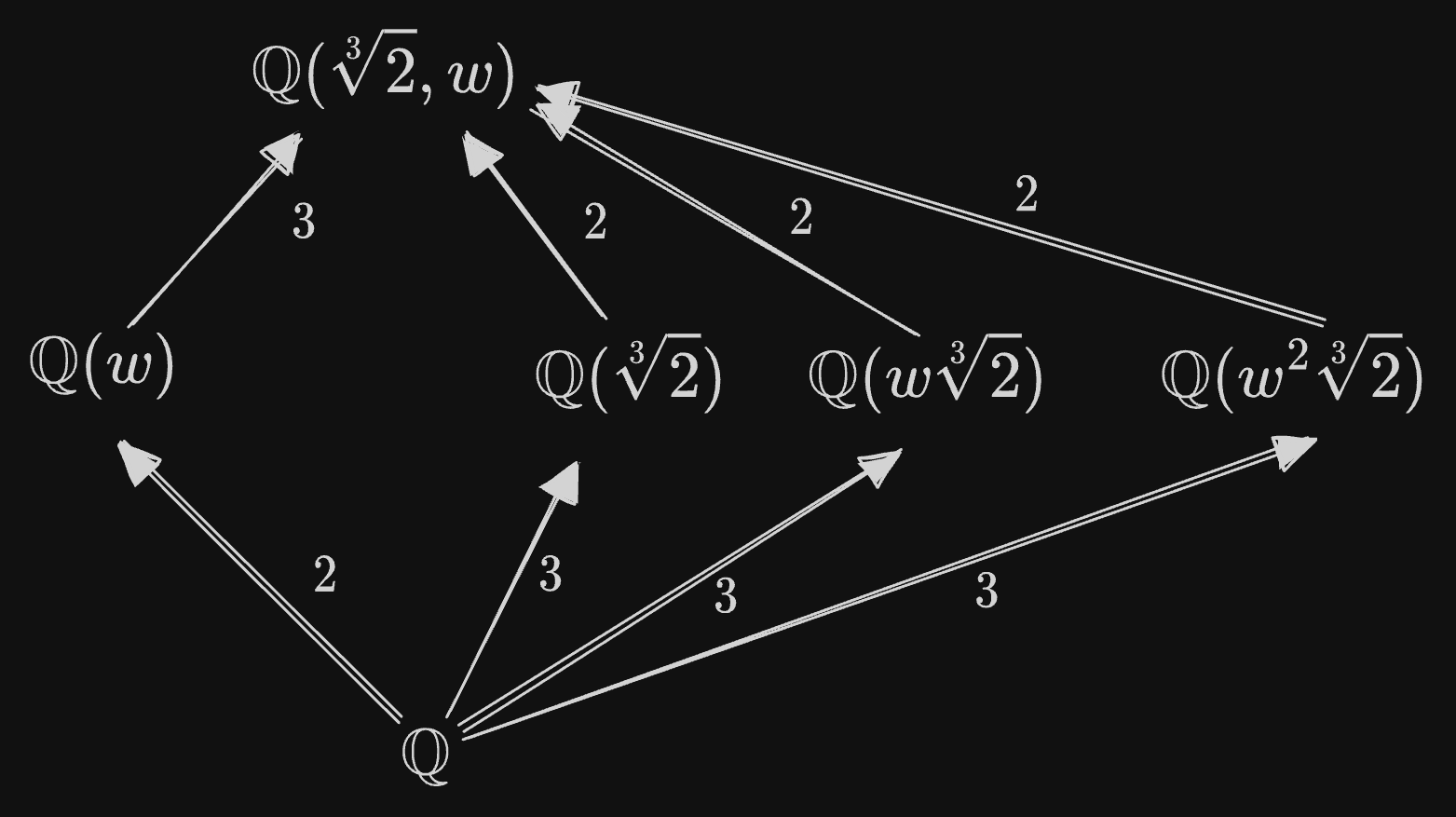
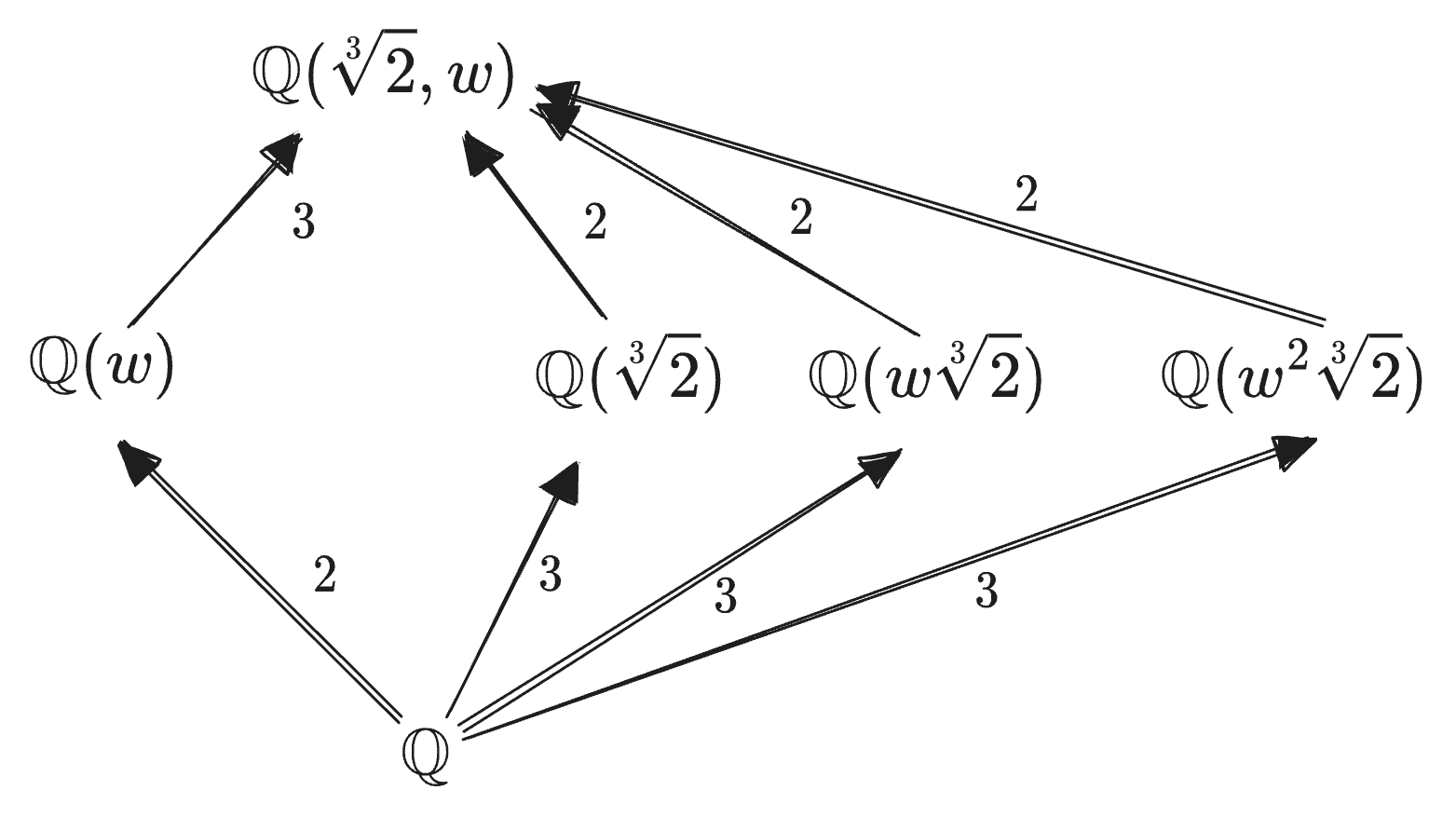
3 2 , 3 2 w , 3 2 w 2 , w = 2 i 3 − 1 = e 3 2 πi We know from examples in the previous section that E : = Q ( ∥ x 3 − 2 ) = Q ( 2 3 , w ) E:=\mathbb Q(\parallel x^3-2)=\mathbb Q(\sqrt[3]2, w) E := Q ( ∥ x 3 − 2 ) = Q ( 3 2 , w ) [ Q ( 2 3 , w ) : Q ] = 6 [\mathbb Q(\sqrt[3]2, w):\mathbb Q]=6 [ Q ( 3 2 , w ) : Q ] = 6 F : = Q F:=\mathbb Q F := Q
Note that E / ⊲ F E/_\lhd F E / ⊲ F E / ⊟ F E/_{\boxminus} F E / ⊟ F ( 2.9.12. b ) (2.9.12.b) ( 2.9.12. b ) ( 2.9.15. b ) (2.9.15.b) ( 2.9.15. b ) E / Gal F E/_\text{Gal}F E / Gal F ( 2.9.16 ) (2.9.16) ( 2.9.16 ) L = F L=F L = F H = Gal ( E / F ) H=\text{Gal}(E/F) H = Gal ( E / F ) ( 2.9.16. b ) (2.9.16.b) ( 2.9.16. b )
∣ Gal ( E / F ) ∣ = ∣ [ E : F ] ∣ = 6 |\text{Gal}(E/F)|=|[E:F]|=6 ∣ Gal ( E / F ) ∣ = ∣ [ E : F ] ∣ = 6 It can be shown that the only groups of order 6 are Z 6 \Z_6 Z 6 S 3 S_3 S 3 { 1 , 2 , 3 } \{1, 2, 3 \} { 1 , 2 , 3 }
We know from the examples in the previous section that Q ( 2 3 ) / Q \mathbb Q(\sqrt[3]2)/\mathbb Q Q ( 3 2 ) / Q ( 2.9.16. c ) (2.9.16.c) ( 2.9.16. c ) Z 6 \Z_6 Z 6
Gal ( E / F ) = S 3 = { ( 1 ) , ( 1 2 ) , ( 1 3 ) , ( 2 3 ) , ( 1 2 3 ) , ( ( 1 3 2 ) ) }
\text{Gal}(E/F)=S_3=\{(1), (1\,2),(1\,3),(2\,3), (1\,2\,3), ((1\,3\,2))\}
Gal ( E / F ) = S 3 = {( 1 ) , ( 1 2 ) , ( 1 3 ) , ( 2 3 ) , ( 1 2 3 ) , (( 1 3 2 ))} The proper non-trivial subgroups of this group are:
H 1 = { ( 1 ) , ( 1 2 ) } H 2 = { ( 1 ) , ( 1 3 ) } H 3 = { ( 1 ) , ( 2 3 ) } H 4 = { ( 1 ) , ( 1 2 3 ) , ( 1 3 2 ) } H_1=\{(1), (1\,2)\} \\
H_2=\{(1), (1\,3)\} \\
H_3=\{(1), (2\,3)\} \\
H_4=\{(1), (1\,2\,3), (1\,3\,2)\} \\ H 1 = {( 1 ) , ( 1 2 )} H 2 = {( 1 ) , ( 1 3 )} H 3 = {( 1 ) , ( 2 3 )} H 4 = {( 1 ) , ( 1 2 3 ) , ( 1 3 2 )} We can simplify the structure if we define τ : = ( 1 2 ) , σ : = ( 1 2 3 ) \tau:=(1\,2), \sigma:=(1\,2\,3) τ := ( 1 2 ) , σ := ( 1 2 3 ) ( 1 3 ) = σ τ , ( 2 3 ) = σ 2 τ (1\,3)=\sigma \tau, (2\,3) = \sigma^2\tau ( 1 3 ) = σ τ , ( 2 3 ) = σ 2 τ
H 1 = ⟨ τ ⟩ G H 2 = ⟨ σ τ ⟩ G H 3 = ⟨ σ 2 τ ⟩ G H 4 = ⟨ σ ⟩ G H_1=\lang \tau \rang_G \\
H_2=\lang \sigma \tau \rang_G \\
H_3=\lang \sigma^2 \tau \rang_G \\
H_4=\lang \sigma \rang_G \\ H 1 = ⟨ τ ⟩ G H 2 = ⟨ σ τ ⟩ G H 3 = ⟨ σ 2 τ ⟩ G H 4 = ⟨ σ ⟩ G Note that ord σ = 3 , ord τ = 2 \text{ord }\sigma = 3, \text{ord }\tau = 2 ord σ = 3 , ord τ = 2
Now let's take a look at the F F F E E E 2 3 \sqrt[3]2 3 2 w w w p o l F ( 2 3 ) = x 3 − 2 , p o l F ( w ) = x 3 − 1 \mathfrak {pol}_F(\sqrt[3]2)=x^3-2, \mathfrak {pol}_F(w)=x^3-1 pol F ( 3 2 ) = x 3 − 2 , pol F ( w ) = x 3 − 1 2 3 \sqrt[3]2 3 2 { 2 3 , w 2 3 , w 2 2 3 } \{\sqrt[3]2, w\sqrt[3]2, w^2\sqrt[3]2\} { 3 2 , w 3 2 , w 2 3 2 } w w w { w , w 2 } \{w, w^2\} { w , w 2 } w w w 1 1 1 1 ∈ F 1 \in F 1 ∈ F F F F
σ : 2 3 ↦ w 2 3 , w ↦ w τ : 2 3 ↦ 2 3 , w ↦ w 2 \sigma: \sqrt[3]2 \mapsto w\sqrt[3]2, w \mapsto w \\
\tau: \sqrt[3]2 \mapsto \sqrt[3]2, w \mapsto w^2 \\ σ : 3 2 ↦ w 3 2 , w ↦ w τ : 3 2 ↦ 3 2 , w ↦ w 2 Note that σ \sigma σ 2 3 , w 2 3 , w 2 2 3 \sqrt[3]2, w\sqrt[3]2, w^2\sqrt[3]2 3 2 , w 3 2 , w 2 3 2 ( 1 2 3 ) (1\,2\,3) ( 1 2 3 ) τ \tau τ w w w w 2 w^2 w 2 w 2 3 w \sqrt[3]2 w 3 2 w 2 2 3 w^2\sqrt[3]2 w 2 3 2 ( 1 2 ) (1\,2) ( 1 2 )
Finally let's see what fields are fixed by Galois subgroups:
H 1 = ⟨ τ ⟩ G ⟹ L 1 = Fix H 1 ( Q ( 2 3 , w ) ) = Q ( 2 3 ) H 2 = ⟨ σ τ ⟩ G ⟹ L 2 = Fix H 2 ( Q ( 2 3 , w ) ) = Q ( w 2 2 3 ) H 3 = ⟨ σ 2 τ ⟩ G ⟹ L 3 = Fix H 3 ( Q ( 2 3 , w ) ) = Q ( w 2 3 ) H 4 = ⟨ σ ⟩ G ⟹ L 4 = Fix H 4 ( Q ( 2 3 , w ) ) = Q ( w )
H_1=\lang \tau \rang_G \implies L_1=\text{Fix}_{H_1}(\mathbb Q(\sqrt[3]2, w))=\mathbb Q(\sqrt[3]2) \\
H_2=\lang \sigma\tau \rang_G \implies L_2=\text{Fix}_{H_2}(\mathbb Q(\sqrt[3]2, w))=\mathbb Q( w^2\sqrt[3]2) \\
H_3=\lang \sigma^2 \tau \rang_G \implies L_3=\text{Fix}_{H_3}(\mathbb Q(\sqrt[3]2, w))=\mathbb Q( w\sqrt[3]2) \\
H_4=\lang \sigma \rang_G \implies L_4=\text{Fix}_{H_4}(\mathbb Q(\sqrt[3]2, w))=\mathbb Q(w) H 1 = ⟨ τ ⟩ G ⟹ L 1 = Fix H 1 ( Q ( 3 2 , w )) = Q ( 3 2 ) H 2 = ⟨ σ τ ⟩ G ⟹ L 2 = Fix H 2 ( Q ( 3 2 , w )) = Q ( w 2 3 2 ) H 3 = ⟨ σ 2 τ ⟩ G ⟹ L 3 = Fix H 3 ( Q ( 3 2 , w )) = Q ( w 3 2 ) H 4 = ⟨ σ ⟩ G ⟹ L 4 = Fix H 4 ( Q ( 3 2 , w )) = Q ( w ) Let's see for example why L 2 = Q ( w 2 2 3 ) L_2 = \mathbb Q( w^2\sqrt[3]2) L 2 = Q ( w 2 3 2 ) w 2 2 3 w^2\sqrt[3]2 w 2 3 2 σ τ ( w 2 2 3 ) = σ ( τ ( w 2 2 3 ) ) = σ ( w 2 3 ) = w 2 2 3 \sigma \tau(w^2\sqrt[3]2)=\sigma(\tau(w^2\sqrt[3]2))=\sigma(w\sqrt[3]2)=w^2\sqrt[3]2 σ τ ( w 2 3 2 ) = σ ( τ ( w 2 3 2 )) = σ ( w 3 2 ) = w 2 3 2 σ τ \sigma \tau σ τ ⟨ σ τ ⟩ G \lang \sigma \tau \rang_G ⟨ σ τ ⟩ G
On the final note: it's easy to see that H 1 ≅ H 2 , ≅ H 3 H_1 \cong H_2, \cong H_3 H 1 ≅ H 2 , ≅ H 3 L 1 ≅ L 2 ≅ L 3 L_1 \cong L_2 \cong L_3 L 1 ≅ L 2 ≅ L 3
It might seem strange that [ Q ( w ) : Q ] = 2 [\mathbb Q(w):\mathbb Q]=2 [ Q ( w ) : Q ] = 2 w w w x 3 − 1 x^3-1 x 3 − 1 w 2 = − 1 − w w^2 = -1-w w 2 = − 1 − w
The only normal subgroup is ⟨ σ ⟩ G \lang \sigma \rang_G ⟨ σ ⟩ G Q \mathbb Q Q Q ( w ) \mathbb Q(w) Q ( w )