3.1 Topological, affine and projective spaces

Topological spaces

We want to start our discussion of algebraic geometry with defining the most abstract geometrical notion of a topological space.

def: Topological space (closed sets)

XSTcclass of subsets of X with properties:1.,XTc2.YiTc    i=1nYiTc3.YiTc    iYiTc(X,Tc)Ttopological spaceYTc    Yclosed set\begin{align*} &\sphericalangle \\ &X \in \mathcal S \\ &T^c - \text{class of subsets of } X \text{ with properties:}\\ \text{1.} \,\, &\empty, X \in T^c \\ \text{2.} \,\,& Y_i \in T^c \implies \bigcup_{i=1}^nY_i \in T^c \\ \text{3.} \,\,& Y_i \in T^c \implies \bigcap_{i}Y_i \in T^c\\ \hline \\ &(X, T^c) \in \mathcal T - \text{topological space} \\ &Y \in T^c \implies Y - \text{closed set} \\ \end{align*}

Each element of TcT^c is called a closed set. If YTcY \in T^c then U=XYU = X \setminus Y is an open set. We can equivalently define the topology of open sets

def: Topological space (open sets)

XSTo(X)class of subsets of X with properties:1.,XTo2.UiTo    i=1nUiTo3.UiTo    iUiTo(X,To)Ttopological space of open setsUTo    Uopen set\begin{align*} &\sphericalangle \\ &X \in \mathcal S \\ &T^o(X) - \text{class of subsets of } X \text{ with properties:}\\ \text{1.} \,\, &\empty, X \in T^o \\ \text{2.} \,\,& U_i \in T^o \implies \bigcap_{i=1}^nU_i \in T^o \\ \text{3.} \,\,& U_i \in T^o \implies \bigcup_{i}U_i \in T^o\\ \hline \\ &(X, T^o ) \in \mathcal T - \text{topological space of open sets} \\ &U \in T^o \implies U - \text{open set} \\ \end{align*}
note

The topological space of closed sets and open sets describe essentially the same thing in two different ways. We can always convert topology of open sets to topology of closed sets and vice versa since:

UTo    XUTcU \in T^o \iff X \setminus U \in T^c

When we have some topology TcT^c we will denote the corresponding open topology by ToT^o. If there's ambiguity about what is the underlying topology is we'll write To(Tc)T^o(T^c) where TcT^c is the underlying closed set topology that is converted to open.

note

Further we'll use the notation (X,T)T(X, T) \in \mathcal T to denote topological space. And then we'll use superscript TcT^c for closed sets and ToT^o for open sets.

In a topological space, a topology can be induced on any subset in the following way:

def: Topological subspace

(X,T)TYXTYc:={YY,YTc}TYo:={YY,YTo}(Y,TY) topological subspaceTYcinduced topology of closed sets TYoinduced topology of open sets \begin{align*} &\sphericalangle \\ &(X, T) \in \mathcal T \\ &Y \subseteq X \\ & T^c_{|Y}:= \{Y' \cap Y, Y' \in T^c\} \\ & T^o_{|Y}:= \{Y' \cap Y, Y' \in T^o\} \\ \hline \\ & (Y, T_{|Y}) - \text{ topological subspace} \\ & T^c_{|Y} - \text{induced topology of closed sets } \\ & T^o_{|Y} - \text{induced topology of open sets } \\ \end{align*}

Next we want to define the basic building blocks of topological spaces akin to primes in numbers and irreducible polynomials in polynomials:

def: Irreducible space

(X,T)TXY1,Y2Tc:Y1X,Y2X,X=Y1Y2(X,T)T\begin{align*} &\sphericalangle \\ &(X, T) \in \mathcal T \\ &X \ne \empty \\ & \nexists Y_1, Y_2 \in T^c: Y_1 \subset X, Y_2 \subset X, X = Y_1 \cup Y_2 \\ \hline \\ &(X, T) \in \mathcal T^{-} \end{align*}

def: Irreducible set

(X,T)TYX(Y,TY)TYS\begin{align*} &\sphericalangle \\ &(X, T) \in \mathcal T \\ & Y \subseteq X \\ &(Y, T_{|Y}) \in \mathcal T^{-} \\ \hline \\ &Y \in S^- \end{align*}

def: Closed and open spaces

(X,T)TYTcUTo(Y,TY)Tcclosed space(U,TU)Toopen space\begin{align*} &\sphericalangle \\ &(X, T) \in \mathcal T \\ &Y \in T^c \\ &U \in T^o \\ \hline \\ &(Y, T_{|Y}) \in \mathcal T^c - \text{closed space} \\ &(U, T_{|U}) \in \mathcal T^o - \text{open space} \end{align*}

Finally, similar to generators of groups and ideals we can define minimal topological sets containing other sets:

def: Set closure

(X,T)TYXY:=YTc,YYY\begin{align*} &\sphericalangle \\ &(X, T) \in \mathcal T \\ &Y \subseteq X \\ \hline \\ &\overline Y := \bigcap_{Y'\in T^c, Y' \supseteq Y} Y' \\ \end{align*}
note

By property 3 of topology YTc\overline Y \in T^c.

def: Dense set

(X,T)TYXY=XYdense\begin{align*} &\sphericalangle \\ &(X, T) \in \mathcal T \\ &Y \subseteq X \\ &\overline Y = X \\ \hline \\ &Y - \text{dense} \end{align*}

Proposition 3.1.1: Non-empty open set in irreducible closed space is dense and irreducible

(X,T)Tc,UTo,UU=XUX\begin{align*} &\sphericalangle \\ &(X, T) \in \mathcal T^{c,-} \\ & U \in T^o, U \ne \empty \\ \hline \\ &\begin{align*} & \overline U = X \hspace{0.5cm} \tag{a}\\ & U \in X^- \hspace{0.5cm} \tag{b}\\ \end{align*} \end{align*}

Proof

a.

Since X=U(XU)X = \overline U \cup (X \setminus U) and XX is irreducible this means that either U=X\overline U = X or XU=XX \setminus U = X. The latter is impossible since UU \ne \empty, so U=X\overline U = X.

b.

If we have U=X1X2=(UX1)(UX2)=U(X1X2),XiTc,XiXU = X_1 \cup X_2=(U \cap X_1) \cup (U \cap X_2) = U \cap (X_1 \cup X_2), X_i \in T^c, X_i \subset X then UX1X2,X1X2TcU \subseteq X_1 \cup X_2, X_1 \cup X_2 \in T_c so X=U=X1X2=X1X2X=\overline U = \overline{X_1 \cup X_2}=X_1 \cup X_2 which is contradiction to irreducibility of SS.

\square

Proposition 3.1.2: The closure or irreducible set is irreducible

(X,T)TZSZS\begin{align*} &\sphericalangle \\ &(X, T) \in \mathcal T \\ & Z \in S^- \\ \hline \\ &\overline Z \in S^- \end{align*}

Proof

Assume Z=X1X2,XiTZc,XiZ\overline Z = X_1 \cup X_2, X_i \in T^c_{|\overline Z}, X_i \subset \overline Z. Then X1X2=ZX    Z=Z(X1X2)=(X1Z)(X2Z)=X1X2,XiTXcX_1 \cup X_2 = \overline Z \supseteq X \implies Z = Z \cap(X_1 \cup X_2)= (X_1 \cap Z) \cup (X_2 \cap Z) = X_1' \cup X_2', X_i' \in T^c_{|X}.

Note that if XiZX_i \supseteq Z then ZXi\overline Z \subseteq X_i which contradicts XiZX_i \subset \overline Z. So XiZX_i \nsupseteq Z and XiZX_i' \subset Z.

\square

def: Noetherian topological space

(X,T)TYiTcY1Y2    n:Yn=Yn+1=(X,T)TN\begin{align*} &\sphericalangle \\ &(X, T) \in \mathcal T \\ &Y_i \in T^c \\ &Y_1 \supseteq Y_2 \supseteq \ldots \implies \exists n: Y_n=Y_{n+1}=\ldots \\ \hline \\ &(X, T) \in \mathcal T^{\mathcal N} \\ \end{align*}

Proposition 3.1.3: Each closed set is a finite union of irreducible closed sets

(X,T)TNYTc!Y1,Yk:YiYj,YiSTc,Y=Y1Yk\begin{align*} &\sphericalangle \\ &(X, T) \in \mathcal T^{\mathcal N} \\ & Y \in T^c \\ \hline \\ &\exists! Y_1, \ldots Y_k: Y_i \nsubseteq Y_j, Y_i \in S^- \cap T^c, Y = Y_1 \cup \ldots \cup Y_k \end{align*}

Proof

Existence

Let X:={VTc:V,ViSTc:V=V1Vn}\mathfrak X:= \{V \in T^c: V \ne \empty, \nexists V_i \in S^- \cap T^c: V = V_1 \cup \ldots \cup V_n\}. Assume X\mathfrak X \ne \empty. Then since (X,T)TN(X, T) \in \mathcal T^{\mathcal N} by Zorn's lemma there's a minimal by inclusion set YXY \in \mathfrak X. Since by construction YSTcY \notin S^- \cap T^c (otherwise trivially V1=YV_1=Y) we can write Y1,Y2Tc:Y=Y1Y2\exists Y_1, Y_2 \in T^c: Y = Y_1 \cup Y_2. Since YY is minimal in X\mathfrak X it follows that Y1,Y2XY_1, Y_2 \notin \mathfrak X so there's a finite set of varities with the union equals to YiY_i. So YY is a finite union of irreducible closed sets as well which is a contradiction.

Finally in each representation we can throw out unnecessary YiY_i to achieve YiYjY_i \nsubseteq Y_j.

Uniqueness

Assume Y=Y1Yr=Y1Ys,Yi,YjV(S)Y = Y_1 \cup \ldots \cup Y_r = Y'_1 \cup \ldots \cup Y'_s, Y_i, Y'_j \in \mathcal V(S). Then Y1Y=Y1Yr    Y1=(Y1Y1)(Y1Yr)Y'_1 \subseteq Y = Y_1 \cup \ldots \cup Y_r \implies Y'_1=(Y'_1 \cap Y_1) \cup \ldots \cup (Y'_1 \cap Y_r).

If i:Y1Yi\forall i: Y'_1 \nsubseteq Y_i then (Y1Yi)Y1(Y'_1 \cap Y_i) \subset Y'_1 and Y1V(S)Y'_1 \notin \mathcal V(S) which is a contradiction. So i:Y1Yi\exists i: Y'_1 \subseteq Y_i. In the same way YiYjY_i \subseteq Y'_j so Y1YjY'_1\subseteq Y'_j but we know that YiYjY_i \nsubseteq Y_j so j=1j=1 and Y1=YiY'_1=Y_i. By excluding Y1Y'_1 and YiY_i from representation and repeating the process we finish the proof.

\square

Proposition 3.1.4: Each open set is a finite union of open sets

(X,T)TNUToU1,,UkTo:U=U1Uk\begin{align*} &\sphericalangle \\ &(X, T) \in \mathcal T^{\mathcal N} \\ & U \in T^o \\ \hline \\ &\exists U_1, \ldots, U_k \in T^o: U = U_1 \cup \ldots \cup U_k \end{align*}

Proof

Take some cover Y\mathfrak Y of UU. If that's infinite then take all distinct UiU_i from it and consider Vn=i=1nUiV_n = \bigcup_{i=1}^n U_i. This means that V1V2...V_1 \subseteq V_2 \subseteq ... . and (XV1)(XV2)...(X \setminus V_1) \supseteq (X \setminus V_2) \supseteq .... Since (X,T)TN(X, T) \in \mathcal T^{\mathcal N} and XViTcX \setminus V_i \in T^c we know that n:kn    XVk=XVn    Vk=Vn\exists n: k\ge n \implies X \setminus V_k=X \setminus V_n \implies V_k=V_n. So we have a finite cover U1,,UnU_1, \ldots, U_n

\square

Affine and projective spaces

After defining the abstract notion of topological space we can move to defining more concrete examples of geometrical spaces.

def: Affine space

An:={(x1,...,xn),xiF,FF}\begin{align*} &\mathbb{A}^n:=\{(x_1, ..., x_n), x_i \in \overline{F}, F \in \mathcal F\} \end{align*}

Note that AnFn\mathbb{A}^n \equiv \overline{F}^n, but we prefer to use the An\mathbb{A}^n notation. This is to emphasize that we're talking about a set that doesn't have any additional structure or properties.

Note that we consider affine (and projective) space on top of algebraically closed field F\overline F.

def: Projective space

(x0,,xn),(y0,,yn)Fn+1(0,,0)P:(x0,,xn)P(y0,,yn)    λF:(x0,,xn)=(λy0,,λyn)Pn:={[x0,...,xn]P} projective space\begin{align*} &\sphericalangle \\ &(x_0, \ldots, x_n), (y_0, \ldots, y_n) \in \overline{F}^{n+1} \setminus (0, \ldots, 0) \\ &\sim_P: (x_0, \ldots, x_n) \sim_P (y_0, \ldots, y_n) \iff \exists \lambda \in \overline{F}^*: (x_0, \ldots, x_n) = (\lambda y_0, \ldots, \lambda y_n) \\ \hline \\ &\mathbb{P}^n:=\{[x_0, ..., x_n]_{\sim_P}\} - \text{ projective space} \end{align*}

Recall that [x0,...,xn][x_0, ..., x_n]_{\sim} is the notation for equivalence class.

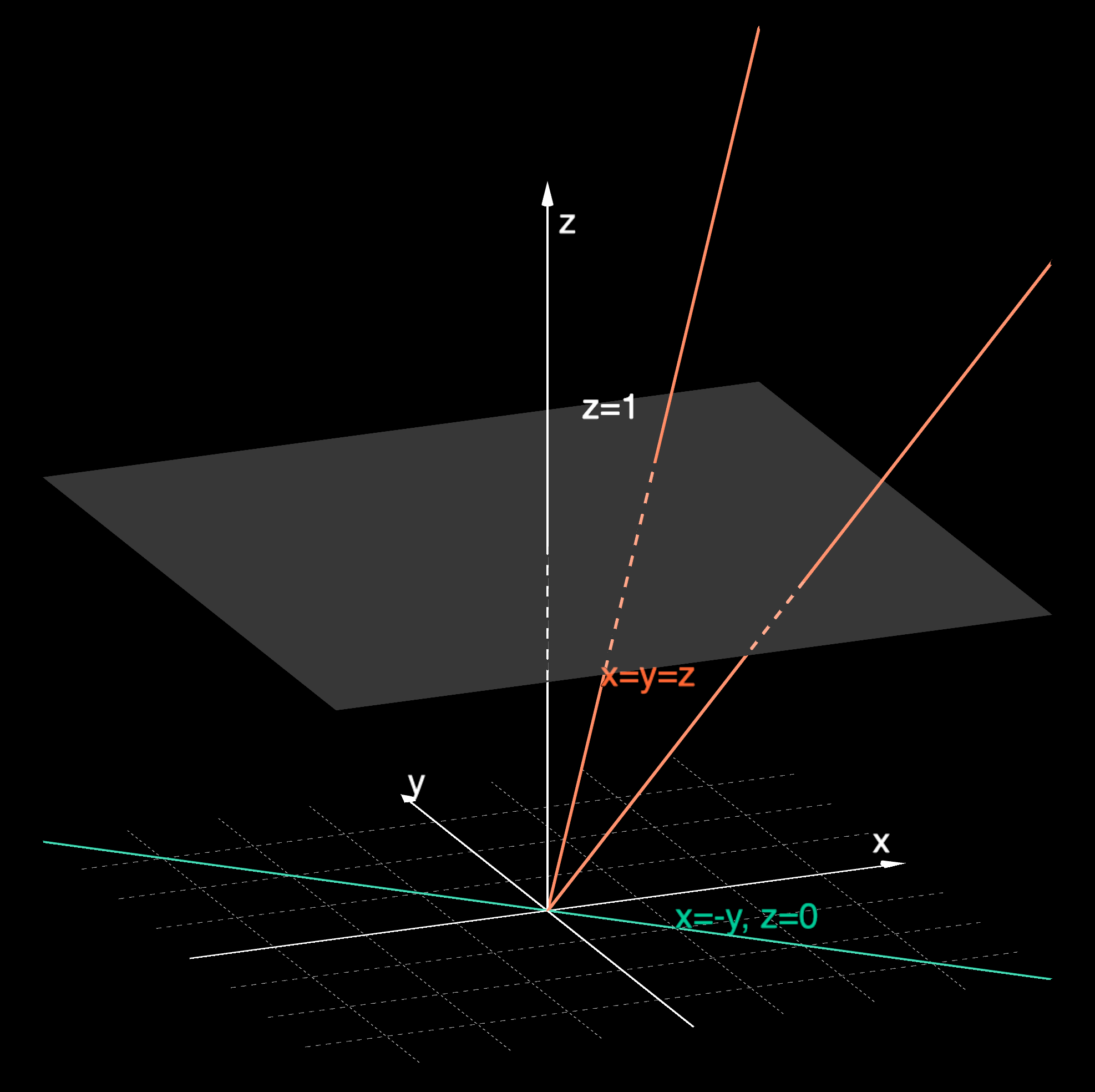
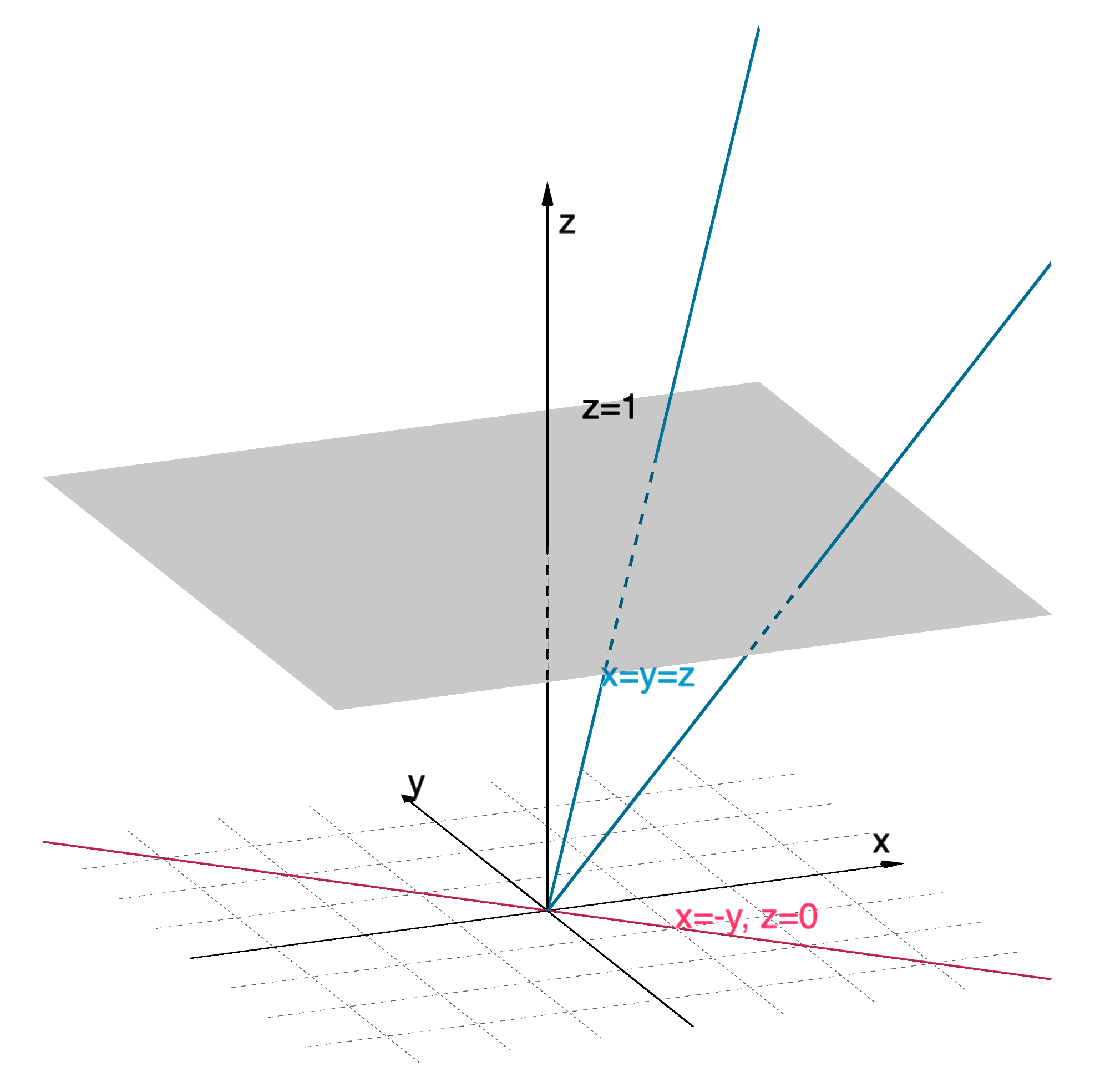
Below is the example of P2\mathbb P^2:

Projective plane

Projective plane

Note that this each point in P2\mathbb P^2 is a line in 3D-space. But we can make a bijection between these lines and the dots of A2\mathbb A^2 via crossings of these lines and the plane z=1z=1. This will cover all A2\mathbb A^2 but there will be some points of P2\mathbb P^2 that are not mapped. Namely the lines that lie in z=0z=0 plane.

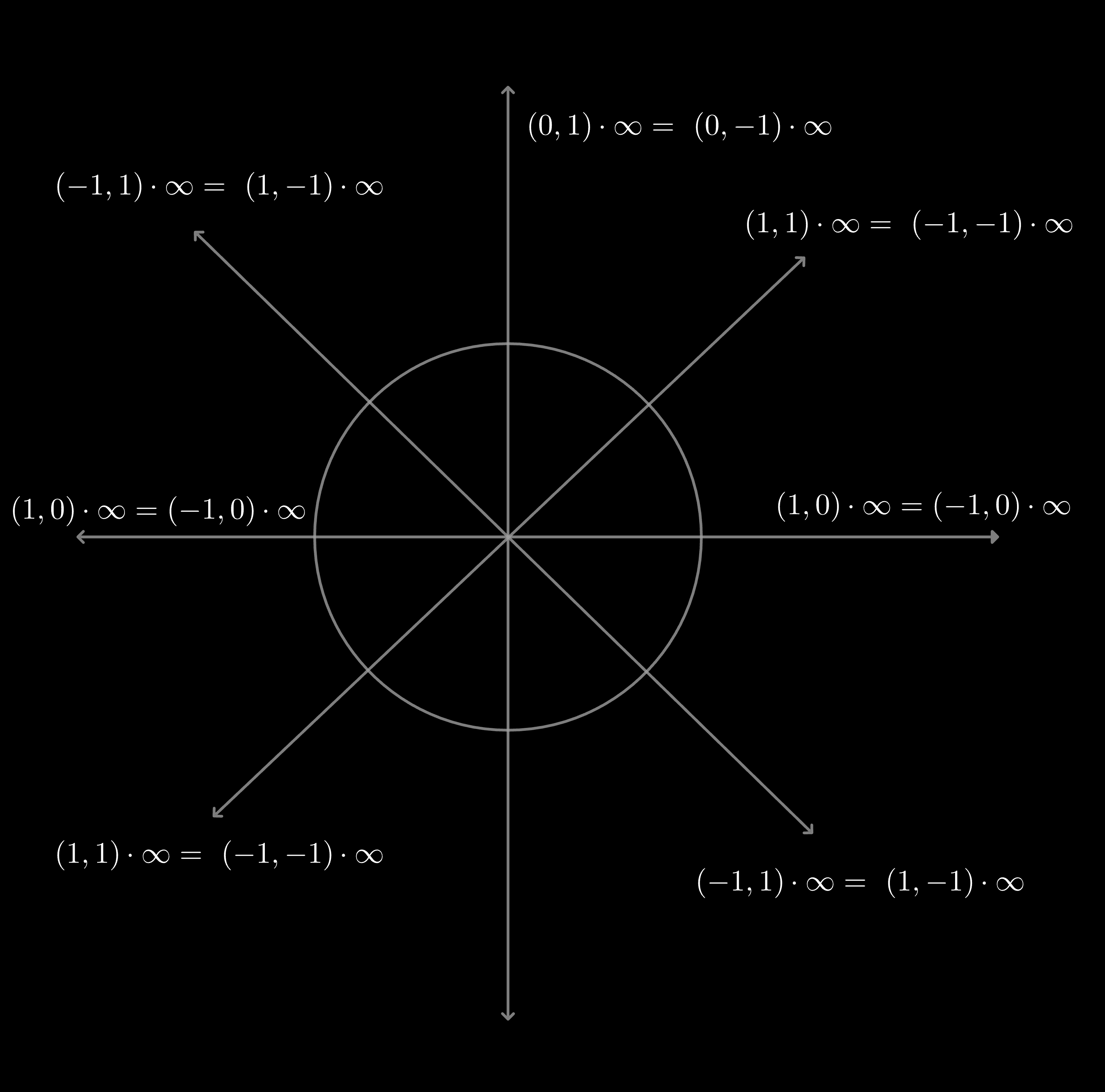
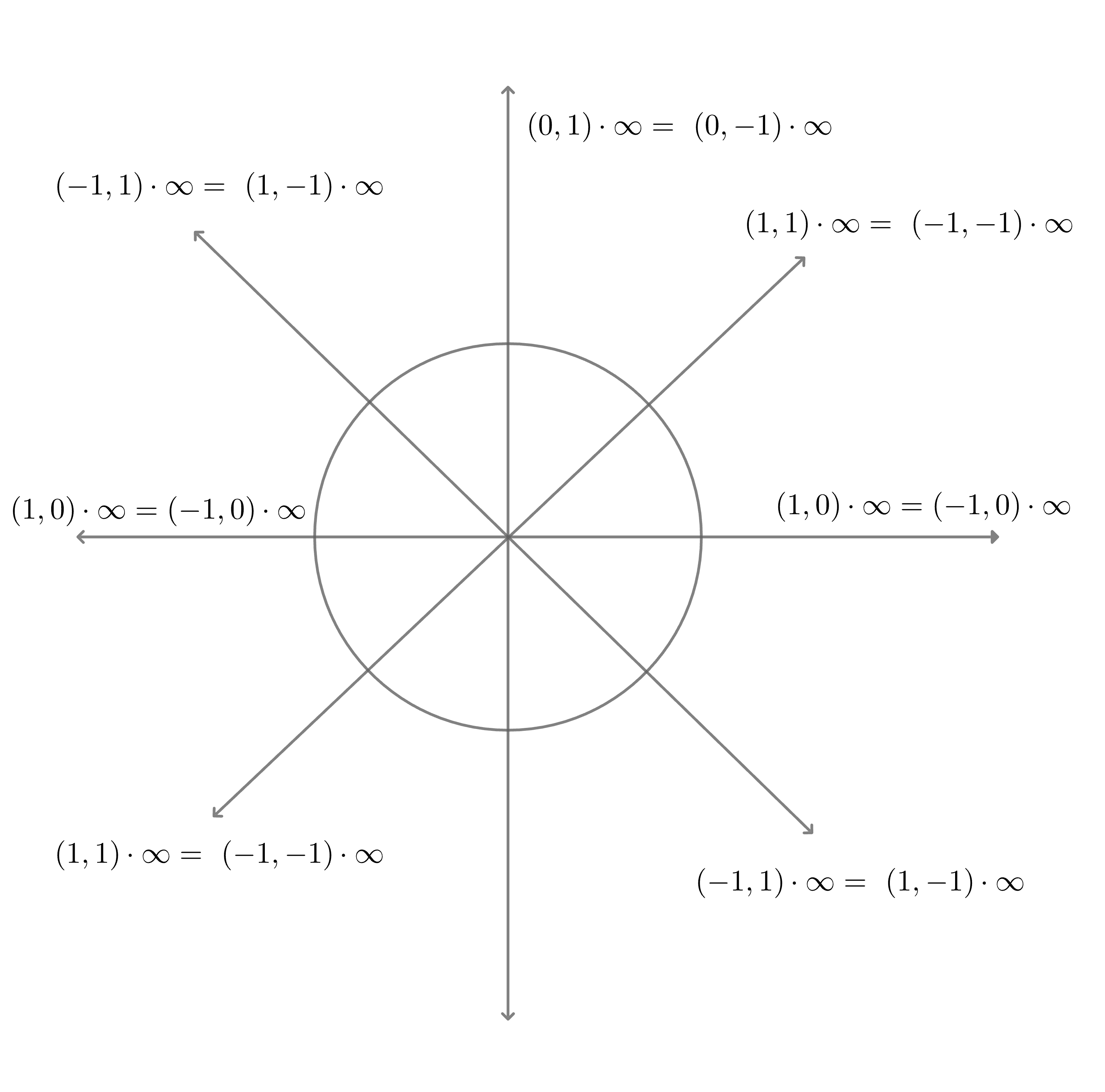
These lines are conceptualized as points of infinity in P2\mathbb P^2 (note they sort of cross z=1z=1 in infinity). But they're not just regular ±\pm \infty. Rather they are a set of directional infinities. Note that we can actually project these infinities into half-circle in the plane so each infinity point will correspond to some point of half circle specifying the direction. This means that we don't distinguish between ++\infty and -\infty because they will lie in the same line.

Projective plane infinities

Projective plane infinities

Note that in P1\mathbb P^1 the only point of infinity will be ±\pm \infty.

So overall we can consider Pn\mathbb P^n as An\mathbb A^n plus some points of infinity. This makes Pn\mathbb P^n closed in some sense like we made algebraic closures and thus having some nice properties and theorems in it.

On the final note - one benefit of projective spaces is we can actually choose any plane to map it to A2\mathbb A^2. In the picture above if we choose z=1z=1 for projection then we'll have one infinity point. On the other hand if we choose y=1y=1 then all points will be finite in A2\mathbb A^2.

note

When we use illustration for spaces like A2\mathbb A^2 and P2\mathbb P^2 we draw it as plane or a 3d space. However, note that we need 4 dimensions to draw proper A2\mathbb A^2 and 6 dimensions for P2\mathbb P^2. Why? Remeber that we are looking at spaces over algebraically closed fields. Since R=C\overline \R = \mathbb C we actually need to make illustrations over the complex numbers. But we'll stick to traditional 2d and 3d pictures for illustrative purposes.

note

In the following sections we'll use the notation Sn\mathbb S^n for either of An\mathbb A^n or Pn\mathbb P^n.

Additionally if we want to say that some topological space lives inside affine space (for example) we'll use the following notation:

An(X,T)T\begin{align*} &\sphericalangle \\ &\mathbb A^n \\ &(X, T) \in \mathcal T \\ \hline \\ & \end{align*}

Zero sets

def: Affine zero set

An,PF[x1,...,xn]Z(P):={XAn:fT    f(X)=0}\begin{align*} &\sphericalangle \\ &\mathbb{A}^n,\\ &P \subseteq \overline{F}[x_1, ..., x_n] \\ \hline \\ &Z(P) :=\{X \in \mathbb{A}^n: \forall f\in T \implies f(X)=0\} \end{align*}

Example: Finite affine vanishing set

Let F=R,P={x2+y2,x2y1}F=\mathbb{R}, P=\{x^2+y^2, x-2y-1\}. Let's find the set Z(P)Z(P).

{x2+y2=0x2y1=0    5y2+4y+1=0    {x=1±2i5y=2±i5\begin{cases} x^2+y^2=0 \\ x-2y-1=0 \end{cases} \implies 5y^2+4y+1=0 \implies \begin{cases} x=\frac{1 \pm 2i}{5} \\ y=\frac{-2\pm i}{5} \end{cases} Z(P)={(1+2i5,2+i5),(12i5,2i5)}Z(P)=\{(\frac{1 + 2i}{5}, \frac{-2 + i}{5}), (\frac{1 - 2i}{5}, \frac{-2 - i}{5})\}

Note that Z(P)Z(P) is composed of complex numbers. This is because, as highlighted at the outset of this chapter, we are always considering F\overline{F} rather than FF. Since F=RF = \mathbb{R}, it follows that F=C\overline{F} = \mathbb{C}.

Example 2: Infinite affine vanishing set

Let F=R,P={x2+y2}F=\mathbb{R}, P=\{x^2+y^2\}. In this case y=±ixy=\pm ix and Z(P)Z(P) are two lines in the complex plane.

Next we want to define vanishing sets for projective spaces. However if we do it in the exact same way as for affine spaces we'll have a problem. Namely the polynomials f([x0,,xn])f([x_0, \ldots, x_n]) will have different values depending on the representative of the equivalence class [x0,,xn][x_0, \ldots, x_n]. This can be resolved if we require for polynomials of vanishing set being homogeneous. In other words, if we consider a set of polynomials as a graded ring

F[x0,,xn]=d=0F[x0,,xn]d,F[x0,,xn]dF[x0,,xn]eF[x0,,xn]d+e\overline{F}[x_0, \ldots, x_n]=\bigoplus_{d=0}^{\infty}\overline{F}[x_0, \ldots, x_n]_d, \\ \overline{F}[x_0, \ldots, x_n]_d\overline{F}[x_0, \ldots, x_n]_e \subseteq \overline{F}[x_0, \ldots, x_n]_{d+e}

We want the polynomials to be in F[x0,,xn]d\overline{F}[x_0, \ldots, x_n]_d for some dd (dd can have different values in the same set of polynomials). In this case [x0,,xn][y0,,yn]    (x0,,xn)=(λy0,,λyn),λ0[x_0, \ldots, x_n] \sim [y_0, \ldots, y_n] \implies (x_0, \ldots, x_n)=(\lambda y_0, \ldots, \lambda y_n), \lambda \ne 0. And if fF[x0,,xn]df \in \overline{F}[x_0, \ldots, x_n]_d then f(x0,,xn)=0    λdf(x0,,xn)=f(λx0,,λxn)=f(y0,,yn)f(x_0, \ldots, x_n)=0 \iff \lambda^d f(x_0, \ldots, x_n)= f(\lambda x_0, \ldots, \lambda x_n) = f(y_0, \ldots, y_n). So we have the following definition:

def: Projective zero set

Pn,F[x0,,xn]=d=0F[x0,,xn]dPd=0F[x0,,xn]dZ(P):={YPn:fP    f(Y)=0}\begin{align*} &\sphericalangle \\ &\mathbb{P}^n,\\ &\overline{F}[x_0, \ldots, x_n]=\bigoplus_{d=0}^{\infty}\overline{F}[x_0, \ldots, x_n]_d \\ &P \subseteq \bigcup_{d=0}^{\infty} \overline{F}[x_0, \ldots, x_n]_d \\ \hline \\ &Z(P) :=\{Y \in \mathbb{P}^n: \forall f\in P \implies f(Y)=0\} \end{align*}

Next, we want to expand the definition of zero set to ideals. For affine zero set this is trivial as ideal is just some set of polynomials over the affine space. So the definition is exactly the same.

For ideals in the projective space it is more complicated. Our requirement for the polynomials of zero set was that Pd=0F[x0,,xn]dP \subseteq \bigcup_{d=0}^{\infty} \overline{F}[x_0, \ldots, x_n]_d. This doesn't hold if PRF[x0,,xn]P \lhd_R \overline{F}[x_0, \ldots, x_n] because PP should be closed under multiplication on any polynomial including non-homogeneus so naturally it will contain non-homogeneous polynomials. To overcome this difficulty let's recall that by (2.5.13)    F[x0,,xn]RN    (2.4.9)p1,,pk:p1,,pkI=P(2.5.13) \implies \overline{F}[x_0, \ldots, x_n] \in \mathcal R^{\mathcal N} \overset{(2.4.9)}\implies \exists p_1, \ldots, p_k: \lang p_1, \ldots, p_k \rang_I = P. So if {p1,,pk}d=0F[x0,,xn]d\{p_1, \ldots, p_k\} \subseteq \bigcup_{d=0}^{\infty} \overline{F}[x_0, \ldots, x_n]_d then we can say Z(P)=Z(p1,,pkI):=Z({p1,,pk})Z(P)=Z(\lang p_1, \ldots, p_k \rang_I):=Z(\{ p_1, \ldots, p_k \}). Consider some polynomial gP,g(x0,,xn)=f(x0,,xn)pi(x0,,xn)g \in P, g(x_0, \ldots, x_n) = f(x_0, \ldots, x_n)p_i(x_0, \ldots, x_n). Note that if YZ(P)Y \in Z(P) then pi(Y)=0p_i(Y)=0. It's true that f(x)f(x) might be not homogeneous and thus undefined at YY. But we "sort of" don't care about it because g(Y)=f(Y)pi(Y)g(Y)=f(Y)p_i(Y) and pi(Y)=0p_i(Y)=0 and no matter what value f(Y)f(Y) takes we always have g(Y)=0g(Y)=0. So we introduce the following definitions:

def: Homogeneous ideal

PnIRF[x0,,xn]Pd=0F[x0,,xn]d,P<:I=PIIgrF[x0,,xn]\begin{align*} &\sphericalangle \\ &\mathbb P^n \\ &I \lhd_R \overline{F}[x_0, \ldots, x_n] \\ &\exists P \subseteq \bigcup_{d=0}^{\infty} \overline{F}[x_0, \ldots, x_n]_d, |P| < \infty: I = \lang P \rang_I \\ \hline \\ &I \lhd_{gr} \overline{F}[x_0, \ldots, x_n] \end{align*}
note

Homogeneous ideal is still an ideal. That is IgrF[x0,,xn]    IRF[x0,,xn]I \lhd_{gr} \overline{F}[x_0, \ldots, x_n] \implies I \lhd_{R} \overline{F}[x_0, \ldots, x_n]

Proposition 3.1.5: Homogeneous ideals properties

FFI1,I2grF[x0,,xn]I1I2grF[x0,,xn]I1+I2grF[x0,,xn]\begin{align*} &\sphericalangle \\ &F \in \mathcal F \\ &I_1, I_2 \lhd_{gr} \overline F[x_0, \ldots, x_n] \\ \hline \\ &\begin{align*} &I_1I_2 \lhd_{gr} F[x_0, \ldots, x_n] \hspace{0.5cm} \tag{a}\\ &I_1+I_2 \lhd_{gr} F[x_0, \ldots, x_n] \hspace{0.5cm} \tag{b}\\ \end{align*} \end{align*}

Proof

a.

Note that by (2.5.13)(2.5.13) F[x0,,xn]RN\overline F[x_0, \ldots, x_n] \in \mathcal R^{\mathcal N} so each ideal is finitely generated. So in (a)(a) we'll have an ideal that is generated by cross products, each cross product will be homogeneous.

b.

(2.3.4.b)    I1+I2=I1I2I(2.3.4.b) \implies I_1+I_2 = \lang I_1 \cup I_2 \rang_I so the generating set for I1+I2I_1+I_2 is homogeneous.

\square

def: Projective zero set of an ideal

PnIgrF[x0,,xn]Pd=0F[x0,,xn]d,P<:I=PIZ(I):=Z(P)\begin{align*} &\sphericalangle \\ &\mathbb P^n \\ &I \lhd_{gr} \overline{F}[x_0, \ldots, x_n] \\ &P \subseteq \bigcup_{d=0}^{\infty} \overline{F}[x_0, \ldots, x_n]_d, |P| < \infty: I = \lang P \rang_I \\ \hline \\ &Z(I):=Z(P) \end{align*}

We'll make a final note that any set PP can be turned into ideal PI\lang P \rang_I and as we discussed above Z(P)=Z(PI)Z(P)=Z(\lang P \rang_I). So instead of discussing zero sets of arbitrary polynomials subsets we can limits disucssions only to the zero sets of ideals for An\mathbb A^n and homogeneous ideals in Pn\mathbb P^n.

Proposition 3.1.6: Zero sets properties

An(or Pn)I1,I2,RF[x1,,xn](or I1,I2,grF[x0,,xn])I1I2    Z(I1)Z(I2)Z(I1I2In)=Z(I1)Z(I2)Z(In)Z(I1+I2+)=Z(I1)Z(I2)\begin{align*} &\sphericalangle \\ &\mathbb A^n (\text{or } \mathbb P^n) \\ &I_1, I_2, \ldots \lhd_R \overline F[x_1, \ldots, x_n] (\text{or } I_1, I_2, \ldots \lhd_{gr} \overline F[x_0, \ldots, x_n]) \\ \hline \\ &\begin{align*} &I_1 \subseteq I_2 \implies Z(I_1) \supseteq Z(I_2) \hspace{0.5cm} \tag{a} \\ &Z(I_1 I_2 \ldots I_n) = Z(I_1) \cup Z(I_2) \cup \ldots \cup Z(I_n) \hspace{0.5cm} \tag{b} \\ &Z(I_1 + I_2 + \ldots) = Z(I_1) \cap Z(I_2) \cap \ldots \hspace{0.5cm} \tag{c} \\ \end{align*} \end{align*}

Proof

a.

Follows from definition

b.

By (2.5.13)(2.5.13) we know that F[x1,,xn]RN\overline F[x_1, \ldots, x_n] \in \mathcal R^{\mathcal N} so each ideal is finitely generated. So I1InI_1\ldots I_n is generated by the cross products of the generating sets. It's easy to verify that in this case (b)(b) holds true.

For projective case we know from (3.1.5)(3.1.5) that I1I2IngrF[x0,,xn]I_1I_2 \ldots I_n \lhd_{gr} \overline F[x_0, \ldots, x_n], so the proof above is the same.

c.

I1+I2+I_1+I_2+\ldots is a finite linear combinations of terms from generating sets of I1,I2,I_1, I_2, \ldots (see (2.4.2),(2.3.4)(2.4.2), (2.3.4)). So we can always take polynomials from InI_n to prove Z(I1+I2+)Z(In)    Z(I1+I2+)Z(I1)Z(I2)Z(I_1 + I_2 + \ldots) \subseteq Z(I_n) \implies Z(I_1 + I_2 + \ldots) \subseteq Z(I_1) \cap Z(I_2) \cap \ldots. On the other hand if QZ(I1)Z(I2)Q \in Z(I_1) \cap Z(I_2) \cap \ldots it will be a zero for each Z(In)Z(I_n) and so of Z(I1+I2+)Z(I_1 + I_2 + \ldots).

For projective case we know from (3.1.5)(3.1.5) that I1+I2+grF[x0,,xn]I_1+I_2 +\ldots \lhd_{gr} \overline F[x_0, \ldots, x_n], so the proof above is the same.

\square

Lemma 3.1.7: Field extension that is finitely generated F-algebra is algebraic

E/FFEAid,FEfinitely generated F-algebraE/AF\begin{align*} &\sphericalangle \\ &E/F \in \mathcal F \\ &E \in \mathcal A_{\text{id}, F} \\ &E - \text{finitely generated } F\text{-algebra} \\ \hline \\ &E/_AF \end{align*}

Proof intuition

E/FE/F means that E=F(x1,,xn)E=F(x_1, \ldots, x_n) so xix_i should be in denominators. On the other hand since it's a finitely-generated algebra it should be polynomials so 1/xi1/x_i should be represented as a polynomial. It cannot be if xix_i is transcendental but can be if it's algebraic (like in Q(2)/Q\mathbb Q(\sqrt 2)/\mathbb Q we have 1/2=2/21/\sqrt 2 = \sqrt 2 / 2)

Proof

We will assume that E/TFE/_TF and prove that it cannot be a finitely generated FF-algebra.

Assume trdeg(E/F)=1\text{trdeg}(E/F)=1, that is E/AF(x)E/_AF(x), xx is the element of transcendence basis. Note that each element in EE is some polynomial over finite set of elements in EE with coefficents in FF.

eE    e=p(α1,,αn,x)e \in E \implies e = p(\alpha_1, \ldots, \alpha_n, x)

If we consider E/F(x)E/F(x) then each element in EE is a polynomial of algebraic elements with coefficients in F(x)F(x). Since each algebraic element have finite degree it follows that [E:F(x)]<[E:F(x)]< \infty. Let {e1,,el}BF(x)(E)\{e_1, \ldots, e_l\} \in \mathfrak B_{F(x)}(E) and write multiplication table:

eiej=kaijk(x)bijk(x)ek,aijk,bijkF[x]e_ie_j=\sum_k\frac{a_{ijk}(x)}{b_{ijk}(x)}e_k, a_{ijk}, b_{ijk} \in F[x]

Now consider some arbitrary f1,fmEf_1, \ldots f_m \in E and add f0=1f_0 = 1 to it. Let AA be the FF-algebra they generate. We want to prove that it's smaller than EE, so EE cannot be finitely-generated FF-algebra. In terms of our basis:

fi=jcij(x)dij(x)ej,cij,dijF[x]f_i = \sum_j \frac{c_{ij}(x)}{d_{ij}(x)}e_j, c_{ij}, d_{ij} \in F[x]

Consider some element aAa \in A - it's a linear combination of f0=1f_0=1 and some products of f1,,fmf_1, \ldots, f_m. If we apply the multiplication table of eieje_ie_j we'll see that aa is some F(x)F(x)-linear combination of eie_i where denominators are only bijkb_{ijk} and dijd_{ij}. In other words for any aAa \in A as a linear combination of eie_i all irreducible factors in denominators are from bb and dd.

Next note that the set of fif_i is finite so we'll have a finite number of irreducibles in denominator. So z:=1/some other irreduciblez:=1/\text{some other irreducible} will have it in denominator and therefore cannot be expressed as a polynomial in fif_i. Note that by (2.4.12)(2.4.12) irreducible = prime in F[x]F[x] which is a UFD. So we can use similar argument showing there are infinitely many primes (or irreducibles) in F[x]F[x] (if there's a finite number of primes p1,,pnp_1, \ldots, p_n then pn+1=p1pn+1p_{n+1}=p_1 \cdot \ldots \cdot p_n+1 is a prime).

Finally for trdeg(E/F)>1\text{trdeg}(E/F)>1 we can choose subextension of trdeg(E/F)=1\text{trdeg}(E/F)=1 that will be algebraic by the above, hence contradiction.

\square

Proposition 3.1.8: Weak Zero point theorem (Nullstellensatz)

FFmMI(F[x1,,xn])PF[x1,,xn]a1,anF:x1a1,,xnanI=mZ(P)=    PI=F[x1,,xn]\begin{align*} &\sphericalangle \\ &F \in \mathcal F \\ & \mathfrak m \in \mathfrak M_I(\overline F[x_1, \ldots, x_n]) \\ &P \subseteq \overline F[x_1, \ldots, x_n]\\ \hline \\ &\begin{align*} &\exists a_1, \ldots a_n \in \overline F: \lang x_1-a_1, \ldots, x_n-a_n\rang_I=\mathfrak m \hspace{0.5cm} \tag{a}\\ &Z(P) = \empty \implies \lang P \rang_I = \overline F[x_1, \ldots, x_n] \hspace{0.5cm} \tag{b}\\ \end{align*} \end{align*}

Proof

a.

By (2.4.21)(2.4.21) we have E:=F[x1,,xn]/mE:=\overline F[x_1, \ldots, x_n] / \mathfrak m is a field. By (2.4.6)(2.4.6) and definition of maximal ideal mF=\mathfrak m \cap \overline F = \empty so E/FE/\overline F. On the other hand F[x1,,xn]\overline F[x_1, \ldots, x_n] is a finitely-generated F\overline F-algebra and so is EE. So by (3.1.7)(3.1.7) we have E/AFE/_A \overline F. But since F\overline F is algebraically closed that means E=FE=\overline F. So under the natural homomorphism map F[x1,,xn]F[x1,,xn]/m\overline F[x_1, \ldots, x_n] \to \overline F[x_1, \ldots, x_n]/\mathfrak m we have xiaiFx_i \mapsto a_i \in \overline F so xiaimx_i-a_i \in \mathfrak m and

x1a1,,xnanIm\lang x_1-a_1, \ldots, x_n-a_n\rang_I\subseteq \mathfrak m

Denote I:=x1a1,,xnanII:=\lang x_1-a_1, \ldots, x_n-a_n\rang_I and consider evaluation homomorphism ε(a1,,an):F[x1,,xn]F\varepsilon_{(a_1, \ldots, a_n)}: \overline F[x_1, \ldots, x_n] \to \overline F. Since kerε(a1,,an)=I\ker \varepsilon_{(a_1, \ldots, a_n)} = I by (2.3.9)(2.3.9) we have F[x1,,xn]/Iε(a1,,an)(F[x1,,xn])=F\overline F[x_1, \ldots, x_n]/I \cong \varepsilon_{(a_1, \ldots, a_n)}(\overline F[x_1, \ldots, x_n])=\overline F. So F[x1,,xn]/IF    (2.4.21)IMI(F)\overline F[x_1, \ldots, x_n]/I \in \mathcal F \overset{(2.4.21)}\implies I \in \mathfrak M_I(\overline F). And thus we have

x1a1,,xnanI=m\lang x_1-a_1, \ldots, x_n-a_n\rang_I = \mathfrak m

b.

PIF[x1,,xn]    PIm=x1a1,,xnanI    (a1,,an)Z(P)    Z(P)\lang P \rang_I \ne \overline F[x_1, \ldots, x_n] \implies \\ \lang P \rang_I \subseteq \mathfrak m = \lang x_1-a_1, \ldots, x_n-a_n\rang_I \implies \\ (a_1, \ldots, a_n) \in Z(P) \implies Z(P) \ne \empty

\square

Proposition 3.1.9: Zero point theorem (Nullstellensatz)

FFg,p1,,pmF[x1,,xn]zZ(p1,,pm):g(z)=0gp1,,pmI\begin{align*} &\sphericalangle \\ &F \in \mathcal F \\ &g, p_1, \ldots, p_m \in \overline F[x_1, \ldots, x_n] \\ &\forall z \in Z(p_1, \ldots, p_m): g(z) = 0 \\ \hline \\ &g \in \sqrt{\lang p_1, \ldots, p_m \rang_I} \end{align*}

Proof

Consider polynomials P:={p1,,pm,xn+1g1}F[x1,,xn+1]P:=\{p_1, \ldots, p_m, x_{n+1}g-1\} \subseteq \overline F[x_1, \ldots, x_{n+1}]. It's obvious that Z(P)=Z(P)=\empty so by (3.1.8)(3.1.8) we have PI=F[x1,,xn+1]\lang P \rang_I = \overline F[x_1, \ldots, x_{n+1}] and thus:

1=f1p1++fmpm+fm+1(xn+1g1)1=f_1p_1+\ldots+f_mp_m+f_{m+1}(x_{n+1}g-1)

Now consider a homomorphism ϕ:F[x1,,xn+1]F(x1,,xn),xn+11/g\phi: \overline F[x_1, \ldots, x_{n+1}] \to \overline F(x_1, \ldots, x_{n}), x_{n+1} \to 1/g. The image of the equation above under this homomorphism becomes:

1=f1(x1,,xn,1/g)p1++fm(x1,,xn,1/g)pm1=f_1(x_1, \ldots, x_n, 1/g)p_1+\ldots+f_m(x_1, \ldots, x_n, 1/g)p_m

If we clear the gg denominators we'll have a gkg^k on the left-hand side and a linear combination of polynomials pip_i and with coefficents in F[x1,,xn]\overline F[x_1, \ldots, x_n] on the right hand side which belongs to p1,,pmI\lang p_1, \ldots, p_m \rang_I.

\square

Zariski topology

In the previous section we figure out that ideals in F[x1,,xn]\overline F[x_1, \ldots, x_n] can be mapped to zero sets in An\mathbb A^n and Pn\mathbb P^n. It turns out that these sets form a topology on An\mathbb A^n and Pn\mathbb P^n.

def: Zariski topology

T:=Z(An)T:=Z(Pn)XTc    IRF[x1,,xn]:Z(I)=XXTc    IgrF[x0,,xn]:Z(I)=Z\begin{align*} &\sphericalangle \\ &T:=\mathcal Z(\mathbb A^n) \\ &T':=\mathcal Z(\mathbb P^n) \\ &X \in T^c \iff \exists I \lhd_R \overline F[x_1, \ldots, x_n]:Z(I)=X \\ &X \in T'^c \iff \exists I \lhd_{gr} \overline F[x_0, \ldots, x_n]:Z(I)=Z \\ \end{align*}

Proposition 3.1.10: Zariski topology is a topology of closed sets

(An,Z(An))T(Pn,Z(Pn))T\begin{align*} &\sphericalangle \\ & \\ \hline \\ &\begin{align*} & (\mathbb A^n, \mathcal Z(\mathbb A^n)) \in \mathcal T\hspace{0.5cm} \tag{a}\\ & (\mathbb P^n, \mathcal Z(\mathbb P^n)) \in \mathcal T\hspace{0.5cm} \tag{b}\\ \end{align*} \end{align*}

Proof

a.

First, =Z(F[x1,,xn]),An=Z({0})\empty =Z(\overline F[x_1, \ldots, x_n]), \mathbb A^n = Z(\{0\}). Then if we have XiTcX_i \in T^c then we can take IiF[x1,,xn]:Xi=Z(Ii)I_i \lhd \overline F[x_1, \ldots, x_n]: X_i=Z(I_i). Then by (3.1.5)(3.1.5) X1Xn=Z(I1In)Zc(An)X_1 \cup \ldots \cup X_n=Z(I_1\ldots I_n) \in \mathcal Z^c(\mathbb A^n) and X1X2=Z(I1+I2+)Zc(An)X_1 \cap X_2 \cap \ldots = Z(I_1 + I_2 + \ldots) \in \mathcal Z^c(\mathbb A^n).

b.

Proved exactly the same

\square

def: Algebraic set

Algebraic set is any closed set in Zariski topology.

note

We will refer to algebraic sets and closed sets interchangeably. However note that there could be other types of closed sets under other topologies.

In the previous sections on zero sets we defined the mapping from ideals to sets. Now when we have a topology on Sn\mathbb S^n we want to define the reverse mapping:

def: Vanishing ideal

XAnYPnI(X):={fF[x1,...,xn]:QX    f(Q)=0}I(Y):=fd=0F[x0,,xn]d:QX    f(Q)=0I\begin{align*} &\sphericalangle \\ &X \subseteq \mathbb A^n\\ &Y \subseteq \mathbb P^n\\ \hline \\ &I(X) :=\{f \in \overline{F}[x_1, ..., x_n]:\forall Q \in X \implies f(Q)=0\} \\ &I(Y) :=\lang f \in \bigcup_{d=0}^{\infty} \overline{F}[x_0, \ldots, x_n]_d:\forall Q \in X \implies f(Q)=0\rang_I \end{align*}
note

In affine case the set of polynomials that vanishes on XX naturally forms an ideal. In projective case it's not true so note we're taking an ideal closure.

Example: Affine vanishing ideal

Let k=R,X={(1+2i5,2+i5),(12i5,2i5)}k=\mathbb{R}, X=\{(\frac{1 + 2i}{5}, \frac{-2 + i}{5}), (\frac{1 - 2i}{5}, \frac{-2 - i}{5})\}. Let's find the ideal I(X)I(X). As can be seen from example above:

I(X)=x2+y2,x2y1II(X) = \lang x^2+y^2, x-2y-1 \rang_I

Example: Projective vanishing ideal

Consider Y:={[1,0,0]}P2Y:=\{[1,0,0]\}\subseteq \mathbb P^2. For this set I(Y):=y,zII(Y):=\lang y, z \rang_I.

Corrolary 3.1.11: Affine and projective spaces are irreducible

(X:=Sn,Tc:=Zc(Sn))T(X,T)T\begin{align*} &\sphericalangle \\ &(X:=\mathbb S^n, T^c := \mathcal Z^c(\mathbb S^n)) \in \mathcal T \\ \hline \\ &(X, T) \in \mathcal T^{-} \end{align*}

Proof

Since I(S)={0}PI(F[x1,,xn])I(S)=\{0\} \in \mathfrak P_I(\overline F[x_1, \ldots, x_n]) then by (3.1.13.i)(3.1.13.i) we have SSS \in S^- so (X,T)T(S)(X, T) \in \mathcal T^{-}(S).

\square

Proposition 3.1.12: Affine and projective spaces are noetherian

(Sn,T:=Z(Sn))TN\begin{align*} &(\mathbb S^n, T := \mathcal Z(\mathbb S^n)) \in \mathcal T^{\mathcal N} \end{align*}

Proof

Consider XiTc,X1X2X_i \in T^c, X_1 \supseteq X_2 \supseteq \ldots. Then I(X1)I(X2)I(X_1) \subseteq I(X_2) \subseteq \ldots. Since F[x1,,xn]RN\overline F[x_1, \ldots, x_n] \in \mathcal R^{\mathcal N} we know that k:I(Xk)=I(Xk+1)=\exists k: I(X_k)=I(X_{k+1})=\ldots. So Z(I(Xk))=Z(I(Xk+1))=Z(I(X_k))=Z(I(X_{k+1})) = \ldots. Since Z(I(X))=XZ(I(X))=X for closed sets, we finish the proof.

\square

Proposition 3.1.13: Algebraic sets and vanishing ideals relations

(Sn,T:=Z(Sn))TX,X1,X2,SnJ,J1,J2,RF[x1,...,xn](grF[x0,...,xn] for Pn)J1J2    Z(J1)Z(J2)X1X2    I(X1)I(X2)I(Z(J))=J(additional requirement Jx0,,xnI for Pn)Z(I(X))=XZ(J1Jk)=Z(J1)Z(Jk)Z(J1+J2+)=Z(J1)Z(J2)I(X1Xk)=I(X1)I(Xk)XiTc    I(X1X2)=I(X1)+I(X2)+XTc,XSn    I(X)PI(F[x1,...,xn])(PI(F[x0,...,xn] for Pn)\begin{align*} &\sphericalangle \\ &(\mathbb S^n, T := \mathcal Z(\mathbb S^n)) \in \mathcal T \\ &X, X_1, X_2, \ldots \subseteq \mathbb S^n \\ &J, J_1, J_2, \ldots \lhd_R \overline{F}[x_1, ..., x_n] (\lhd_{gr} \overline{F}[x_0, ..., x_n] \text{ for } \mathbb P^n) \\ \hline \\ &\begin{align*} &J_1 \subseteq J_2 \implies Z(J_1) \supseteq Z(J_2) \tag{a}\\ &X_1 \subseteq X_2 \implies I(X_1) \supseteq I(X_2) \tag{b}\\ &I(Z(J)) = \sqrt{J} \,\,(\text{additional requirement } J \ne \lang x_0, \ldots, x_n \rang_I \text{ for }\mathbb P^n) \tag{c} \\ &Z(I(X)) = \overline X \tag {d} \\ &Z(J_1\ldots J_k) = Z(J_1) \cup \ldots \cup Z(J_k) \hspace{0.5cm} \tag{e} \\ &Z(J_1 + J_2 + \ldots) = Z(J_1) \cap Z(J_2) \cap \ldots \hspace{0.5cm} \tag{f}\\ &I(X_1 \cup \ldots \cup X_k) = I(X_1) \cap \ldots \cap I(X_k) \hspace{0.5cm} \tag{g} \\ &X_i \in T^c \implies I(X_1 \cap X_2 \cap \ldots) = \sqrt{I(X_1) + I(X_2) + \ldots }\hspace{0.5cm}\tag{h} \\ &X \in T^c, X \in \mathbb S^{n-} \iff I(X) \in \mathfrak P_I(\overline{F}[x_1, ..., x_n]) (\mathfrak P_I(\overline{F}[x_0, ..., x_n] \text{ for } \mathbb P^n) \hspace{0.5cm}\tag{i} \\ \end{align*} \end{align*}

Proof

a., b.

Obvious from definitions

c.

Since I(Z(J))I(Z(J)) vanishes on all points where JJ vanishes, by (3.1.9)(3.1.9) we have I(Z(J))JI(Z(J)) \subseteq \sqrt J. On the other hand if pJ    pkJ    xZ(J):pk(x)=0    xZ(J):p(x)=0    p(x)I(Z(J))    JI(Z(J))p \in \sqrt J \implies p^k \in J \implies \forall x \in Z(J): p^k(x)=0 \implies \forall x \in Z(J): p(x)=0 \implies p(x) \in I(Z(J)) \implies \sqrt J \subseteq I(Z(J)).

For projective case there's one exception, namely the ideal J:=x0,,xnIJ:=\lang x_0, \ldots, x_n \rang_I is radical, i.e. J=J\sqrt J = J. The zero set Z(J)Z(J) should have been {(0,,0)}\{(0, \ldots, 0)\} but the problem is this point is not in Pn\mathbb P^n. So Z(J)=Z(J)=\empty and I()=F[x0,,xn]I(\empty)=\overline F[x_0, \ldots, x_n]. If zero point was in Pn\mathbb P^n then this problem wouldn't exist. So we make additional requirement that Jx0,,xnIJ \ne \lang x_0, \ldots, x_n \rang_I which is also called irrelevant ideal.

d.

Note that xX    pI(X):p(x)=0    xZ(I(X))    XZ(I(X))x \in X \implies \forall p \in I(X): p(x)=0 \implies x \in Z(I(X)) \implies X \subseteq Z(I(X)). By definition Z(I(X))Zc(Sn)Z(I(X)) \in \mathcal Z^c(\mathbb S^n) so XZ(I(X))\overline X \subseteq Z(I(X)).

On the other hand consider some YZc(Sn),YXY\in \mathcal Z^c(\mathbb S^n), Y \supseteq X. Then IRF[x1,...,xn](grF[x0,...,xn] for Pn),:Y=Z(I)X    I(Z(I))I(X)\exists I \lhd_R \overline{F}[x_1, ..., x_n] (\lhd_{gr} \overline{F}[x_0, ..., x_n] \text{ for } \mathbb P^n ), : Y = Z(I) \supseteq X \implies I(Z(I)) \subseteq I(X). But since II(Z(I))I \subseteq I(Z(I)) so Y=Z(I)Z(I(Z(I)))Z(I(X))Y=Z(I) \supseteq Z(I(Z(I))) \supseteq Z(I(X)). So XZ(I(X))\overline X \supseteq Z(I(X))

e., f.

Follows from (3.1.6)(3.1.6)

g.

On the left hand side and right hand side we state that some pp vanishes on all XiX_i.

h.

I(Z(I(X1)++I(Xk)))=I(X1)++I(Xk)I(Z(I(X_1)+\ldots+I(X_k))) = \sqrt{I(X_1)+\ldots+I(X_k)}

i.

    \implies

Assume I(X)PI(F[x1,,xn]))I(X) \notin \mathfrak P_I(\overline F[x_1, \ldots, x_n])) and pqI(X),p,qI(X)\exists pq \in I(X), p,q \notin I(X). Then Z(pq)XZ(pq) \supseteq X and X=XZ(pq)=X(Z(p)Z(q))=(XZ(p))(XZ(q))X=X\cap Z(pq)= X \cap (Z(p) \cup Z(q)) = (X\cap Z(p))\cup(X\cap Z(q)). Since p,qI(X)p, q \notin I(X) we have XZ(p)X,XZ(q)XX \cap Z(p) \subset X, X \cap Z(q) \subset X and so XSn,TcX \notin \mathbb S^{n,-} \cap T^c

    \impliedby

If XSn,TcX \notin \mathbb S^{n,-} \cap T^c then X=X1X2,XiXX=X_1 \cup X_2, X_i \subset X then I(Xi)I(X)I(X_i) \supset I(X). Consider pI(X1)I(X)p \in I(X_1)\setminus I(X), qI(X2)I(X)q \in I(X_2)\setminus I(X). Then pqpq is zero on X1X_1 and X2X_2 so pqI(X1)I(X2)=I(X1X2)=I(X)pq \in I(X_1) \cap I(X_2)=I(X_1 \cup X_2)=I(X) so pqI(X)pq \in I(X).

\square

From the statement above we see that there's a natural bijection JZ(J)J \to Z(J) and XI(X)X \to I(X) from algebraic sets to radical ideals (the ideals such that J=JJ = \sqrt J). By (3.1.8)(3.1.8) points corrsepond to maximal ideals. And by (3.1.13.i)(3.1.13.i) Prime ideal cossespond to irreducible closet sets. We summarize this in the following table:
GeometryAlgebraSnF[x1,,xn]ClosureRadicalClosed setRadical idealIrreducible closed setPrime idealPointMaximal ideal\def\arraystretch{1.5} \begin{array}{c:c} \textbf{Geometry} & \textbf{Algebra} \\ \hline \mathbb S^n & \empty \\ \hline \mathbb \empty & \overline F[x_1, \ldots, x_n] \\ \hline \text{Closure} & \text{Radical} \\ \hline \text{Closed set} & \text{Radical ideal} \\ \hline \text{Irreducible closed set} & \text{Prime ideal} \\ \hline \text{Point} &\text{Maximal ideal} \end{array}