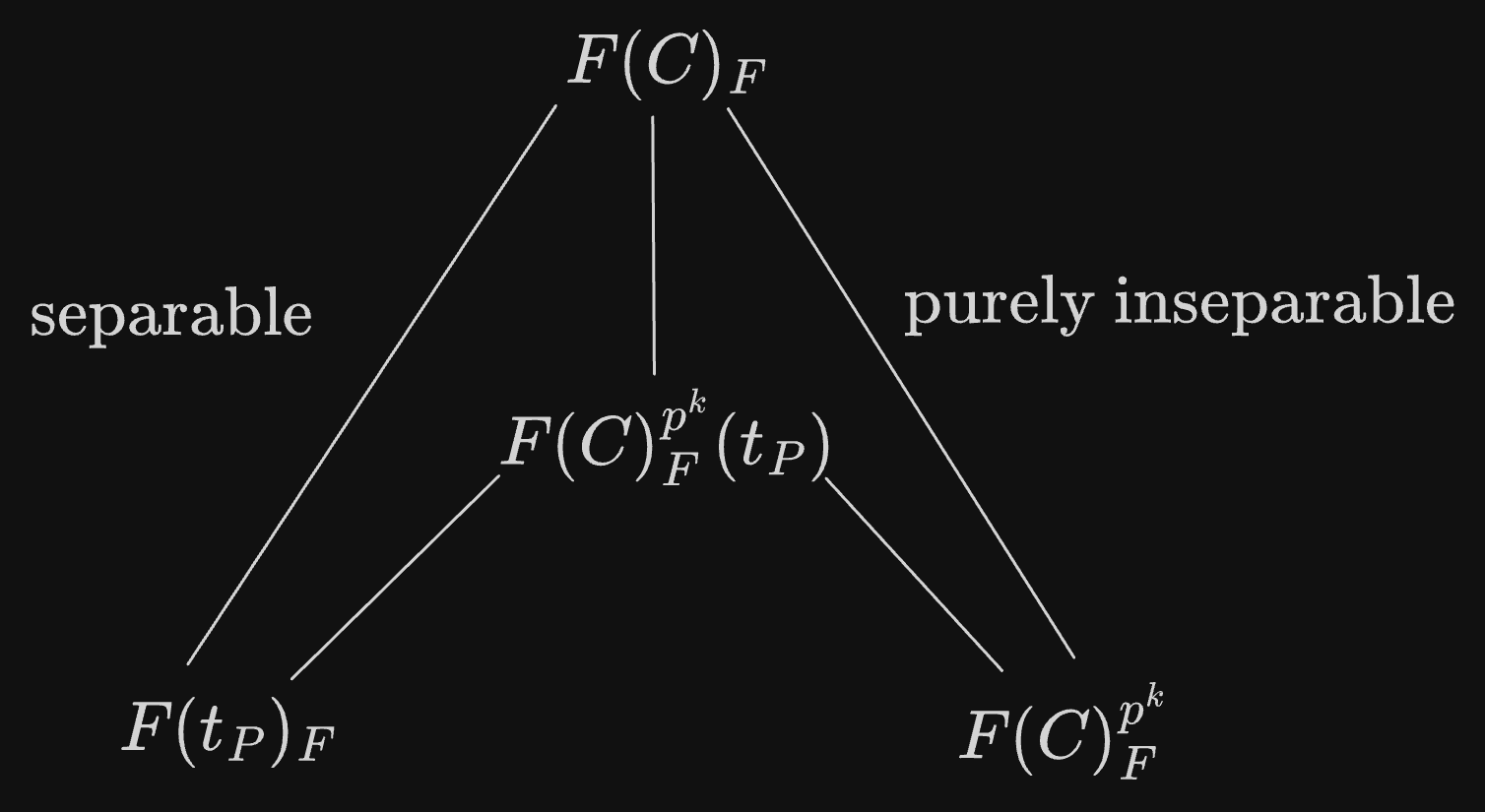
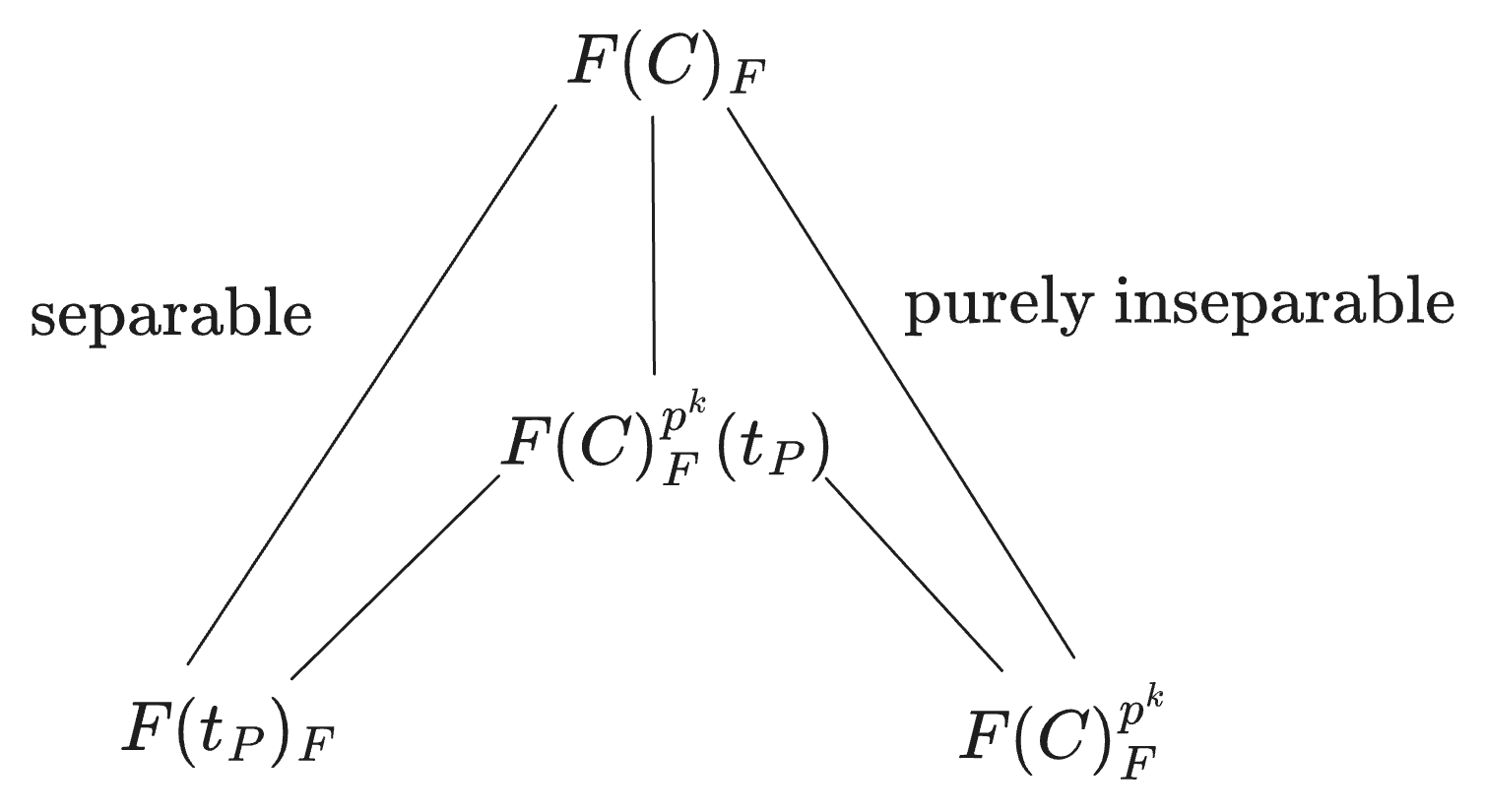
3.4 Curves
def: Curve
∢ ( X : = P n , T : = Z ( P n ) ) ∈ T C ∈ T c ∩ X − dim C = 1 C ∈ C \begin{align*}
&\sphericalangle \\
&(X:=\mathbb P^n, T := \mathcal Z(\mathbb P^n)) \in \mathcal T \\
&C \in T^{c} \cap X^- \\
&\dim C = 1
\\
\hline
\\
&C \in \mathfrak C
\end{align*} ∢ ( X := P n , T := Z ( P n )) ∈ T C ∈ T c ∩ X − dim C = 1 C ∈ C Function order at point
Proposition 3.4.1: Regular local ring at a smooth point of a curve is a discrete valuation ring
∢ ( X : = P n , T : = Z ( P n ) ) ∈ T C ∈ C P ∈ S ( C ) O C , P r ∈ R D V R \begin{align*}
&\sphericalangle \\
&(X:=\mathbb P^n, T := \mathcal Z(\mathbb P^n)) \in \mathcal T \\
&C \in \mathfrak C \\
&P \in \cancel S(C)
\\
\hline
\\
&\mathcal O^r_{C,P} \in \mathcal R^{\mathcal {DVR}}
\end{align*} ∢ ( X := P n , T := Z ( P n )) ∈ T C ∈ C P ∈ S ( C ) O C , P r ∈ R D V R Proof
Recall that O C , P r : = { f g , f , g , ∈ S ( C ) d , g ( P ) ≠ 0 } \mathcal O^r_{C,P}:=\{\frac{f}{g}, f, g, \in S(C)_d, g(P)\ne 0\} O C , P r := { g f , f , g , ∈ S ( C ) d , g ( P ) = 0 } n n n O C , P r ∈ R N \mathcal O^r_{C,P} \in \mathcal R^{\mathcal N} O C , P r ∈ R N
Next since C ∈ T c ∩ X − C \in T^{c} \cap X^- C ∈ T c ∩ X − I ( C ) ∈ P I ( F ‾ [ x 1 , … , x n ] ) I(C) \in \mathfrak P_I(\overline F[x_1, \ldots, x_n]) I ( C ) ∈ P I ( F [ x 1 , … , x n ]) O C , P r ∈ R I D \mathcal O^r_{C,P} \in \mathcal R^{\mathcal {ID}} O C , P r ∈ R I D
Then O C , P r ∈ R L \mathcal O^r_{C,P} \in \mathcal R^{\mathcal {L}} O C , P r ∈ R L m P \mathfrak m_P m P
By ( 3.3.9 ) (3.3.9) ( 3.3.9 ) dim O C , P r = dim C = 1 \dim \mathcal O^r_{C,P}=\dim C = 1 dim O C , P r = dim C = 1
O C , P r ∈ R N ∩ R L ∩ R I D , dim O C , P r = 1 \mathcal O^r_{C,P} \in \mathcal R^{\mathcal N} \cap \mathcal R^{\mathcal {L}} \cap \mathcal R^{\mathcal {ID}}, \dim \mathcal O^r_{C,P}=1 O C , P r ∈ R N ∩ R L ∩ R I D , dim O C , P r = 1 Next, since P ∈ S ( C ) P \in \cancel S(C) P ∈ S ( C ) ( 3.3.10 ) dim O C , P r / m P m P / m P 2 = 1 (3.3.10) \dim_{\mathcal O^r_{C,P}/\mathfrak m_P}\mathfrak m_P / \mathfrak m_P^2=1 ( 3.3.10 ) dim O C , P r / m P m P / m P 2 = 1
So by ( 2.7.21 ) (2.7.21) ( 2.7.21 ) O C , P r ∈ R D V R \mathcal O^r_{C,P} \in \mathcal R^{\mathcal {DVR}} O C , P r ∈ R D V R
□ \square □
def: Function order at point p
∢ ( X : = P n , T : = Z ( P n ) ) ∈ T C ∈ C P ∈ S ( C ) ⟹ O C , P r ∈ R D V R v − discrete valuation f ∈ F ( O C , P r ) = F ( C ) ord P f : = v ( f ) \begin{align*}
&\sphericalangle \\
&(X:=\mathbb P^n, T := \mathcal Z(\mathbb P^n)) \in \mathcal T \\
&C \in \mathfrak C \\
&P \in \cancel S(C) \implies \mathcal O^r_{C,P} \in \mathcal R^{\mathcal {DVR}} \\
&v - \text{discrete valuation} \\
&f \in \mathfrak F(\mathcal O^r_{C,P})=F(C)\\
\hline
\\
&\text{ord}_Pf:=v(f)
\end{align*} ∢ ( X := P n , T := Z ( P n )) ∈ T C ∈ C P ∈ S ( C ) ⟹ O C , P r ∈ R D V R v − discrete valuation f ∈ F ( O C , P r ) = F ( C ) ord P f := v ( f ) Recall that maximal ideal in O C , P r \mathcal O^r_{C,P} O C , P r P P P ord P f \text{ord}_Pf ord P f f f f P P P
Obviously poles (roots of denominator) counts as order with negative sign
From ( 2.7.21 ) (2.7.21) ( 2.7.21 ) t t t ord P t = 1 \text{ord}_Pt=1 ord P t = 1 ⟨ f ⟩ I = ⟨ t ord P ( f ) ⟩ I ⟺ f = u t ord P ( f ) , u ∈ O C , P r ∗ = { f / g , f , g ∈ S ( C ) d , f ( P ) ≠ 0 , g ( P ) ≠ 0 } \lang f \rang_I=\lang t^{\text{ord}_P(f)} \rang_I \iff f = u t^{\text{ord}_P(f)}, u \in O^{r*}_{C,P}=\{f/g, f, g \in S(C)_d, f(P) \ne 0,g(P) \ne 0\} ⟨ f ⟩ I = ⟨ t ord P ( f ) ⟩ I ⟺ f = u t ord P ( f ) , u ∈ O C , P r ∗ = { f / g , f , g ∈ S ( C ) d , f ( P ) = 0 , g ( P ) = 0 }
Proposition 3.4.2: Number of points non-zero and negative order
∢ ( X : = P n , T : = Z ( P n ) ) ∈ T C ∈ C ∩ S f ∈ F ( C ) , f ≠ 0 ∣ P : ord P f ≠ 0 ∣ < ∞ ∣ P : ord P f < 0 ∣ = 0 ⟹ f ∈ F ‾ \begin{align*}
&\sphericalangle \\
&(X:=\mathbb P^n, T := \mathcal Z(\mathbb P^n)) \in \mathcal T \\
&C \in \mathfrak C \cap \cancel S \\
&f \in F(C), f \ne 0 \\
\hline
\\
&\begin{align*}
&|P: \text{ord}_Pf\ne 0| < \infty \hspace{0.5cm} \tag{a}\\
&|P: \text{ord}_Pf< 0| =0 \implies f \in \overline F\hspace{0.5cm} \tag{b}\\
\end{align*}
\end{align*} ∢ ( X := P n , T := Z ( P n )) ∈ T C ∈ C ∩ S f ∈ F ( C ) , f = 0 ∣ P : ord P f = 0∣ < ∞ ∣ P : ord P f < 0∣ = 0 ⟹ f ∈ F ( a ) ( b ) Example: Order of function for ellpitic curve
Consider a curve over P 2 \mathbb P^2 P 2
C : y 2 z = x 3 + x z 2 , C: y^2z = x^3+xz^2, C : y 2 z = x 3 + x z 2 , We want to explore the order of a function
f ( x , y , z ) : = y − x z f(x,y,z):=\frac{y-x}{z} f ( x , y , z ) := z y − x at different points.
First let's check if this curve have some singular points:
J : = ( − 2 x 2 − z 2 2 y z y 2 − 2 z x ) J:=
\begin{pmatrix}
-2x^2-z^2 & 2yz & y^2-2zx
\end{pmatrix} \\ J := ( − 2 x 2 − z 2 2 yz y 2 − 2 z x ) The singular point would be some projective point [ x , y , z ] [x, y, z] [ x , y , z ] [ 0 , 0 , 0 ] [0,0,0] [ 0 , 0 , 0 ] rank J < 2 − 1 = 1 \text{rank } J<2-1=1 rank J < 2 − 1 = 1 J = ( 0 0 0 ) J=(0\, 0\, 0) J = ( 0 0 0 ) 2 y z = 0 2yz = 0 2 yz = 0 y = 0 y = 0 y = 0 z = 0 z=0 z = 0 z = 0 z=0 z = 0 − 2 x 2 − z 2 = 0 ⟹ x = 0 , y 2 − 2 z x = 0 ⟹ y = 0 -2x^2-z^2=0 \implies x = 0, y^2 - 2zx = 0 \implies y=0 − 2 x 2 − z 2 = 0 ⟹ x = 0 , y 2 − 2 z x = 0 ⟹ y = 0 [ 0 , 0 , 0 ] [0,0,0] [ 0 , 0 , 0 ] z ≠ 0 z \ne 0 z = 0 y = 0 y=0 y = 0 C C C
Now back to the function f f f
Let's figure out at which points P P P ord P f ≠ 0 \text{ord}_Pf \ne 0 ord P f = 0 y − x = 0 y-x=0 y − x = 0 z = 0 z=0 z = 0 z = 0 z=0 z = 0 x = 0 x=0 x = 0 P 4 = [ 0 , 1 , 0 ] P_4 = [0,1,0] P 4 = [ 0 , 1 , 0 ] z ≠ 0 z \ne 0 z = 0 z = 1 z=1 z = 1 y = x y=x y = x x 2 = x 3 + x ⟹ x = w 1 , w 2 , w 3 , w 1 = 0 , w 2 = e i 2 π / 3 , w 3 = e − i 2 π / 3 x^2=x^3+x \implies x = w_1, w_2, w_3, w_1 = 0, w_2=e^{i2\pi/3}, w_3=e^{-i2\pi/3} x 2 = x 3 + x ⟹ x = w 1 , w 2 , w 3 , w 1 = 0 , w 2 = e i 2 π /3 , w 3 = e − i 2 π /3
P 1 = [ w 1 , w 1 , 1 ] P 2 = [ w 2 , w 2 , 1 ] P 3 = [ w 3 , w 3 , 1 ] P 4 = [ 0 , 1 , 0 ] P_1 = [w_1,w_1,1] \\
P_2 = [w_2,w_2,1] \\
P_3 = [w_3,w_3,1] \\
P_4 = [0,1,0] \\ P 1 = [ w 1 , w 1 , 1 ] P 2 = [ w 2 , w 2 , 1 ] P 3 = [ w 3 , w 3 , 1 ] P 4 = [ 0 , 1 , 0 ] Consider some point P i = [ w i , w i , 1 ] P_i=[w_i, w_i, 1] P i = [ w i , w i , 1 ] O P i r \mathcal O^r_{P_i} O P i r m P i = { f / g : f , g ∈ F ‾ [ x , y , z ] / I ( C ) d , f ( P ) = 0 , g ( P ) ≠ 0 } \mathfrak m_{P_i}=\{f/g: f, g \in \overline F[x, y, z]/I(C)_d, f(P)=0, g(P) \ne 0\} m P i = { f / g : f , g ∈ F [ x , y , z ] / I ( C ) d , f ( P ) = 0 , g ( P ) = 0 }
According to ( 3.1.8 ) (3.1.8) ( 3.1.8 ) M P i = ⟨ x − w i , y − w i , z − 1 ⟩ I , M P i ⊆ F ‾ [ x , y , x ] , M P i = { f ∈ F ‾ [ x , y , z ] : f ( P ) = 0 } M_{P_i}=\lang x-w_i, y -w_i, z-1 \rang_I, M_{P_i} \subseteq \overline F[x, y, x], M_{P_i} = \{f \in \overline F[x, y, z]: f(P)=0\} M P i = ⟨ x − w i , y − w i , z − 1 ⟩ I , M P i ⊆ F [ x , y , x ] , M P i = { f ∈ F [ x , y , z ] : f ( P ) = 0 }
Note that this is still not m P i \mathfrak m_{P_i} m P i F ‾ [ x , y , z ] \overline F[x,y,z] F [ x , y , z ] F ‾ [ x , y , z ] / I ( C ) \overline F[x,y,z]/I(C) F [ x , y , z ] / I ( C ) ( 3.3.2 ) (3.3.2) ( 3.3.2 ) x → x / z , y → y / z , z → z / z = 1 x \to x/z, y \to y/z, z \to z/z=1 x → x / z , y → y / z , z → z / z = 1
m P i = ⟨ x / z − w i , y / z − w i , z / z − 1 ⟩ I = ⟨ x − w i z z , y − w i z z ⟩ I \mathfrak m_{P_i} = \lang x/z-w_i, y/z-w_i, z/z - 1 \rang_I = \lang \frac{x-w_iz}{z}, \frac{y-w_iz}{z} \rang_I m P i = ⟨ x / z − w i , y / z − w i , z / z − 1 ⟩ I = ⟨ z x − w i z , z y − w i z ⟩ I But the curve C C C m P i \mathfrak m_{P_i} m P i x − w i z z \frac{x-w_iz}{z} z x − w i z y − w i z z \frac{y-w_iz}{z} z y − w i z C C C
y 2 z 2 = x 3 z 3 + x z = x z z 2 + x 2 z 2 ⟹ x z = y 2 z 2 ⋅ z 2 z 2 + x 2 \frac{y^2}{z^2}=\frac{x^3}{z^3}+\frac{x}{z}=\frac{x}{z} \frac{z^2 + x^2}{z^2} \implies \\
\frac{x}{z}=\frac{y^2}{z^2}\cdot \frac{z^2}{z^2+x^2} z 2 y 2 = z 3 x 3 + z x = z x z 2 z 2 + x 2 ⟹ z x = z 2 y 2 ⋅ z 2 + x 2 z 2 Note that z 2 z 2 + x 2 ∈ O P i r \frac{z^2}{z^2+x^2} \in \mathcal O^r_{P_i} z 2 + x 2 z 2 ∈ O P i r w 1 = 0 w_1=0 w 1 = 0 m P 1 = ⟨ y z ⟩ I \mathfrak m_{P_1} = \lang \frac{y}{z} \rang_I m P 1 = ⟨ z y ⟩ I w 2 , w 3 w_2, w_3 w 2 , w 3
ord P i ( y − w i z ) / z = 1 ord P i ( x − w i z ) / z = 2 \text{ord}_{P_i}(y-w_iz)/z=1 \\
\text{ord}_{P_i}(x - w_iz)/z=2 \\ ord P i ( y − w i z ) / z = 1 ord P i ( x − w i z ) / z = 2 Next
ord P i f = ord P i ( y − w i z z − x − w i z z ) = ord P i ( y − w i z z ) + ord P i ( 1 − x − w i z y − w i z ) \text{ord}_{P_i}f=\text{ord}_{P_i}(\frac{y-w_iz}{z}-\frac{x-w_iz}{z})= \\
\text{ord}_{P_i}(\frac{y-w_iz}{z})+\text{ord}_{P_i}(1-\frac{x-w_iz}{y-w_iz}) \\ ord P i f = ord P i ( z y − w i z − z x − w i z ) = ord P i ( z y − w i z ) + ord P i ( 1 − y − w i z x − w i z ) Consider
g ( x , y , z ) : = x − w i z y − w i z = x / z − w i y / z − w i = ( x / z − w i ) ( y / z + w i ) ( y / z ) 2 − w i 2 = ( x / z − w i ) ( y / z + w i ) ( x / z ) 3 + x / z − w i 2 = ( x / z − w i ) ( y / z + w i ) ( x / z ) 3 + x / z − w i 3 − w i = ( x / z − w i ) ( y / z + w i ) ( x / z − w i ) ( ( x / z ) 2 + w i x / z + w i 2 ) + x / z − w i = ( y / z + w i ) ( x / z ) 2 + w i x / z + w i 2 + 1
g(x,y,z):=\frac{x-w_iz}{y-w_iz}=\frac{x/z-w_i}{y/z-w_i}= \\
\frac{(x/z-w_i)(y/z+w_i)}{(y/z)^2-w_i^2}=\frac{(x/z-w_i)(y/z+w_i)}{(x/z)^3+x/z-w_i^2}=\\
\frac{(x/z-w_i)(y/z+w_i)}{(x/z)^3+x/z-w_i^3-w_i}=\\
\frac{(x/z-w_i)(y/z+w_i)}{(x/z-w_i)((x/z)^2+w_ix/z+w_i^2)+x/z-w_i} = \\
\frac{(y/z+w_i)}{(x/z)^2+w_ix/z+w_i^2 +1} g ( x , y , z ) := y − w i z x − w i z = y / z − w i x / z − w i = ( y / z ) 2 − w i 2 ( x / z − w i ) ( y / z + w i ) = ( x / z ) 3 + x / z − w i 2 ( x / z − w i ) ( y / z + w i ) = ( x / z ) 3 + x / z − w i 3 − w i ( x / z − w i ) ( y / z + w i ) = ( x / z − w i ) (( x / z ) 2 + w i x / z + w i 2 ) + x / z − w i ( x / z − w i ) ( y / z + w i ) = ( x / z ) 2 + w i x / z + w i 2 + 1 ( y / z + w i ) By plugging w i w_i w i 0 0 0
g ( w i , w i , 1 ) = 0 ⟹ ord P i ( 1 − x − w i z y − w i z ) = 0 ⟹ ord P i f = 1 g(w_i,w_i,1)=0 \implies \text{ord}_{P_i}(1-\frac{x-w_iz}{y-w_iz}) = 0 \implies \\
\text{ord}_{P_i}f = 1 g ( w i , w i , 1 ) = 0 ⟹ ord P i ( 1 − y − w i z x − w i z ) = 0 ⟹ ord P i f = 1 Now consider point P 4 = [ 0 , 1 , 0 ] P_4 = [0,1,0] P 4 = [ 0 , 1 , 0 ] M P 4 = ⟨ x , y − 1 , z ⟩ I M_{P_4}=\lang x, y-1, z \rang_I M P 4 = ⟨ x , y − 1 , z ⟩ I m P 4 = ⟨ x / y , z / y ⟩ I \mathfrak m_{P_4}=\lang x/y, z/y \rang_I m P 4 = ⟨ x / y , z / y ⟩ I z / y z/y z / y
z / y = ( x / y ) 3 + ( x / y ) ( z 2 / y 2 ) = ( x / y ) ( x 2 / y 2 + z 2 / y 2 ) ⟹ x 2 + z 2 y 2 ∈ O P 4 r m P 4 = ⟨ x / y ⟩ I z/y=(x/y)^3+(x/y)(z^2/y^2)=(x/y)(x^2/y^2+z^2/y^2) \overset{\frac{x^2+z^2}{y^2} \in \mathcal O^r_{P_4}}\implies \\
\mathfrak m_{P_4}=\lang x/y \rang_I z / y = ( x / y ) 3 + ( x / y ) ( z 2 / y 2 ) = ( x / y ) ( x 2 / y 2 + z 2 / y 2 ) ⟹ y 2 x 2 + z 2 ∈ O P 4 r m P 4 = ⟨ x / y ⟩ I Unlike the previous cases we cannot use the relation z / y = ( x / y ) ( x 2 / y 2 + z 2 / y 2 ) z/y=(x/y)(x^2/y^2+z^2/y^2) z / y = ( x / y ) ( x 2 / y 2 + z 2 / y 2 ) z / y z/y z / y ( x 2 / y 2 + z 2 / y 2 ) − 1 ∉ O P 4 r (x^2/y^2+z^2/y^2)^{-1}\notin \mathcal O^r_{P_4} ( x 2 / y 2 + z 2 / y 2 ) − 1 ∈ / O P 4 r
z / y = g ( x , y , z ) x a / y a ⟹ g ( x , y , z ) = y a − 1 z x a z/y = g(x,y,z)x^a/y^a \implies g(x, y, z)=\frac{y^{a-1}z}{x^a} z / y = g ( x , y , z ) x a / y a ⟹ g ( x , y , z ) = x a y a − 1 z If we consider a = 1 , 2 a=1, 2 a = 1 , 2 g ∉ O P 4 r g \notin \mathcal O^r_{P_4} g ∈ / O P 4 r a = 3 a=3 a = 3
g ( x , y , z ) = y 2 z x 3 = y 2 z y 2 z − x z 2 = y 2 y 2 − x z ∈ O P 4 r g(x, y, z)=\frac{y^2z}{x^3}=\frac{y^2z}{y^2z-xz^2}=\frac{y^2}{y^2-xz} \in \mathcal O^r_{P_4} g ( x , y , z ) = x 3 y 2 z = y 2 z − x z 2 y 2 z = y 2 − x z y 2 ∈ O P 4 r ord P 4 z / y = 3 ord P 4 x / y = 1 ord P 4 x / z = 1 − 3 = − 2 ord P 4 y / z = − 3 ord P 4 f = ord P 4 x − y z = ord P 4 y z ( x / y − 1 ) = ord P 4 ( y / z ) = − 3 \text{ord }_{P_4} z/y=3 \\
\text{ord }_{P_4} x/y=1 \\
\text{ord }_{P_4} x/z=1-3=-2 \\
\text{ord }_{P_4} y/z=-3 \\
\text{ord }_{P_4}f=\text{ord }_{P_4}\frac{x-y}{z} = \text{ord }_{P_4}\frac{y}{z}(x/y-1)=\\
\text{ord }_{P_4}(y/z)=-3 ord P 4 z / y = 3 ord P 4 x / y = 1 ord P 4 x / z = 1 − 3 = − 2 ord P 4 y / z = − 3 ord P 4 f = ord P 4 z x − y = ord P 4 z y ( x / y − 1 ) = ord P 4 ( y / z ) = − 3 Finally we have
ord P 1 f = 1 ord P 2 f = 1 ord P 3 f = 1 ord P 4 f = − 3 \text{ord }_{P_1} f= 1 \\
\text{ord }_{P_2} f= 1 \\
\text{ord }_{P_3} f= 1 \\
\text{ord }_{P_4} f= -3 \\
ord P 1 f = 1 ord P 2 f = 1 ord P 3 f = 1 ord P 4 f = − 3 Notice that orders sum to 0. As we'll see later it's no coincidence.
Example: Singular curve
Consider a curve
C 2 : y 2 z = x 3 + x 2 z , C_2:y^2z = x^3+x^2z, C 2 : y 2 z = x 3 + x 2 z , J 2 : = ( − 2 x 2 − 2 x z 2 y z y 2 − x 2 ) J 2 ( [ 0 , 0 , 1 ] ) = ( 0 0 0 ) J_2:=
\begin{pmatrix}
-2x^2-2xz & 2yz & y^2-x^2
\end{pmatrix} \\
J_2([0,0,1])=\begin{pmatrix}
0 & 0 & 0
\end{pmatrix} \\ J 2 := ( − 2 x 2 − 2 x z 2 yz y 2 − x 2 ) J 2 ([ 0 , 0 , 1 ]) = ( 0 0 0 ) So this curve has a singular point [ 0 , 0 , 1 ] [0,0,1] [ 0 , 0 , 1 ] O [ 0 , 0 , 1 ] r \mathcal O^r_{[0,0,1]} O [ 0 , 0 , 1 ] r
def: Ramification index
∢ P n C 1 , C 2 ∈ C / F C 1 = S ( C 1 ) , C 2 = S ( C 2 ) ϕ : C 1 ⇝ R a t C 2 , ϕ ≠ const P ∈ C 1 t ϕ ( P ) − uniformizer in F ( C 2 ) F e ϕ ( P ) = ord P ( ϕ ∗ t ϕ ( P ) ) , \begin{align*}
&\sphericalangle \\
&\mathbb P^n \\
&C_1, C_2 \in \mathfrak C/F \\
&C_1 = \cancel S(C_1), C_2 = \cancel S(C_2) \\
&\phi: C_1 \rightsquigarrow_{Rat} C_2, \phi \ne \text{const} \\
&P \in C_1 \\
&t_{\phi(P)} - \text{uniformizer in } F(C_2)_F
\\
\hline
\\
&e_{\phi}(P)=\text{ord}_P(\phi^*t_{\phi(P)}),
\end{align*} ∢ P n C 1 , C 2 ∈ C / F C 1 = S ( C 1 ) , C 2 = S ( C 2 ) ϕ : C 1 ⇝ R a t C 2 , ϕ = const P ∈ C 1 t ϕ ( P ) − uniformizer in F ( C 2 ) F e ϕ ( P ) = ord P ( ϕ ∗ t ϕ ( P ) ) , If e ϕ ( P ) = 1 e_{\phi}(P)=1 e ϕ ( P ) = 1 ϕ \phi ϕ
Example: Ramification index
Consider
ϕ : P 1 / R → P 1 / R , ϕ ( [ x , y ] ) ↦ [ x 3 ( x − y ) 2 , y 5 ] \phi: \mathbb P^1/\R \to \mathbb P^1/\R, \phi([x,y]) \mapsto [x^3(x-y)^2, y^5] ϕ : P 1 / R → P 1 / R , ϕ ([ x , y ]) ↦ [ x 3 ( x − y ) 2 , y 5 ] We'd like to consider point [ 0 , 1 ] [0,1] [ 0 , 1 ] ϕ − 1 [ 0 , 1 ] = { [ 0 , 1 ] , [ 1 , 1 ] } \phi^{-1}[0,1]=\{[0,1], [1,1]\} ϕ − 1 [ 0 , 1 ] = {[ 0 , 1 ] , [ 1 , 1 ]}
For point P = [ 0 , 1 ] P=[0,1] P = [ 0 , 1 ]
ϕ ( P ) = [ 0 , 1 ] t [ 0 , 1 ] = x / y ϕ ∗ t [ 0 , 1 ] = x 3 ( x − y ) 2 y 5 e ϕ ( P ) = ord P ϕ ∗ t ϕ ( P ) = 3 \phi(P)= [0,1] \\
t_{[0,1]}=x/y \\
\phi^*t_{[0,1]}=\frac{x^3(x-y)^2}{y^5} \\
e_\phi(P)=\text{ord}_{P}\phi^*t_{\phi(P)}=3 ϕ ( P ) = [ 0 , 1 ] t [ 0 , 1 ] = x / y ϕ ∗ t [ 0 , 1 ] = y 5 x 3 ( x − y ) 2 e ϕ ( P ) = ord P ϕ ∗ t ϕ ( P ) = 3 For point Q = [ 1 , 1 ] Q=[1,1] Q = [ 1 , 1 ]
ϕ ( Q ) = [ 0 , 1 ] t [ 0 , 1 ] = x / y ϕ ∗ t [ 0 , 1 ] = x 3 ( x − y ) 2 y 5 t [ 1 , 1 ] = x − y y e ϕ ( Q ) = ord P ϕ ∗ t ϕ ( P ) = ord [ 1 , 1 ] x 3 ( x − y ) 2 y 5 = 2 \phi(Q)= [0,1] \\
t_{[0,1]}=x/y \\
\phi^*t_{[0,1]}=\frac{x^3(x-y)^2}{y^5} \\
t_{[1,1]}=\frac{x-y}{y} \\
e_\phi(Q)=\text{ord}_{P}\phi^*t_{\phi(P)}=\text{ord}_{[1,1]}\frac{x^3(x-y)^2}{y^5}=2 ϕ ( Q ) = [ 0 , 1 ] t [ 0 , 1 ] = x / y ϕ ∗ t [ 0 , 1 ] = y 5 x 3 ( x − y ) 2 t [ 1 , 1 ] = y x − y e ϕ ( Q ) = ord P ϕ ∗ t ϕ ( P ) = ord [ 1 , 1 ] y 5 x 3 ( x − y ) 2 = 2 Thus we have
∑ P ∈ ϕ − 1 ( [ 0 , 1 ] ) e ϕ ( P ) = 5 \sum_{P \in \phi^{-1}([0,1]) } e_\phi(P) = 5 P ∈ ϕ − 1 ([ 0 , 1 ]) ∑ e ϕ ( P ) = 5 Notice that it matches the degree of polynomials in ϕ \phi ϕ
Morphisms and rational maps
Proposition 3.4.3: Smooth curve rational map is a morphism
∢ P n C ∈ C C = S ( C ) ( X , T c , O X ) ∈ V ϕ : C ⇝ R a t X ϕ : C ⇝ R s p X \begin{align*}
&\sphericalangle \\
&\mathbb P^n \\
&C \in \mathfrak C \\
&C = \cancel S(C) \\
&(X, T^c, \mathcal O_X) \in \mathcal V \\
&\phi: C \rightsquigarrow_{Rat}X
\\
\hline
\\
&\phi: C \rightsquigarrow_{Rsp}X
\end{align*} ∢ P n C ∈ C C = S ( C ) ( X , T c , O X ) ∈ V ϕ : C ⇝ R a t X ϕ : C ⇝ R s p X Proof
Assume ϕ = [ ϕ 0 , … , ϕ k ] \phi = [\phi_0, \ldots, \phi_k] ϕ = [ ϕ 0 , … , ϕ k ] P P P m : = min i ord P ϕ i m:=\min_i \text{ord}_P\phi_i m := min i ord P ϕ i [ t − m ϕ 0 ( P ) , … , t − m ϕ k ( P ) ] [t^{-m}\phi_0(P), \ldots, t^{-m}\phi_k(P)] [ t − m ϕ 0 ( P ) , … , t − m ϕ k ( P )] 0 0 0
Since point P P P ϕ \phi ϕ
□ \square □
Example: Rational map to P 1 \mathbb P^1 P 1
Consider C / F C/F C / F f = g / h ∈ F ( C ) F f = g/h \in F(C)_F f = g / h ∈ F ( C ) F ϕ : = [ f , 1 ] \phi:=[f, 1] ϕ := [ f , 1 ] U : = C ∖ Z ( h ) U:=C \setminus Z(h) U := C ∖ Z ( h ) Z ( h ) Z(h) Z ( h ) ϕ ( P ) : = [ h ( P ) ⋅ f ( P ) , 1 ⋅ h ( P ) ] = [ 1 , 0 ] \phi(P):=[h(P)\cdot f(P), 1\cdot h(P)]=[1,0] ϕ ( P ) := [ h ( P ) ⋅ f ( P ) , 1 ⋅ h ( P )] = [ 1 , 0 ]
ϕ ( P ) = { [ f ( P ) , 1 ] , f ∈ O C , P r [ 1 , 0 ] , f ∉ O C , P r \phi(P) = \begin{cases}
[f(P), 1], f \in \mathcal O^r_{C,P} \\
[1,0], f \notin \mathcal O^r_{C,P}
\end{cases} ϕ ( P ) = { [ f ( P ) , 1 ] , f ∈ O C , P r [ 1 , 0 ] , f ∈ / O C , P r def: Rational map degree
∢ P n C 1 , C 2 ∈ C / F ϕ : C 1 ⇝ R a t C 2 deg ϕ : = { [ F ( C 1 ) F : ϕ ∗ F ( C 2 ) F ] , if ϕ ≠ const 0 , if ϕ = const \begin{align*}
&\sphericalangle \\
&\mathbb P^n \\
&C_1, C_2 \in \mathfrak C/F \\
&\phi: C_1 \rightsquigarrow_{Rat} C_2 \\
\hline
\\
&\deg\phi:=\begin{cases}
[F(C_1)_F:\phi^*F(C_2)_F], \text{if } \phi \ne \text{const} \\
0, \text{if } \phi = \text{const}
\end{cases}
\end{align*} ∢ P n C 1 , C 2 ∈ C / F ϕ : C 1 ⇝ R a t C 2 deg ϕ := { [ F ( C 1 ) F : ϕ ∗ F ( C 2 ) F ] , if ϕ = const 0 , if ϕ = const We call ϕ \phi ϕ
Example: Rational map degree
Consider
ϕ : P 1 / R → P 1 / R , ϕ ( [ x , y ] ) ↦ [ x 3 ( x − y ) 2 , y 5 ] \phi: \mathbb P^1/\R \to \mathbb P^1/\R, \phi([x,y]) \mapsto [x^3(x-y)^2, y^5] ϕ : P 1 / R → P 1 / R , ϕ ([ x , y ]) ↦ [ x 3 ( x − y ) 2 , y 5 ] Then F ( P 1 ) = F ( x / y ) F(\mathbb P^1)=F(x/y) F ( P 1 ) = F ( x / y ) ϕ ∗ F ( P 1 ) = F ( x 3 ( x − y ) 2 y 5 ) \phi^*F(\mathbb P^1)=F(\frac{x^3(x-y)^2}{y^5}) ϕ ∗ F ( P 1 ) = F ( y 5 x 3 ( x − y ) 2 )
t : = x / y x 3 ( x − y ) 2 y 5 = t 3 ( t 2 − 2 t + 1 ) = t 5 − 2 t 4 + t 3 ⟹ deg ϕ = [ F ( x / y ) : F ( x 3 ( x − y ) 2 y 5 ) ] = 5 t:= x/y \\
\frac{x^3(x-y)^2}{y^5}=t^3(t^2-2t+1)=t^5-2t^4+t^3 \implies \\
\deg \phi=[F(x/y):F(\frac{x^3(x-y)^2}{y^5})]=5 t := x / y y 5 x 3 ( x − y ) 2 = t 3 ( t 2 − 2 t + 1 ) = t 5 − 2 t 4 + t 3 ⟹ deg ϕ = [ F ( x / y ) : F ( y 5 x 3 ( x − y ) 2 )] = 5 □ \square □
Proposition 3.4.4: Rational map of degree one is an isomopshism of smooth curves
∢ P n C 1 , C 2 ∈ C C i = S ( C i ) ϕ : C 1 ⇝ R a t C 2 deg ϕ = 1 ϕ : C 1 ≅ C 2 \begin{align*}
&\sphericalangle \\
&\mathbb P^n \\
&C_1, C_2 \in \mathfrak C \\
&C_i = \cancel S(C_i) \\
&\phi: C_1 \rightsquigarrow_{Rat} C_2 \\
&\deg \phi = 1
\\
\hline
\\
&\phi: C_1 \cong C_2
\end{align*} ∢ P n C 1 , C 2 ∈ C C i = S ( C i ) ϕ : C 1 ⇝ R a t C 2 deg ϕ = 1 ϕ : C 1 ≅ C 2 Proposition 3.4.5: Morphism between curves
∢ P n C 1 , C 2 ∈ C ϕ : C 1 ⇝ R s p C 2 ( ϕ = const ) ∨ ( ϕ ( C 1 ) = C 2 ) \begin{align*}
&\sphericalangle \\
&\mathbb P^n \\
&C_1, C_2 \in \mathfrak C \\
&\phi: C_1 \rightsquigarrow_{Rsp} C_2
\\
\hline
\\
&(\phi = \text{const}) \vee (\phi(C_1)=C_2)
\end{align*} ∢ P n C 1 , C 2 ∈ C ϕ : C 1 ⇝ R s p C 2 ( ϕ = const ) ∨ ( ϕ ( C 1 ) = C 2 ) Proposition 3.4.6: Degree and ramification index
∢ P n C 1 , C 2 ∈ C / F C i = S ( C i ) ϕ : C 1 ⇝ R a t C 2 deg ϕ > 0 ( ϕ ≠ const ) Q ∈ C 2 ∑ P ∈ ϕ − 1 ( Q ) e ϕ ( P ) = deg ϕ \begin{align*}
&\sphericalangle \\
&\mathbb P^n \\
&C_1, C_2 \in \mathfrak C/F \\
&C_i = \cancel S(C_i)\\
&\phi: C_1 \rightsquigarrow_{Rat} C_2 \\
&\deg \phi > 0 (\phi \ne \text{const}) \\
&Q \in C_2 \\
\hline
\\
&\sum_{P \in \phi^{-1}(Q)} e_{\phi}(P)=\deg \phi
\end{align*} ∢ P n C 1 , C 2 ∈ C / F C i = S ( C i ) ϕ : C 1 ⇝ R a t C 2 deg ϕ > 0 ( ϕ = const ) Q ∈ C 2 P ∈ ϕ − 1 ( Q ) ∑ e ϕ ( P ) = deg ϕ Example: Degree and ramification index
Consider
ϕ : P 1 / R → P 1 / R , ϕ ( [ x , y ] ) ↦ [ x 3 ( x − y ) 2 , y 5 ] \phi: \mathbb P^1/\R \to \mathbb P^1/\R, \phi([x,y]) \mapsto [x^3(x-y)^2, y^5] ϕ : P 1 / R → P 1 / R , ϕ ([ x , y ]) ↦ [ x 3 ( x − y ) 2 , y 5 ] From examples above we know that deg ϕ = 5 \deg \phi = 5 deg ϕ = 5 ∑ P ∈ ϕ − 1 ( [ 0 , 1 ] ) e ϕ ( P ) = 5 \sum_{P \in \phi^{-1}([0,1]) } e_\phi(P) = 5 ∑ P ∈ ϕ − 1 ([ 0 , 1 ]) e ϕ ( P ) = 5
□ \square □
We already defined a pullback on ringed spaces and so on affine varieties. But we'll further need the inverse of pullback. The problem with the inverse is that ϕ ∗ : F ( C 2 ) → F ( C 1 ) \phi_*: F(C_2) \to F(C_1) ϕ ∗ : F ( C 2 ) → F ( C 1 ) ϕ ∗ − 1 \phi_*^{-1} ϕ ∗ − 1
N F ( C 1 ) / ϕ ∗ F ( C 2 ) : F ( C 1 ) → ϕ ∗ F ( C 2 ) , f ↦ ∏ σ ∈ Gal ( F ( C 1 ) / ϕ ∗ F ( C 2 ) ) σ ( f ) N_{F(C_1)/\phi^*F(C_2)}: F(C_1) \to \phi^*F(C_2), f \mapsto \prod_{\sigma \in \text{Gal}(F(C_1)/\phi^*F(C_2))}\sigma(f) N F ( C 1 ) / ϕ ∗ F ( C 2 ) : F ( C 1 ) → ϕ ∗ F ( C 2 ) , f ↦ σ ∈ Gal ( F ( C 1 ) / ϕ ∗ F ( C 2 )) ∏ σ ( f ) Thus image of f f f ϕ ∗ F ( C 2 ) \phi^*F(C_2) ϕ ∗ F ( C 2 )
def: Pushforward
∢ P n C 1 , C 2 ∈ C ϕ : C 1 ⇝ R a t C 2 ϕ ∗ : = ( ϕ ∗ ) − 1 ∘ N F ( C 1 ) / ϕ ∗ F ( C 2 ) \begin{align*}
&\sphericalangle \\
&\mathbb P^n \\
&C_1, C_2 \in \mathfrak C\\
&\phi: C_1 \rightsquigarrow_{Rat} C_2 \\
\hline
\\
&\phi_*:=(\phi^*)^{-1} \circ N_{F(C_1)/\phi^*F(C_2)}
\end{align*} ∢ P n C 1 , C 2 ∈ C ϕ : C 1 ⇝ R a t C 2 ϕ ∗ := ( ϕ ∗ ) − 1 ∘ N F ( C 1 ) / ϕ ∗ F ( C 2 ) ∢ P n , F ∈ F P , char F = p ∈ P C ∈ C / F P ∈ S ( C ) t P − uniformizer in F F ( C ) F / A F ( t P ) F [ F ( C ) F : F ( t P ) F ] < ∞ F ( C ) F / ⊟ F ( t P ) F \begin{align*}
&\sphericalangle \\
&\mathbb P^n, F \in \mathcal F^{\mathcal P}, \text{char }F = p \in \mathfrak P \\
&C \in \mathfrak C/F \\
&P \in \cancel S(C) \\
&t_P - \text{ uniformizer in }F
\\
\hline
\\
&\begin{align*}
&F(C)_F/_AF(t_P)_F \hspace{0.5cm} \tag{a}\\
&[F(C)_F:F(t_P)_F] < \infty \hspace{0.5cm} \tag{b}\\
&F(C)_F/_{\boxminus}F(t_P)_F \hspace{0.5cm} \tag{c}\\
\end{align*}
\end{align*} ∢ P n , F ∈ F P , char F = p ∈ P C ∈ C / F P ∈ S ( C ) t P − uniformizer in F F ( C ) F / A F ( t P ) F [ F ( C ) F : F ( t P ) F ] < ∞ F ( C ) F / ⊟ F ( t P ) F ( a ) ( b ) ( c ) Proof
a.
By ( 3.3.4 ) (3.3.4) ( 3.3.4 ) trdeg F ( C ) F / F = 1 \text{trdeg }F(C)_F/F=1 trdeg F ( C ) F / F = 1 t P t_P t P F F F trdeg F ( t P ) F / F = 1 \text{trdeg }F(t_P)_F/F=1 trdeg F ( t P ) F / F = 1 t P ⊆ F ( C ) F t_P \subseteq F(C)_F t P ⊆ F ( C ) F F ( C ) F / A F ( t P ) F F(C)_F/_AF(t_P)_F F ( C ) F / A F ( t P ) F
b.
Since F ( C ) F / A F ( t P ) F F(C)_F/_AF(t_P)_F F ( C ) F / A F ( t P ) F F ( C ) F F(C)_F F ( C ) F F F F F ( t P ) F F(t_P)_F F ( t P ) F [ F ( C ) F : F ( t P ) F ] < ∞ [F(C)_F:F(t_P)_F] < \infty [ F ( C ) F : F ( t P ) F ] < ∞
c.
Consider some z ∈ F ( C ) F z \in F(C)_F z ∈ F ( C ) F f ∈ F ( t P ) F ‾ F ( C ) F f \in \overline {F(t_P)_F}_{F(C)_F} f ∈ F ( t P ) F F ( C ) F z z z F ( t P ) F F(t_P)_F F ( t P ) F q ( x ) : = p o l F ( t P ) F ( a ) = ∑ i , j a i j t P i x j q(x):=\mathfrak{pol}_{F(t_P)_F}(a)=\sum_{i,j}a_{ij}t_P^ix^j q ( x ) := pol F ( t P ) F ( a ) = ∑ i , j a ij t P i x j t P t_P t P
q ( t , x ) = ∑ i , j a i j t i x j q(t,x)=\sum_{i,j}a_{ij}t^ix^j q ( t , x ) = i , j ∑ a ij t i x j If there's a term ∑ i , j a i j t i x j \sum_{i,j}a_{ij}t^ix^j ∑ i , j a ij t i x j j ≠ 0 ( m o d p ) j \ne 0 \pmod p j = 0 ( mod p ) ∂ q ( t , x ) / ∂ x ≠ 0 \partial q(t,x)/\partial x \ne 0 ∂ q ( t , x ) / ∂ x = 0 ( 2.9.9. b ) (2.9.9.b) ( 2.9.9. b ) q ( x ) ∈ F ( t P ) F , ⊟ [ x ] ⟹ z ∈ F ( t P ) F , ⊟ q(x) \in F(t_P)_{F,\boxminus}[x] \implies z \in F(t_P)_{F,\boxminus} q ( x ) ∈ F ( t P ) F , ⊟ [ x ] ⟹ z ∈ F ( t P ) F , ⊟
Assume otherwise that each term has j = 0 ( m o d p ) j = 0 \pmod p j = 0 ( mod p ) q ( t , x ) = r ( t , x p ) q(t,x)=r(t,x^p) q ( t , x ) = r ( t , x p ) F ∈ F P F \in \mathcal F^{\mathcal P} F ∈ F P ( 2.9.12. c ) (2.9.12.c) ( 2.9.12. c ) a i j = b i j p a_ij=b_{ij}^p a i j = b ij p ( 2.10.3 ) (2.10.3) ( 2.10.3 ) r ( t p , x p ) = s ( t , x ) p r(t^p,x^p)=s(t,x)^p r ( t p , x p ) = s ( t , x ) p s s s q q q p p p t t t
q ( t , x ) = r ( t , x p ) = ∑ k = 0 p − 1 s k ( t , x ) p t k q(t,x)=r(t,x^p)=\sum_{k=0}^{p-1}s_k(t,x)^pt^k q ( t , x ) = r ( t , x p ) = k = 0 ∑ p − 1 s k ( t , x ) p t k Consider q ( t p , z ) q(t_p, z) q ( t p , z )
ord P s k ( t P , z ) p t P k = p ⋅ ord P s k ( t P , z ) + k = k ( m o d p ) \text{ord}_Ps_k(t_P,z)^pt_P^k=p \cdot \text{ord}_Ps_k(t_P,z) + k = k \pmod p ord P s k ( t P , z ) p t P k = p ⋅ ord P s k ( t P , z ) + k = k ( mod p ) Since q ( t P , z ) = 0 q(t_P,z)=0 q ( t P , z ) = 0 s k ( t P , z ) p z k s_k(t_P,z)^pz^k s k ( t P , z ) p z k
s 0 ( t P , z ) = … = s p − 1 ( t P , z ) = 0 s_0(t_P,z) = \ldots = s_{p-1}(t_P,z) = 0 s 0 ( t P , z ) = … = s p − 1 ( t P , z ) = 0 (i.e. terms can't cancel out since the have different order of vanishing and can be represented as u t k ut^k u t k
Obviously ∃ k \exists k ∃ k s k ( t , x ) s_k(t,x) s k ( t , x ) x x x q ( t , x ) q(t,x) q ( t , x ) x x x deg x s k ( t , x ) ≤ 1 / p ⋅ q ( t , x ) \deg_x s_k(t,x) \le 1/p\cdot q(t,x) deg x s k ( t , x ) ≤ 1/ p ⋅ q ( t , x ) s k ( t P , z ) = 0 s_k(t_P,z)=0 s k ( t P , z ) = 0 q ( t , x ) q(t,x) q ( t , x )
□ \square □
def: Frobenius morphism
∢ F ∈ F P char F = p ∈ P P n C ∈ C / F C ρ : = Z ( f ρ : f ∈ I ( C ) ) ρ ⇝ : C → C ρ , [ x 0 , … , x n ] ↦ [ x 0 p , … , x n p ] \begin{align*}
&\sphericalangle \\
&F \in \mathcal F^{\mathcal P} \\
&\text{char }F = p \in \mathfrak P \\
&\mathbb P^n \\
&C \in \mathfrak C/F \\
&C^{\rho}:=Z({f^{\rho}: f \in I(C}))
\\
\hline
\\
&\rho_{\rightsquigarrow}: C \to C^{\rho}, [x_0, \ldots, x_n] \mapsto [x_0^{p}, \ldots, x_n^p]
\end{align*} ∢ F ∈ F P char F = p ∈ P P n C ∈ C / F C ρ := Z ( f ρ : f ∈ I ( C )) ρ ⇝ : C → C ρ , [ x 0 , … , x n ] ↦ [ x 0 p , … , x n p ] Recall that we denote f ϕ : = ϕ ( a 0 ) + ϕ ( a 1 ) x + … f^{\phi}:=\phi(a_0)+\phi(a_1)x + \ldots f ϕ := ϕ ( a 0 ) + ϕ ( a 1 ) x + … ρ ( a ) : = a p \rho(a):=a^p ρ ( a ) := a p f ρ : = a 0 p + a 1 p x + … f^{\rho}:=a_0^p+a_1^px+ \ldots f ρ := a 0 p + a 1 p x + …
By ( 2.3.10 ) (2.3.10) ( 2.3.10 ) ρ : C → C p \rho: C \to C^{p} ρ : C → C p [ x 0 , … , x n ] ↦ [ x 0 p , … , x n p ] [x_0, \ldots, x_n] \mapsto [x_0^{p}, \ldots, x_n^p] [ x 0 , … , x n ] ↦ [ x 0 p , … , x n p ]
We can apply Frobenius several times to get:
ρ ⇝ k : C → C p k , [ x 0 , … , x n ] ↦ [ x 0 p k , … , x n p k ] \rho_{\rightsquigarrow}^k: C \to C^{p^k}, [x_0, \ldots, x_n] \mapsto [x_0^{p^k}, \ldots, x_n^{p^k}] ρ ⇝ k : C → C p k , [ x 0 , … , x n ] ↦ [ x 0 p k , … , x n p k ] Proposition 3.4.8: Degree of Frobenius morphism
∢ F ∈ F P char F = p ∈ P P n C ∈ C / F ( ρ ⇝ k ) ∗ F ( C ρ k ) F = F ( C ) F p k : = { f p k : f ∈ F ( C ) F } ρ ⇝ k − purely inseparable deg ρ ⇝ k = p k \begin{align*}
&\sphericalangle \\
&F \in \mathcal F^{\mathcal P} \\
&\text{char }F = p \in \mathfrak P \\
&\mathbb P^n \\
&C \in \mathfrak C/F \\
\hline
\\
&\begin{align*}
&(\rho_{\rightsquigarrow}^{k})^*F(C^{\rho^k})_F=F(C)^{p^k}_F := \{f^{p^k}: f \in F(C)_F\} \hspace{0.5cm} \tag{a}\\
&\rho_{\rightsquigarrow}^k - \text{purely inseparable} \hspace{0.5cm} \tag{b}\\
&\deg \rho_{\rightsquigarrow}^k = p^k \hspace{0.5cm} \tag{c}\\
\end{align*}
\end{align*} ∢ F ∈ F P char F = p ∈ P P n C ∈ C / F ( ρ ⇝ k ) ∗ F ( C ρ k ) F = F ( C ) F p k := { f p k : f ∈ F ( C ) F } ρ ⇝ k − purely inseparable deg ρ ⇝ k = p k ( a ) ( b ) ( c ) Proof
a.
( ρ ⇝ k ) ∗ F ( C ρ k ) F = f ( x 0 p k , … , x n p k ) g ( x 0 p k , … , x n p k ) = F ∈ F P ( f ( x 0 , … , x n ) g ( x 0 , … , x n ) ) p k = F ( C ) F p k (\rho_{\rightsquigarrow}^{k})^*F(C^{\rho^k})_F=\frac{f(x_0^{p^k}, \ldots, x_n^{p^k})}{g(x_0^{p^k}, \ldots, x_n^{p^k})} \overset{F \in \mathcal F^{\mathcal P}} = \\
(\frac{f(x_0, \ldots, x_n)}{g(x_0, \ldots, x_n)})^{p^k} = F(C)^{p^k}_F ( ρ ⇝ k ) ∗ F ( C ρ k ) F = g ( x 0 p k , … , x n p k ) f ( x 0 p k , … , x n p k ) = F ∈ F P ( g ( x 0 , … , x n ) f ( x 0 , … , x n ) ) p k = F ( C ) F p k b.
From ( a ) (a) ( a ) F ( C ) / ( ρ ⇝ k ) ∗ F ( C ρ k ) F = F ( C ) / F ( C ) F p k F(C)/(\rho_{\rightsquigarrow}^{k})^*F(C^{\rho^k})_F=F(C) / F(C)^{p^k}_F F ( C ) / ( ρ ⇝ k ) ∗ F ( C ρ k ) F = F ( C ) / F ( C ) F p k ∀ α ∈ F ( C ) : α p k ∈ F ( C ) F p k \forall \alpha \in F(C): \alpha^{p^k} \in F(C)^{p^k}_F ∀ α ∈ F ( C ) : α p k ∈ F ( C ) F p k ( 2.9.10. a ) (2.9.10.a) ( 2.9.10. a )
c.
Take some non-singular point P ∈ C P \in C P ∈ C t P t_P t P F ( C ) / ⊟ F ( t P ) F(C)/_{\boxminus}F(t_P) F ( C ) / ⊟ F ( t P ) ( 3.4.7 ) (3.4.7) ( 3.4.7 ) F ( C ) / □ F ( C ) F p k F(C)/_{\Box}F(C)^{p^k}_F F ( C ) / □ F ( C ) F p k ( b ) (b) ( b )
So the extension F ( C ) F / F ( C ) F p k ( t P ) F(C)_F/F(C)^{p^k}_F(t_P) F ( C ) F / F ( C ) F p k ( t P ) ( 2.9.11 ) (2.9.11) ( 2.9.11 ) F ( C ) F = F ( C ) F p k ( t P ) F(C)_F=F(C)^{p^k}_F(t_P) F ( C ) F = F ( C ) F p k ( t P ) ( a ) (a) ( a )
deg ρ k = [ F ( C ) F p k ( t P ) : F ( C ) F p k ] \deg \rho^k=[F(C)^{p^k}_F(t_P):F(C)^{p^k}_F] deg ρ k = [ F ( C ) F p k ( t P ) : F ( C ) F p k ] Obviously t P ∈ F ( C ) ⟹ t P p k ∈ F ( C ) F p k t_P \in F(C) \implies t_P^{p^k} \in F(C)^{p^k}_F t P ∈ F ( C ) ⟹ t P p k ∈ F ( C ) F p k t P p k − 1 ∉ F ( C ) F p k t_P^{p^{k}-1} \notin F(C)^{p^k}_F t P p k − 1 ∈ / F ( C ) F p k ∃ f ∈ F ( C ) : f p k = t P p k − 1 \exists f \in F(C): f^{p^k}=t_P^{p^{k}-1} ∃ f ∈ F ( C ) : f p k = t P p k − 1
p k − 1 = ord P t P p k − 1 = p k ord P f ⟹ ord P f = ( p k − 1 ) / p = p k − 1 − 1 / p p^{k}-1=\text{ord}_Pt_P^{p^{k}-1}=p^k\text{ord}_Pf \implies \\ \text{ord}_Pf = (p^{k}-1)/p=p^{k-1}-1/p p k − 1 = ord P t P p k − 1 = p k ord P f ⟹ ord P f = ( p k − 1 ) / p = p k − 1 − 1/ p But that's impossible because order is integer.
□ \square □
Divisors
def: Divisor
∢ P n C ∈ C D : = ∑ P ∈ Y n P ( P ) , n P ∈ Z , ∣ P ∈ Y : n P ≠ 0 ∣ < ∞ D ∈ Div ( C ) \begin{align*}
&\sphericalangle \\
&\mathbb P^n \\
&C \in \mathfrak C \\
\hline
\\
&D: = \sum_{P \in Y} n_P(P), n_P \in \Z, |P \in Y: n_P \ne 0| \lt \infty \\
&D \in \text{Div}(C)
\end{align*} ∢ P n C ∈ C D := P ∈ Y ∑ n P ( P ) , n P ∈ Z , ∣ P ∈ Y : n P = 0∣ < ∞ D ∈ Div ( C ) Divisor if a formal sum of n P ( P ) n_P(P) n P ( P ) C → Z C \to \Z C → Z
Div ( C ) \text{Div}(C) Div ( C ) + + + n P n_P n P
The Galois group Gal ( F ‾ / F ) \text{Gal}(\overline F/F) Gal ( F / F ) Div ( C ) \text{Div}(C) Div ( C )
D σ = ∑ n P ( P σ )
D^\sigma=\sum n_P(P^\sigma)
D σ = ∑ n P ( P σ ) We say that divisor D D D F F F D / F D/F D / F ∀ σ ∈ Gal ( F ‾ / F ) : D σ = D \forall \sigma \in \text{Gal}(\overline F/F): D^{\sigma}=D ∀ σ ∈ Gal ( F / F ) : D σ = D Div F ( C ) \text{Div}_F(C) Div F ( C ) F F F
If D = n 1 ( P 1 ) + … + n k ( P k ) D = n_1(P_1)+ \ldots +n_k(P_k) D = n 1 ( P 1 ) + … + n k ( P k ) D / F D/F D / F P i σ = P i P_i^\sigma=P_i P i σ = P i 2 ( ( 1 + i , 1 − i ) ) + 2 ( ( 1 − i , 1 + i ) ) 2((1+i, 1-i))+2((1-i, 1+i)) 2 (( 1 + i , 1 − i )) + 2 (( 1 − i , 1 + i )) R \R R
def: Degree of divisor
∢ P n C ∈ C D = ∑ P ∈ C n P ( P ) deg D : = ∑ P ∈ C n P \begin{align*}
&\sphericalangle \\
&\mathbb P^n \\
&C \in \mathfrak C \\
&D = \sum_{P \in C} n_P(P)
\\
\hline
\\
&\deg D:=\sum_{P \in C} n_P
\end{align*} ∢ P n C ∈ C D = P ∈ C ∑ n P ( P ) deg D := P ∈ C ∑ n P def: Divisors of degree 0 subgroup
∢ P n C ∈ C Div 0 ( C ) : = { D ∈ Div 0 ( C ) : deg D = 0 } \begin{align*}
&\sphericalangle \\
&\mathbb P^n \\
&C \in \mathfrak C \\
\hline
\\
&\text{Div}^0(C) :=\{D \in \text{Div}^0(C): \deg D = 0\}\end{align*} ∢ P n C ∈ C Div 0 ( C ) := { D ∈ Div 0 ( C ) : deg D = 0 } def: Divisor of a function
∢ P n C ∈ C C = S ( C ) f ∈ F ( C ) ∗ div ( f ) : = ∑ P ∈ C ord P ( f ) ( P ) \begin{align*}
&\sphericalangle \\
&\mathbb P^n \\
&C \in \mathfrak C \\
&C = \cancel S (C) \\
&f \in F(C)^*\\
\hline
\\
&\text{div}(f):=\sum_{P \in C}\text{ord}_P(f)(P)
\end{align*} ∢ P n C ∈ C C = S ( C ) f ∈ F ( C ) ∗ div ( f ) := P ∈ C ∑ ord P ( f ) ( P ) Example: Divisors on elliptic curve
Assume char F ≠ 2 \text{char}F \ne 2 char F = 2 e 1 , e 2 , e 3 ∈ F ‾ e_1, e_2, e_3 \in \overline F e 1 , e 2 , e 3 ∈ F
C : y 2 = ( x − e 1 ) ( x − e 2 ) ( x − e 3 ) C: y^2 = (x-e_1)(x-e_2)(x-e_3) C : y 2 = ( x − e 1 ) ( x − e 2 ) ( x − e 3 ) If we consider a projective equation and assume z = 0 z=0 z = 0 C : P ∞ = [ 0 , 1 , 0 ] C: P_{\infty}=[0,1,0] C : P ∞ = [ 0 , 1 , 0 ]
Define P i = ( e i , 0 ) P_i=(e_i, 0) P i = ( e i , 0 ) f i ( x ) = x − e i f_i(x)=x-e_i f i ( x ) = x − e i P i P_i P i P ∞ P_\infty P ∞ x − z e i z \frac{x-ze_i}{z} z x − z e i P i P_i P i m P i = ⟨ ( x − z e i ) / z , y / z ⟩ I \mathfrak m_{P_i}=\lang (x-ze_i)/z, y/z \rang_I m P i = ⟨( x − z e i ) / z , y / z ⟩ I ord P i f i = 2 \text{ord}_{P_i}f_i=2 ord P i f i = 2
For P ∞ {P_\infty} P ∞
ord P ∞ x / y = 1 ord P ∞ z / y = 3 ord P ∞ z / x = ord P ∞ z / y + ord P ∞ y / x = 3 − 1 = 2 ord P ∞ f i = ord P ∞ x − e i z z = ord P ∞ x − e i z y + ord P ∞ y / z = ord P ∞ x / y + ord P ∞ 1 − e i z x + ord P ∞ y / z = 1 + 0 − 3 = − 2 \text{ord}_{P_{\infty}}x/y=1 \\
\text{ord}_{P_{\infty}}z/y=3 \\
\text{ord}_{P_{\infty}}z/x=\text{ord}_{P_{\infty}}z/y + \text{ord}_{P_{\infty}}y/x = 3-1=2 \\
\text{ord}_{P_{\infty}}f_i=\text{ord}_{P_{\infty}} \frac{x-e_iz}{z}=\text{ord}_{P_{\infty}} \frac{x-e_iz}{y}+\text{ord}_{P_{\infty}}y/z= \\
\text{ord}_{P_{\infty}} x/y+\text{ord}_{P_{\infty}} 1-\frac{e_iz}{x}+\text{ord}_{P_{\infty}}y/z=1+0-3=-2
ord P ∞ x / y = 1 ord P ∞ z / y = 3 ord P ∞ z / x = ord P ∞ z / y + ord P ∞ y / x = 3 − 1 = 2 ord P ∞ f i = ord P ∞ z x − e i z = ord P ∞ y x − e i z + ord P ∞ y / z = ord P ∞ x / y + ord P ∞ 1 − x e i z + ord P ∞ y / z = 1 + 0 − 3 = − 2 So we have:
div ( x − e i ) = 2 ( P i ) − 2 ( P ∞ ) \text{div}(x-e_i)=2(P_i)-2(P_\infty) div ( x − e i ) = 2 ( P i ) − 2 ( P ∞ ) Now for function y y y P i P_i P i P ∞ P_\infty P ∞ ord P ∞ z / y = 3 \text{ord}_{P_{\infty}}z/y=3 ord P ∞ z / y = 3
div ( y ) = ( P 1 ) + ( P 2 ) + ( P 3 ) − 3 ( P ∞ ) \text{div}(y)=(P_1)+(P_2)+(P_3)-3(P_\infty) div ( y ) = ( P 1 ) + ( P 2 ) + ( P 3 ) − 3 ( P ∞ ) □ \square □
It's easy to check that
div ( f σ ) = ( div ( f ) ) σ \text{div}(f^{\sigma})=(\text{div}(f))^{\sigma} div ( f σ ) = ( div ( f ) ) σ In particular f ∈ F ( C ) F ⟹ div ( f ) ∈ Div F ( C ) f \in F(C)_F \implies \text{div}(f) \in \text{Div}_F(C) f ∈ F ( C ) F ⟹ div ( f ) ∈ Div F ( C )
Also note that ord P \text{ord}_P ord P
div : F ( C ) ∗ ⇝ G Div ( C ) \text{div}: F(C)^* \rightsquigarrow_G \text{Div}(C) div : F ( C ) ∗ ⇝ G Div ( C ) def: Principal divisor
∢ P n C ∈ C C = S ( C ) D ∈ Div ( C ) ∃ f ∈ F ( C ) ∗ : D = div ( f ) D − prinicipal D ∈ Div ⟨ ⟩ ( C ) \begin{align*}
&\sphericalangle \\
&\mathbb P^n \\
&C \in \mathfrak C \\
&C = \cancel S (C) \\
&D \in \text{Div}(C) \\
&\exists f \in F(C)^*: D = \text{div}(f)\\
\hline
\\
&D - \text{prinicipal} \\
&D \in \text{Div}_{\lang \rang}(C)
\end{align*} ∢ P n C ∈ C C = S ( C ) D ∈ Div ( C ) ∃ f ∈ F ( C ) ∗ : D = div ( f ) D − prinicipal D ∈ Div ⟨ ⟩ ( C ) def: Equivalent divisors
∢ P n C ∈ C C = S ( C ) D 1 , D 2 ∈ Div ( C ) D 1 − D 2 ∈ Div ⟨ ⟩ ( C ) D 1 ∼ D 2 \begin{align*}
&\sphericalangle \\
&\mathbb P^n \\
&C \in \mathfrak C \\
&C = \cancel S (C) \\
&D_1, D_2 \in \text{Div}(C) \\
&D_1 - D_2 \in \text{Div}_{\lang \rang}(C) \\
\hline
\\
&D_1 \sim D_2
\end{align*} ∢ P n C ∈ C C = S ( C ) D 1 , D 2 ∈ Div ( C ) D 1 − D 2 ∈ Div ⟨ ⟩ ( C ) D 1 ∼ D 2 def: Picard group
∢ P n C ∈ C C = S ( C ) Pic ( C ) : = Div ( C ) / Div ⟨ ⟩ ( C ) \begin{align*}
&\sphericalangle \\
&\mathbb P^n \\
&C \in \mathfrak C \\
&C = \cancel S (C) \\
\hline
\\
&\text{Pic}(C):=\text{Div}(C)/\text{Div}_{\lang \rang}(C)
\end{align*} ∢ P n C ∈ C C = S ( C ) Pic ( C ) := Div ( C ) / Div ⟨ ⟩ ( C ) We denote Pic F ( C ) \text{Pic}_F(C) Pic F ( C ) Pic F ( C ) \text{Pic}_F(C) Pic F ( C ) Pic F ( C ) ≠ Div F ( C ) / Div F , ⟨ ⟩ ( C ) \text{Pic}_F(C) \ne \text{Div}_F(C)/\text{Div}_{F,\lang \rang}(C) Pic F ( C ) = Div F ( C ) / Div F , ⟨ ⟩ ( C )
Proposition 3.4.9: Zero divisor and constant funtion
∢ P n C ∈ C C = S ( C ) f ∈ F ( C ) ∗ div ( f ) = 0 ⟺ f ∈ F ‾ ∗ \begin{align*}
&\sphericalangle \\
&\mathbb P^n \\
&C \in \mathfrak C \\
&C = \cancel S (C) \\
&f \in F(C)^* \\
\hline
\\
&\text{div}(f)=0 \iff f \in \overline F^*
\end{align*} ∢ P n C ∈ C C = S ( C ) f ∈ F ( C ) ∗ div ( f ) = 0 ⟺ f ∈ F ∗ Proof
⟹ \implies ⟹
div ( f ) = 0 \text{div}(f)=0 div ( f ) = 0 f f f C → P 1 C \to \mathbb P^1 C → P 1
ϕ ( P ) = { [ f ( P ) , 1 ] , f ∈ O C , P r [ 1 , 0 ] , f ∉ O C , P r \phi(P) = \begin{cases}
[f(P), 1], f \in \mathcal O^r_{C,P} \\
[1,0], f \notin \mathcal O^r_{C,P}
\end{cases} ϕ ( P ) = { [ f ( P ) , 1 ] , f ∈ O C , P r [ 1 , 0 ] , f ∈ / O C , P r By ( 3.4.3 ) (3.4.3) ( 3.4.3 ) f f f ( 3.4.5 ) (3.4.5) ( 3.4.5 )
⟸ \impliedby ⟸
Obvious.
□ \square □
In the previous sections we discussed pullbacks and pushforwards of function fields. Now we define it for divisors. Assume ϕ : C 1 ⇝ R a t C 2 \phi: C_1 \rightsquigarrow_{Rat}C_2 ϕ : C 1 ⇝ R a t C 2
ϕ ∗ : Div ( C 2 ) → Div ( C 1 ) , ( Q ) ↦ ∑ P ∈ ϕ − 1 ( Q ) e ϕ ( P ) ( P ) ϕ ∗ : Div ( C 1 ) → Div ( C 2 ) , ( P ) ↦ ϕ ( P ) ( P ) \phi^*:\text{Div}(C_2) \to \text{Div}(C_1), (Q) \mapsto \sum_{P \in \phi^{-1}(Q)}e_\phi(P)(P) \\
\phi_*:\text{Div}(C_1) \to \text{Div}(C_2), (P) \mapsto \phi(P)(P) ϕ ∗ : Div ( C 2 ) → Div ( C 1 ) , ( Q ) ↦ P ∈ ϕ − 1 ( Q ) ∑ e ϕ ( P ) ( P ) ϕ ∗ : Div ( C 1 ) → Div ( C 2 ) , ( P ) ↦ ϕ ( P ) ( P ) Proposition 3.4.10: Pullbacks, pushforwards and divisors
∢ P n C 1 , C 2 , C 3 ∈ C C i = S ( C i ) ϕ : C 1 ⇝ R a t C 2 , ϕ ≠ const f ∈ F ( C 1 ) ∗ g ∈ F ( C 2 ) ∗ D ∈ Div ( C 2 ) ψ : C 2 ⇝ R a t C 3 , ϕ ≠ const deg ( ϕ ∗ D ) = ( deg ϕ ) ( deg D ) ϕ ∗ ( div ( g ) ) = div ( ϕ ∗ g ) , deg ( ϕ ∗ D ) = deg D , ∀ D ∈ Div ( C 2 ) ϕ ∗ ( div ( f ) ) = div ( ϕ ∗ f ) ϕ ∗ ∘ ϕ ∗ acts as multiplication by deg ϕ ( ψ ∘ ϕ ) ∗ = ψ ∗ ∘ ϕ ∗ , ( ψ ∘ ϕ ) ∗ = ψ ∗ ∘ ϕ ∗ \begin{align*}
&\sphericalangle \\
&\mathbb P^n \\
&C_1, C_2, C_3 \in \mathfrak C \\
&C_i = \cancel S (C_i) \\
&\phi: C_1 \rightsquigarrow_{Rat} C_2, \phi \ne
\text{const} \\
&f \in F(C_1)^* \\
&g \in F(C_2)^* \\
&D \in \text{Div}(C_2) \\
&\psi: C_2 \rightsquigarrow_{Rat} C_3, \phi \ne
\text{const} \\
\hline
\\
&\begin{align*}
&\deg(\phi^*D)=(\deg \phi)(\deg D) \hspace{0.5cm} \tag{a}\\
& \phi^*(\text{div}(g))=\text{div}(\phi^*g), \hspace{0.5cm} \tag{b}\\
& \deg(\phi_*D) = \deg D , \forall D \in \text{Div}(C_2)\hspace{0.5cm} \tag{c}\\
& \phi_*(\text{div}(f))=\text{div}(\phi_*f)\hspace{0.5cm} \tag{d}\\
& \phi_*\circ \phi^* \text{acts as multiplication by } \deg \phi\hspace{0.5cm} \tag{e}\\
& (\psi \circ \phi)^*=\psi^* \circ \phi^*, (\psi \circ \phi)_*=\psi_* \circ \phi_*\hspace{0.5cm} \tag{f}\\
\end{align*}
\end{align*} ∢ P n C 1 , C 2 , C 3 ∈ C C i = S ( C i ) ϕ : C 1 ⇝ R a t C 2 , ϕ = const f ∈ F ( C 1 ) ∗ g ∈ F ( C 2 ) ∗ D ∈ Div ( C 2 ) ψ : C 2 ⇝ R a t C 3 , ϕ = const deg ( ϕ ∗ D ) = ( deg ϕ ) ( deg D ) ϕ ∗ ( div ( g )) = div ( ϕ ∗ g ) , deg ( ϕ ∗ D ) = deg D , ∀ D ∈ Div ( C 2 ) ϕ ∗ ( div ( f )) = div ( ϕ ∗ f ) ϕ ∗ ∘ ϕ ∗ acts as multiplication by deg ϕ ( ψ ∘ ϕ ) ∗ = ψ ∗ ∘ ϕ ∗ , ( ψ ∘ ϕ ) ∗ = ψ ∗ ∘ ϕ ∗ ( a ) ( b ) ( c ) ( d ) ( e ) ( f ) Proof
a.
Easy to check using defintions and ( 3.4.6 ) (3.4.6) ( 3.4.6 )
b.
ord P ( ϕ ∗ f ) = ord P ( ϕ ∗ t ϕ ( P ) ord ϕ ( P ) f ) = e ϕ ( P ) ⋅ ord ϕ ( P ) f \text{ord}_P(\phi^*f)=\text{ord}_P(\phi^*t_{\phi(P)}^{\text{ord}_{\phi(P)}f})=e_{\phi}(P)\cdot \text{ord}_{\phi(P)}f ord P ( ϕ ∗ f ) = ord P ( ϕ ∗ t ϕ ( P ) ord ϕ ( P ) f ) = e ϕ ( P ) ⋅ ord ϕ ( P ) f c.
Obvious from definition
d, e, f
Left as an exercise
□ \square □
Proposition 3.4.11: Degree of a principal divisor
∢ P n C ∈ C C = S ( C ) f ∈ F ( C ) ∗ deg ( div ( f ) ) = 0 \begin{align*}
&\sphericalangle \\
&\mathbb P^n \\
&C \in \mathfrak C \\
&C = \cancel S (C) \\
&f \in F(C)^* \\
\hline
\\
&\deg(\text{div}(f))=0
\end{align*} ∢ P n C ∈ C C = S ( C ) f ∈ F ( C ) ∗ deg ( div ( f )) = 0 Proof
Consider a morphism ϕ : C → P 1 \phi: C \to \mathbb P^1 ϕ : C → P 1
ϕ ( P ) = { [ f ( P ) , 1 ] , f ∈ O C , P r [ 1 , 0 ] , f ∉ O C , P r \phi(P) = \begin{cases}
[f(P), 1], f \in \mathcal O^r_{C,P} \\
[1,0], f \notin \mathcal O^r_{C,P}
\end{cases} ϕ ( P ) = { [ f ( P ) , 1 ] , f ∈ O C , P r [ 1 , 0 ] , f ∈ / O C , P r Then from definitions div ( f ) = ϕ ∗ ( ( 0 ) − ( ∞ ) ) \text{div}(f)=\phi^*((0) - (\infty)) div ( f ) = ϕ ∗ (( 0 ) − ( ∞ )) f f f
deg div ( f ) = deg ϕ ∗ ( ( 0 ) − ( ∞ ) ) = deg ϕ ⋅ deg ( ( 0 ) − ( ∞ ) ) = 0 \deg\text{div}(f)=\deg\phi^*((0) - (\infty))=\deg \phi \cdot \deg((0) - (\infty)) = 0 deg div ( f ) = deg ϕ ∗ (( 0 ) − ( ∞ )) = deg ϕ ⋅ deg (( 0 ) − ( ∞ )) = 0 □ \square □
Differentials
∢ P n C ∈ C Ω C : = { d f : f ∈ F ( C ) } 1. d ( f + g ) = d f + d g 2. d ( f g ) = g d f + f d g 3. d a = 0 , ∀ a ∈ F ‾ \begin{align*}
&\sphericalangle \\
&\mathbb P^n \\
&C \in \mathfrak C \\
\hline
\\
& \Omega_C:=\{df: f \in F(C)\} \\
& 1.\ d(f+g) = df + dg \\
& 2.\ d(fg) = gdf + fdg \\
& 3.\ da = 0, \forall a \in \overline{F} \\
\end{align*} ∢ P n C ∈ C Ω C := { df : f ∈ F ( C )} 1. d ( f + g ) = df + d g 2. d ( f g ) = g df + fd g 3. d a = 0 , ∀ a ∈ F Ω C \Omega_C Ω C F ‾ \overline F F
Eventually we want to arrive at the definition of divisor of a differential. So let's start with pullback
def: Pull-back differential
ϕ ∗ : ∑ f i d x i ↦ ∑ ( ϕ ∗ f i ) d ( ϕ ∗ x i ) \phi^*: \sum f_idx_i \mapsto \sum (\phi^*f_i)d(\phi^*x_i) ϕ ∗ : ∑ f i d x i ↦ ∑ ( ϕ ∗ f i ) d ( ϕ ∗ x i ) Proposition 3.4.12: Differentials properties
∢ P n C ∈ C P ∈ C t P − uniformizer p : = char F Ω C ∈ M F ( C ) , dim F ( C ) Ω C = 1 ω ∈ Ω C ⟹ ∃ ! g ∈ F ( C ) : ω = g d t P , g : = ω / d t P ord P ( ω ) : = ord P ( ω / d t P ) is independent of t P ord P ( ω ) ≠ 0 for finitely many P ( p = 0 ) ∨ ( p ∤ ord P ( x ) ) ⟹ ord P ( f ⋅ d x ) = ord P ( f ) + ord P ( x ) − 1 ord P f ≥ 0 ⟹ ord P d f / d t ≥ 0 \begin{align*}
&\sphericalangle \\
&\mathbb P^n \\
&C \in \mathfrak C \\
&P \in C \\
&t_P - \text{uniformizer} \\
&p:= \text{char }F \\
\hline
\\
&\begin{align*}
&\Omega_C \in \mathcal M_{F(C)}, \dim_{F(C)} \Omega_C = 1 \hspace{0.5cm} \tag{a}\\
& \omega \in \Omega_C \implies \exists! g \in F(C): \omega=gdt_P, g:=\omega/dt_P\hspace{0.5cm} \tag{b}\\
&\text{ord}_P(\omega):=\text{ord}_P(\omega/dt_P) \text{ is independent of } t_P \hspace{0.5cm} \tag{c}\\
&\text{ord}_P(\omega) \ne 0 \text{ for finitely many } P \hspace{0.5cm} \tag{d}\\
&(p = 0) \vee (p \nmid \text{ord}_P(x)) \implies \text{ord}_P(f\cdot dx) = \text{ord}_P(f)+\text{ord}_P(x)-1 \hspace{0.5cm} \tag{e}\\
&\text{ord}_Pf \ge 0 \implies \text{ord}_Pdf/dt \ge 0 \hspace{0.5cm} \tag{f}\\
\end{align*}
\end{align*} ∢ P n C ∈ C P ∈ C t P − uniformizer p := char F Ω C ∈ M F ( C ) , dim F ( C ) Ω C = 1 ω ∈ Ω C ⟹ ∃ ! g ∈ F ( C ) : ω = g d t P , g := ω / d t P ord P ( ω ) := ord P ( ω / d t P ) is independent of t P ord P ( ω ) = 0 for finitely many P ( p = 0 ) ∨ ( p ∤ ord P ( x )) ⟹ ord P ( f ⋅ d x ) = ord P ( f ) + ord P ( x ) − 1 ord P f ≥ 0 ⟹ ord P df / d t ≥ 0 ( a ) ( b ) ( c ) ( d ) ( e ) ( f ) def: Differential divisor
∢ P n C ∈ C ω ∈ Ω C div ( ω ) : = ∑ P ∈ C ord P ω ( P ) \begin{align*}
&\sphericalangle \\
&\mathbb P^n \\
&C \in \mathfrak C \\
&\omega \in \Omega_C \\
\hline
\\
&\text{div}(\omega) := \sum_{P \in C}\text{ord}_P \omega(P)
\end{align*} ∢ P n C ∈ C ω ∈ Ω C div ( ω ) := P ∈ C ∑ ord P ω ( P ) Since by ( 3.4.12. a ) (3.4.12.a) ( 3.4.12. a ) ω 1 , ω 2 \omega_1, \omega_2 ω 1 , ω 2 ω 1 = f ω 2 , f ∈ F ( C ) \omega_1= f\omega_2, f \in F(C) ω 1 = f ω 2 , f ∈ F ( C )
div ( ω 1 ) − div ( ω 2 ) = div ( f ) \text{div}(\omega_1)-\text{div}(\omega_2) = \text{div}(f) div ( ω 1 ) − div ( ω 2 ) = div ( f ) So each differential is in the same coset of the Picard group and we can make the following definition:
def: Canonical divisor
∢ P n C ∈ C Div Ω ( C ) − the coset of Picard group for differential divisors D ∈ Div Ω ( C ) − canonical divisor \begin{align*}
&\sphericalangle \\
&\mathbb P^n \\
&C \in \mathfrak C \\
& \\
\hline
\\
&\text{Div}_\Omega(C) - \text{the coset of Picard group for differential divisors} \\
&D \in \text{Div}_\Omega(C) - \text{canonical divisor}
\end{align*} ∢ P n C ∈ C Div Ω ( C ) − the coset of Picard group for differential divisors D ∈ Div Ω ( C ) − canonical divisor Rieman-Roch theorem
We're almost ready to formulate the Rieman-Roch theorem. But before that couple more definitions.
def: Divisors partial order
∢ P n C ∈ C D 1 = ∑ n p 1 ( P ) , D 2 = ∑ n p 2 ( P ) ∀ P ∈ Y : n p 1 ≥ n p 2 D 1 ≥ D 2 \begin{align*}
&\sphericalangle \\
&\mathbb P^n \\
&C \in \mathfrak C \\
&D_1 = \sum{n_{p_1}}(P), D_2 = \sum{n_{p_2}}(P) \\
&\forall P \in Y: n_{p_1} \ge n_{p_2} \\
\hline
\\
&D_1 \ge D_2
\end{align*} ∢ P n C ∈ C D 1 = ∑ n p 1 ( P ) , D 2 = ∑ n p 2 ( P ) ∀ P ∈ Y : n p 1 ≥ n p 2 D 1 ≥ D 2 def: L(D)
∢ P n C ∈ C D ∈ Div ( C ) L ( D ) : = { f ∈ F ( C ) ∗ : div ( f ) + D ≥ 0 } ∪ { 0 } \begin{align*}
&\sphericalangle \\
&\mathbb P^n \\
&C \in \mathfrak C \\
& D \in \text{Div}(C) \\
\hline
\\
&L(D) := \{f \in F(C)^*: \text{div}(f) + D \ge 0\} \cup \{0\}
\end{align*} ∢ P n C ∈ C D ∈ Div ( C ) L ( D ) := { f ∈ F ( C ) ∗ : div ( f ) + D ≥ 0 } ∪ { 0 } It can be proved that L ( D ) L(D) L ( D ) F ‾ \overline F F
We finally can state Rieman-Roch theorem. We'll use it extensively further for proving that there exist functions for some predefined divisor.
Theorem 3.4.13: Rieman-Roch
∢ P n C ∈ C D ω ∈ Div Ω ( C ) ∃ g : ∀ D ∈ Div ( C ) : dim F ‾ L ( D ) − dim F ‾ L ( D ω − D ) = deg D − g + 1 \begin{align*}
&\sphericalangle \\
&\mathbb P^n \\
&C \in \mathfrak C \\
& D_\omega \in \text{Div}_\Omega(C) \\
\hline
\\
&\exists g: \forall D \in \text{Div}(C): \dim_{\overline F} L(D)-\dim_{\overline F} L(D_\omega-D) = \deg D - g + 1
\end{align*} ∢ P n C ∈ C D ω ∈ Div Ω ( C ) ∃ g : ∀ D ∈ Div ( C ) : dim F L ( D ) − dim F L ( D ω − D ) = deg D − g + 1 def: Genus of a curve
∢ P n C ∈ C gen ( C ) is a g from Rieman-Roch \begin{align*}
&\sphericalangle \\
&\mathbb P^n \\
&C \in \mathfrak C \\
\hline
\\
&\text{gen}(C) \text{ is a } g \text{ from Rieman-Roch}
\end{align*} ∢ P n C ∈ C gen ( C ) is a g from Rieman-Roch Corrolary 3.4.14: Divisors properties from Rieman-Roch
∢ P n C ∈ C D ω ∈ Div Ω ( C ) g : = gen ( C ) dim L ( D ω ) = g deg D ω = 2 g − 2 deg D > 2 g − 2 ⟹ dim L ( D ) = deg D − g + 1 gen ( P 1 ) = 0 \begin{align*}
&\sphericalangle \\
&\mathbb P^n \\
&C \in \mathfrak C \\
&D_\omega \in \text{Div}_\Omega(C) \\
&g:=\text{gen}(C) \\
\hline
\\
&\begin{align*}
& \dim L(D_\omega)=g\hspace{0.5cm} \tag{a}\\
& \deg D_\omega = 2g-2\hspace{0.5cm} \tag{b}\\
& \deg D > 2g-2 \implies \dim L(D)=\deg D - g+1\hspace{0.5cm} \tag{c}\\
& \text{gen}(\mathbb P^1)=0 \hspace{0.5cm} \tag{d}\\
\end{align*}
\end{align*} ∢ P n C ∈ C D ω ∈ Div Ω ( C ) g := gen ( C ) dim L ( D ω ) = g deg D ω = 2 g − 2 deg D > 2 g − 2 ⟹ dim L ( D ) = deg D − g + 1 gen ( P 1 ) = 0 ( a ) ( b ) ( c ) ( d ) Proof
a.
Note that L ( 0 ) L(0) L ( 0 ) ( 3.4.2. b ) (3.4.2.b) ( 3.4.2. b ) L ( 0 ) = F ‾ ⟹ dim L ( 0 ) = 1 L(0)=\overline F \implies \dim L(0)=1 L ( 0 ) = F ⟹ dim L ( 0 ) = 1 D = 0 D=0 D = 0
dim L ( 0 ) − dim L ( D ω ) = deg 0 − g + 1 ⟹ dim L ( D ω ) = g \dim L(0)-\dim L(D_\omega)=\deg 0 -g + 1 \implies \\
\dim L(D_\omega) = g dim L ( 0 ) − dim L ( D ω ) = deg 0 − g + 1 ⟹ dim L ( D ω ) = g b.
Take D = D ω D=D_\omega D = D ω
dim L ( D ω ) − dim L ( 0 ) = deg D ω − g + 1 ⟹ deg D ω = 2 g − 2 \dim L(D_\omega)-\dim L(0)=\deg D_\omega -g + 1 \implies \\ \deg D_\omega = 2g-2 dim L ( D ω ) − dim L ( 0 ) = deg D ω − g + 1 ⟹ deg D ω = 2 g − 2 c.
First consider some arbitrary D ′ D' D ′ deg D ′ < 0 \deg D'<0 deg D ′ < 0 f ∈ L ( D ′ ) , f ≠ 0 f \in L(D'), f \ne 0 f ∈ L ( D ′ ) , f = 0 ( 3.4.11 ) (3.4.11) ( 3.4.11 ) 0 = deg ( div ( f ) ) ≥ deg ( − D ′ ) = − deg D ′ ⟹ deg D ′ ≥ 0 0=\deg(\text{div}(f))\ge \deg(-D')=-\deg D' \implies \deg D' \ge 0 0 = deg ( div ( f )) ≥ deg ( − D ′ ) = − deg D ′ ⟹ deg D ′ ≥ 0 L ( D ′ ) = { 0 } L(D')=\{0\} L ( D ′ ) = { 0 }
deg D ′ < 0 ⟹ dim L ( D ′ ) = 0 \deg D'<0 \implies \dim L(D')=0 deg D ′ < 0 ⟹ dim L ( D ′ ) = 0 Since deg D ω = 2 g − 2 \deg D_\omega=2g-2 deg D ω = 2 g − 2 deg D > 2 g − 2 \deg D > 2g-2 deg D > 2 g − 2 deg ( D ω − D ) < 0 ⟹ dim L ( D ω − D ) = 0 \deg (D_\omega - D) <0 \implies \dim L(D_\omega - D)=0 deg ( D ω − D ) < 0 ⟹ dim L ( D ω − D ) = 0
dim L ( D ) = deg D − g + 1 \dim L(D)=\deg D - g+1 dim L ( D ) = deg D − g + 1 d.
Consider a differential d x ∈ Ω P 1 dx \in \Omega_{\mathbb P^1} d x ∈ Ω P 1
∀ α ∈ F ‾ : ord α d x = ord α d ( x − α ) = ( 3.4.12. e ) ord α ( x − α ) − 1 = 0 ord ∞ d x = ord ∞ x − 1 = − 2 \forall \alpha \in \overline F: \text{ord}_\alpha dx=\text{ord}_\alpha d(x-\alpha)\overset{(3.4.12.e)}=\text{ord}_\alpha (x-\alpha)-1=0 \\
\text{ord}_{\infty} dx = \text{ord}_{\infty} x-1 = -2 ∀ α ∈ F : ord α d x = ord α d ( x − α ) = ( 3.4.12. e ) ord α ( x − α ) − 1 = 0 ord ∞ d x = ord ∞ x − 1 = − 2 So div ( d x ) = − 2 ( ∞ ) \text{div}(dx)=-2(\infty) div ( d x ) = − 2 ( ∞ ) ω ∈ Ω P 1 \omega \in \Omega_{\mathbb P^1} ω ∈ Ω P 1 ( 3.4.12. b ) (3.4.12.b) ( 3.4.12. b ) deg ( div ( ω ) ) = deg ( div ( d x ) ) = − 2 \deg(\text{div}(\omega))=\deg(\text{div}(dx))=-2 deg ( div ( ω )) = deg ( div ( d x )) = − 2
In particular there cannot be any differential with div ( ω ) ≥ 0 \text{div}(\omega)\ge 0 div ( ω ) ≥ 0 dim L ( D ω ) = 0 \dim L(D_\omega)=0 dim L ( D ω ) = 0 ( a ) (a) ( a ) g = 0 g=0 g = 0
□ \square □