4.3 Pairings
Torsion subgroups
def: m-torsion subgroup
∢ ( E , O ) ∈ E m ∈ N E [ m ] : = { P ∈ E : [ m ] P = 0 } \begin{align*}
&\sphericalangle \\
&(E, O) \in \mathcal E \\
&m \in \N
\\
\hline
\\
&E[m]:=\{P \in E: [m]P=0\}
\end{align*} ∢ ( E , O ) ∈ E m ∈ N E [ m ] := { P ∈ E : [ m ] P = 0 } The m m m m m m d d d d ∣ m d \mid m d ∣ m
In fact it's exactly the same as ker [ m ] \ker [m] ker [ m ]
def: Torsion subgroup
∢ ( E , O ) ∈ E E tors : = ⋃ m ∈ N E [ m ] \begin{align*}
&\sphericalangle \\
&(E, O) \in \mathcal E \\
\hline
\\
&E_{\text{tors}}:=\bigcup_{m \in \N} E[m]
\end{align*} ∢ ( E , O ) ∈ E E tors := m ∈ N ⋃ E [ m ] Proposition 4.3.2: m-torsion structure
∢ p = char F ( E , O ) / F ∈ E p ∤ m ( including p = 0 ) E [ m ] ≅ Z / m Z × Z / m Z \begin{align*}
&\sphericalangle \\
&p = \text{char } F \\
&(E, O)/F \in \mathcal E \\
&p \nmid m (\text{including } p=0)
\\
\hline
\\
&E[m]\cong \Z/m\Z \times \Z/m\Z
\end{align*} ∢ p = char F ( E , O ) / F ∈ E p ∤ m ( including p = 0 ) E [ m ] ≅ Z / m Z × Z / m Z Proof
By ( 4.2.9 ) (4.2.9) ( 4.2.9 ) [ m ] [m] [ m ] ( 4.2.7 ) (4.2.7) ( 4.2.7 ) ( 4.2.10 ) (4.2.10) ( 4.2.10 )
m 2 = deg [ m ] = ∣ ker [ m ] ∣ ≡ ∣ E [ m ] ∣ m^2=\deg[m]=|\ker [m]|\equiv|E[m]| m 2 = deg [ m ] = ∣ ker [ m ] ∣ ≡ ∣ E [ m ] ∣ Note that for every d ∣ m d \mid m d ∣ m ∣ E [ d ] ∣ = d 2 |E[d]|=d^2 ∣ E [ d ] ∣ = d 2 ( 2.2.39 ) (2.2.39) ( 2.2.39 )
E [ m ] ≅ Z / m Z × Z / m Z E[m]\cong \Z/m\Z \times \Z/m\Z E [ m ] ≅ Z / m Z × Z / m Z □ \square □
Though ( E , O ) (E,O) ( E , O ) F F F F ‾ \overline{F} F E [ m ] E[m] E [ m ] m m m E [ m ] E[m] E [ m ] E F q E_{\mathbb F_q} E F q ( 4.2.11 ) (4.2.11) ( 4.2.11 ) E = E F ‾ E=E_{\overline{\mathbb F}} E = E F F ‾ \overline {\mathbb F} F
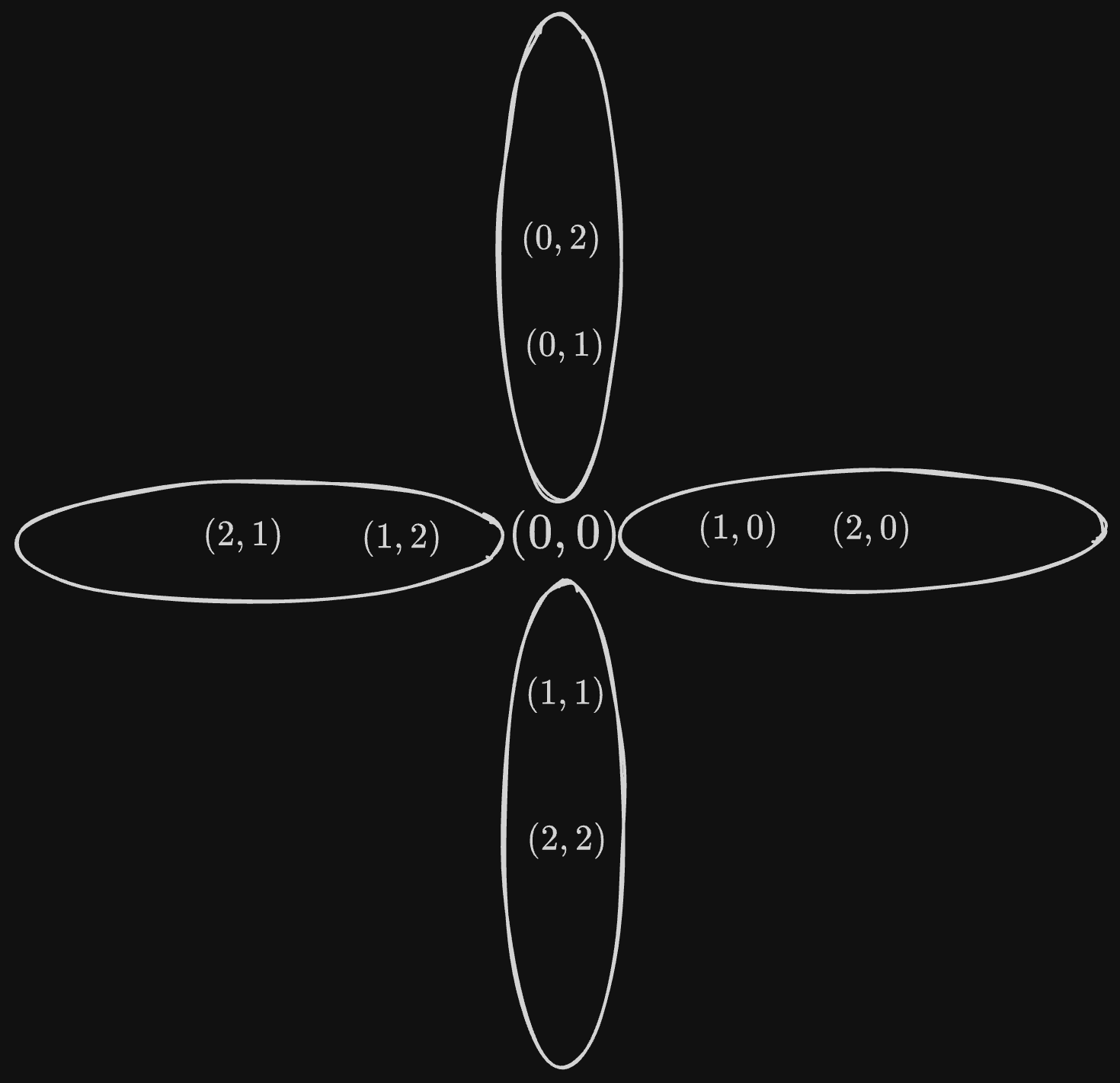
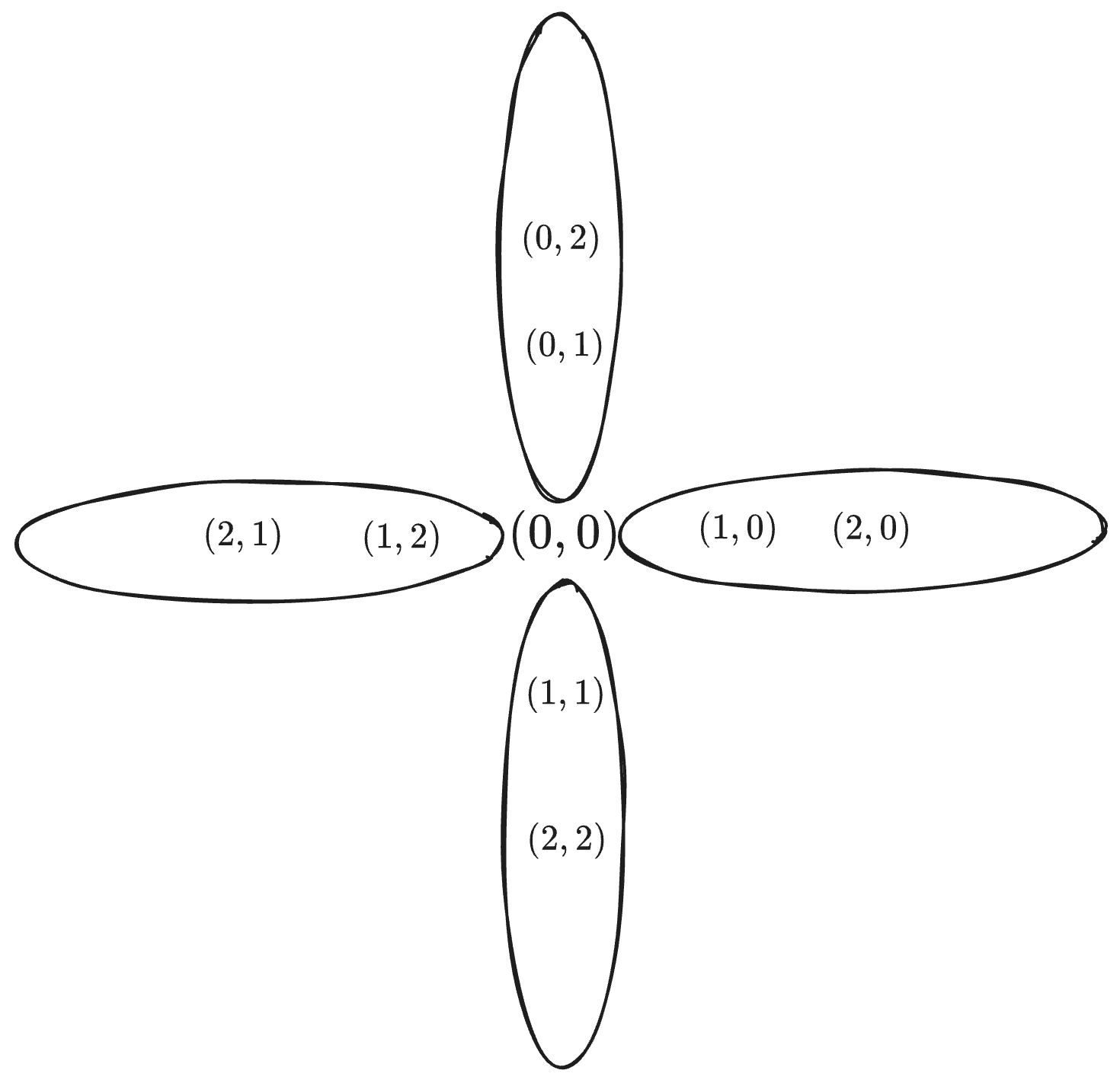
Now assume m m m r r r E [ r ] ≅ Z / r Z × Z / r Z E[r]\cong \Z/r\Z \times \Z/r\Z E [ r ] ≅ Z / r Z × Z / r Z r r r r ∣ r 2 r \mid r^2 r ∣ r 2 Z / r Z \Z/r\Z Z / r Z r r r E [ r ] E[r] E [ r ] r + 1 r+1 r + 1 r r r
⟨ ( 0 , 1 ) ⟩ G ⟨ ( 1 , 0 ) ⟩ G ⟨ ( 1 , 1 ) ⟩ G ⟨ ( 1 , 2 ) ⟩ G … ⟨ ( 1 , r − 1 ) ⟩ G \lang (0,1) \rang_G \\
\lang (1,0) \rang_G \\
\lang (1,1) \rang_G \\
\lang (1,2) \rang_G \\
\ldots \\
\lang (1,r-1) \rang_G \\ ⟨( 0 , 1 ) ⟩ G ⟨( 1 , 0 ) ⟩ G ⟨( 1 , 1 ) ⟩ G ⟨( 1 , 2 ) ⟩ G … ⟨( 1 , r − 1 ) ⟩ G Why is this list exaustive and each group is unique? Because if we take any element ( a , b ) (a, b) ( a , b ) a = 0 a =0 a = 0 ⟨ ( 0 , 1 ) ⟩ G \lang (0,1) \rang_G ⟨( 0 , 1 ) ⟩ G b = 0 b=0 b = 0 ⟨ ( 1 , 0 ) ⟩ G \lang (1,0) \rang_G ⟨( 1 , 0 ) ⟩ G r − 1 r-1 r − 1
Note that ( 0 , 0 ) (0,0) ( 0 , 0 ) r ( r + 1 ) − r = r 2 r(r+1)-r=r^2 r ( r + 1 ) − r = r 2 − r -r − r ( 0 , 0 ) (0,0) ( 0 , 0 ) r r r r r r
Of course we use here integers but on elliptic curve this will be elliptic curve points.
Propostion 4.3.1: Weil conjectures for elliptic curves
∢ q = p n , p ∈ P ( E , O ) / F q ∈ E t : = ∣ E F q ∣ − q − 1 χ ( x ) : = x 2 − t x + q α , β : χ ( α ) = χ ( β ) = 0 ϕ : = ρ ⇝ n ∣ α ∣ = ∣ β ∣ = q ∣ E F q k ∣ = q k + 1 − α k − β k ϕ 2 − [ t ] ∘ ϕ + [ q ] = [ 0 ] \begin{align*}
&\sphericalangle \\
&q=p^n, p \in \mathfrak P \\
&(E,O)/\mathbb F_q \in \mathcal E \\
&t:= |E_{\mathbb F_q}|-q-1 \\
&\chi(x):=x^2-tx+q \\
& \alpha, \beta: \chi(\alpha)=\chi(\beta)=0 \\
& \phi:=\rho_{\rightsquigarrow}^n \\
\hline
\\
&\begin{align*}
&|\alpha|=|\beta|=\sqrt q \hspace{0.5cm} \tag{a}\\
&|E_{\mathbb F_{q^k}}|=q^k+1-\alpha^k-\beta^k \hspace{0.5cm} \tag{b}\\
&\phi^2 - [t]\circ \phi + [q] = [0] \hspace{0.5cm} \tag{c}\\
\end{align*}
\end{align*} ∢ q = p n , p ∈ P ( E , O ) / F q ∈ E t := ∣ E F q ∣ − q − 1 χ ( x ) := x 2 − t x + q α , β : χ ( α ) = χ ( β ) = 0 ϕ := ρ ⇝ n ∣ α ∣ = ∣ β ∣ = q ∣ E F q k ∣ = q k + 1 − α k − β k ϕ 2 − [ t ] ∘ ϕ + [ q ] = [ 0 ] ( a ) ( b ) ( c ) Note that we have two eigenvalues of Frobenius. The first one is 1 1 1 ϕ ( P ) = P \phi(P)=P ϕ ( P ) = P
ϕ 2 − [ t ] ∘ ϕ + [ q ] = [ 1 ] − [ t ] + [ q ] = [ 1 − t + q ] = [ E F q ] = [ 0 ] \phi^2 - [t]\circ \phi + [q]=[1] - [t] + [q] = [1-t+q]=[E_{\mathbb F_q}]=[0] ϕ 2 − [ t ] ∘ ϕ + [ q ] = [ 1 ] − [ t ] + [ q ] = [ 1 − t + q ] = [ E F q ] = [ 0 ] Since the product of roots of characteriscic polynomial is q q q q q q
So when we have r ∣ q k − 1 r \mid q^k-1 r ∣ q k − 1 r r r F q \mathbb F_q F q
Consider a trace mapping:
T ( P ) : = ∑ σ ∈ Gal ( F q k / F q ) σ ( P ) = ∑ t = 0 k − 1 ( x q i , y q i ) T(P):=\sum_{\sigma \in \text{Gal}(\mathbb F_{q^k}/\mathbb F_{q})}\sigma(P)=\sum_{t=0}^{k-1}(x^{q^i},y^{q^i}) T ( P ) := σ ∈ Gal ( F q k / F q ) ∑ σ ( P ) = t = 0 ∑ k − 1 ( x q i , y q i ) Note that it will fix F q \mathbb F_q F q T : F q k → F q \text{T}: \mathbb F_{q^k} \to \mathbb F_q T : F q k → F q E [ r ] F q E[r]_{\mathbb F_q} E [ r ] F q trace-image subgroup. Note that trace will fix each point of the trace-image subgroup, that is will send it to itself.
Now let's define another group by using and anti-trace map
T a ( P ) : = [ k ] P − T ( P ) T^a(P):=[k]P-T(P) T a ( P ) := [ k ] P − T ( P ) If we consider it as the map of the whole torsion then it will be a subgroup of this torsion because T a ( P 1 + P 2 ) : = [ k ] ( P 1 + P 2 ) − T ( P 1 + P 2 ) T^a(P_1+P_2):=[k](P_1+P_2)-T(P_1+P_2) T a ( P 1 + P 2 ) := [ k ] ( P 1 + P 2 ) − T ( P 1 + P 2 ) P P P F q \mathbb F_q F q [ k ] P [k]P [ k ] P
T ( T a ( P ) ) = T a ( P ) + ϕ ( T a ( P ) ) + … + ϕ k − 1 ( T a ( P ) ) = [ k ] P − T a ( P ) + [ k ] ϕ ( P ) − T ( P ) + … + [ k ] ϕ k − 1 ( P ) − T ( P ) = [ k ] T a ( P ) − [ k ] T a ( P ) = O T(T^a(P))=T^a(P)+\phi(T^a(P))+\ldots + \phi^{k-1}(T^a(P))= \\
[k]P-T^a(P) + [k]\phi(P)-T(P)+\ldots + [k]\phi^{k-1}(P)-T(P) = \\
[k]T^a(P)-[k]T^a(P)=O T ( T a ( P )) = T a ( P ) + ϕ ( T a ( P )) + … + ϕ k − 1 ( T a ( P )) = [ k ] P − T a ( P ) + [ k ] ϕ ( P ) − T ( P ) + … + [ k ] ϕ k − 1 ( P ) − T ( P ) = [ k ] T a ( P ) − [ k ] T a ( P ) = O So we call this group a trace-kernel subgroup. As we noted above this group is not empty so the kernel is at least the size of this group which is r r r
Finally if there's a point P ∈ E [ r ] : ϕ ( P ) = [ q ] P P\in E[r]: \phi(P)=[q]P P ∈ E [ r ] : ϕ ( P ) = [ q ] P T ( P ) = P + [ q ] P + … + [ q k − 1 ] P = [ ( q k − 1 ) / ( q − 1 ) ] P = O T(P)=P+[q]P+\ldots+[q^{k-1}]P=[(q^k-1)/(q-1)]P=O T ( P ) = P + [ q ] P + … + [ q k − 1 ] P = [( q k − 1 ) / ( q − 1 )] P = O q q q
To sum up we have two groups:
G 1 : = T ( E [ r ] ) trace-image subgroup ϕ ( P ) = P G 2 : = ker E [ r ] T trace-kernel subgroup ϕ ( P ) = [ q ] P \begin{array}{c|c|c}
\mathbb G_1: = T(E[r]) & \text{trace-image subgroup} & \phi(P)=P \\
\mathbb G_2 := \ker_{E[r]} T & \text{trace-kernel subgroup} & \phi(P)=[q]P \\
\end{array} G 1 := T ( E [ r ]) G 2 := ker E [ r ] T trace-image subgroup trace-kernel subgroup ϕ ( P ) = P ϕ ( P ) = [ q ] P Weil pairing
We want to have a pairing function that maps two points of elliptic curve to a field that is bilinear, non-trivial and Galois invariant.
Consider a field F F F char F = p \text{char} F=p char F = p m : p ∤ m m: p \nmid m m : p ∤ m Q ∈ E [ m ] Q \in E[m] Q ∈ E [ m ] [ m ] Q − [ m ] O = O [m]Q-[m]O=O [ m ] Q − [ m ] O = O ( 4.2.4 ) (4.2.4) ( 4.2.4 ) f m , Q ∈ F ( E ) f_{m,Q} \in F(E) f m , Q ∈ F ( E )
div ( f m , Q ) = m ( Q ) − m ( O ) \text{div}(f_{m, Q})=m(Q)-m(O) div ( f m , Q ) = m ( Q ) − m ( O ) Since [ m ] ≠ const [m]\ne \text{const} [ m ] = const ( 3.4.5 ) (3.4.5) ( 3.4.5 )
Q [ m ] − 1 : [ m ] Q [ m ] − 1 = Q Q_{[m]^{-1}}:[m]Q_{[m]^{-1}}=Q Q [ m ] − 1 : [ m ] Q [ m ] − 1 = Q Consider a divisor:
D : = [ m ] ∗ ( Q ) − [ m ] ∗ ( O ) = ∑ S ∈ [ m ] − 1 ( Q ) e [ m ] ( S ) ( S ) − ∑ T ∈ [ m ] − 1 ( O ) e [ m ] ( T ) ( T ) D:=[m]^*(Q)-[m]^*(O)=\sum_{S \in [m]^{-1}(Q)}e_{[m]}(S)(S)-\sum_{T \in [m]^{-1}(O)}e_{[m]}(T)(T) D := [ m ] ∗ ( Q ) − [ m ] ∗ ( O ) = S ∈ [ m ] − 1 ( Q ) ∑ e [ m ] ( S ) ( S ) − T ∈ [ m ] − 1 ( O ) ∑ e [ m ] ( T ) ( T ) Recall that by ( 4.2.9 ) (4.2.9) ( 4.2.9 ) [ m ] [m] [ m ] e [ m ] = 1 e_{[m]}=1 e [ m ] = 1 ( O ) (O) ( O ) ker [ m ] ≡ E [ m ] \ker [m] \equiv E[m] ker [ m ] ≡ E [ m ] Q Q Q Q [ m ] − 1 + E [ m ] Q_{[m]^{-1}}+E[m] Q [ m ] − 1 + E [ m ]
D = ∑ R ∈ E [ m ] ( Q [ m ] − 1 + R ) − ( R ) D= \sum_{R \in E[m]}(Q_{[m]^{-1}}+R)-(R) D = R ∈ E [ m ] ∑ ( Q [ m ] − 1 + R ) − ( R ) Note that the degree of this divisor is obvoisly 0 0 0 ∑ R ∈ E [ m ] Q [ m ] − 1 + R − R = ∑ R ∈ E [ m ] Q [ m ] − 1 = [ m 2 ] Q [ m ] − 1 = [ m ] Q = O \sum_{R \in E[m]}Q_{[m]^{-1}}+R-R=\sum_{R \in E[m]}Q_{[m]^{-1}}=[m^2]Q_{[m]^{-1}}=[m]Q=O ∑ R ∈ E [ m ] Q [ m ] − 1 + R − R = ∑ R ∈ E [ m ] Q [ m ] − 1 = [ m 2 ] Q [ m ] − 1 = [ m ] Q = O D D D g m , Q g_{m,Q} g m , Q
div ( g m , Q ) = [ m ] ∗ ( Q ) − [ m ] ∗ ( O ) = ∑ R ∈ E [ m ] ( Q [ m ] − 1 + R ) − ( R ) \text{div}(g_{m,Q})=[m]^*(Q)-[m]^*(O)=\sum_{R \in E[m]}(Q_{[m]^{-1}}+R)-(R) div ( g m , Q ) = [ m ] ∗ ( Q ) − [ m ] ∗ ( O ) = R ∈ E [ m ] ∑ ( Q [ m ] − 1 + R ) − ( R ) Then notice that:
( f m , Q ∘ [ m ] ) ( P ) = f m , Q ( [ m ] P ) div ( f m , Q ∘ [ m ] ) = m ∑ T ∈ [ m ] − 1 ( Q ) ( T ) − m ∑ S ∈ [ m ] − 1 ( O ) ( S ) = ∑ R ∈ E [ m ] m ( Q [ m ] − 1 + R ) − m ( R ) div ( g m , Q m ) = ∑ R ∈ E [ m ] m ( Q [ m ] − 1 + R ) − m ( R ) = div ( f m , Q ∘ [ m ] ) ⟹ div ( g m , Q m f ∘ [ m ] ) = 0 ⟹ f m , Q ∘ [ m ] = c g m , Q m (f_{m, Q} \circ [m])(P) = f_{m, Q}([m]P) \\
\text{div}(f_{m, Q} \circ [m]) = m\sum_{T \in [m]^{-1}(Q)}(T)-m\sum_{S \in [m]^{-1}(O)}(S)= \\
\sum_{R \in E[m]}m(Q_{[m]^{-1}}+R)-m(R) \\
\text{div}(g_{m, Q}^m) = \sum_{R \in E[m]}m(Q_{[m]^{-1}}+R)-m(R) = \text{div}(f_{m, Q} \circ [m]) \implies \\
\text{div}(\frac{g_{m, Q}^m}{f \circ [m]})=0 \implies
f_{m, Q} \circ [m] = c g_{m, Q}^m ( f m , Q ∘ [ m ]) ( P ) = f m , Q ([ m ] P ) div ( f m , Q ∘ [ m ]) = m T ∈ [ m ] − 1 ( Q ) ∑ ( T ) − m S ∈ [ m ] − 1 ( O ) ∑ ( S ) = R ∈ E [ m ] ∑ m ( Q [ m ] − 1 + R ) − m ( R ) div ( g m , Q m ) = R ∈ E [ m ] ∑ m ( Q [ m ] − 1 + R ) − m ( R ) = div ( f m , Q ∘ [ m ]) ⟹ div ( f ∘ [ m ] g m , Q m ) = 0 ⟹ f m , Q ∘ [ m ] = c g m , Q m Since g m g^m g m c = 1 c = 1 c = 1
f m , Q ∘ [ m ] = g m , Q m f_{m, Q} \circ [m] = g_{m, Q}^m f m , Q ∘ [ m ] = g m , Q m Next take some point P ∈ E [ m ] P \in E[m] P ∈ E [ m ] X ∈ E X \in E X ∈ E
( g m , Q ( X + P ) g m , Q ( X ) ) m = f m , Q ( [ m ] X + [ m ] P ) f m , Q ( [ m ] X ) = 1 (\frac{g_{m, Q}(X+P)}{g_{m, Q}(X)})^m=\frac{f_{m, Q}([m]X+[m]P)}{f_{m, Q}([m]X)}=1 ( g m , Q ( X ) g m , Q ( X + P ) ) m = f m , Q ([ m ] X ) f m , Q ([ m ] X + [ m ] P ) = 1 So the mapping ϕ : E → P 1 , X ↦ g m , Q ( X + P ) g m , Q ( X ) \phi: E \to \mathbb P^1, X \mapsto \frac{g_{m, Q}(X+P)}{g_{m, Q}(X)} ϕ : E → P 1 , X ↦ g m , Q ( X ) g m , Q ( X + P ) F ‾ \overline F F ( 3.4.5 ) (3.4.5) ( 3.4.5 ) ϕ \phi ϕ m m m
We'll denote the cyclic group of m m m μ m : = { x ∈ F ‾ : x m = 1 } \mu_m:=\{x \in \overline F: x^m=1\} μ m := { x ∈ F : x m = 1 }
def: Weil pairing
∢ ( E , O ) / F ∈ E char F ∤ m e m ( P , Q ) : E [ m ] × E [ m ] → μ m , P , Q ↦ g m , Q ( X + P ) g m , Q ( X ) \begin{align*}
&\sphericalangle \\
&(E, O)/F \in \mathcal E \\
&\text{char} F \nmid m \\
\hline
\\
&e_m(P,Q): E[m] \times E[m] \to \mu_m, P,Q \mapsto \frac{g_{m, Q}(X+P)}{g_{m, Q}(X)}
\end{align*} ∢ ( E , O ) / F ∈ E char F ∤ m e m ( P , Q ) : E [ m ] × E [ m ] → μ m , P , Q ↦ g m , Q ( X ) g m , Q ( X + P ) Proposition 4.3.3: Weil pairing properties
∢ ( E , O ) / F ∈ E char F ∤ m P i , Q i ∈ E [ m ] e m ( P 1 + P 2 , Q ) = e m ( P 1 , Q ) e m ( P 2 , Q ) e m ( P , Q 1 + Q 2 ) = e m ( P , Q 1 ) e m ( P , Q 2 ) e m ( P , P ) = 1 e m ( P , Q ) = e m ( Q , P ) − 1 ∀ σ ∈ Gal F ‾ / F : e m ( P , Q ) σ = e m ( P σ , Q σ ) ∀ P ∈ E [ m m ′ ] , Q ∈ E [ m ] : e m m ′ ( P , Q ) = e m ( [ m ′ ] P , Q ) ( ∀ S ∈ E [ m ] : e m ( S , T ) = 1 ) ⟹ T = O \begin{align*}
&\sphericalangle \\
&(E, O)/F \in \mathcal E \\
&\text{char} F \nmid m \\
&P_i, Q_i \in E[m] \\
\hline
\\
&\begin{align*}
&e_m(P_1+P_2,Q)=e_m(P_1,Q)e_m(P_2,Q) \hspace{0.5cm} \tag{a}\\
&e_m(P,Q_1+Q_2)=e_m(P,Q_1)e_m(P,Q_2) \hspace{0.5cm} \tag{b}\\
&e_m(P,P)=1 \hspace{0.5cm} \tag{c}\\
&e_m(P,Q)=e_m(Q,P)^{-1} \hspace{0.5cm} \tag{d}\\
&\forall \sigma \in \text{Gal}_{\overline F/F}: e_m(P,Q)^\sigma = e_m(P^\sigma ,Q^\sigma )\hspace{0.5cm} \tag{e}\\
&\forall P \in E[mm'], Q \in E[m]: e_{mm'}(P ,Q)=e_{m}([m']P ,Q) \hspace{0.5cm} \tag{f}\\
& (\forall S \in E[m]: e_m(S,T)=1) \implies T = O\hspace{0.5cm} \tag{g}\\
\end{align*}
\end{align*} ∢ ( E , O ) / F ∈ E char F ∤ m P i , Q i ∈ E [ m ] e m ( P 1 + P 2 , Q ) = e m ( P 1 , Q ) e m ( P 2 , Q ) e m ( P , Q 1 + Q 2 ) = e m ( P , Q 1 ) e m ( P , Q 2 ) e m ( P , P ) = 1 e m ( P , Q ) = e m ( Q , P ) − 1 ∀ σ ∈ Gal F / F : e m ( P , Q ) σ = e m ( P σ , Q σ ) ∀ P ∈ E [ m m ′ ] , Q ∈ E [ m ] : e m m ′ ( P , Q ) = e m ([ m ′ ] P , Q ) ( ∀ S ∈ E [ m ] : e m ( S , T ) = 1 ) ⟹ T = O ( a ) ( b ) ( c ) ( d ) ( e ) ( f ) ( g ) Proof
a.
e m ( P 1 + P 2 , Q ) = g m , Q ( X + P 1 + P 2 ) g m , Q ( X ) = g m , Q ( X + P 1 + P 2 ) g m , Q ( X + P 1 ) g m , Q ( X + P 1 ) g m , Q ( X ) = e ( P 1 , Q ) e ( P 2 , Q ) e_m(P_1+P_2, Q)=\frac{g_{m, Q}(X+P_1+P_2)}{g_{m, Q}(X)}= \\\frac{g_{m, Q}(X+P_1+P_2)}{g_{m, Q}(X+P_1)}\frac{g_{m, Q}(X+P_1)}{g_{m, Q}(X)} = e(P_1,Q)e(P_2,Q) e m ( P 1 + P 2 , Q ) = g m , Q ( X ) g m , Q ( X + P 1 + P 2 ) = g m , Q ( X + P 1 ) g m , Q ( X + P 1 + P 2 ) g m , Q ( X ) g m , Q ( X + P 1 ) = e ( P 1 , Q ) e ( P 2 , Q ) b.
Consider a function h h h
div ( h ) = ( Q 1 + Q 2 ) − ( Q 1 ) − ( Q 2 ) + ( O ) \text{div}(h)=(Q_1+Q_2)-(Q_1)-(Q_2)+(O) div ( h ) = ( Q 1 + Q 2 ) − ( Q 1 ) − ( Q 2 ) + ( O ) Then we have
div ( f m , Q 1 + Q 2 f m , Q 1 f m , Q 2 ) = m ( Q 1 + Q 2 ) − m ( O ) − m ( Q 1 ) + m ( O ) − m ( Q 2 ) + m ( O ) = m ( Q 1 + Q 2 ) − m ( Q 1 ) − m ( Q 2 ) + m ( O ) = m div ( h ) = div ( h m ) ⟹ f m , Q 1 + Q 2 = c f m , Q 1 f m , Q 2 h m \text{div}(\frac{f_{m, Q_1+Q_2}}{f_{m, Q_1}f_{m, Q_2}})=m(Q_1+Q_2)-m(O)-m(Q_1)+m(O)-m(Q_2)+m(O) =\\
m(Q_1+Q_2)-m(Q_1)-m(Q_2)+m(O)=m\text{div}(h)=\text{div}(h^m) \implies \\
f_{m, Q_1+Q_2}=cf_{m, Q_1}f_{m, Q_2}h^m div ( f m , Q 1 f m , Q 2 f m , Q 1 + Q 2 ) = m ( Q 1 + Q 2 ) − m ( O ) − m ( Q 1 ) + m ( O ) − m ( Q 2 ) + m ( O ) = m ( Q 1 + Q 2 ) − m ( Q 1 ) − m ( Q 2 ) + m ( O ) = m div ( h ) = div ( h m ) ⟹ f m , Q 1 + Q 2 = c f m , Q 1 f m , Q 2 h m Now let's compose it with [ m ] [m] [ m ]
g m , Q 1 + Q 2 m = f m , Q 1 + Q 2 ∘ m = c ( f m , Q 1 ∘ m ) ( f m , Q 2 ∘ m ) ( h m ∘ m ) = c g m , Q 1 m g m , Q 2 m ( h m ∘ m ) ⟹ g m , Q 1 + Q 2 = c g m , Q 1 g m , Q 2 ( h ∘ m ) g^m_{m, Q_1+Q_2}=f_{m, Q_1+Q_2} \circ m=c(f_{m, Q_1} \circ m)(f_{m, Q_2} \circ m)(h^m \circ m) = \\
cg^m_{m, Q_1}g_{m, Q_2}^m(h^m \circ m) \implies \\
g_{m, Q_1+Q_2}=cg_{m, Q_1}g_{m, Q_2}(h \circ m) g m , Q 1 + Q 2 m = f m , Q 1 + Q 2 ∘ m = c ( f m , Q 1 ∘ m ) ( f m , Q 2 ∘ m ) ( h m ∘ m ) = c g m , Q 1 m g m , Q 2 m ( h m ∘ m ) ⟹ g m , Q 1 + Q 2 = c g m , Q 1 g m , Q 2 ( h ∘ m ) So
e m ( P , Q 1 + Q 2 ) = g m , Q 1 + Q 2 ( X + P ) g m , Q 1 + Q 2 ( X ) = g m , Q 1 ( X + P ) g m , Q 2 ( X + P ) h ( [ m ] X + [ m ] P ) g m , Q 1 ( X ) g m , Q 2 ( X ) h ( [ m ] X ) = e m ( P , Q 1 ) e m ( P , Q 2 ) e_m(P,Q_1+Q_2)=\frac{g_{m, Q_1+Q_2}(X+P)}{g_{m, Q_1+Q_2}(X)}=\\
\frac{g_{m, Q_1}(X+P)g_{m, Q_2}(X+P)h([m]X+[m]P)}{g_{m, Q_1}(X)g_{m, Q_2}(X)h([m]X)}=e_m(P,Q_1)e_m(P,Q_2) e m ( P , Q 1 + Q 2 ) = g m , Q 1 + Q 2 ( X ) g m , Q 1 + Q 2 ( X + P ) = g m , Q 1 ( X ) g m , Q 2 ( X ) h ([ m ] X ) g m , Q 1 ( X + P ) g m , Q 2 ( X + P ) h ([ m ] X + [ m ] P ) = e m ( P , Q 1 ) e m ( P , Q 2 ) c.
Consider a translation-by-P map τ P : E → E , Q ↦ Q + P \tau_P: E \to E, Q \mapsto Q+P τ P : E → E , Q ↦ Q + P
div ( ∏ k = 0 m − 1 f m , P ∘ τ [ k ] P ) = m ∑ k = 0 m − 1 ( [ 1 − i ] P ) − ( [ − i ] P ) = 0 \text{div}(\prod_{k=0}^{m-1}f_{m,P} \circ \tau_{[k]P}) = m\sum_{k=0}^{m-1}([1-i]P)-([-i]P)=0 div ( k = 0 ∏ m − 1 f m , P ∘ τ [ k ] P ) = m k = 0 ∑ m − 1 ([ 1 − i ] P ) − ([ − i ] P ) = 0 So we have:
∀ X ∈ E : ∏ k = 0 m − 1 ( f m , P ∘ τ [ k ] P ) ( X ) = const \forall X \in E: \prod_{k=0}^{m-1}(f_{m,P} \circ \tau_{[k]P})(X)=\text{const} ∀ X ∈ E : k = 0 ∏ m − 1 ( f m , P ∘ τ [ k ] P ) ( X ) = const Now taking P [ m ] − 1 : [ m ] P [ m ] − 1 = P P_{[m]^{-1}}:[m]P_{[m]^{-1}}=P P [ m ] − 1 : [ m ] P [ m ] − 1 = P
( f m , P ∘ [ m ] ∘ τ [ k ] P [ m ] − 1 ) ( X ) = f m , P ( [ m ] ( X + [ k ] P [ m ] − 1 ) ) = f m , P ( [ m ] X + [ k ] P ) ∀ X ∈ E : ∏ k = 0 m − 1 ( g m , P m ∘ τ P [ m ] − 1 ) ( X ) = ∏ k = 0 m − 1 ( f m , P ∘ [ m ] ∘ τ [ k ] P [ m ] − 1 ) ( X ) = ∏ k = 0 m − 1 f m , P ( [ m ] X + [ k ] P ) (f_{m,P} \circ [m] \circ \tau_{[k]P_{[m]^{-1}}})(X)=f_{m,P}([m](X+[k]P_{[m]^{-1}}))= \\
f_{m,P}([m]X+[k]P) \\
\forall X \in E: \prod_{k=0}^{m-1}(g_{m,P}^m \circ \tau_{P_{[m]^{-1}}})(X) =
\prod_{k=0}^{m-1}(f_{m,P} \circ [m] \circ \tau_{[k]P_{[m]^{-1}}})(X) =\\
\prod_{k=0}^{m-1}f_{m,P}([m]X+[k]P) ( f m , P ∘ [ m ] ∘ τ [ k ] P [ m ] − 1 ) ( X ) = f m , P ([ m ] ( X + [ k ] P [ m ] − 1 )) = f m , P ([ m ] X + [ k ] P ) ∀ X ∈ E : k = 0 ∏ m − 1 ( g m , P m ∘ τ P [ m ] − 1 ) ( X ) = k = 0 ∏ m − 1 ( f m , P ∘ [ m ] ∘ τ [ k ] P [ m ] − 1 ) ( X ) = k = 0 ∏ m − 1 f m , P ([ m ] X + [ k ] P ) So it follows that:
∏ k = 0 m − 1 g m , P m ∘ τ P [ m ] − 1 = const ⟹ ∏ k = 0 m − 1 g m , P ∘ τ P [ m ] − 1 = const \prod_{k=0}^{m-1}g_{m,P}^m \circ \tau_{P_{[m]^{-1}}} = \text{const} \implies \\
\prod_{k=0}^{m-1}g_{m,P} \circ \tau_{P_{[m]^{-1}}}= \text{const} k = 0 ∏ m − 1 g m , P m ∘ τ P [ m ] − 1 = const ⟹ k = 0 ∏ m − 1 g m , P ∘ τ P [ m ] − 1 = const In particular taking X ′ = X + P [ m ] − 1 X' = X+P_{[m]^{-1}} X ′ = X + P [ m ] − 1
∏ k = 0 m − 1 g m , P ( X + [ k ] P [ m ] − 1 ) = ∏ k = 0 m − 1 g m , P ( X + [ k + 1 ] P [ m ] − 1 ) \prod_{k=0}^{m-1}g_{m,P}(X+[k]P_{[m]^{-1}})=\prod_{k=0}^{m-1}g_{m,P}(X+[k+1]P_{[m]^{-1}}) k = 0 ∏ m − 1 g m , P ( X + [ k ] P [ m ] − 1 ) = k = 0 ∏ m − 1 g m , P ( X + [ k + 1 ] P [ m ] − 1 ) Cancelling similar terms:
g m , P ( X ) = g m , P ( X + [ m ] P [ m ] − 1 ) = g m , P ( X + P ) ⟹ e m ( P , P ) = 1 g_{m,P}(X)=g_{m,P}(X+[m]P_{[m]^{-1}})=g_{m,P}(X+P) \implies \\
e_m(P,P)=1 g m , P ( X ) = g m , P ( X + [ m ] P [ m ] − 1 ) = g m , P ( X + P ) ⟹ e m ( P , P ) = 1 d.
e m ( P + Q , P + Q ) = e m ( P , P ) e m ( P , Q ) e m ( Q , P ) e m ( Q , Q ) ⟹ e m ( P , Q ) e m ( Q , P ) = 1 e_m(P+Q,P+Q)=e_m(P,P)e_m(P,Q)e_m(Q,P)e_m(Q,Q) \implies \\
e_m(P,Q)e_m(Q,P)=1 e m ( P + Q , P + Q ) = e m ( P , P ) e m ( P , Q ) e m ( Q , P ) e m ( Q , Q ) ⟹ e m ( P , Q ) e m ( Q , P ) = 1 e.
Recall that for any f ∈ F ( E ) , P ∈ E : f ( P ) σ = f σ ( P σ ) f \in F(E), P \in E: f(P)^\sigma = f^{\sigma}(P^\sigma) f ∈ F ( E ) , P ∈ E : f ( P ) σ = f σ ( P σ )
div ( f m , Q ) = m ( Q ) − m ( O ) div ( f m , Q σ ) = div ( f m , Q ) σ = m ( Q σ ) − m ( O ) = div ( f m , Q σ ) ⟹ f m , Q σ = f m , Q σ \text{div}(f_{m, Q})=m(Q)-m(O) \\
\text{div}(f^\sigma_{m,Q})=\text{div}(f_{m,Q})^\sigma=m(Q^\sigma)-m(O)=\text{div}(f_{m,Q^\sigma}) \implies \\
f^\sigma_{m,Q} = f_{m,Q^\sigma} div ( f m , Q ) = m ( Q ) − m ( O ) div ( f m , Q σ ) = div ( f m , Q ) σ = m ( Q σ ) − m ( O ) = div ( f m , Q σ ) ⟹ f m , Q σ = f m , Q σ The same is true for g g g
e m ( P , Q ) σ = g m , Q σ ( X σ + P σ ) g m , Q σ ( X σ ) = g m , Q σ ( X σ + P σ ) g m , Q σ ( X σ ) = e m ( P σ , Q σ ) e_m(P,Q)^\sigma=\frac{g_{m, Q}^{\sigma}(X^{\sigma}+P^{\sigma})}{g^{\sigma}_{m, Q}(X^{\sigma})}=
\frac{g_{m, Q^{\sigma}}(X^{\sigma}+P^{\sigma})}{g_{m, Q^{\sigma}}(X^{\sigma})}=e_m(P^\sigma, Q^\sigma) e m ( P , Q ) σ = g m , Q σ ( X σ ) g m , Q σ ( X σ + P σ ) = g m , Q σ ( X σ ) g m , Q σ ( X σ + P σ ) = e m ( P σ , Q σ ) f.
Notice that:
div ( f m , Q m ′ ) = m ′ m ( Q ) − m ′ m ( O ) ( g m , Q ∘ [ m ′ ] ) m m ′ = ( f m , Q ∘ [ m m ′ ] ) m ′ = f m m ′ , Q ∘ [ m m ′ ] = g m m ′ , Q \text{div}(f_{m, Q}^{m'})=m'm(Q)-m'm(O) \\
(g_{m, Q}\circ [m'])^{mm'}=(f_{m, Q}\circ [mm'])^{m'}=f_{mm',Q}\circ [mm']=g_{mm',Q} div ( f m , Q m ′ ) = m ′ m ( Q ) − m ′ m ( O ) ( g m , Q ∘ [ m ′ ] ) m m ′ = ( f m , Q ∘ [ m m ′ ] ) m ′ = f m m ′ , Q ∘ [ m m ′ ] = g m m ′ , Q So
e m m ′ ( P , Q ) = g m , Q ∘ [ m ′ ] ( X + P ) g m , Q ∘ [ m ′ ] ( X ) = g m , Q ( Y + [ m ′ ] P ) g m , Q ( Y ) = e m ( [ m ′ ] P , Q ) e_{mm'}(P,Q)=\frac{g_{m, Q}\circ [m'](X+P)}{g_{m, Q}\circ [m'](X)}=\frac{g_{m, Q}(Y+[m']P)}{g_{m, Q}(Y)}=e_{m}([m']P,Q) e m m ′ ( P , Q ) = g m , Q ∘ [ m ′ ] ( X ) g m , Q ∘ [ m ′ ] ( X + P ) = g m , Q ( Y ) g m , Q ( Y + [ m ′ ] P ) = e m ([ m ′ ] P , Q ) g.
We will not prove it here.
□ \square □
This definition of pairing works fine but it's a bit tedious for real world calculation. After all it involved finding f f f m ( Q ) − m ( O ) m(Q)-m(O) m ( Q ) − m ( O ) g g g [ m ] ∗ ( Q ) − [ m ] ∗ ( O ) [m]^*(Q)-[m]^*(O) [ m ] ∗ ( Q ) − [ m ] ∗ ( O ) m ( Q ) − m ( O ) m(Q)-m(O) m ( Q ) − m ( O )
We start this journey by defining how to calculate function of divisor.
def: Divisor support
∢ D = ∑ n P ( P ) supp ( D ) : = { P : n P ≠ 0 } \begin{align*}
&\sphericalangle \\
&D = \sum n_P(P)
\\
\hline
\\
&\text{supp}(D):=\{P: n_P \ne 0\}
\end{align*} ∢ D = ∑ n P ( P ) supp ( D ) := { P : n P = 0 } def: Divisor sum
∢ D = ∑ n P ( P ) sum ( D ) : = ∑ [ n P ] P \begin{align*}
&\sphericalangle \\
&D = \sum n_P(P)
\\
\hline
\\
&\text{sum}(D):=\sum [n_P]P
\end{align*} ∢ D = ∑ n P ( P ) sum ( D ) := ∑ [ n P ] P def: Function evaluation on divisor
∢ ( E , O ) ∈ E D = ∑ n P ( P ) f ∈ F ( E ) supp ( div ( f ) ) ∩ supp ( D ) = ∅ f ( D ) : = ∏ P ∈ supp ( D ) f ( P ) n P \begin{align*}
&\sphericalangle \\
&(E, O) \in \mathcal E \\
&D = \sum n_P(P) \\
&f \in F(E) \\
&\text{supp}(\text{div}(f)) \cap \text{supp}(D) = \empty
\\
\hline
\\
&f(D):=\prod_{P \in \text{supp}(D)} f(P)^{n_P}
\end{align*} ∢ ( E , O ) ∈ E D = ∑ n P ( P ) f ∈ F ( E ) supp ( div ( f )) ∩ supp ( D ) = ∅ f ( D ) := P ∈ supp ( D ) ∏ f ( P ) n P Note that this definition make sense if supports are disjoint. Otherwise we'll have 0 0 0 0 0 0
Proposition 4.3.4: Weil reciprocity
∢ ( E , O ) ∈ E f , g ∈ F ( E ) supp ( div ( f ) ) ∩ supp ( div ( g ) ) = ∅ g ( div ( f ) ) = f ( div ( g ) ) \begin{align*}
&\sphericalangle \\
&(E, O) \in \mathcal E \\
&f,g \in F(E) \\
&\text{supp}(\text{div}(f)) \cap \text{supp}(\text{div}(g)) = \empty
\\
\hline
\\
&g(\text{div}(f))=f(\text{div}(g))
\end{align*} ∢ ( E , O ) ∈ E f , g ∈ F ( E ) supp ( div ( f )) ∩ supp ( div ( g )) = ∅ g ( div ( f )) = f ( div ( g )) Proof
First, let's prove for the case E = P 1 E = \mathbb P^1 E = P 1 f = ( x − α 1 ) … ( x − α n ) , g = ( x − β 1 ) … ( x − β k ) f = (x-\alpha_1)\ldots(x-\alpha_n), g=(x-\beta_1)\ldots(x-\beta_k) f = ( x − α 1 ) … ( x − α n ) , g = ( x − β 1 ) … ( x − β k )
α 1 − β 1 … α n − β k … α n − β 1 … α n − β k \begin{matrix}
\alpha_1-\beta_1 & \ldots & \alpha_n-\beta_k \\
\ldots \\
\alpha_n-\beta_1 & \ldots & \alpha_n-\beta_k
\end{matrix} α 1 − β 1 … α n − β 1 … … α n − β k α n − β k Notice that g ( div ( f ) ) g(\text{div}(f)) g ( div ( f )) f ( div ( g ) ) f(\text{div}(g)) f ( div ( g )) g ( div ( f ) ) g(\text{div}(f)) g ( div ( f )) f ( div ( g ) ) f(\text{div}(g)) f ( div ( g )) − 1 -1 − 1 ( − 1 ) m k (-1)^{mk} ( − 1 ) mk f f f n n n n n n g g g k k k ( − 1 ) m k (-1)^{mk} ( − 1 ) mk
Now let's prove for arbitrary E E E
f ( ϕ ∗ D ) = ( ϕ ∗ f ) ( D ) , f ( ϕ ∗ D ) = ( ϕ ∗ f ) ( D ) f(\phi^*D)=(\phi_*f)(D), f(\phi_*D)=(\phi^*f)(D) f ( ϕ ∗ D ) = ( ϕ ∗ f ) ( D ) , f ( ϕ ∗ D ) = ( ϕ ∗ f ) ( D ) Consider a mapping:
ϕ ( P ) = { [ g ( P ) , 1 ] , g ∈ O C , P r [ 1 , 0 ] , g ∉ O C , P r \phi(P) = \begin{cases}
[g(P), 1], g \in \mathcal O^r_{C,P} \\
[1,0], g \notin \mathcal O^r_{C,P}
\end{cases} ϕ ( P ) = { [ g ( P ) , 1 ] , g ∈ O C , P r [ 1 , 0 ] , g ∈ / O C , P r Then
f ( div ( g ) ) = f ( ϕ ∗ ( ( 0 ) − ( ∞ ) ) ) = ( ϕ ∗ f ) ( ( 0 ) − ( ∞ ) ) = ( ϕ ∗ f ) ( div ( x ) ) f(\text{div}(g))=f(\phi^*((0)-(\infty)))=(\phi_*f)((0)-(\infty))= \\
(\phi_*f)(\text{div}(x)) f ( div ( g )) = f ( ϕ ∗ (( 0 ) − ( ∞ ))) = ( ϕ ∗ f ) (( 0 ) − ( ∞ )) = ( ϕ ∗ f ) ( div ( x )) Now notice that the latter are actually functions in P 1 \mathbb P^1 P 1
f ( div ( g ) ) = ( ϕ ∗ f ) ( div ( x ) ) = x ( div ( ϕ ∗ f ) ) = x ( ϕ ∗ div ( f ) ) = ϕ ∗ x ( div ( f ) ) = g ( div ( f ) ) f(\text{div}(g))=(\phi_*f)(\text{div}(x))=x(\text{div}(\phi_*f))=x(\phi_*\text{div}(f))= \\
\phi^*x(\text{div}(f))=g(\text{div}(f)) f ( div ( g )) = ( ϕ ∗ f ) ( div ( x )) = x ( div ( ϕ ∗ f )) = x ( ϕ ∗ div ( f )) = ϕ ∗ x ( div ( f )) = g ( div ( f )) □ \square □
def: Alternative definition of Weil pairing
∢ ( E , O ) ∈ E m ∈ N : char F ∤ m S , T ∈ E [ m ] D S , D T ∈ Div 0 ( E ) sum ( D S ) = S , sum ( D T ) = T supp ( D S ) ∩ supp ( D T ) = ∅ h S , h T ∈ F ( E ) : div ( h S ) = m D S , div ( h T ) = m D T e ^ m ( S , T ) : = h T ( D S ) h S ( D T ) \begin{align*}
&\sphericalangle \\
&(E, O) \in \mathcal E \\
&m \in \N: \text{char}F \nmid m \\
&S, T \in E[m] \\
&D_S, D_T \in \text{Div}^0(E) \\
&\text{sum}(D_S)=S,\text{sum}(D_T)=T \\
&\text{supp}(D_S) \cap \text{supp}(D_T) = \empty \\
&h_S, h_T \in F(E):\text{div}(h_S)=mD_S, \text{div}(h_T)=mD_T
\\
\hline
\\
&\hat e_m(S,T):=\frac{h_T(D_S)}{h_S(D_T)}
\end{align*} ∢ ( E , O ) ∈ E m ∈ N : char F ∤ m S , T ∈ E [ m ] D S , D T ∈ Div 0 ( E ) sum ( D S ) = S , sum ( D T ) = T supp ( D S ) ∩ supp ( D T ) = ∅ h S , h T ∈ F ( E ) : div ( h S ) = m D S , div ( h T ) = m D T e ^ m ( S , T ) := h S ( D T ) h T ( D S ) Next we want to prove a serios of propositions that will lead us to the conclusion that this definition is equivalent.
From now on we'll assume that we always work in a torsion of the size m m m f m , P f_{m,P} f m , P f P f_P f P
First define two quantities:
c ( [ m ] V , [ m ] W ) : = f [ m ] V + [ m ] W ( X ) f [ m ] V ( X ) f [ m ] W ( X − [ m ] V ) d ( V , W ) : = g [ m ] V + [ m ] W ( X ) g [ m ] V ( X ) g [ m ] W ( X − V ) c([m]V,[m]W):=\frac{f_{[m]V+[m]W}(X)}{f_{[m]V}(X)f_{[m]W}(X-[m]V)} \\
d(V,W):=\frac{g_{[m]V+[m]W}(X)}{g_{[m]V}(X)g_{[m]W}(X-V)} \\ c ([ m ] V , [ m ] W ) := f [ m ] V ( X ) f [ m ] W ( X − [ m ] V ) f [ m ] V + [ m ] W ( X ) d ( V , W ) := g [ m ] V ( X ) g [ m ] W ( X − V ) g [ m ] V + [ m ] W ( X ) Proposition 4.3.5: The alternative definition of Weil pairing
∢ ( E , O ) ∈ E m ∈ N : char F ∤ m S , T ∈ E [ m ] c ( [ m ] V , [ m ] W ) , d ( V , W ) = const ( X ) d ( V , W ) m = c ( [ m ] V , [ m ] W ) V , W , U ∈ E [ m 2 ] ⟹ d ( V , W + [ m ] U ) = d ( V , W ) V , W , U ∈ E [ m 2 ] ⟹ d ( V + [ m ] U , W ) = d ( V , W ) e m ( [ m ] U , [ m ] W ) d ( U , V ) d ( V , U ) = d ( V , W ) d ( U + W , V ) d ( V , U + W ) d ( W , V ) e m ( S , T ) = c ( S , T ) c ( T , S ) e ^ m ( S , T ) = e m ( S , T ) \begin{align*}
&\sphericalangle \\
&(E, O) \in \mathcal E \\
&m \in \N: \text{char}F \nmid m \\
&S, T \in E[m] \\
\hline
\\
&\begin{align*}
& c([m]V,[m]W), d(V,W) = \text{const}(X)\hspace{0.5cm} \tag{a}\\
& d(V,W)^m=c([m]V,[m]W)\hspace{0.5cm} \tag{b}\\
& V,W,U \in E[m^2] \implies d(V,W+[m]U)=d(V,W)\hspace{0.5cm} \tag{c}\\
& V,W,U \in E[m^2] \implies d(V+[m]U,W)=d(V,W)e_m([m]U,[m]W)\hspace{0.5cm} \tag{d}\\
& \frac{d(U,V)}{d(V,U)}=\frac{d(V,W)d(U+W,V)}{d(V,U+W)d(W,V)}\hspace{0.5cm} \tag{e}\\
& e_m(S,T)=\frac{c(S,T)}{c(T,S)}\hspace{0.5cm} \tag{f}\\
& \hat e_m(S,T)=e_m(S,T)\hspace{0.5cm} \tag{g}\\
\end{align*}
\end{align*} ∢ ( E , O ) ∈ E m ∈ N : char F ∤ m S , T ∈ E [ m ] c ([ m ] V , [ m ] W ) , d ( V , W ) = const ( X ) d ( V , W ) m = c ([ m ] V , [ m ] W ) V , W , U ∈ E [ m 2 ] ⟹ d ( V , W + [ m ] U ) = d ( V , W ) V , W , U ∈ E [ m 2 ] ⟹ d ( V + [ m ] U , W ) = d ( V , W ) e m ([ m ] U , [ m ] W ) d ( V , U ) d ( U , V ) = d ( V , U + W ) d ( W , V ) d ( V , W ) d ( U + W , V ) e m ( S , T ) = c ( T , S ) c ( S , T ) e ^ m ( S , T ) = e m ( S , T ) ( a ) ( b ) ( c ) ( d ) ( e ) ( f ) ( g ) Proof
a.
First note that
d ( V , W ) ( X ) m = f [ m ] V + [ m ] W ( [ m ] X ) f [ m ] V ( [ m ] X ) f [ m ] W ( [ m ] X − [ m ] V ) = c ( [ m ] W , [ m ] V ) ( [ m ] X ) d(V,W)(X)^m=\frac{f_{[m]V+[m]W}([m]X)}{f_{[m]V}([m]X)f_{[m]W}([m]X-[m]V)}= \\
c([m]W,[m]V)([m]X) d ( V , W ) ( X ) m = f [ m ] V ([ m ] X ) f [ m ] W ([ m ] X − [ m ] V ) f [ m ] V + [ m ] W ([ m ] X ) = c ([ m ] W , [ m ] V ) ([ m ] X ) So we have:
div ( c ( m V , m W ) ) = m ( [ m ] V + [ m ] W ) − m ( O ) − ( m ( [ m ] V ) − m ( O ) ) − − ( m ( [ m ] V + [ m ] W ) − m ( [ m ] V ) ) = 0 \text{div}(c(mV,mW))= \\
m([m]V+[m]W)-m(O)-(m([m]V)-m(O))- \\
-(m([m]V+[m]W)-m([m]V)) = 0\\ div ( c ( mV , mW )) = m ([ m ] V + [ m ] W ) − m ( O ) − ( m ([ m ] V ) − m ( O )) − − ( m ([ m ] V + [ m ] W ) − m ([ m ] V )) = 0 This implies that c ( [ m ] W , [ m ] V ) c([m]W,[m]V) c ([ m ] W , [ m ] V ) X X X d ( V , W ) m d(V,W)^m d ( V , W ) m 0 = div ( d ( V , W ) m ) = m div ( d ( V , W ) ) ⟹ div ( d ( V , W ) ) = 0 0=\text{div}(d(V,W)^m)=m\text{div}(d(V,W))\implies \text{div}(d(V,W)) = 0 0 = div ( d ( V , W ) m ) = m div ( d ( V , W )) ⟹ div ( d ( V , W )) = 0 d ( V , W ) d(V,W) d ( V , W )
b.
Follows immediately from ( a ) (a) ( a )
c.
Note that since W ∈ E [ m 2 ] W \in E[m^2] W ∈ E [ m 2 ] [ m ] ( W + [ m ] U ) = [ m ] W [m](W+[m]U)=[m]W [ m ] ( W + [ m ] U ) = [ m ] W
d ( V , W + [ m ] U ) = g [ m ] V + [ m ] W ( X ) g [ m ] V ( X ) g [ m ] W ( X − V ) = d ( V , W ) d(V,W+[m]U)=\frac{g_{[m]V+[m]W}(X)}{g_{[m]V}(X)g_{[m]W}(X-V)}=d(V,W) d ( V , W + [ m ] U ) = g [ m ] V ( X ) g [ m ] W ( X − V ) g [ m ] V + [ m ] W ( X ) = d ( V , W ) d.
d ( V + [ m ] U , W ) = g [ m ] V + [ m ] W ( X ) g [ m ] V ( X ) g [ m ] W ( X − V − [ m ] U ) = g [ m ] V + [ m ] W ( X ) g [ m ] V ( X ) g [ m ] W ( X − V ) ⋅ g [ m ] W ( X − V ) g [ m ] W ( X − V − [ m ] U ) = d ( V , W ) e n ( [ m ] U , [ m ] W ) d(V+[m]U,W)=\frac{g_{[m]V+[m]W}(X)}{g_{[m]V}(X)g_{[m]W}(X-V-[m]U)}= \\
\frac{g_{[m]V+[m]W}(X)}{g_{[m]V}(X)g_{[m]W}(X-V)}\cdot \frac{g_{[m]W}(X-V)}{g_{[m]W}(X-V-[m]U)} = \\
d(V,W)e_n([m]U,[m]W) d ( V + [ m ] U , W ) = g [ m ] V ( X ) g [ m ] W ( X − V − [ m ] U ) g [ m ] V + [ m ] W ( X ) = g [ m ] V ( X ) g [ m ] W ( X − V ) g [ m ] V + [ m ] W ( X ) ⋅ g [ m ] W ( X − V − [ m ] U ) g [ m ] W ( X − V ) = d ( V , W ) e n ([ m ] U , [ m ] W ) For the last equation assume X ′ = X − V − [ m ] U X'=X-V-[m]U X ′ = X − V − [ m ] U
e.
First consider some equations for U , V , W U, V, W U , V , W
g [ m ] U + ( [ m ] V + [ m ] W ) ( X ) = d ( U , V + W ) g [ m ] U ( X ) g [ m ] V + [ m ] W ( X − U ) = d ( U , V + W ) d ( V , W ) g [ m ] U ( X ) g [ m ] V ( X − U ) g [ m ] W ( X − U − V ) g_{[m]U+([m]V+[m]W)}(X)=d(U,V+W)g_{[m]U}(X)g_{[m]V+[m]W}(X-U)= \\
d(U,V+W)d(V,W)g_{[m]U}(X)g_{[m]V}(X-U)g_{[m]W}(X-U-V) g [ m ] U + ([ m ] V + [ m ] W ) ( X ) = d ( U , V + W ) g [ m ] U ( X ) g [ m ] V + [ m ] W ( X − U ) = d ( U , V + W ) d ( V , W ) g [ m ] U ( X ) g [ m ] V ( X − U ) g [ m ] W ( X − U − V ) On the other hand:
g ( [ m ] U + [ m ] V ) + [ m ] W ( X ) = d ( U + V , W ) g [ m ] U + [ m ] V ( X ) g [ m ] W ( X − U − V ) = d ( U + V , W ) d ( U , V ) g [ m ] U ( X ) g [ m ] V ( X − U ) ) g [ m ] W ( X − U − V ) g_{([m]U+[m]V)+[m]W}(X)=d(U+V,W)g_{[m]U+[m]V}(X)g_{[m]W}(X-U-V)= \\
d(U+V,W)d(U,V)g_{[m]U}(X)g_{[m]V}(X-U))g_{[m]W}(X-U-V) g ([ m ] U + [ m ] V ) + [ m ] W ( X ) = d ( U + V , W ) g [ m ] U + [ m ] V ( X ) g [ m ] W ( X − U − V ) = d ( U + V , W ) d ( U , V ) g [ m ] U ( X ) g [ m ] V ( X − U )) g [ m ] W ( X − U − V ) Equating these two and cancelling common terms:
d ( U , V + W ) d ( V , W ) = d ( U + V , W ) d ( U , V ) d(U,V+W)d(V,W)=d(U+V,W)d(U,V) d ( U , V + W ) d ( V , W ) = d ( U + V , W ) d ( U , V ) Now we can make the same equality but permute U , V , W U,V,W U , V , W V , U , W V,U,W V , U , W
d ( V , U + W ) d ( U , W ) = d ( U + V , W ) d ( V , U ) d(V,U+W)d(U,W)=d(U+V,W)d(V,U) d ( V , U + W ) d ( U , W ) = d ( U + V , W ) d ( V , U ) Dividing these two equations:
d ( U , V ) d ( V , U ) = d ( V , W ) d ( U , W ) d ( U , V + W ) d ( V , U + W ) \frac{d(U,V)}{d(V,U)}=\frac{d(V,W)}{d(U,W)}\frac{d(U,V+W)}{d(V,U+W)} d ( V , U ) d ( U , V ) = d ( U , W ) d ( V , W ) d ( V , U + W ) d ( U , V + W ) Finally for U , W , V U,W,V U , W , V
d ( U , V + W ) d ( W , V ) = d ( U + W , V ) d ( U , W ) ⟹ d ( U , V + W ) d ( U , W ) = d ( U + W , V ) d ( W , V ) d(U,V+W)d(W,V)=d(U+W,V)d(U,W) \implies \\
\frac{d(U,V+W)}{d(U,W)}=\frac{d(U+W,V)}{d(W,V)} d ( U , V + W ) d ( W , V ) = d ( U + W , V ) d ( U , W ) ⟹ d ( U , W ) d ( U , V + W ) = d ( W , V ) d ( U + W , V ) So:
d ( U , V ) d ( V , U ) = d ( V , W ) d ( U , W ) d ( U , V + W ) d ( V , U + W ) = d ( V , W ) d ( U + W , V ) d ( W , V ) d ( V , U + W ) \frac{d(U,V)}{d(V,U)}=\frac{d(V,W)}{d(U,W)}\frac{d(U,V+W)}{d(V,U+W)}= \\
\frac{d(V,W)d(U+W,V)}{d(W,V)d(V,U+W)}
d ( V , U ) d ( U , V ) = d ( U , W ) d ( V , W ) d ( V , U + W ) d ( U , V + W ) = d ( W , V ) d ( V , U + W ) d ( V , W ) d ( U + W , V ) e.
Assume S , T ∈ E [ m ] S, T \in E[m] S , T ∈ E [ m ] U , V ∈ E [ m 2 ] : [ m ] U = S , [ m ] V = T U, V \in E[m^2]: [m]U=S, [m]V=T U , V ∈ E [ m 2 ] : [ m ] U = S , [ m ] V = T ( d ) (d) ( d ) W W W W = [ j ] U W=[j]U W = [ j ] U
c ( [ n ] U , [ n ] V ) c ( [ n ] V , [ n ] U ) = ( b ) ( d ( U , V ) d ( V , U ) ) n = ( d ) ∏ j = 0 m − 1 d ( V , [ j ] U ) d ( U + [ j ] U , V ) d ( V , U + [ j ] U ) d ( [ j ] U , V ) \frac{c([n]U, [n]V)}{c([n]V, [n]U)}\overset{(b)}=(\frac{d(U,V)}{d(V,U)})^n \overset{(d)}=\prod_{j=0}^{m-1}\frac{d(V,[j]U)d(U+[j]U,V)}{d(V,U+[j]U)d([j]U,V)} c ([ n ] V , [ n ] U ) c ([ n ] U , [ n ] V ) = ( b ) ( d ( V , U ) d ( U , V ) ) n = ( d ) j = 0 ∏ m − 1 d ( V , U + [ j ] U ) d ([ j ] U , V ) d ( V , [ j ] U ) d ( U + [ j ] U , V ) Note that the above terms are a translation-by-U from below terms so they all cancel except the first and the last one, that is j = 0 j=0 j = 0 j = m − 1 j=m-1 j = m − 1
c ( [ n ] U , [ n ] V ) c ( [ n ] V , [ n ] U ) = d ( V , O ) d ( [ m ] U , V ) d ( V , [ m ] U ) d ( O , V ) \frac{c([n]U, [n]V)}{c([n]V, [n]U)} = \frac{d(V,O)d([m]U, V)}{d(V,[m]U)d(O,V)} c ([ n ] V , [ n ] U ) c ([ n ] U , [ n ] V ) = d ( V , [ m ] U ) d ( O , V ) d ( V , O ) d ([ m ] U , V ) Now turning back to ( c ) (c) ( c ) W = O W=O W = O d ( V , [ m ] U ) = d ( V , O ) d(V,[m]U)=d(V,O) d ( V , [ m ] U ) = d ( V , O ) ( d ) (d) ( d ) V = O , W = V V=O, W=V V = O , W = V d ( [ m ] U , V ) = d ( O , V ) e m ( [ m ] U , [ m ] V ) d([m]U,V)=d(O,V)e_m([m]U,[m]V) d ([ m ] U , V ) = d ( O , V ) e m ([ m ] U , [ m ] V )
e m ( [ m ] U , [ m ] V ) = c ( [ m ] U , [ m ] V ) c ( [ m ] V , [ m ] U ) ⟹ e m ( S , T ) = c ( S , T ) c ( T , S ) e_m([m]U,[m]V)=\frac{c([m]U,[m]V)}{c([m]V,[m]U)} \implies \\
e_m(S,T)=\frac{c(S,T)}{c(T,S)} e m ([ m ] U , [ m ] V ) = c ([ m ] V , [ m ] U ) c ([ m ] U , [ m ] V ) ⟹ e m ( S , T ) = c ( T , S ) c ( S , T ) f.
We now know that
e m ( S , T ) = c ( S , T ) c ( T , S ) = f T ( X ) f S ( X − T ) f S ( X ) f T ( X − S ) e_m(S,T)=\frac{c(S,T)}{c(T,S)}=\frac{f_T(X)f_S(X-T)}{f_S(X)f_T(X-S)} e m ( S , T ) = c ( T , S ) c ( S , T ) = f S ( X ) f T ( X − S ) f T ( X ) f S ( X − T ) Pick X 0 ∈ E X_0 \in E X 0 ∈ E
D S ′ = ( S ) − ( O ) , D T ′ = ( X 0 ) − ( X 0 − T ) ⟹ sum ( D S ′ ) = S , sum ( D T ′ ) = T D'_S = (S)-(O), D'_T=(X_0)-(X_0-T) \implies \\
\text{sum}(D'_S)=S,\text{sum}(D'_T)=T D S ′ = ( S ) − ( O ) , D T ′ = ( X 0 ) − ( X 0 − T ) ⟹ sum ( D S ′ ) = S , sum ( D T ′ ) = T Then define:
F S ′ : = f S ( X ) , F T ′ : = 1 f T ( X 0 − X ) ⟹ div ( F S ′ ) = m ( S ) − m ( O ) = m D S ′ div ( F T ′ ) = m ( X 0 ) − m ( X 0 − T ) = m D T ′ F'_S:=f_S(X), F'_T:=\frac{1}{f_T(X_0-X)} \implies\\
\text{div}(F'_S)=m(S)-m(O)=mD_S' \\
\text{div}(F'_T)=m(X_0) - m(X_0-T) = mD_T' F S ′ := f S ( X ) , F T ′ := f T ( X 0 − X ) 1 ⟹ div ( F S ′ ) = m ( S ) − m ( O ) = m D S ′ div ( F T ′ ) = m ( X 0 ) − m ( X 0 − T ) = m D T ′ So
e m ( S , T ) = F S ′ ( D T ′ ) F T ′ ( D S ′ ) e_m(S,T)=\frac{F'_S(D'_T)}{F'_T(D'_S)} e m ( S , T ) = F T ′ ( D S ′ ) F S ′ ( D T ′ ) Thus the we proved the theorem for specific divisors. Now let's prove it for general divisors. Consider arbitrary divisors D T D_T D T D S D_S D S
sum ( D S ) = S , sum ( D T ) = T
\text{sum}(D_S)=S, \text{sum}(D_T)=T
sum ( D S ) = S , sum ( D T ) = T From ( 4.2.4 ) (4.2.4) ( 4.2.4 )
∃ h 1 , h 2 ∈ F ( E ) : D S = div ( h 1 ) + D S ′ , D T = div ( h 2 ) + D T ′
\exists h_1, h_2 \in F(E): D_S=\text{div}(h_1)+D'_S, D_T=\text{div}(h_2)+D'_T
∃ h 1 , h 2 ∈ F ( E ) : D S = div ( h 1 ) + D S ′ , D T = div ( h 2 ) + D T ′ Define
F S : = F S ′ h 1 m , F T : = F T ′ h 2 m ⟹ div ( F S ) = div ( F S ′ ) + m div ( h ) = m D S ′ + m div ( h ) = m D S div ( F T ) = m D T F_S:=F'_Sh_1^m,F_T:=F'_Th_2^m \implies \\
\text{div}(F_S)=\text{div}(F'_S)+m\text{div}(h)=mD'_S+m\text{div}(h)=mD_S \\
\text{div}(F_T) = mD_T F S := F S ′ h 1 m , F T := F T ′ h 2 m ⟹ div ( F S ) = div ( F S ′ ) + m div ( h ) = m D S ′ + m div ( h ) = m D S div ( F T ) = m D T First assume that supp ( D S ′ + D S ) ∩ supp ( D T ′ + D T ) = ∅ \text{supp}(D'_S + D_S) \cap \text{supp}(D'_T + D_T) = \empty supp ( D S ′ + D S ) ∩ supp ( D T ′ + D T ) = ∅
F T ( D S ) F S ( D T ) = h 2 ( D S ) m F T ′ ( D S ) h 1 ( D T ) m F S ′ ( D T ) = h 2 ( div ( h 1 ) ) m h 2 ( D S ′ ) m F T ′ ( div ( h 1 ) ) F T ′ ( D S ′ ) h 1 ( div ( h 2 ) ) m h 1 ( D T ′ ) m F S ′ ( div ( h 2 ) ) F S ′ ( D T ′ ) \frac{F_T(D_S)}{F_S(D_T)}=\frac{h_2(D_S)^mF'_T(D_S)}{h_1(D_T)^mF'_S(D_T)}=\frac{h_2(\text{div}(h_1))^mh_2(D'_S)^mF'_T(\text{div}(h_1))F'_T(D'_S)}{h_1(\text{div}(h_2))^mh_1(D'_T)^mF'_S(\text{div}(h_2))F'_S(D'_T)} F S ( D T ) F T ( D S ) = h 1 ( D T ) m F S ′ ( D T ) h 2 ( D S ) m F T ′ ( D S ) = h 1 ( div ( h 2 ) ) m h 1 ( D T ′ ) m F S ′ ( div ( h 2 )) F S ′ ( D T ′ ) h 2 ( div ( h 1 ) ) m h 2 ( D S ′ ) m F T ′ ( div ( h 1 )) F T ′ ( D S ′ ) By ( 4.3.4 ) (4.3.4) ( 4.3.4 )
h 1 ( div ( h 2 ) ) = h 2 ( div ( h 1 ) ) h 2 ( D S ′ ) m = h 2 ( m D S ′ ) = h 2 ( div ( F S ′ ) ) = F S ′ ( div ( h 2 ) ) h 1 ( D T ′ ) m = F T ′ ( div ( h 1 ) ) h_1(\text{div}(h_2))=h_2(\text{div}(h_1)) \\
h_2(D'_S)^m=h_2(mD'_S)=h_2(\text{div}(F'_S))=F'_S(\text{div}(h_2)) \\
h_1(D'_T)^m=F'_T(\text{div}(h_1)) h 1 ( div ( h 2 )) = h 2 ( div ( h 1 )) h 2 ( D S ′ ) m = h 2 ( m D S ′ ) = h 2 ( div ( F S ′ )) = F S ′ ( div ( h 2 )) h 1 ( D T ′ ) m = F T ′ ( div ( h 1 )) So we have:
e m ( S , T ) = F T ( D S ) F S ( D T ) = F T ′ ( D S ′ ) F S ′ ( D T ′ ) e_m(S,T)=\frac{F_T(D_S)}{F_S(D_T)}=\frac{F'_T(D'_S)}{F'_S(D'_T)} e m ( S , T ) = F S ( D T ) F T ( D S ) = F S ′ ( D T ′ ) F T ′ ( D S ′ ) Finally if supp ( D S ′ + D S ) ∩ supp ( D T ′ + D T ) ≠ ∅ \text{supp}(D'_S + D_S) \cap \text{supp}(D'_T + D_T) \ne \empty supp ( D S ′ + D S ) ∩ supp ( D T ′ + D T ) = ∅
D S ′ ′ = ( X 1 + S ) − X 1 , D T ′ ′ = ( Y 1 + T ) − ( Y 1 ) D''_S=(X_1+S)-X_1, D''_T=(Y_1+T)-(Y_1) D S ′′ = ( X 1 + S ) − X 1 , D T ′′ = ( Y 1 + T ) − ( Y 1 ) And choose X 1 ∈ E X_1 \in E X 1 ∈ E Y 1 ∈ E Y_1 \in E Y 1 ∈ E supp ( D S ′ + D S ′ ′ ) ∩ supp ( D T ′ + D T ′ ′ ) = ∅ \text{supp}(D'_S + D''_S) \cap \text{supp}(D'_T + D''_T) = \empty supp ( D S ′ + D S ′′ ) ∩ supp ( D T ′ + D T ′′ ) = ∅ supp ( D S ′ ′ + D S ) ∩ supp ( D T ′ ′ + D T ) = ∅ \text{supp}(D''_S + D_S) \cap \text{supp}(D''_T + D_T) = \empty supp ( D S ′′ + D S ) ∩ supp ( D T ′′ + D T ) = ∅
e m ( S , T ) = F T ( D S ) F S ( D T ) = F T ′ ( D S ′ ) F S ′ ( D T ′ ) = F T ′ ′ ( D S ′ ) F S ′ ′ ( D T ′ ) e_m(S,T)=\frac{F_T(D_S)}{F_S(D_T)}=\frac{F'_T(D'_S)}{F'_S(D'_T)}=\frac{F''_T(D'_S)}{F''_S(D'_T)} e m ( S , T ) = F S ( D T ) F T ( D S ) = F S ′ ( D T ′ ) F T ′ ( D S ′ ) = F S ′′ ( D T ′ ) F T ′′ ( D S ′ ) □ \square □
Embedding degree
So now we know about E [ r ] E[r] E [ r ] E E E E [ r ] F q E[r]_{\mathbb F_q} E [ r ] F q r ∤ ∣ E F q ∣ r \nmid |E_{\mathbb F_q}| r ∤ ∣ E F q ∣ r r r E [ r ] F q = ∅ E[r]_{\mathbb F_q} = \empty E [ r ] F q = ∅ r ∣ E F q r \mid E_{\mathbb F_q} r ∣ E F q ( 2.2.34 ) (2.2.34) ( 2.2.34 ) r r r r r r ⟨ ( 0 , 1 ) ⟩ G \lang (0,1) \rang_G ⟨( 0 , 1 ) ⟩ G
If we have just one element from another subgroup then from the subgroup structure above it's clear that will have all r r r E F q E_{\mathbb F_q} E F q r + 1 r+1 r + 1
Now note that if we start extending F q \mathbb F_q F q F q 2 \mathbb F_{q^2} F q 2 F q 3 \mathbb F_{q^3} F q 3 F ‾ \overline F F k : E [ r ] ⊈ E F q k − 1 , E [ r ] ⊆ E F q k k: E[r] \nsubseteq E_{\mathbb F_{q^{k-1}}}, E[r] \subseteq E_{\mathbb F_{q^{k}}} k : E [ r ] ⊈ E F q k − 1 , E [ r ] ⊆ E F q k k k k r r r
def: Group of r-th roots in a field
∢ F q ∈ F μ r : = { x ∈ F : x r = 1 } \begin{align*}
&\sphericalangle \\
&\mathbb F_q \in \mathcal F \\
\hline
\\
&\mu_r:=\{x \in F: x^r=1\}
\end{align*} ∢ F q ∈ F μ r := { x ∈ F : x r = 1 } Recall that this group is cyclic that it has a generator called primitive r-th root of unity .
Proposition 4.3.6: Embedding degree
∢ q = p n , p ∈ P ( E , O ) / F q ∈ E r ∈ P , r ∣ ∣ E F q ∣ , r ∤ q − 1 The following k are the same: k = arg min k E [ r ] ⊆ E F q k k = arg min k μ r ⊆ F q k k = arg min k r ∣ q k − 1 \begin{align*}
&\sphericalangle \\
&q = p^n, p \in \mathfrak P \\
&(E, O)/\mathbb F_q \in \mathcal E \\
&r \in \mathfrak P, r \mid |E_{\mathbb F_q}|, r \nmid q-1 \\
\hline
\\
&\text{The following } k\text{ are the same:} \\
&\begin{align*}
&k=\argmin_k E[r] \subseteq E_{\mathbb F_{q^k}} \hspace{0.5cm} \tag{a}\\
&k=\argmin_k \mu_r \subseteq \mathbb F_{q^k} \hspace{0.5cm} \tag{b}\\
&k=\argmin_k r \mid q^{k}-1 \hspace{0.5cm} \tag{c}\\
\end{align*}
\end{align*} ∢ q = p n , p ∈ P ( E , O ) / F q ∈ E r ∈ P , r ∣ ∣ E F q ∣ , r ∤ q − 1 The following k are the same: k = k arg min E [ r ] ⊆ E F q k k = k arg min μ r ⊆ F q k k = k arg min r ∣ q k − 1 ( a ) ( b ) ( c ) Proof
( a ) ⟹ ( b ) (a) \implies (b) ( a ) ⟹ ( b )
Assume e r ( E [ r ] , E [ r ] ) = μ d ⊆ μ r e_r(E[r],E[r])=\mu_d \subseteq \mu_r e r ( E [ r ] , E [ r ]) = μ d ⊆ μ r
∀ S , T ∈ E [ r ] : 1 = e r ( S , T ) d = e r ( [ d ] S , T ) ⟹ ( 4.3.5. h ) ∀ S ∈ E [ r ] : [ d ] S = O \forall S, T \in E[r]:1=e_r(S,T)^d=e_r([d]S,T) \overset{(4.3.5.h)}\implies
\forall S \in E[r]: [d]S=O ∀ S , T ∈ E [ r ] : 1 = e r ( S , T ) d = e r ([ d ] S , T ) ⟹ ( 4.3.5. h ) ∀ S ∈ E [ r ] : [ d ] S = O So ∣ [ d ] − 1 ( O ) ∣ = ∣ E [ r ] ∣ = r 2 |[d]^{-1}(O)|=|E[r]|=r^2 ∣ [ d ] − 1 ( O ) ∣ = ∣ E [ r ] ∣ = r 2 ( 4.2.7 ) (4.2.7) ( 4.2.7 ) d = r d=r d = r
Finally since E [ r ] ⊆ E F q k E[r] \subseteq E_{\mathbb F_{q^k}} E [ r ] ⊆ E F q k ∀ σ ∈ Gal F ‾ / F q k ⊆ Gal F ‾ / F q , ∀ S ∈ E F q k : S σ = S \forall \sigma \in \text{Gal}_{\overline F/\mathbb F_{q^k}} \subseteq \text{Gal}_{\overline F/\mathbb F_q}, \forall S \in E_{\mathbb F_{q^k}}: S^{\sigma}=S ∀ σ ∈ Gal F / F q k ⊆ Gal F / F q , ∀ S ∈ E F q k : S σ = S ∀ x ∈ μ m : ∃ P , Q ∈ E F q k : x = e ( P , Q ) \forall x \in \mu_m: \exists P, Q \in E_{\mathbb F_{q^k}}: x=e(P,Q) ∀ x ∈ μ m : ∃ P , Q ∈ E F q k : x = e ( P , Q ) ( 4.3.3. e ) (4.3.3.e) ( 4.3.3. e )
x σ = e ( P , Q ) σ = e ( P σ , Q σ ) = e ( P , Q ) = x x^\sigma = e(P,Q)^{\sigma}=e(P^{\sigma}, Q^{\sigma})=e(P,Q)=x x σ = e ( P , Q ) σ = e ( P σ , Q σ ) = e ( P , Q ) = x So we have μ r ⊆ F q k \mu_r \subseteq \mathbb F_{q^k} μ r ⊆ F q k
( b ) ⟹ ( c ) (b) \implies (c) ( b ) ⟹ ( c )
μ r \mu_r μ r F q k \mathbb F_{q^k} F q k ∣ μ r ∣ = r |\mu_r|=r ∣ μ r ∣ = r ∣ F q k ∗ ∣ = q k − 1 |\mathbb F_{q^k}^*|=q^k-1 ∣ F q k ∗ ∣ = q k − 1
( c ) ⟹ ( a ) (c) \implies (a) ( c ) ⟹ ( a )
Since r ∈ P r \in \mathfrak P r ∈ P ( 2.2.34 ) (2.2.34) ( 2.2.34 ) ∃ P ∈ E [ r ] F q ⊆ E F q \exists P \in E[r]_{\mathbb F_q} \subseteq E_{\mathbb F_q} ∃ P ∈ E [ r ] F q ⊆ E F q r r r E [ r ] ≅ Z / r Z × Z / r Z E[r]\cong \Z/r\Z \times \Z/r\Z E [ r ] ≅ Z / r Z × Z / r Z { P , T } \{P,T\} { P , T } E [ r ] E[r] E [ r ]
Next if q = p n q=p^n q = p n ϕ = ρ n \phi = \rho^n ϕ = ρ n ϕ ∈ Gal ( F ‾ q / F q ) = ⟨ ϕ ⟩ , Gal ( F ‾ q / F q k ) = ⟨ ϕ k ⟩ \phi \in \text{Gal}(\overline {\mathbb F}_q/\mathbb F_q) = \lang \phi \rang, \text{Gal}(\overline {\mathbb F}_q/\mathbb F_{q^k}) = \lang \phi^k \rang ϕ ∈ Gal ( F q / F q ) = ⟨ ϕ ⟩ , Gal ( F q / F q k ) = ⟨ ϕ k ⟩
P ϕ = P , T ϕ = [ a ] P + [ b ] T , a , b ∈ Z / r Z P^{\phi}=P, T^{\phi}=[a]P+[b]T, a,b \in \Z/r\Z P ϕ = P , T ϕ = [ a ] P + [ b ] T , a , b ∈ Z / r Z (for the last it's easy to check that E [ r ] E[r] E [ r ]
As a next step consider the following:
e r ( P , T ) q = e r ( P , T ) ϕ = e r ( P ϕ , T ϕ ) = e r ( P , [ a ] P + [ b ] T ) = e r ( P , T ) b e_r(P,T)^q=e_r(P,T)^{\phi}=e_r(P^{\phi},T^{\phi})=e_r(P,[a]P+[b]T) = \\
e_r(P,T)^b e r ( P , T ) q = e r ( P , T ) ϕ = e r ( P ϕ , T ϕ ) = e r ( P , [ a ] P + [ b ] T ) = e r ( P , T ) b Note that from the proof of ( a ) (a) ( a ) P , T P, T P , T E [ m ] E[m] E [ m ] e r ( P , T ) e_r(P,T) e r ( P , T ) F ‾ q \overline{\mathbb F}_q F q ( a ) (a) ( a )
q = b ( m o d r ) q = b \pmod r q = b ( mod r ) So T ϕ = [ a ] P + [ q ] T T^{\phi}= [a]P+[q]T T ϕ = [ a ] P + [ q ] T
T ϕ k = [ a ( 1 + q + … + q k − 1 ) ] P + [ q k ] T T^{\phi^k}=[a(1+q+\ldots+q^{k-1})]P+[q^k]T T ϕ k = [ a ( 1 + q + … + q k − 1 )] P + [ q k ] T But q k = 1 ( m o d r ) q^k=1\pmod r q k = 1 ( mod r ) [ q k ] T = T [q^k]T=T [ q k ] T = T q − 1 ≠ 0 ( m o d r ) q-1 \ne 0 \pmod r q − 1 = 0 ( mod r ) ( 1 + q + … + q k − 1 ) = q k − 1 q − 1 = 0 ( m o d r ) (1+q+\ldots+q^{k-1})=\frac{q^k-1}{q-1}=0 \pmod r ( 1 + q + … + q k − 1 ) = q − 1 q k − 1 = 0 ( mod r ) T ϕ k = T ⟹ T ∈ F q k T^{\phi^k}=T \implies T \in \mathbb F_{q^k} T ϕ k = T ⟹ T ∈ F q k
□ \square □
def: Embedding degree
∢ ( E , O ) / F q ∈ E r ∈ P , r ∣ ∣ E F q ∣ deg e ( r ) : = { 1 if r ∣ q − 1 Any condition of ( 4.3.6 ) otherwise \begin{align*}
&\sphericalangle \\
&(E, O)/\mathbb F_q \in \mathcal E \\
&r \in \mathfrak P, r \mid |E_{\mathbb F_q}|
\\
\hline
\\
&\text{deg}_e(r):=\begin{cases}
1 \text{ if } r \mid q-1 \\
\text{Any condition of } (4.3.6) \text{ otherwise}
\end{cases}
\end{align*} ∢ ( E , O ) / F q ∈ E r ∈ P , r ∣ ∣ E F q ∣ deg e ( r ) := { 1 if r ∣ q − 1 Any condition of ( 4.3.6 ) otherwise Tate pairing
Tate pairing is based on the ideas of Weil pairing but advances it two ways: first its second argument is not restricted to E [ r ] E[r] E [ r ] f r , Q f_{r,Q} f r , Q
We start with the defintion that is based on Weil pairing. Further we'll consider the following parameters:
q = p m , p ∈ P r ∈ P k : = deg e ( r ) r ∣ ∣ E F q ∣ , r 2 ∤ ∣ E F q k ∣ ρ q : = ρ m q = p^m, p \in \mathfrak P \\
r \in \mathfrak P \\
k:=\text{deg}_e(r)\ \\
r \mid |E_{\mathbb F_q}|, r^2 \nmid |E_{\mathbb F_{q^k}}| \\
\rho_q := \rho^m q = p m , p ∈ P r ∈ P k := deg e ( r ) r ∣ ∣ E F q ∣ , r 2 ∤ ∣ E F q k ∣ ρ q := ρ m def: Tate pairing
∢ ( E , O ) / F q ∈ E P ∈ E [ r ] F q k Q ∈ E F q k R ∈ E : [ r ] R = Q Modified Tate pairing: τ r : E [ r ] F q k × E F q k / [ r ] E F q k → μ r , P , Q ↦ e r ( P , R − R ρ q ) Tate pairing: ⟨ . , . ⟩ r : E [ r ] F q k × E F q k / [ r ] E F q k → F q k ∗ / ( F q k ∗ ) r , P , Q ↦ τ r ( P , Q ) r \begin{align*}
&\sphericalangle \\
&(E, O)/\mathbb F_q \in \mathcal E \\
&P \in E[r]_{\mathbb F_{q^k}} \\
&Q \in E_{\mathbb F_{q^k}} \\
&R \in E: [r]R=Q
\\
\hline
\\
&\text{Modified Tate pairing:} \\
&\tau_r: E[r]_{\mathbb F_{q^k}} \times E_{\mathbb F_{q^k}}/[r]E_{\mathbb F_{q^k}} \to \mu_r, \\
&P,Q \mapsto e_r(P,R-R^{\rho_q}) \\
&\text{Tate pairing:} \\
&\lang .\,,. \rang_r: E[r]_{\mathbb F_{q^k}} \times E_{\mathbb F_{q^k}}/[r]E_{\mathbb F_{q^k}} \to \mathbb F_{q^k}^*/\mathbb (F_{q^k}^*)^r, \\
&P,Q \mapsto \sqrt[r]{\tau_r(P,Q)}
\end{align*} ∢ ( E , O ) / F q ∈ E P ∈ E [ r ] F q k Q ∈ E F q k R ∈ E : [ r ] R = Q Modified Tate pairing: τ r : E [ r ] F q k × E F q k / [ r ] E F q k → μ r , P , Q ↦ e r ( P , R − R ρ q ) Tate pairing: ⟨ . , . ⟩ r : E [ r ] F q k × E F q k / [ r ] E F q k → F q k ∗ / ( F q k ∗ ) r , P , Q ↦ r τ r ( P , Q ) Instead of a point Q Q Q Q + [ r ] E F q k Q+[r]E_{\mathbb F_{q^k}} Q + [ r ] E F q k
Here where we'd like to have a property r 2 ∤ ∣ E F q k ∣ r^2 \nmid |E_{\mathbb F_{q^k}}| r 2 ∤ ∣ E F q k ∣ ∣ E F q k ∣ |E_{\mathbb F_{q^k}}| ∣ E F q k ∣ E F q k / [ r ] E F q k E_{\mathbb F_{q^k}}/[r]E_{\mathbb F_{q^k}} E F q k / [ r ] E F q k
Assume E ≅ Z / 12 Z E\cong \Z/12\Z E ≅ Z /12 Z r = 3 , r 2 ∤ 12 r=3, r^2 \nmid 12 r = 3 , r 2 ∤ 12 E [ 3 ] = { 0 , 4 , 8 } E[3]=\{0,4,8\} E [ 3 ] = { 0 , 4 , 8 } E / [ 3 ] E = Z / 3 Z E/[3]E=\Z/3\Z E / [ 3 ] E = Z /3 Z { 0 , 1 , 2 } = Z / 3 Z \{0,1,2\}=\Z/3\Z { 0 , 1 , 2 } = Z /3 Z
On the other hand if r = 2 , r 2 ∣ 12 r=2, r^2 \mid 12 r = 2 , r 2 ∣ 12 E [ 2 ] = { 0 , 6 } E[2]=\{0,6\} E [ 2 ] = { 0 , 6 } { 0 } \{0\} { 0 } Z / 2 Z \Z/2\Z Z /2 Z
Previously we discussed that [ r ] [r] [ r ] [ r ] E F q k ≠ E F q k [r]E_{\mathbb F_{q^k}} \ne E_{\mathbb F_{q^k}} [ r ] E F q k = E F q k [ r ] [r] [ r ] E E E F ‾ q k \overline {\mathbb F}_{q^k} F q k
Proposition 4.3.7: Tate pairing properties
∢ ( E , O ) / F q ∈ E P i ∈ E [ r ] F q k Q i ∈ E F q k / r E F q k Tate pairing is well-defined τ r ( P 1 + P 2 , Q ) = τ r ( P 1 , Q ) + τ r ( P 2 , Q ) τ r ( P , Q 1 + Q 2 ) = τ r ( P , Q 1 ) + τ r ( P , Q 2 ) ( ∀ P ∈ E [ r ] : e m ( P , Q ) = 1 ) ⟹ Q = O \begin{align*}
&\sphericalangle \\
&(E, O)/\mathbb F_q \in \mathcal E \\
&P_i \in E[r]_{\mathbb F_{q^k}} \\
&Q_i \in E_{\mathbb F_{q^k}}/rE_{\mathbb F_{q^k}}
\\
\hline
\\
&\begin{align*}
&\text{Tate pairing is well-defined} \hspace{0.5cm} \tag{a}\\
&\tau_r(P_1+P_2, Q)=\tau_r(P_1, Q)+\tau_r(P_2, Q)\hspace{0.5cm} \tag{b} \\
&\tau_r(P, Q_1+Q_2)=\tau_r(P, Q_1)+\tau_r(P, Q_2)\hspace{0.5cm} \tag{c} \\
& (\forall P \in E[r]: e_m(P,Q)=1) \implies Q = O\hspace{0.5cm} \tag{d}\\
\end{align*}
\end{align*} ∢ ( E , O ) / F q ∈ E P i ∈ E [ r ] F q k Q i ∈ E F q k / r E F q k Tate pairing is well-defined τ r ( P 1 + P 2 , Q ) = τ r ( P 1 , Q ) + τ r ( P 2 , Q ) τ r ( P , Q 1 + Q 2 ) = τ r ( P , Q 1 ) + τ r ( P , Q 2 ) ( ∀ P ∈ E [ r ] : e m ( P , Q ) = 1 ) ⟹ Q = O ( a ) ( b ) ( c ) ( d ) Proof
a.
First we need to make sure that Weil pairing is defined and the definition is independent on the choice of R R R
O = Q − Q ρ q = [ r ] ( R − R ρ q ) ⟹ R − R ρ q ∈ E [ r ] O = Q - Q^{\rho_q}=[r](R-R^{\rho_q}) \implies R-R^{\rho_q} \in E[r] O = Q − Q ρ q = [ r ] ( R − R ρ q ) ⟹ R − R ρ q ∈ E [ r ] So Weil parinig is well-defined. Now consider R ′ : [ r ] R ′ = Q R':[r]R'=Q R ′ : [ r ] R ′ = Q T : = R ′ − R T:=R'-R T := R ′ − R [ r ] T = O ⟹ T ∈ E [ r ] [r]T=O \implies T \in E[r] [ r ] T = O ⟹ T ∈ E [ r ]
e r ( P , R ′ − R ′ ρ q ) = e r ( P , R − R ρ q + T − T ρ q ) = e r ( P , R − R ρ q ) e r ( P , T ) e r ( P , T ρ q ) e_r(P, R'-R'^{\rho_q})=e_r(P, R-R^{\rho_q}+T-T^{\rho_q})= \\
e_r(P, R-R^{\rho_q})\frac{e_r(P, T)}{e_r(P, T^{\rho_q})} e r ( P , R ′ − R ′ ρ q ) = e r ( P , R − R ρ q + T − T ρ q ) = e r ( P , R − R ρ q ) e r ( P , T ρ q ) e r ( P , T ) Considering that P = P ρ q P=P^{\rho_q} P = P ρ q
e r ( P , T ρ q ) = e r ( P ρ q , T ρ q ) = e r ( P , T ) ρ q = e r ( P , T ) ⟹ e r ( P , R ′ − R ′ ρ q ) = e r ( P , R − R ρ q ) e_r(P, T^{\rho_q})=e_r(P^{\rho_q}, T^{\rho_q})=e_r(P, T)^{\rho_q}=e_r(P, T) \implies \\
e_r(P, R'-R'^{\rho_q})=e_r(P, R-R^{\rho_q}) e r ( P , T ρ q ) = e r ( P ρ q , T ρ q ) = e r ( P , T ) ρ q = e r ( P , T ) ⟹ e r ( P , R ′ − R ′ ρ q ) = e r ( P , R − R ρ q ) So we proved that the value is independent of the choice of R R R Q ′ − Q = [ r ] U ∈ E [ r ] F q k Q'-Q=[r]U\in E[r]_{\mathbb F_{q^k}} Q ′ − Q = [ r ] U ∈ E [ r ] F q k R : [ r ] R = Q R: [r]R=Q R : [ r ] R = Q R ′ : = R + U ⟹ Q ′ = [ r ] R ′ R':=R+U \implies Q'=[r]R' R ′ := R + U ⟹ Q ′ = [ r ] R ′
τ r ( P , Q ′ ) = e r ( P , R ′ − R ′ ρ q ) = e r ( P , R − R ρ q + U − U ρ q ) = e r ( P , R − R ρ q ) = τ r ( P , Q ) \tau_r(P, Q')=e_r(P, R'-R'^{\rho_q})=e_r(P, R-R^{\rho_q}+U-U^{\rho_q})= \\
e_r(P, R-R^{\rho_q})=\tau_r(P,Q) τ r ( P , Q ′ ) = e r ( P , R ′ − R ′ ρ q ) = e r ( P , R − R ρ q + U − U ρ q ) = e r ( P , R − R ρ q ) = τ r ( P , Q ) b.
Obvious
c.
Consider [ r ] R 1 = Q 1 [r]R_1=Q_1 [ r ] R 1 = Q 1 [ r ] R 2 = Q 2 [r]R_2=Q_2 [ r ] R 2 = Q 2
τ r ( P , Q 1 + Q 2 ) = e r ( P , R 1 − R 1 ρ q + R 2 − R 2 ρ q ) = e r ( P , R 1 − R 1 ρ q ) e r ( P , R 2 − R 2 ρ q ) = τ r ( P , Q 1 ) τ r ( P , Q 2 ) \tau_r(P, Q_1+Q_2)=e_r(P, R_1-R_1^{\rho_q}+R_2-R_2^{\rho_q})= \\
e_r(P, R_1-R_1^{\rho_q})e_r(P, R_2-R_2^{\rho_q})=\tau_r(P, Q_1)\tau_r(P, Q_2) τ r ( P , Q 1 + Q 2 ) = e r ( P , R 1 − R 1 ρ q + R 2 − R 2 ρ q ) = e r ( P , R 1 − R 1 ρ q ) e r ( P , R 2 − R 2 ρ q ) = τ r ( P , Q 1 ) τ r ( P , Q 2 ) d.
We will not prove it here
□ \square □
Now as in the Weil pairing we'd like to give an alternative definition that is more suitable for calculations and prove the equivalence. But first let's prove some proposition that will make sure that we have enough flexibility in choosing different divisors.
Proposition 4.3.8: Equivalent invariant divisors existence
∢ ( E , O ) / F q ∈ E D 1 : D 1 ρ q = D 1 S ⊆ E , ∣ S ∣ < ∞ ∃ D : D ρ q = D , D ∼ D 1 , supp ( D 1 ) ∩ supp ( D ) = ∅ \begin{align*}
&\sphericalangle \\
&(E, O)/\mathbb F_q \in \mathcal E \\
&D_1: D_1^{\rho_q}=D_1 \\
& S \subseteq E, |S| < \infty \\
\hline
\\
&\exists D: D^{\rho_q}=D, D \sim D_1, \text{supp}(D_1) \cap \text{supp}(D)= \empty
\end{align*} ∢ ( E , O ) / F q ∈ E D 1 : D 1 ρ q = D 1 S ⊆ E , ∣ S ∣ < ∞ ∃ D : D ρ q = D , D ∼ D 1 , supp ( D 1 ) ∩ supp ( D ) = ∅ Proof
Assume D = ∑ c j ( P j ) D=\sum c_j(P_j) D = ∑ c j ( P j ) x x x q q q P j ∈ E F q x P_j \in E_{\mathbb F_{q^x}} P j ∈ E F q x ∃ M : ∀ j : [ M ] P j = O \exists M: \forall j: [M]P_j=O ∃ M : ∀ j : [ M ] P j = O m = 1 ( m o d M ) m=1 \pmod M m = 1 ( mod M ) T ∈ E F q m T \in E_{\mathbb F_{q^m}} T ∈ E F q m T ρ q m = T T^{\rho_q^m}=T T ρ q m = T ρ q \rho_q ρ q { 1 , T ρ q , … , T ρ q m − 1 } \{1, T^{\rho_q}, \ldots, T^{\rho_q^{m-1}}\} { 1 , T ρ q , … , T ρ q m − 1 }
D : = ∑ i = 0 m − 1 ∑ j = 1 d c j ( ( P j + T ρ q i ) − ( T ρ q i ) ) D:=\sum_{i=0}^{m-1} \sum_{j=1}^dc_j((P_j+T^{\rho^i_q})-(T^{\rho^i_q})) D := i = 0 ∑ m − 1 j = 1 ∑ d c j (( P j + T ρ q i ) − ( T ρ q i )) Note that since D 1 ρ q = D 1 D_1^{\rho_q}=D_1 D 1 ρ q = D 1 c j ρ q = c j ′ , P j ρ q = P j ′ c_j^{\rho_q}=c_{j'}, P_j^{\rho_q}=P_{j'} c j ρ q = c j ′ , P j ρ q = P j ′ c j c_j c j { 1 , T ρ q , … , T ρ q m − 1 } \{1, T^{\rho_q}, \ldots, T^{\rho_q^{m-1}}\} { 1 , T ρ q , … , T ρ q m − 1 } D ρ q = D D^{\rho_q}=D D ρ q = D
Next, sice m = 1 ( m o d M ) m=1 \pmod M m = 1 ( mod M ) [ M ] P j = 0 [M]P_j=0 [ M ] P j = 0
sum ( ∑ i = 0 m − 1 ( P j + T ρ q i ) − ( T ρ q i ) ) = m P j = P j \text{sum}(\sum_{i=0}^{m-1} (P_j+T^{\rho^i_q})-(T^{\rho^i_q}))=mP_j=P_j sum ( i = 0 ∑ m − 1 ( P j + T ρ q i ) − ( T ρ q i )) = m P j = P j So sum ( D 1 − D ) = 0 , deg ( D 1 − D ) = 0 \text{sum}(D_1-D)=0, \deg(D_1-D)=0 sum ( D 1 − D ) = 0 , deg ( D 1 − D ) = 0 D 1 ∼ D D_1 \sim D D 1 ∼ D
Finally note that if D D D S S S T ρ q i T^{\rho^i_q} T ρ q i P j + T ρ q i P_j+T^{\rho^i_q} P j + T ρ q i i , j ∈ S i,j \in S i , j ∈ S ⋃ i ( ρ q i ) − 1 ( S ) ∪ ⋃ i , j ( ρ q i ) − 1 ( S − P j ) \bigcup_{i}(\rho^i_q)^{-1}(S) \cup \bigcup_{i,j}(\rho^i_q)^{-1}(S-P_j) ⋃ i ( ρ q i ) − 1 ( S ) ∪ ⋃ i , j ( ρ q i ) − 1 ( S − P j ) m ( d + 1 ) s m(d+1)s m ( d + 1 ) s s : = ∣ S ∣ s:=|S| s := ∣ S ∣ ( 4.2.11 ) (4.2.11) ( 4.2.11 ) ∣ E F q m ∣ ≥ q m − 1 − 2 q m / 2 |E_{\mathbb F_q^m}|\ge q^m-1-2q^{m/2} ∣ E F q m ∣ ≥ q m − 1 − 2 q m /2 m m m T T T m m m T T T T T T
□ \square □
Proposition 4.3.9: Invariant functions existence
∢ ( E , O ) / F q ∈ E D ∈ Div 0 ( E ) sum ( D ) = 0 D = D ρ q ∃ f : div ( f ) = D , f ρ q = f \begin{align*}
&\sphericalangle \\
&(E, O)/\mathbb F_q \in \mathcal E \\
&D \in \text{Div}^0(E) \\
&\text{sum}(D)=0\\
&D=D^{\rho_q}
\\
\hline
\\
&\exists f: \text{div}(f)=D, f^{\rho_q}=f
\end{align*} ∢ ( E , O ) / F q ∈ E D ∈ Div 0 ( E ) sum ( D ) = 0 D = D ρ q ∃ f : div ( f ) = D , f ρ q = f Proof
Take some f 1 : div ( f 1 ) = D f_1: \text{div}(f_1)=D f 1 : div ( f 1 ) = D
div ( f 1 ρ q ) = D ρ q = D = div ( f 1 ) ⟹ f 1 ρ k / f 1 = c ∈ F ‾ q ∗ \text{div}(f_1^{\rho_q})=D^{\rho_q}=D=\text{div}(f_1) \implies \\
f_1^{\rho_k}/f_1 = c \in \overline{\mathbb F}_q^* div ( f 1 ρ q ) = D ρ q = D = div ( f 1 ) ⟹ f 1 ρ k / f 1 = c ∈ F q ∗ Now take some d : c = d q − 1 = d ρ q / d d: c=d^{q-1}=d^{\rho_q}/d d : c = d q − 1 = d ρ q / d
( f 1 / d ) ρ q = f 1 ρ q / d ρ q = c f 1 / d ρ q = f 1 / d (f_1/d)^{\rho_q}=f_1^{\rho_q}/d^{\rho_q}=cf_1/d^{\rho_q}=f_1/d ( f 1 / d ) ρ q = f 1 ρ q / d ρ q = c f 1 / d ρ q = f 1 / d □ \square □
Now that we know we're very flexible in terms of picking a good divisor, let's formulate the alternative definition.
def: Alternative definition of Tate pairing
∢ P ∈ E [ r ] F q k , Q ∈ E F q k D P , D Q ∈ Div 0 ( E ) D P / F q k , D Q / F q k that is D P = D P ρ q , D Q = D Q ρ q sum ( D P ) = P , sum ( D Q ) = Q supp ( D P ) ∩ supp ( D Q ) = ∅ supp D P ∩ supp D Q = ∅ ⟨ P , Q ⟩ r a : = f r , P ( D Q ) τ n a ( P , Q ) = f r , P ( D Q ) ( q k − 1 ) / r \begin{align*}
&\sphericalangle \\
&P \in E[r]_{\mathbb F_{q^k}}, \\
&Q \in E_{\mathbb F_{q^k}} \\
&D_P, D_Q \in \text{Div}^0(E) \\
&D_P/{\mathbb F}_{q^k}, D_Q/{\mathbb F}_{q^k} \text{ that is } D_P=D_P^{\rho_q},D_Q=D_Q^{\rho_q} \\
&\text{sum}(D_P)=P,\text{sum}(D_Q)=Q \\
&\text{supp}(D_P) \cap \text{supp}(D_Q) = \empty \\
&\text{supp}D_P \cap \text{supp}D_Q = \empty \\
\hline
\\
&\lang P,Q \rang^a_r:= f_{r,P}(D_Q) \\
&\tau^a_n(P,Q)=f_{r,P}(D_Q)^{(q^k-1)/r}
\end{align*} ∢ P ∈ E [ r ] F q k , Q ∈ E F q k D P , D Q ∈ Div 0 ( E ) D P / F q k , D Q / F q k that is D P = D P ρ q , D Q = D Q ρ q sum ( D P ) = P , sum ( D Q ) = Q supp ( D P ) ∩ supp ( D Q ) = ∅ supp D P ∩ supp D Q = ∅ ⟨ P , Q ⟩ r a := f r , P ( D Q ) τ n a ( P , Q ) = f r , P ( D Q ) ( q k − 1 ) / r Proposition 4.3.20: Alternative definition of Tate pairing
τ n a ( P , Q ) = τ n ( P , Q )
\tau^a_n(P,Q)=\tau_n(P,Q) τ n a ( P , Q ) = τ n ( P , Q ) Proof
For this proof we'll assume that q : = q k q:=q^k q := q k k k k
Take some point R : [ r ] R = Q R:[r]R = Q R : [ r ] R = Q g g g
div ( g ) = r ( R ) − ( Q ) − ( n − 1 ) ( O ) \text{div}(g)=r(R)-(Q)-(n-1)(O) div ( g ) = r ( R ) − ( Q ) − ( n − 1 ) ( O ) Then
div ( g ρ q ) = r ( R ρ q ) − ( Q ) − ( n − 1 ) ( O ) ⟹ div ( g / g ρ q ) = r ( R ) − r ( R ρ q ) \text{div}(g^{\rho_q})=r(R^{\rho_q})-(Q)-(n-1)(O) \implies \\
\text{div}(g/g^{\rho_q})=r(R)-r(R^{\rho_q}) div ( g ρ q ) = r ( R ρ q ) − ( Q ) − ( n − 1 ) ( O ) ⟹ div ( g / g ρ q ) = r ( R ) − r ( R ρ q ) By ( 4.3.8 ) (4.3.8) ( 4.3.8 ) D 1 = ( P ) − ( O ) D_1=(P)-(O) D 1 = ( P ) − ( O ) D P D_P D P Q , R , O Q, R, O Q , R , O sum ( D P ) = P \text{sum}(D_P)=P sum ( D P ) = P
Take some f : div ( f ) = r D P , f ρ q = f f: \text{div}(f)=rD_P, f^{\rho_q}=f f : div ( f ) = r D P , f ρ q = f ( 4.3.9 ) (4.3.9) ( 4.3.9 ) ( 4.3.5 ) (4.3.5) ( 4.3.5 ) S = P , T = R − R ρ q , D S = D P , D T = ( R ) − ( R ρ q ) , F S = f , F T = g / g ρ q S=P, T=R-R^{\rho_q}, D_S=D_P, D_T=(R)-(R^{\rho_q}), F_S=f, F_T=g/g^{\rho_q} S = P , T = R − R ρ q , D S = D P , D T = ( R ) − ( R ρ q ) , F S = f , F T = g / g ρ q
τ r ( P , Q ) = e r ( P , R − R ρ q ) = ( g / g ρ q ) ( D P ) f ( ( R ) − ( R ρ q ) ) = g ( D P ) g ρ q ( D P ) 1 f ( ( R ) − ( R ρ q ) ) = g ( D P ) g ρ q ( D P ) f ( R ρ q ) f ( R ) = g ( D P ) g ρ q ( D P ρ q ) f ρ q ( R ρ q ) f ( R ) = g ( D P ) f ( R ) ( f ( R ) g ( D P ) ) ρ q = g ( D P ) f ( R ) ( f ( R ) g ( D P ) ) q = ( f ( R ) g ( D P ) ) q − 1 \tau_r(P,Q)=e_r(P, R-R^{\rho_q})=\frac{(g/g^{\rho_q})(D_P)}{f((R)-(R^{\rho_q}))}= \\
\frac{g(D_P)}{g^{\rho_q}(D_P)}\frac{1}{f((R)-(R^{\rho_q}))}=\frac{g(D_P)}{g^{\rho_q}(D_P)}\frac{f(R^{\rho_q})}{f(R)} =\\
\frac{g(D_P)}{g^{\rho_q}(D_P^{\rho_q})}\frac{f^{\rho_q}(R^{\rho_q})}{f(R)}=\frac{g(D_P)}{f(R)} (\frac{f(R)}{g(D_P)})^{\rho_q}= \\
\frac{g(D_P)}{f(R)} (\frac{f(R)}{g(D_P)})^{q}=(\frac{f(R)}{g(D_P)})^{q-1} τ r ( P , Q ) = e r ( P , R − R ρ q ) = f (( R ) − ( R ρ q )) ( g / g ρ q ) ( D P ) = g ρ q ( D P ) g ( D P ) f (( R ) − ( R ρ q )) 1 = g ρ q ( D P ) g ( D P ) f ( R ) f ( R ρ q ) = g ρ q ( D P ρ q ) g ( D P ) f ( R ) f ρ q ( R ρ q ) = f ( R ) g ( D P ) ( g ( D P ) f ( R ) ) ρ q = f ( R ) g ( D P ) ( g ( D P ) f ( R ) ) q = ( g ( D P ) f ( R ) ) q − 1 Then note that:
f ( R ) r f ( Q ) f ( O ) f ( O ) r = f ( div ( g ) ) = g ( div ( f ) ) = g ( D P ) r ⟹ ( f ( R ) g ( D P ) ) r = f ( Q ) f ( O ) f ( O ) r ⟹ raise to ( q − 1 ) / r τ r ( P , Q ) = ( f ( Q ) f ( O ) ) ( q − 1 ) / r f ( O ) q − 1 \frac{f(R)^r}{f(Q)}\frac{f(O)}{f(O)^r}=f(\text{div}(g))=g(\text{div}(f))=g(D_P)^r \implies \\
(\frac{f(R)}{g(D_P)})^{r}=\frac{f(Q)}{f(O)}f(O)^{r} \overset{\text{raise to } (q-1)/r}\implies \\
\tau_r(P,Q) = (\frac{f(Q)}{f(O)})^{(q-1)/r}f(O)^{q-1} f ( Q ) f ( R ) r f ( O ) r f ( O ) = f ( div ( g )) = g ( div ( f )) = g ( D P ) r ⟹ ( g ( D P ) f ( R ) ) r = f ( O ) f ( Q ) f ( O ) r ⟹ raise to ( q − 1 ) / r τ r ( P , Q ) = ( f ( O ) f ( Q ) ) ( q − 1 ) / r f ( O ) q − 1 We know that f = f ρ q f=f^{\rho_q} f = f ρ q O = O ρ q O=O^{\rho_q} O = O ρ q f ( O ) ρ q = f ( O ) ⟹ f ( O ) ∈ F q f(O)^{\rho_q}=f(O) \implies f(O) \in \mathbb F_q f ( O ) ρ q = f ( O ) ⟹ f ( O ) ∈ F q D P D_P D P O O O f ( O ) ∈ F q ∗ f(O) \in \mathbb F_q^* f ( O ) ∈ F q ∗ f ( O ) q − 1 = 1 f(O)^{q-1}=1 f ( O ) q − 1 = 1
Now define divisor D Q : = ( Q ) − ( O ) D_Q:=(Q)-(O) D Q := ( Q ) − ( O ) D P D_P D P D P D_P D P
τ r ( P , Q ) = f ( D Q ) ( q − 1 ) / r = τ r a ( P , Q ) \tau_r(P,Q) = f(D_Q)^{(q-1)/r}=\tau^a_r(P,Q) τ r ( P , Q ) = f ( D Q ) ( q − 1 ) / r = τ r a ( P , Q ) □ \square □
Miller algorithm
We see that in Tate pairing the only non-trivial thing to calculate is the function f f f r ( P ) − r ( O ) , P ∈ E [ r ] r(P)-r(O), P \in E[r] r ( P ) − r ( O ) , P ∈ E [ r ]
div f r , P = r ( P ) − ( [ r ] P ) − ( r − 1 ) ( O ) \text{div}f_{r,P}=r(P)-([r]P)-(r-1)(O) div f r , P = r ( P ) − ([ r ] P ) − ( r − 1 ) ( O ) Note that this function has a divisor r ( P ) − r ( O ) r(P)-r(O) r ( P ) − r ( O ) P ∈ E [ r ] P \in E[r] P ∈ E [ r ]
Recall that the line through P , Q P, Q P , Q [ r ] P [r]P [ r ] P
l [ r ] P , P = ( [ r ] P ) + ( P ) + ( − [ r + 1 ] P ) − 3 ( O ) l [ r ] P , [ r ] P = 2 ( [ r ] P ) + ( − [ 2 r ] P ) − 3 ( O ) l_{[r]P,P}=([r]P)+(P) + (-[r+1]P)-3(O) \\
l_{[r]P,[r]P}=2([r]P)+(-[2r]P)-3(O) l [ r ] P , P = ([ r ] P ) + ( P ) + ( − [ r + 1 ] P ) − 3 ( O ) l [ r ] P , [ r ] P = 2 ([ r ] P ) + ( − [ 2 r ] P ) − 3 ( O ) And vertical line passing though [ r ] P [r]P [ r ] P
v [ r ] P = ( [ r ] P ) + ( − [ r ] P ) − 2 ( O ) v_{[r]P}=([r]P)+(-[r]P)-2(O) v [ r ] P = ([ r ] P ) + ( − [ r ] P ) − 2 ( O ) So:
div ( l [ r ] P , P / v [ r + 1 ] P ) = ( [ r ] P ) + ( P ) − ( [ r + 1 ] P ) − ( O ) div ( l [ r ] P , [ r ] P / v [ 2 r ] P ) = 2 ( [ r ] P ) − ( [ 2 r ] P ) − ( O ) \text{div}(l_{[r]P,P}/v_{[r+1]P})=([r]P)+(P)-([r+1]P)-(O)\\
\text{div}(l_{[r]P,[r]P}/v_{[2r]P})=2([r]P)-([2r]P)-(O) div ( l [ r ] P , P / v [ r + 1 ] P ) = ([ r ] P ) + ( P ) − ([ r + 1 ] P ) − ( O ) div ( l [ r ] P , [ r ] P / v [ 2 r ] P ) = 2 ([ r ] P ) − ([ 2 r ] P ) − ( O ) And
div f 2 r , P = 2 r ( P ) − ( [ 2 r ] P ) − ( 2 r − 1 ) ( O ) = ( 2 r ( P ) − 2 ( [ r ] P ) − 2 ( r − 1 ) ( O ) ) + 2 ( [ r ] P ) − ( [ 2 r ] P ) − ( O ) = div ( f r , P 2 ) div + ( l [ r ] P , [ r ] P / v [ 2 r ] P ) ⟹ f 2 r , P ( x ) = f r , P 2 ( x ) l [ r ] P , [ r ] P ( x ) / v [ 2 r ] P ( x ) \text{div}{f_{2r,P}}=2r(P)-([2r]P)-(2r-1)(O) = \\
(2r(P)-2([r]P)-2(r-1)(O))+2([r]P)-([2r]P)-(O)=\\
\text{div}(f^2_{r,P})\text{div}+(l_{[r]P,[r]P}/v_{[2r]P}) \implies \\
{f_{2r,P}}(x)=f^2_{r,P}(x)l_{[r]P,[r]P}(x)/v_{[2r]P}(x) div f 2 r , P = 2 r ( P ) − ([ 2 r ] P ) − ( 2 r − 1 ) ( O ) = ( 2 r ( P ) − 2 ([ r ] P ) − 2 ( r − 1 ) ( O )) + 2 ([ r ] P ) − ([ 2 r ] P ) − ( O ) = div ( f r , P 2 ) div + ( l [ r ] P , [ r ] P / v [ 2 r ] P ) ⟹ f 2 r , P ( x ) = f r , P 2 ( x ) l [ r ] P , [ r ] P ( x ) / v [ 2 r ] P ( x ) On the other hand for points P P P Q Q Q
div f r + 1 , P = ( r + 1 ) ( P ) − ( [ r + 1 ] P ) − r ( O ) = ( [ r ] P − ( [ r ] ) P − ( r − 1 ) O + ( P ) ) + ( [ r ] P ) − ( [ r + 1 ] P ) − ( O ) = div f r , P + div ( l [ r ] P , P / v [ r + 1 ] P ) ⟹ f r + 1 , P ( x ) = f r , P ( x ) l [ r ] P , P ( x ) / v [ r + 1 ] P ( x ) \text{div}{f_{r+1,P}}=(r+1)(P)-([r+1]P)-r(O)=\\
([r]P-([r])P-(r-1)O +(P)) +([r]P)-([r+1]P) -(O)= \\
\text{div}f_{r,P}+\text{div}(l_{[r]P,P}/v_{[r+1]P}) \implies \\
f_{r+1,P}(x)=f_{r,P}(x)l_{[r]P,P}(x)/v_{[r+1]P}(x) div f r + 1 , P = ( r + 1 ) ( P ) − ([ r + 1 ] P ) − r ( O ) = ([ r ] P − ([ r ]) P − ( r − 1 ) O + ( P )) + ([ r ] P ) − ([ r + 1 ] P ) − ( O ) = div f r , P + div ( l [ r ] P , P / v [ r + 1 ] P ) ⟹ f r + 1 , P ( x ) = f r , P ( x ) l [ r ] P , P ( x ) / v [ r + 1 ] P ( x ) So we can use this fact to employ double and add algorithm for quickly finding f r , P ( D Q ) f_{r,P}(D_Q) f r , P ( D Q )
f 1 , P ( D Q ) = 1 f r + 1 , P ( D Q ) = f r , P ( D Q ) l [ r ] P , P ( D Q ) / v [ r + 1 ] P ( D Q ) f 2 r , P ( D Q ) = f r , P 2 ( D Q ) l [ r ] P , [ r ] P ( D Q ) / v [ 2 r ] P ( D Q ) f_{1,P}(D_Q)=1 \\
f_{r+1,P}(D_Q)=f_{r,P}(D_Q)l_{[r]P,P}(D_Q)/v_{[r+1]P}(D_Q)\\
{f_{2r,P}}(D_Q)=f^2_{r,P}(D_Q)l_{[r]P,[r]P}(D_Q)/v_{[2r]P}(D_Q)
f 1 , P ( D Q ) = 1 f r + 1 , P ( D Q ) = f r , P ( D Q ) l [ r ] P , P ( D Q ) / v [ r + 1 ] P ( D Q ) f 2 r , P ( D Q ) = f r , P 2 ( D Q ) l [ r ] P , [ r ] P ( D Q ) / v [ 2 r ] P ( D Q ) Ate pairing
Ate pairing is an optimization of Tate pairing aiming to reduce the Miller loop length.
First note that the divosor of f a , O f_{a,O} f a , O
Next, we have the following equation for Miller function:
div ( f a b , Q ) = a b ( Q ) − ( [ a b ] Q ) − ( a b − 1 ) ( O ) div ( f a , Q b ) = a b ( Q ) − b ( [ a ] Q ) − ( a b − b ) ( O ) div ( f b , [ a ] Q ) = b ( [ a ] Q ) − ( [ a b ] Q ) − ( b − 1 ) ( O ) ⟹ div ( f a b , Q ) = div ( f a , Q b ) + div ( f b , [ a ] Q ) ⟹ f a b , Q ( P ) = f a , Q b ( P ) ⋅ f b , [ a ] Q ( P ) \text{div}(f_{ab, Q})=ab(Q)-([ab]Q)-(ab-1)(O) \\
\text{div}(f_{a,Q}^b)=ab(Q)-b([a]Q)-(ab-b)(O) \\
\text{div}(f_{b,[a]Q})=b([a]Q)-([ab]Q)-(b-1)(O) \implies \\
\text{div}(f_{ab, Q})= \text{div}(f_{a,Q}^b)+\text{div}(f_{b,[a]Q}) \implies \\
f_{ab, Q}(P)=f_{a,Q}^b(P)\cdot f_{b,[a]Q}(P) div ( f ab , Q ) = ab ( Q ) − ([ ab ] Q ) − ( ab − 1 ) ( O ) div ( f a , Q b ) = ab ( Q ) − b ([ a ] Q ) − ( ab − b ) ( O ) div ( f b , [ a ] Q ) = b ([ a ] Q ) − ([ ab ] Q ) − ( b − 1 ) ( O ) ⟹ div ( f ab , Q ) = div ( f a , Q b ) + div ( f b , [ a ] Q ) ⟹ f ab , Q ( P ) = f a , Q b ( P ) ⋅ f b , [ a ] Q ( P ) Let's take some λ = q ( m o d r ) \lambda = q \pmod r λ = q ( mod r ) q k − 1 = 0 ( m o d r ) q^k-1 = 0 \pmod r q k − 1 = 0 ( mod r ) λ k − 1 = 0 ( m o d r ) \lambda^k-1 = 0 \pmod r λ k − 1 = 0 ( mod r ) m : = ( λ k − 1 ) / r m:=(\lambda^k-1)/r m := ( λ k − 1 ) / r
f λ k , Q ( P ) = f λ k − 1 , Q ( P ) l [ λ k − 1 ] Q , Q ( P ) / v [ λ k ] Q ( P ) = f λ k − 1 , Q ( P ) l O , Q ( P ) / v Q ( P ) = f λ k − 1 , Q ( P ) = f m r , Q ( P ) f_{\lambda^k, Q}(P)=f_{\lambda^k-1, Q}(P)l_{[\lambda^k-1]Q,Q}(P)/v_{[\lambda^k]Q}(P)= \\
f_{\lambda^k-1, Q}(P)l_{O,Q}(P)/v_{Q}(P)=f_{\lambda^k-1, Q}(P)=\\
f_{mr, Q}(P) f λ k , Q ( P ) = f λ k − 1 , Q ( P ) l [ λ k − 1 ] Q , Q ( P ) / v [ λ k ] Q ( P ) = f λ k − 1 , Q ( P ) l O , Q ( P ) / v Q ( P ) = f λ k − 1 , Q ( P ) = f m r , Q ( P ) Let's raise both sides to ( q k − 1 ) / r : (q^k-1)/r: ( q k − 1 ) / r :
f λ k , Q ( P ) ( q k − 1 ) / r = f m r , Q ( P ) ( q k − 1 ) / r = f r , Q ( P ) m ( q k − 1 ) / r f m , [ r ] Q ( P ) = f r , Q ( P ) m ( q k − 1 ) / r f m , O ( P ) = f r , Q ( P ) m ( q k − 1 ) / r = τ r ( Q , P ) m f_{\lambda^k, Q}(P)^{(q^k-1)/r}=f_{mr, Q}(P)^{(q^k-1)/r} = \\
f_{r, Q}(P)^{m(q^k-1)/r}f_{m, [r]Q}(P)=f_{r, Q}(P)^{m(q^k-1)/r}f_{m, O}(P)= \\
f_{r, Q}(P)^{m(q^k-1)/r}=\tau_r(Q,P)^m f λ k , Q ( P ) ( q k − 1 ) / r = f m r , Q ( P ) ( q k − 1 ) / r = f r , Q ( P ) m ( q k − 1 ) / r f m , [ r ] Q ( P ) = f r , Q ( P ) m ( q k − 1 ) / r f m , O ( P ) = f r , Q ( P ) m ( q k − 1 ) / r = τ r ( Q , P ) m Now assuming a = λ , b = λ k − 1 a=\lambda, b = \lambda^{k-1} a = λ , b = λ k − 1 f a b , Q ( P ) = f a , Q b ( P ) ⋅ f b , [ a ] Q ( P ) f_{ab, Q}(P)=f_{a,Q}^b(P)\cdot f_{b,[a]Q}(P) f ab , Q ( P ) = f a , Q b ( P ) ⋅ f b , [ a ] Q ( P ) [ λ i ] Q = [ q i ] Q [\lambda^i]Q=[q^i]Q [ λ i ] Q = [ q i ] Q
f λ k , Q ( P ) = f λ , Q λ k − 1 ( P ) ⋅ f λ , [ q ] Q λ k − 2 ( P ) ⋅ … ⋅ f λ , [ q k − 1 ] Q λ ( P ) f_{\lambda^k,Q}(P)=f_{\lambda,Q}^{\lambda^{k-1}}(P)\cdot f_{\lambda,[q]Q}^{\lambda^{k-2}}(P)\cdot \ldots \cdot f_{\lambda,[q^{k-1}]Q}^{\lambda}(P) f λ k , Q ( P ) = f λ , Q λ k − 1 ( P ) ⋅ f λ , [ q ] Q λ k − 2 ( P ) ⋅ … ⋅ f λ , [ q k − 1 ] Q λ ( P ) Next we want to take Q ∈ G 2 Q \in \mathbb G_2 Q ∈ G 2 P ∈ G 1 P \in \mathbb G_1 P ∈ G 1
f λ k , Q ( P ) q = ϕ ( f λ k , Q ( P ) ) = f λ k , ϕ ( Q ) ( ϕ ( P ) ) = f λ k , [ q ] Q ( P ) f_{\lambda^k,Q}(P)^q=\phi(f_{\lambda^k,Q}(P))= \\
f_{\lambda^k,\phi(Q)}(\phi(P))=f_{\lambda^k,[q]Q}(P) f λ k , Q ( P ) q = ϕ ( f λ k , Q ( P )) = f λ k , ϕ ( Q ) ( ϕ ( P )) = f λ k , [ q ] Q ( P ) So we have:
f λ k , Q ( P ) = f λ , Q ( P ) ∑ i = 0 k − 1 λ k − 1 − i q i f_{\lambda^k,Q}(P)=f_{\lambda,Q}(P)^{\sum_{i=0}^{k-1}\lambda^{k-1-i}q^i} f λ k , Q ( P ) = f λ , Q ( P ) ∑ i = 0 k − 1 λ k − 1 − i q i And:
τ r ( Q , P ) m = ( f λ , Q ( P ) ( q k − 1 ) / r ) ∑ i = 0 k − 1 λ k − 1 − i q i \tau_r(Q,P)^m=(f_{\lambda,Q}(P)^{(q^k-1)/r})^{\sum_{i=0}^{k-1}\lambda^{k-1-i}q^i} τ r ( Q , P ) m = ( f λ , Q ( P ) ( q k − 1 ) / r ) ∑ i = 0 k − 1 λ k − 1 − i q i So if r ∤ m r \nmid m r ∤ m
α λ : G 1 × G 2 → μ r , ( P , Q ) ↦ f λ , P ( D Q ) ( q k − 1 ) / r \alpha_{\lambda}: \mathbb G_1 \times \mathbb G_2 \to \mu_r, (P,Q) \mapsto f_{\lambda, P}(D_Q)^{(q^k-1)/r} α λ : G 1 × G 2 → μ r , ( P , Q ) ↦ f λ , P ( D Q ) ( q k − 1 ) / r where λ = q ( m o d r ) \lambda=q \pmod r λ = q ( mod r ) log r \log r log r log λ \log \lambda log λ
Twists
One final optimization that is frequently used is the so-called twists. This is essentially isomorphic curves for a given elliptic curve. Why do we need that? In general the higher the degree of the field the harder it's to make arithmetic calculations inside of it. For example F q 12 \mathbb F_{q^{12}} F q 12 F q \mathbb F_q F q
Consider an equation
E : y 2 = x 3 + A x + B , A , B ∈ F q
E: y^2=x^3+Ax+B, A, B \in \mathbb F_{q}
E : y 2 = x 3 + A x + B , A , B ∈ F q and an isomorphism of the form:
( x , y ) ↦ ( x / u 2 , y / u 3 ) , u ∈ F q k , ∄ v ∈ F q k : v 2 = u
(x,y) \mapsto (x/u^2,y/u^3), u \in \mathbb F_{q^k}, \nexists v \in \mathbb F_{q^k}: v^2=u
( x , y ) ↦ ( x / u 2 , y / u 3 ) , u ∈ F q k , ∄ v ∈ F q k : v 2 = u Then the isomorphic equation will become:
E ′ : y 2 = x 3 + A u 4 x + u 6 B E': y^2=x^3+Au^4x+u^6B E ′ : y 2 = x 3 + A u 4 x + u 6 B Now note that there are several cases for values of u , A u, A u , A B B B
A = 0 , u 6 ∈ F q k / 6 A=0, u^6 \in \mathbb F_{q^{k/6}} A = 0 , u 6 ∈ F q k /6 E ′ / F q k / 6 E' / {\mathbb F}_{q^{k/6}} E ′ / F q k /6 d = 6 d=6 d = 6
A = 0 , u 6 ∈ F q k / 3 A=0, u^6 \in \mathbb F_{q^{k/3}} A = 0 , u 6 ∈ F q k /3 E ′ / F q k / 3 E' / {\mathbb F}_{q^{k/3}} E ′ / F q k /3 d = 3 d=3 d = 3
B = 0 , u 4 ∈ F q k / 4 B=0, u^4 \in \mathbb F_{q^{k/4}} B = 0 , u 4 ∈ F q k /4 E ′ / F q k / 4 E' / {\mathbb F}_{q^{k/4}} E ′ / F q k /4 d = 4 d=4 d = 4
u 2 ∈ F q k / 2 u^2 \in \mathbb F_{q^{k/2}} u 2 ∈ F q k /2 E ′ / F q k / 2 E' / {\mathbb F}_{q^{k/2}} E ′ / F q k /2 d = 2 d=2 d = 2