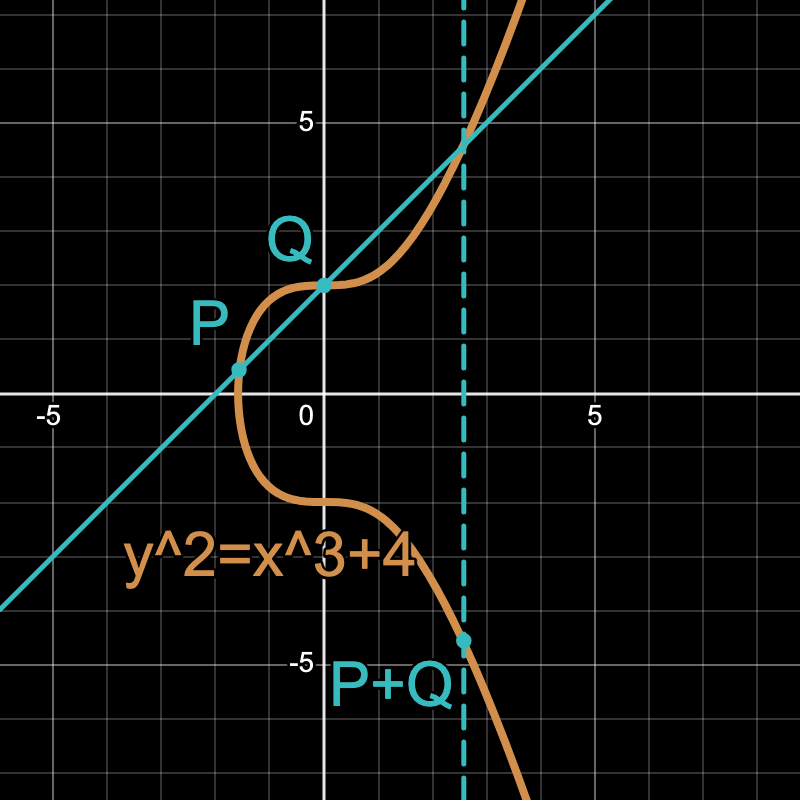
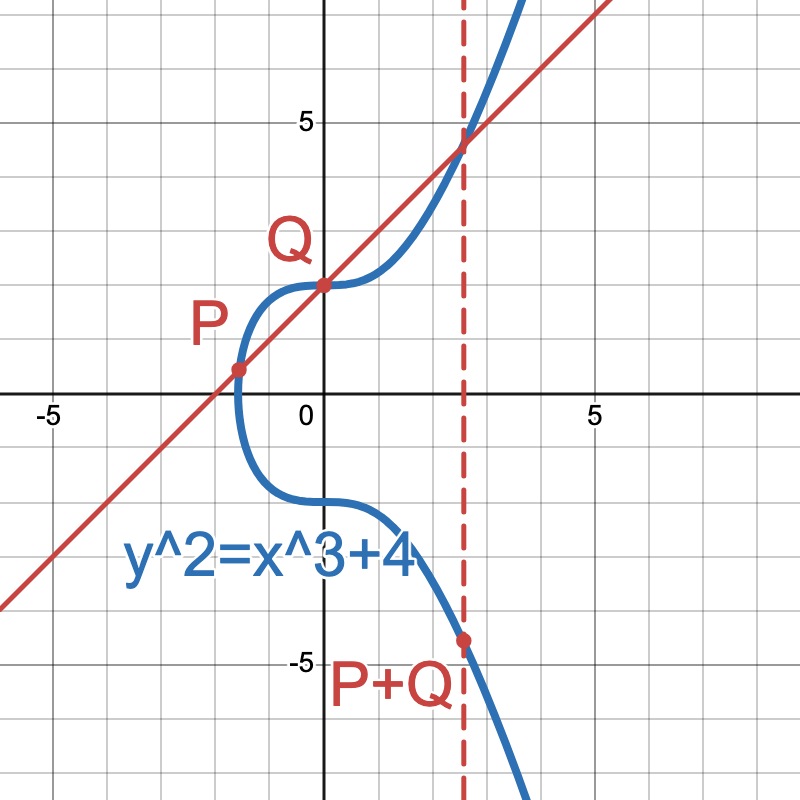
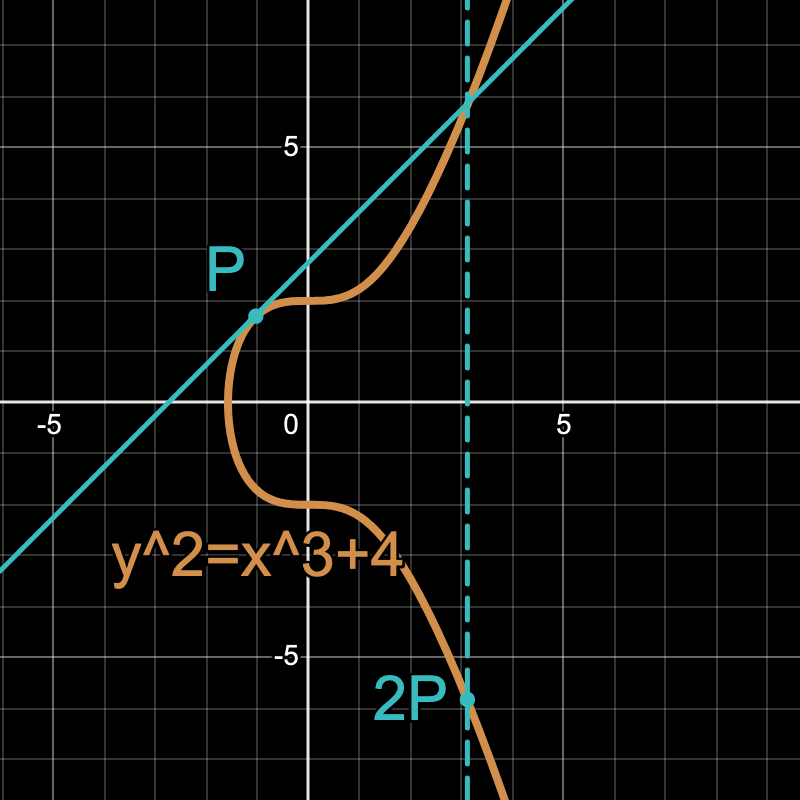
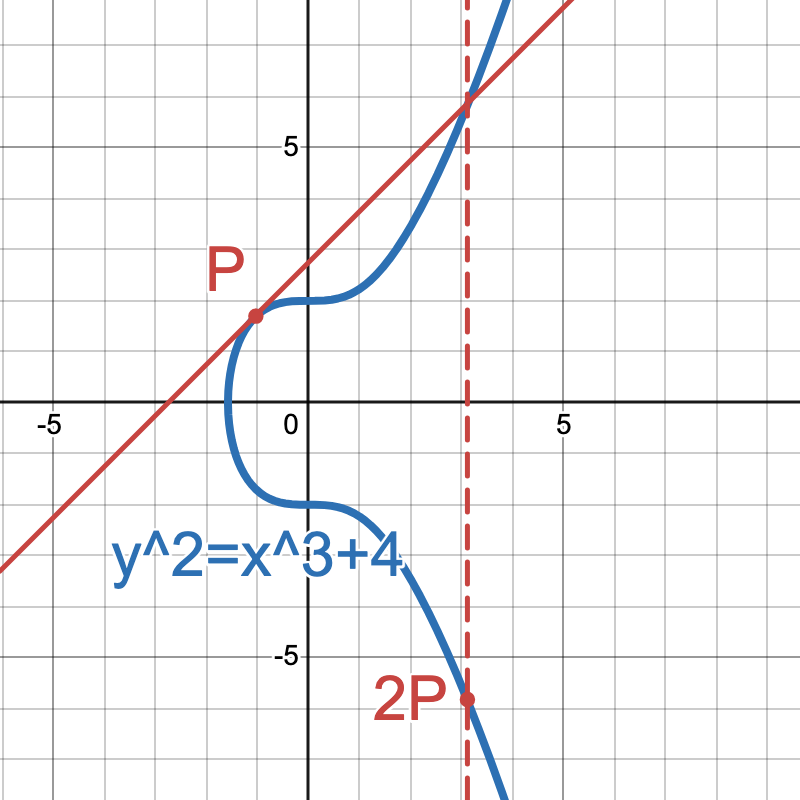
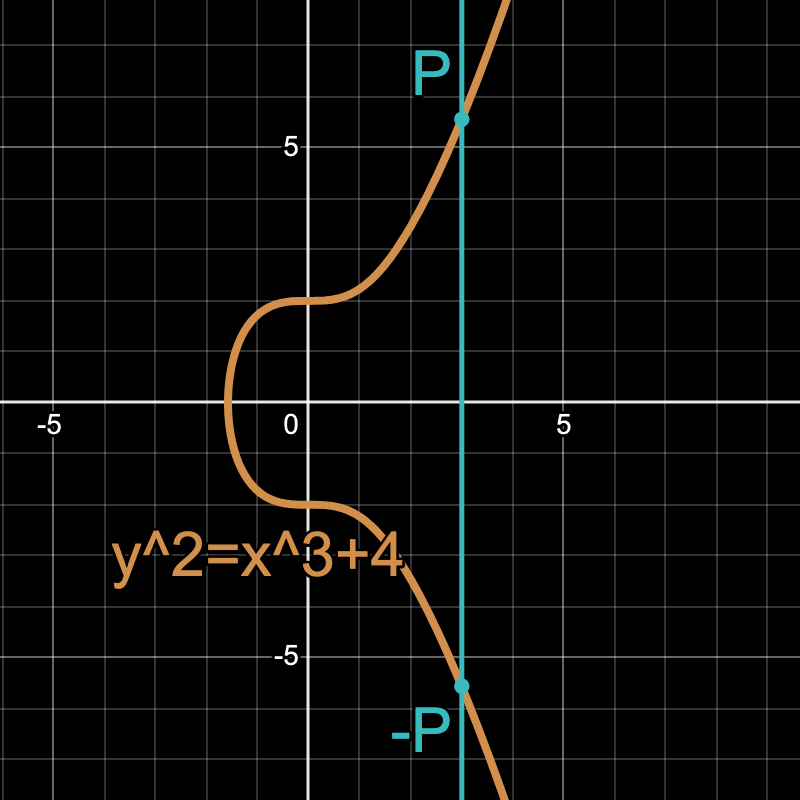
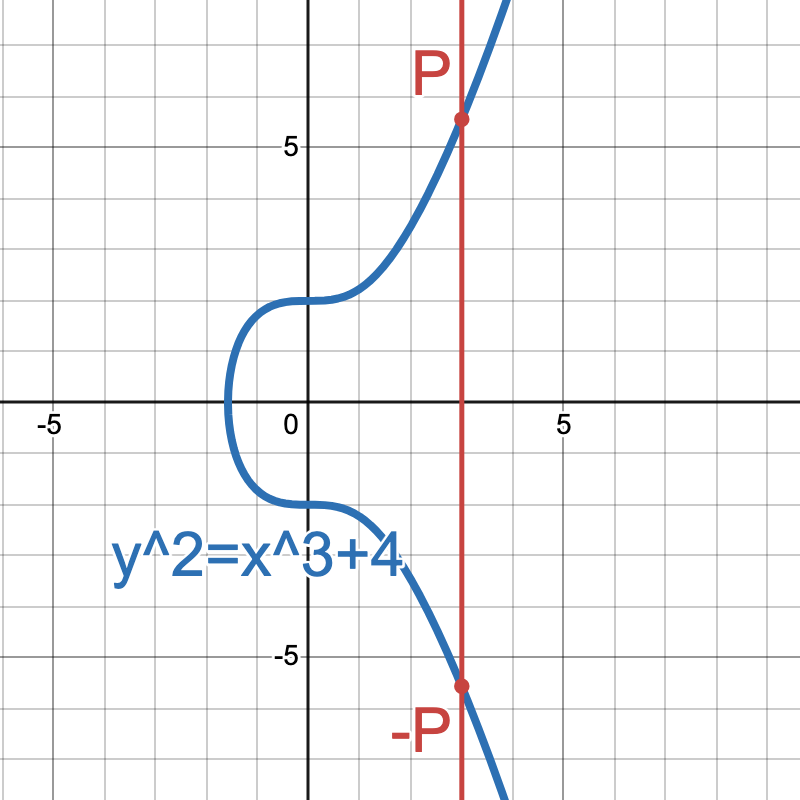
We want to define a group made of the points of elliptic curve. We will make two definitions - one is geometrical and the other is algebraic. We'll start with geometric.
Consider an elliptic curve in Weierstass form E/F and recall that is has a point O=[0,1,0].
First we will define the neutral element of the elliptic curve group to be O.
Next if we have a point P=(x0,y0)∈EF then we define the inverse −P:=(x0,−y0)∈EF. Thus P+(−P)=O.
Finally if we have two points P=(xp,yp),Q=(xq,yq)∈EF and draw a line through this points (or tangent line if P=Q, remember we can always do it since the curve is smooth). If the line of the equation is l:=ax+by+c and since axp+byp+c=0 and axq+byq+c=0 we know that l∈F[x,y]. So for other points of intersection we'll have the system of equations:
{ax+by+c=0y2=x3+Ax+B
This set of equations have at least two roots P and Q so since we have an equation of degree 3 it will have a 3rd point that we'll assign −(P+Q) in a group. Note that if b=0 then we'll have an equation in F[x,y] (that is with coefficents from F, not F). Then xp+xq+x−(p+q) will be the coefficent of polynomal at x which is in F. So xp+xq+x−(p+q)∈F,xp∈F,xq∈F⟹x−(p+q)∈F. From ax+by+c=0 we also imply that y−(p+q)∈F.
Thus we have the following three cases for adding points on elliptic curve:
P=Q
P=Q
P=−Q
Let's summarize the geometric group law. Consider a curve
y2+a1xy+a3y=x3+a2x2+a4x+a6
If P0:=(x0,y0) then −P0=(x0,−y0−a1x0−a3)
Now consider points P1+P2=P3,Pi:=(xi,yi).
Case 1.
If x1=x2,y1+y2+a1x2+a3=0 then P3=0
Case 2.
We consider a line y=ax+b:
{a=x2−x1y2−y1,b=x2−x1y1x2−y2x1 if x1=x2a=2y1+a1x1+a33x12+2a2x1+a4−a1y1,b=2y1+a1x1+a3−x13+a4x1+2a6−a3y1
As part of geometry - algebra duality that we saw several times earlier we want to define an algebraic group on elliptic curve and prove that it's isomorphic to the geometric group. This group will be a factor group
Pic0(E):=Div0(E)/Div⟨⟩(E)
Next we're gonna make several propositions to prove that this group is isomorphic to the geometric group.
Proposition 4.2.1: Equivalent divisors on elliptic curve
Consider a divisor DO:=D+(O), it has degDO=degD+degO=1>2g−2 so by (3.4.14.c) we have:
dimL(D+(O))=1
Consider some non zero f∈L(D+(O)). By definition of L and (3.4.11) we know that:
div(f)≥−D−(O),deg(div(f))=0
Since −D−(O) gives a lower bound, we cannot have more poles than that. And this lower bound degee is −1 so there's exactly one point we can add to make deg(div(f))=0. So
div(f)=−D−(O)+(P)
for some points P∈E. Hence
D∼(P)−(O)
Uniqueness
Consider D∼(P′)−(O), in this case:
(P′)∼(D)+(O)∼(P)
So by (4.2.1):P′=P
□
Note that [D]∼ is an element of Pic0(E) and (4.2.2) tells us that each such class of equivalence has a unique corresponding point in E. That means we can define a map:
ε:Pic0(E)→E
Then
ε−1:E→Pic0(E),P→(P)−(O)+Div⟨⟩(E)
Proposition 4.2.3: Algebraic-geometric group isomopshism
(note that like we saw in examples earlier that ordP(x−x0)=2,ordP(y−y0)=1)
The same will work for Q and R.
Now the pole of l/z (again refer to examples before):
ordO(zax+by+cz)=ordO(yax+by+cz)+ordO(y/z)=−3
So we have:
div(l/z)=(P)+(Q)+(R)−3(O)
Now for the line l′ passing trough P+Q and R:
l′:a′x+c′z=0
Similar to the above we'll have two zeros of order one in R and P+Q. But for O we'll have b=0 so ordO(yax+cz)=1 and this the pole at O has order −2. To sum up
∢(E,O)∈Em∈Z[m]:E⇝EE,{P↦[m]P,m≥0P↦[−m](−P),m<0[m]−multiplication by m isogeny
Note that we just defined a group law but why is is an isogeny? We'll not give the proof here but the main idea is it clearly sends O to O and taking the formulas from the geometric group law it's clear that it's a rational map. Since E is smooth (non-singular) then it's a morphism as well.
Propostion 4.2.4: Isogeny induces a group homomorphism
If ∀P∈E1:ϕ(P)=0 then there's nothing to prove. Otherwise ϕ=const and notice that by (3.4.10)ϕ∗ and ϕ∗ takes divisors of degree 0 to divisors of degree 0 and principal divisors to principal divisors. Moreover they do it as homomorphisms:
ϕ∗:Pic0(E2)⇝GPic0(E1)ϕ∗:Pic0(E1)⇝GPic0(E2)
Coupling that with (4.2.3) we have the commutative diagram:
In the course of the proof we shown ϕ as a group homomorphism using zero degree-zero picard groups. But we can also go in other direction and build a E2⇝GE1 homomorphism using ϕ∗:
∢(E1,O1),(E2,O2)∈Eϕ:E1⇝EE2,ϕ=constdegϕ=m∃!ϕ^:(E2,O2)⇝εE(E1,O1),ϕ∘ϕ^=[m]Then as a group homomorphism:ϕ^:(E2,O2)⇝GDiv0(E2)⇝ϕ∗GDiv0(E1)⇝sumG(E1,O1)ϕ^:Q↦(Q)−(O)↦ϕ∗((Q)−(O))=∑nP(P)↦∑[nP]P
∢(E1,O1),(E2,O2)∈Eϕ:E1⇝EE2,ϕ=constdegϕ=mϕ∘ϕ^=[m] on E1,ϕ^∘ϕ=[m] on E2η:E2⇝EE3⟹ϕ∘η=ϕ^∘η^ψ:E1⇝EE2⟹ϕ+ψ=ϕ^+η^∀n∈Z:[n]=[n]degϕ=degϕ^ϕ^^=ϕ(a)(b)(c)(d)(e)(f)
Consider and elliptic curve defined over Fq:(E,O)/Fq. Obviously
∣EFq∣≤q2
We can easily refine it further since for each x in the equation we get a maximum of two y so the trivial upper bound is:
∣EFq∣≤2q+1
Let's make it even more precise.
Proposition 4.2.9: Separability of multiplication-by-m and Frobenuis in a finite field
∢q=pn,p∈P(E,O)/Fq∈Em+nρ⇝n− separable⟺p∤m
Before going further we note the following fact. Each field extension E/F may be decomposed into E/⊟S/□F and so we can define the degree of a rational map degϕ=degϕs⋅degϕi. Where degϕs is the degree of separable extension and degϕi is the degree of purely inseparable extension.
Now remember that separability is a notion of whether all roots are different (separable) or all roots are glued into one (purely inseparable). In case of ramification we have several points in pre-image glued together into one. This hints that there's a relation between separability and ramification. In general it is true that unramified mapping is necessary separable. Moreover in case of elliptic curves:
∀Q:#ϕ−1(Q)=degϕseϕ(Q)=degϕi
The above discussions needs strict proofs but we'll skip it here for brevity.
Propostion 4.2.10: Number of points in kernel is separable mapping degree
Next, consider EFq. We know that EFq={P∈E:∀σ∈Gal(Fq/Fq):Pσ=P}. From (2.10.5) we know that Gal(Fq/Fp)=⟨ρ⟩. By (2.8.10) any extension Fr of Fq will have the property r=qk for some k. Thus Gal(Fr/Fq)=⟨ρn⟩. Since F is the limit fo such extensions and each Galois group is generated by ρn then Gal(Fq/Fq)=⟨ρn⟩. And so we can say that
EFq={P∈E:Pρn=P}
By (4.2.9) we know that (1−ρn) is a separable mapping so by (4.2.10) we have:
∣EFq∣=∣ker(1−ρn)∣=deg(1−ρn)
Finally recall that by (3.4.8.c):degρn=pn=q and obviously deg[1]=1 so: